Apple’s Market Value Soars to New Heights: Insights Behind the $5 Trillion Milestone
 10/16 2026
 487
487
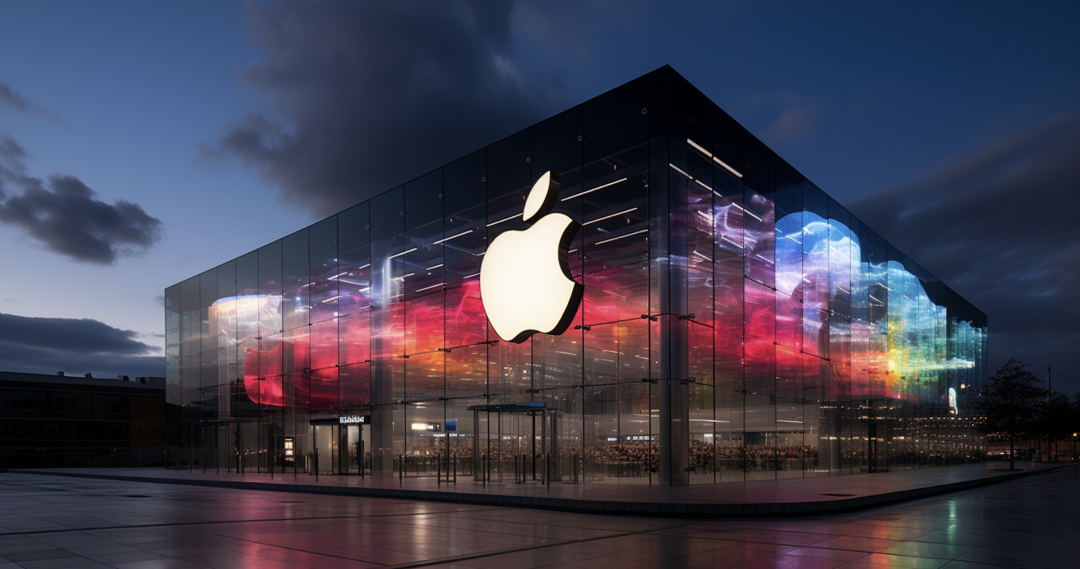
"Losing debates online, but never in the marketplace." Apple’s stock price has once again climbed to a record peak. On October 14 (U.S. Eastern Time), Apple closed at $342.96, marking a 0.5% increase and valuing the company at approximately $5.005 trillion.
After hitting several intraday highs, this time, the record held firm at the closing bell. 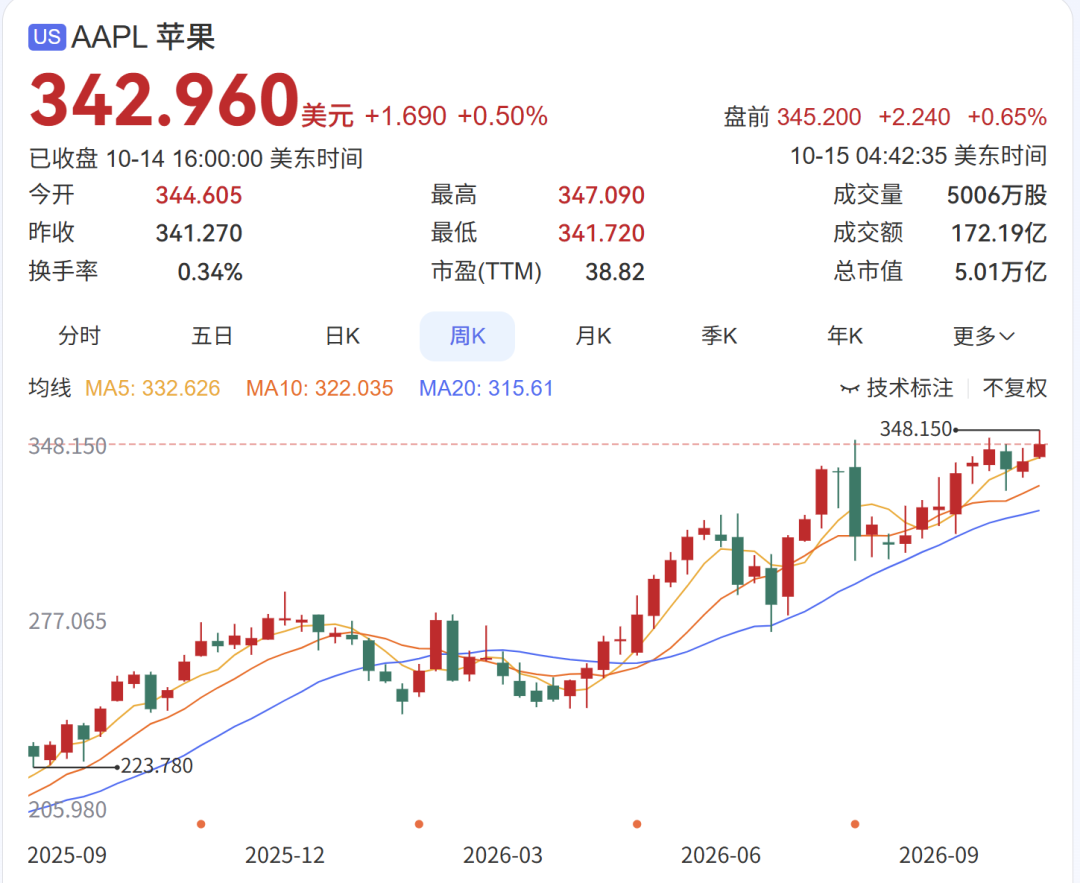
Despite persistent criticisms regarding high prices, incremental upgrades, and sluggish innovation, these concerns have not dampened Apple’s financial performance. A company’s health cannot be judged solely by prevailing opinions.
Consumers may grumble about prices while still placing orders; investors may approve of products but deem the stock overvalued. What makes Apple intriguing is the coexistence of these seemingly contradictory behaviors.
Over the past year, debates about Apple have focused on its advancements in AI and the appeal of its new products. The stock’s rise is not merely driven by speculation about upcoming releases.
Revenue growth, demand for premium models, and the services segment provide tangible evidence of operational strength. As of October 14, Apple’s stock price has risen approximately 26% since the start of the year.
This analysis is based on year-to-date data. As of October 15, the most recent quarterly financial report available covers the third quarter of FY2026, ending June 27. 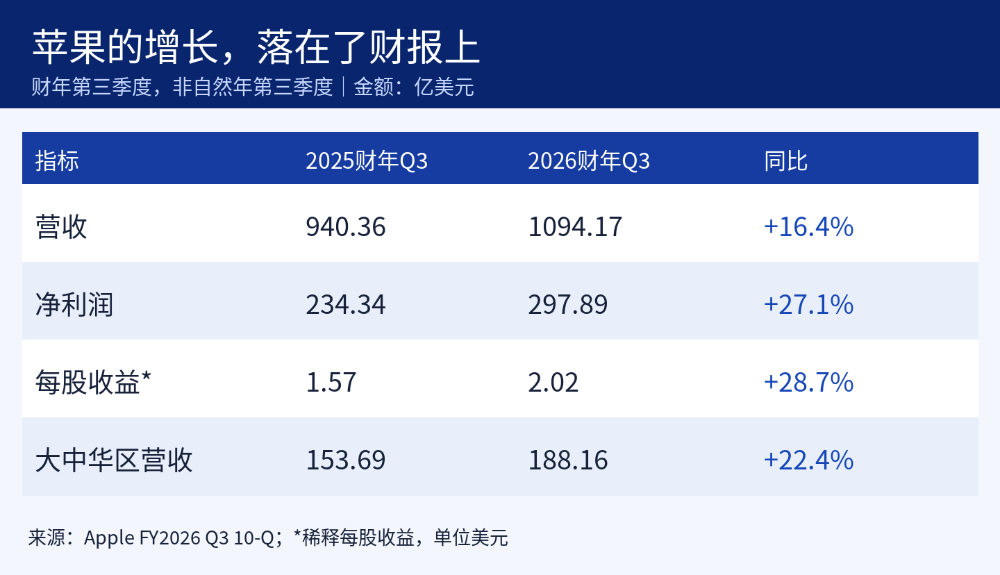
In this report, revenue reached $109.417 billion, with a net profit of $29.789 billion. The growth in iPhone revenue was particularly notable, driven primarily by increased sales of Pro models.
The continued success of high-priced models suggests that Apple’s pricing strategy has found acceptance among a significant portion of consumers this quarter. For the company, the model sold is as important as the volume sold.
However, profit growth cannot be assumed to continue unchanged. Tariff refunds contributed about 2 percentage points to the overall gross margin and $0.11 to diluted earnings per share this quarter.
While these gains are substantial, they should not be viewed as a recurring source of growth each quarter. Revenue growth in Greater China was also influenced by exchange rate factors. The financial report explicitly notes that the strengthening of the RMB against the USD had a favorable impact.
Attributing all reported growth to increased sales oversimplifies the narrative. 

The business extends beyond phone sales 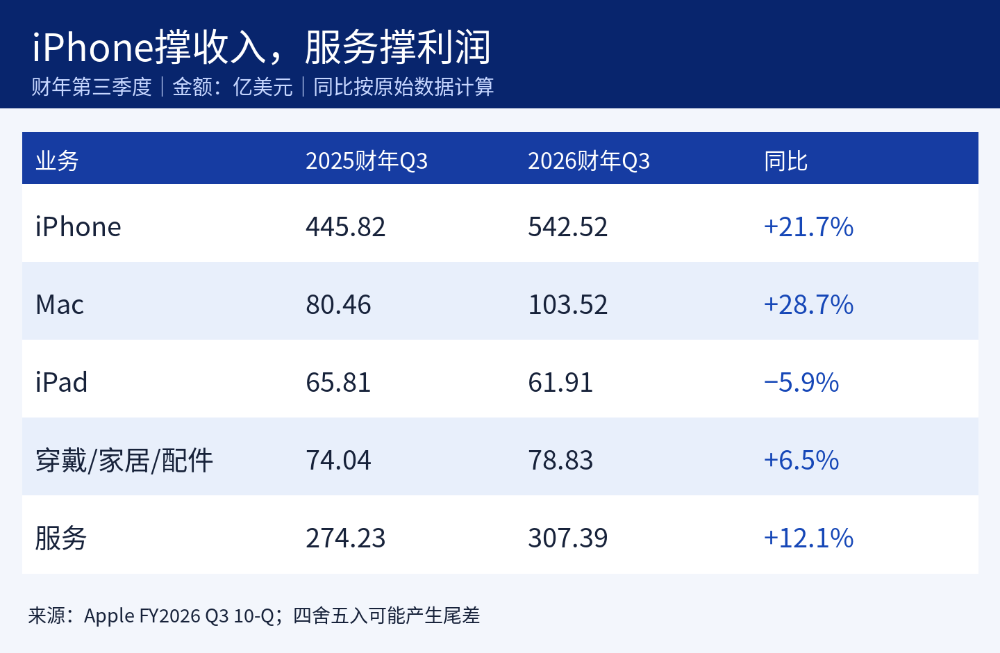
While the iPhone remains Apple’s primary revenue driver, the services business extends the billing cycle.
After purchasing a phone, users may continue to pay for cloud storage, content subscriptions, and apps. Devices like the Mac, iPad, earphones, and watches expand usage scenarios.
While hardware updates follow cycles, the services generated from daily device usage add continuity to revenue.
This is why capital markets take the services business seriously. It transforms one-time device transactions into ongoing customer relationships.
Of course, not every device user will pay, and platform billing methods are subject to regulatory and competitive constraints. 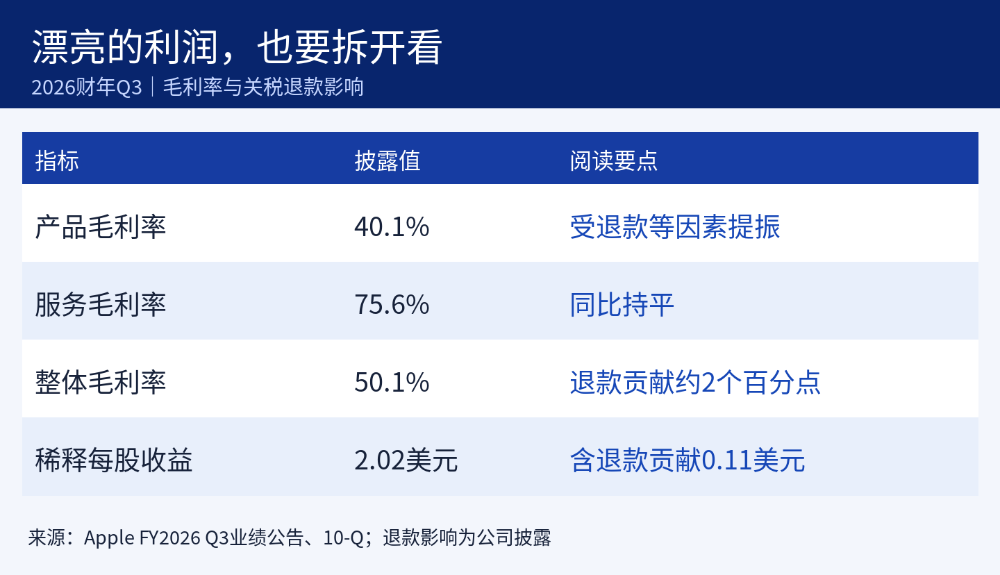
This structure allows Apple not to rely solely on any single new product.
Meanwhile, the decline in iPad revenue this quarter serves as a reminder that a broad product lineup does not guarantee growth in every category.
Apple excels at giving users reasons to buy other devices and services while keeping its main products attractive. This process may lack the excitement of launching groundbreaking technology but has a lasting impact on profits.
You can criticize Apple, but you cannot deny its operational prowess
Smartphones have reached a high level of maturity, making it increasingly difficult for consumers to discern experience differences based solely on a few parameters. Apple remains competitive due to its refinement of chips, systems, industrial design, and app experiences. 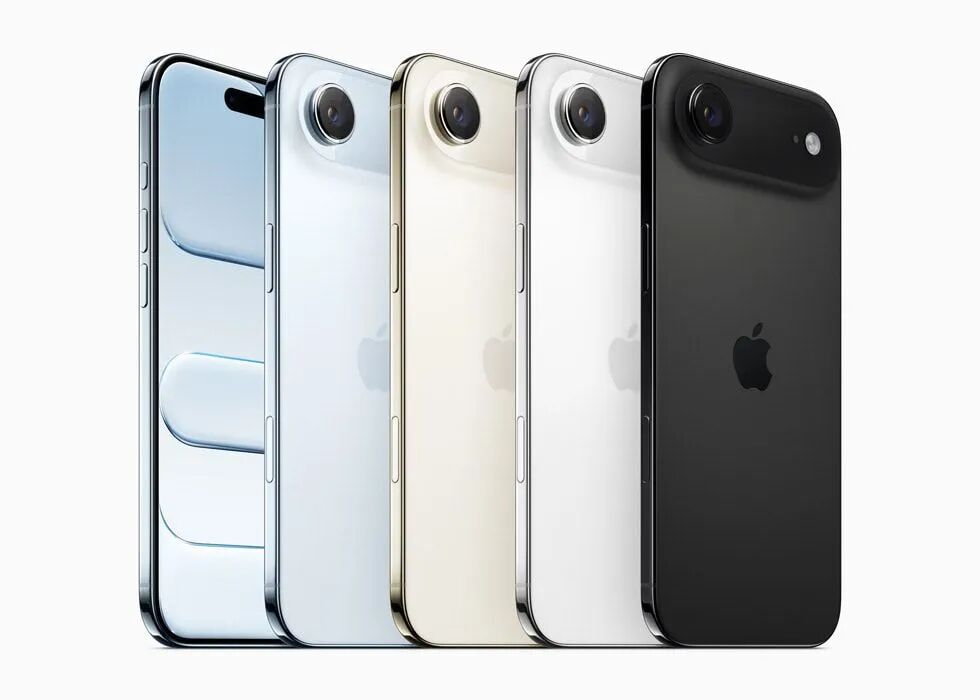
Take Apple’s previously announced iPhone Air as an example. Its processor, wireless network chip, and cellular modem all incorporate in-house solutions.
Consumers notice thickness, feel, and battery life, but behind these are the coordination of power consumption, communication, and internal space. In-house development does not mean leading in every feature but provides more control over product trade-offs.
The commercial value lies in whether engineering improvements translate into experiences users are willing to pay for. Some advantages rarely make headlines.
Whether photos and files can be easily transferred, whether multiple devices work seamlessly together, and whether familiar software can continue to be used are all factors in consumers’ decision to upgrade.
The longer users stay with a system, the more effort is required to adapt to another. The same applies to supply chain capabilities.
IDC’s final data for the second quarter of 2026 shows a 7.4% decline in global smartphone shipments, with Apple and Samsung being the only two vendors among the top five to achieve growth.
IDC attributes their resilience to securing supplies in advance and their high-end product portfolios. When component prices rise, high-end machines are not unscathed. However, procurement scale, supply relationships, and product pricing give large vendors more flexibility.
Operational capabilities that go unnoticed during normal times often make a difference when the industry is under pressure. 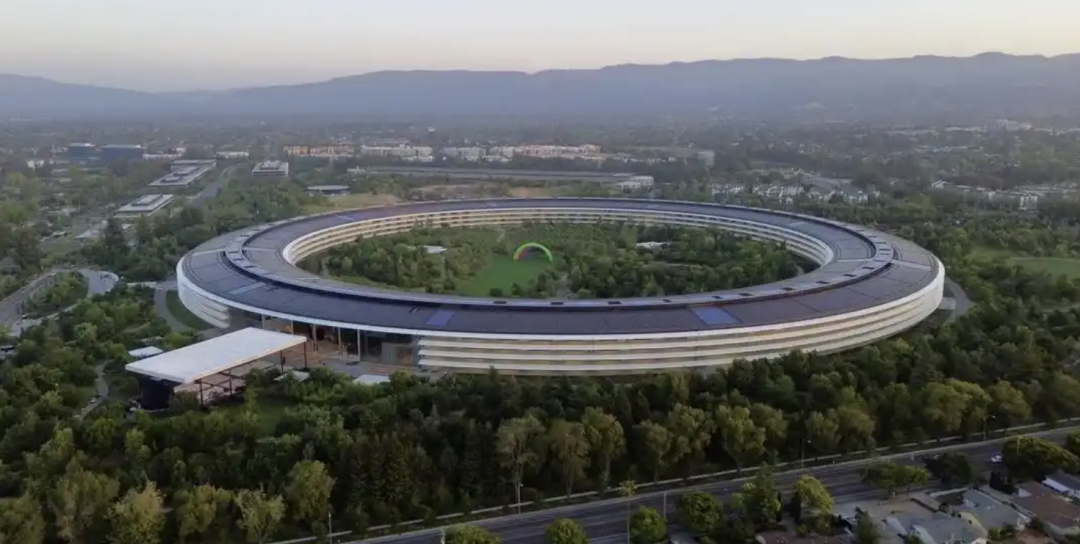
The valuation logic has evolved
Capital markets are increasingly comparing AI investments and cash returns among tech companies. Apple’s relatively restrained capital expenditures are one factor drawing attention.
This does not mean it can bypass AI competition, but investors are temporarily giving higher ratings to this approach. Spending less is easy; creating useful products is hard.
Whether AI truly saves users time and improves daily experiences ultimately depends on actual usage. Apple’s existing device ecosystem provides opportunities but also means that poorly performing features directly impact user perceptions of its products.
Shareholder returns also support market expectations.
The financial report discloses that in the first nine months of FY2026, the company repurchased approximately 215 million shares for $61.8 billion. Repurchases reduce the number of shares and affect per-share metrics, but they do not create operational profits out of thin air, and the purchase price also affects returns.
Returning to the $5 trillion figure. Apple and NVIDIA are the only two companies to have reached this threshold, but they represent two entirely different asset logics.
NVIDIA sells the "shovels" of the AI era, with revenue directly tied to GPU shipments.
Apple sells devices and services used daily by over a billion people, with revenue coming from upgrade cycles, service subscriptions, and ecosystem lock-in.
While the semiconductor sector is being re-evaluated by the market due to capital expenditures and return on investment, Apple’s cash flow stability has become a source of premium.
The $5 trillion mark is neither an endpoint nor a starting point; it is simply the market’s bid for Apple at this moment.
Behind this bid are three consecutive quarters of double-digit growth, an iPhone cycle that outperformed expectations, a services revenue stream being squeezed by regulation but still massive in scale, and an AI strategy that is slow but not off track.
The comment section can continue to argue; many still dislike Apple’s products, but financial reports do not lie.
The $5 trillion market value at least proves that Apple has been on the right path these past few years.
What are your thoughts on this topic? We look forward to your civil and rational insights in the comments section.
Disclaimer: This article is solely for financial hotspot analysis. Data and references are sourced from public queries, company announcements, and Huasheng Securities IFinD. The views expressed are for reference only and do not constitute any investment or consumption advice.
#FinancialHotspots #In-DepthAnalysis #BusinessFinance #InvestmentBankingCircle #ListedCompanies #PrimaryMarket #IPO #AI Thanks for reading patiently. Feel free to click "Like" if you found this helpful.
-
![]()
Thousand-Kilometer Range BMW i3, Ioniq V Priced Under RMB 100,000: Chinese Automakers Must Guard Against Joint Venture Encroachment in Global Expansion
-
![]()
Competition Among Cities Enters the Second Half: The Outcome Lies Beneath the Surface
-
![]()
AI-Generated Comic Drama Concept Stocks Surge: Is ByteDance the Sole Profit-Maker?
-
iPhone 18 Pro Series Sees Price Reductions—Apple Can't Afford to Stay Idle During Double 11
-
![]()
A Whopping 550 Million Yuan Investment! Fanchuangwei’s High-Transparency Optical AR Lens Project Takes Root in Taizhou
-
![]()
Domestic Triumph in Glass Substrate Lithography! Optical Firm Lands Major Orders
-
![]()
AI-Powered Alternatives Offer Free Substitutes, Posing Threat to Adobe's 'All-in-One' Suite
-
![]()
McKinsey Report: AI Inference to Account for 60% of Computing Power by 2030