Full Tracking of iPhone Duo's 'Cracked Screen Gate': A 10,000-Yuan Foldable Screen Breaks After 20 Folds, Hinges Blamed
 10/28 2026
 555
Original content by Caigou Business Review's editorial team
Author | Xuan Niao
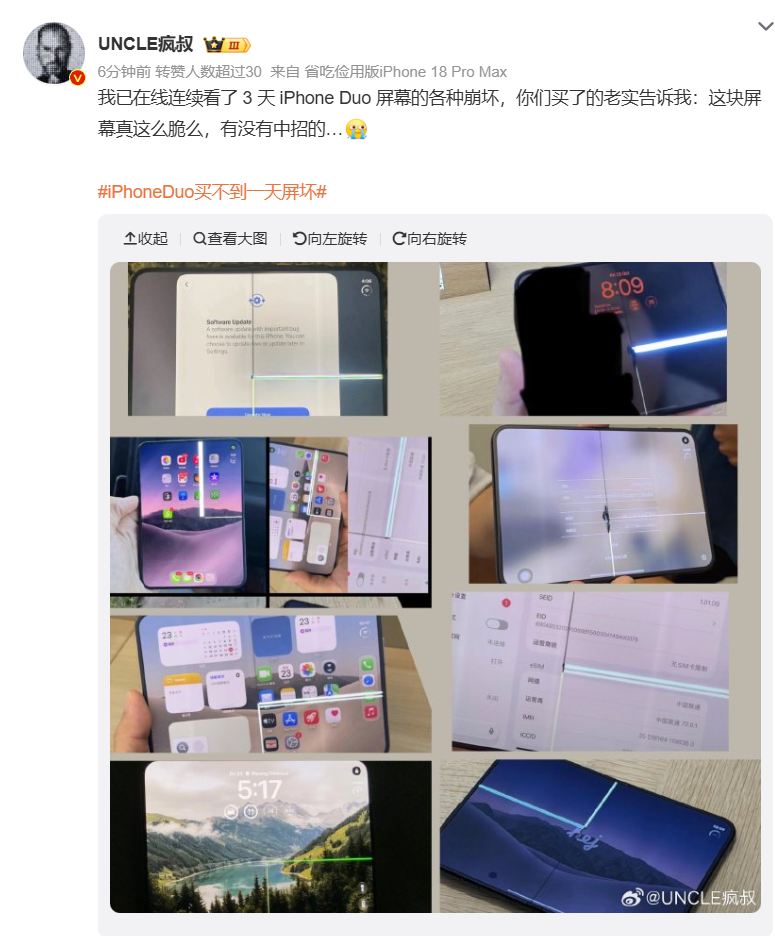
On October 23, Apple's first foldable phone, the iPhone Duo, officially went on sale. Several days have passed since the initial launch, but this highly anticipated release did not meet expectations with resounding success. Instead, it quickly escalated into a persistent quality control crisis. From the first day of sales, numerous users domestically and abroad reported damage to the new phone's inner screen. Some devices failed within hours and after fewer than 20 folds. The failures were almost entirely concentrated directly above the hinge, often manifesting as bright pixel lines or vertical black cracks, accompanied by a "click" sound, and occurred without any impact marks on the inner or outer screens. This sudden "Cracked Screen Gate" has thrust Apple into the eye of a media storm, with related topics continuing to trend online for days. 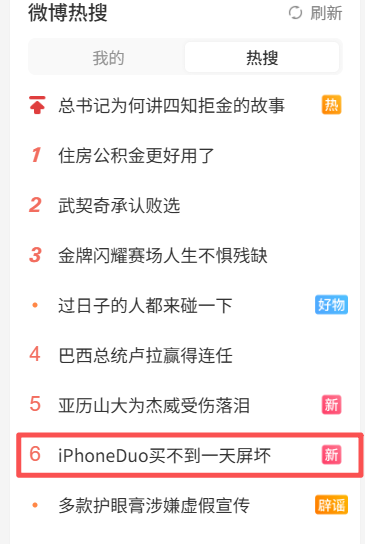
As more real-world cases emerged, reports from major media outlets and netizens compiled into a detailed "Fault Catalog." According to Sina Hot Topics, an Australian user reported that within about six hours of receiving the device, while showing it off to a friend, they first felt something unusual below the inner hinge, then heard a clear "click," and the screen cracked along the hinge, with no damage to the phone's body inside or out. Domestic users also reported hearing a Crispy sound (crackling sound) when normally unfolding the screen, followed by a vertical black crack about 3 centimeters long, with a thinner crack running through the right half of the screen, all without any impact. The nearly 8,000-yuan repair fee outside warranty left many users exclaiming they "can't afford to fix it."
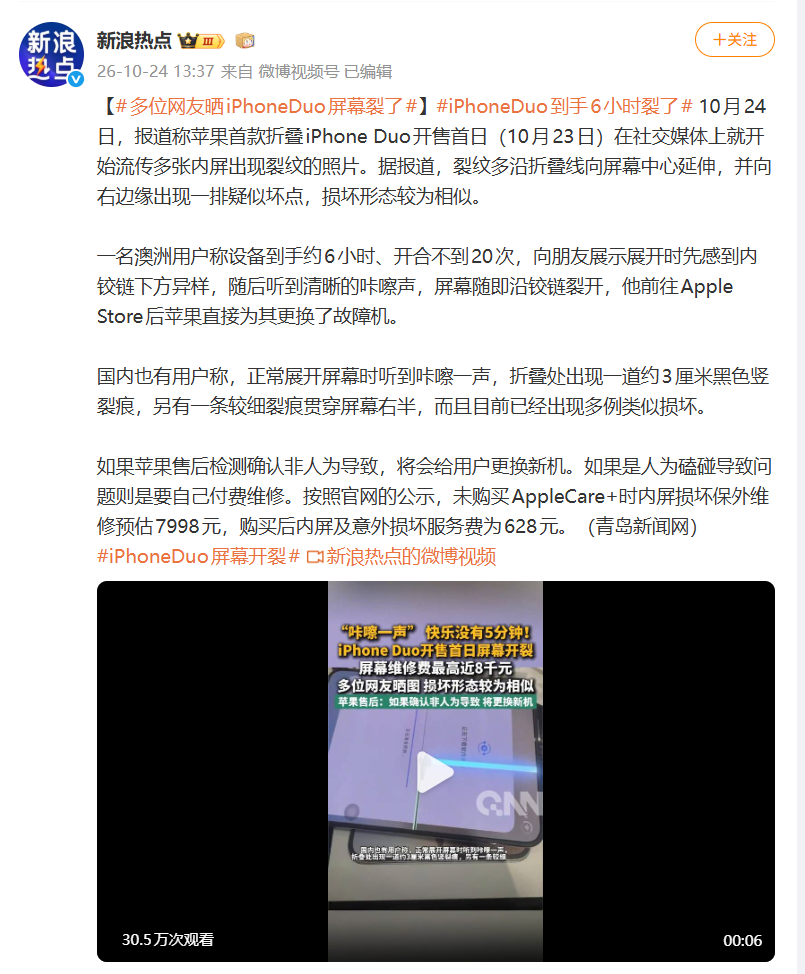
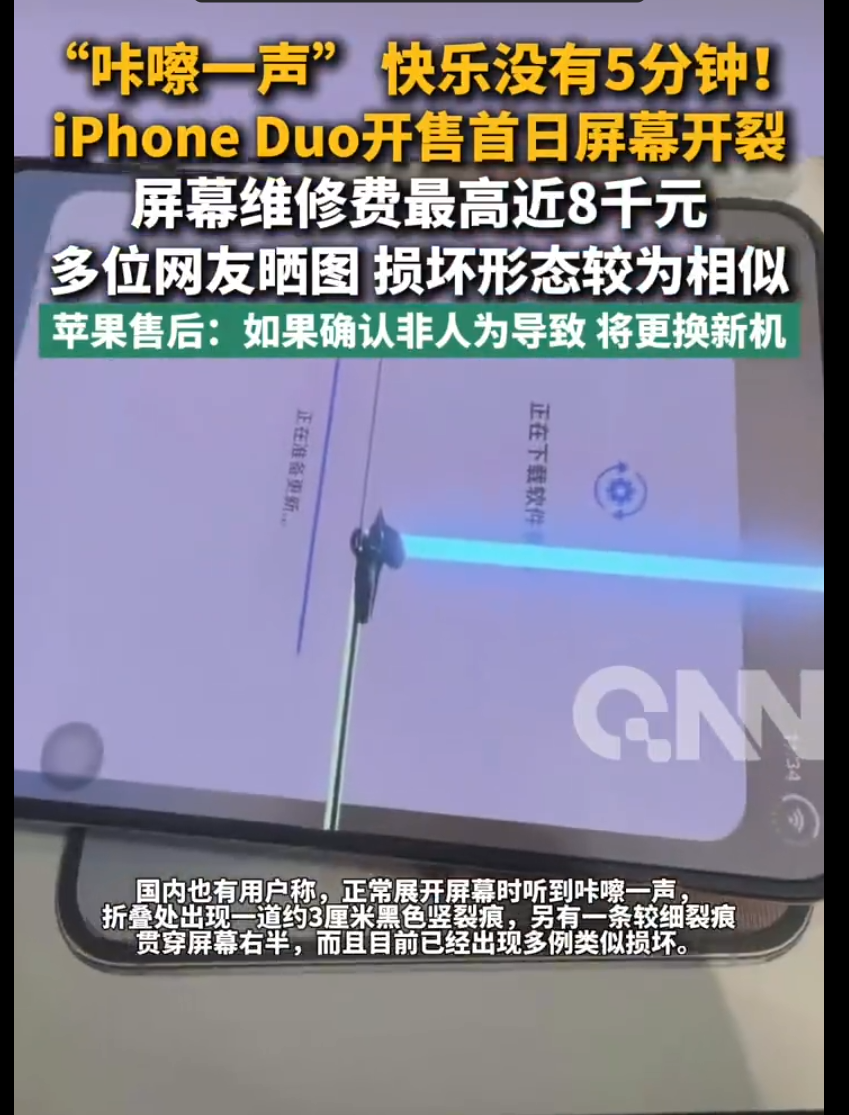
Various user-shot videos went viral on social media, with bloggers wryly noting that while others buy phones to use, buying an iPhone Duo is a "limited-time experience"—handling it gently, avoiding any bumps, yet the screen fails on its own.
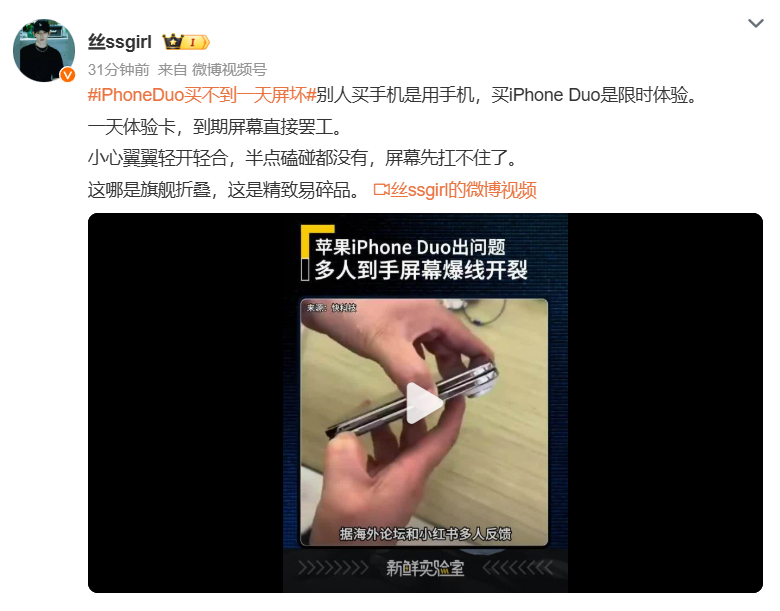
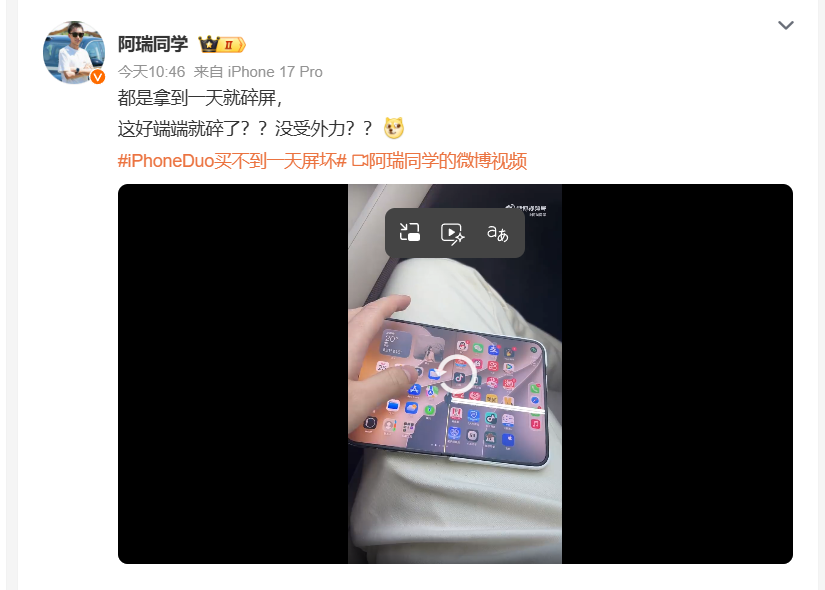
Faced with such a high density of failures, public and tech bloggers' opinions were polarized. Some netizens expressed strong dissatisfaction with quality control. One user remarked, "A 10,000-yuan new phone's screen cracks in a day—is that the wallpaper or a quality control failure?" It was hard to believe that a premium model priced over 10,000 yuan could have such poor quality control. Even bloggers lamented that negative news about the iPhone Duo seemed ubiquitous, feeling Apple should not perform this way.


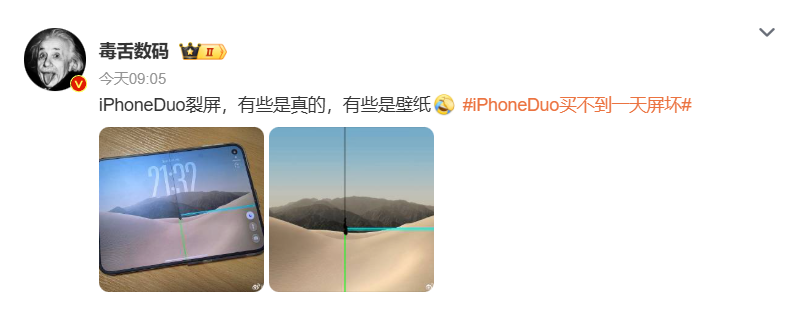
Amid the many real cases, some comical "false alarms" also emerged. Due to some cracks being unusually straight, netizens questioned whether they were cracked screen wallpapers or real damage, even suspecting AI pranks. Well-known tech blogger "Poisonous Tongue Digital" summarized the chaos, stating that some cracked screen images online were real, while others were wallpapers, but genuine failures were indeed numerous.
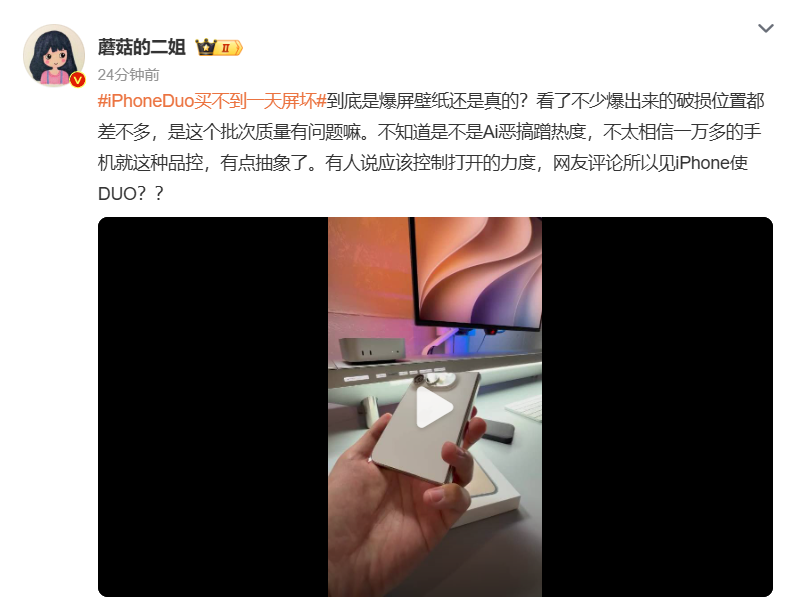
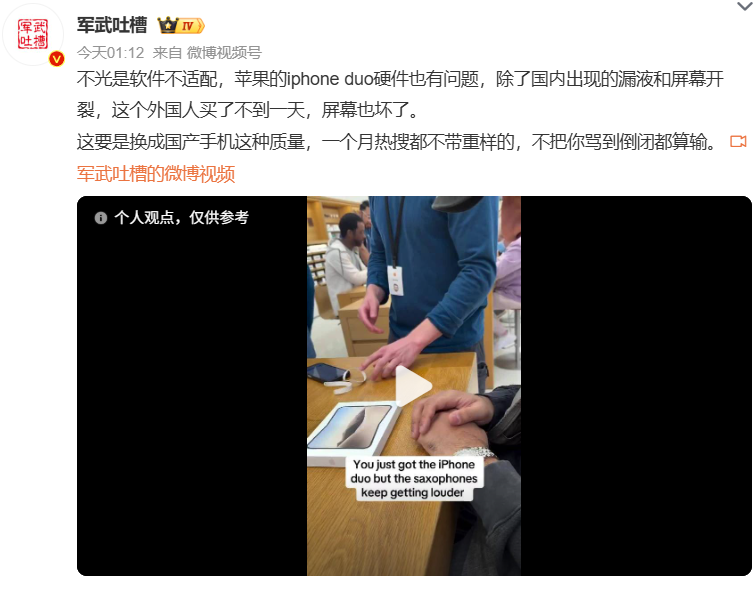
Meanwhile, many adopted a mocking tone. Faced with numerous failures directly above the hinge, one netizen sharply commented that this was likely the price of a "rushed phone"—developed in just a year, how could there be enough testing time? Another prominent figure combined recent Apple software and hardware issues, roast ing that if a domestic phone had such quality and leakage problems, it would have been criticized into closure by netizens.

As netizens' emotions cooled, the focus shifted to technical causes. Photos of cracks shared by many enthusiastic netizens showed highly consistent damage patterns, clearly not isolated flaws.
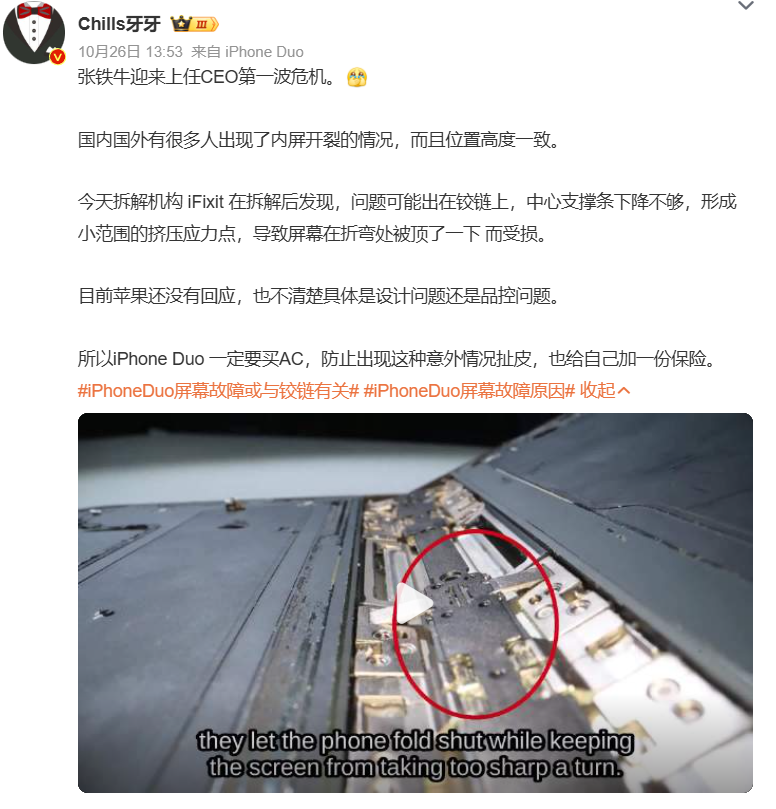
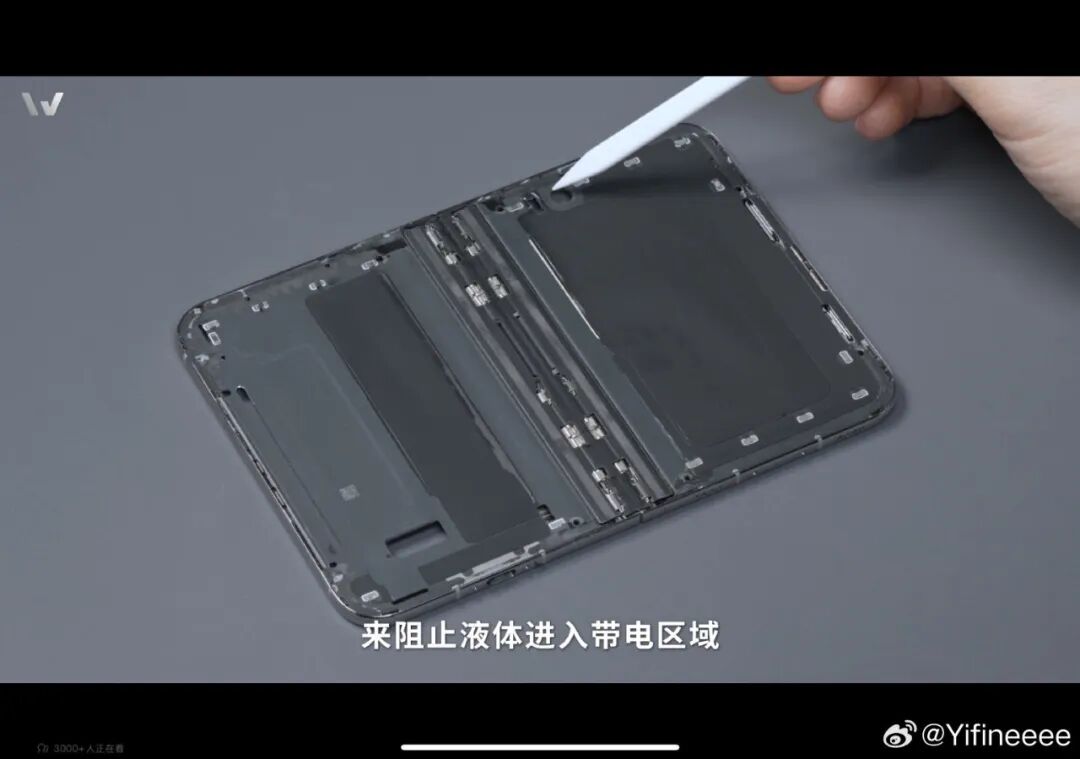
In-depth analysis by professional institutions and industry experts pointed directly to the hinge structure as the core issue. Renowned repair site iFixit noted after disassembly that the problem likely lay in the hinge: the central support strip did not descend enough, creating small-scale stress points that caused the screen to bulge and damage at the fold.
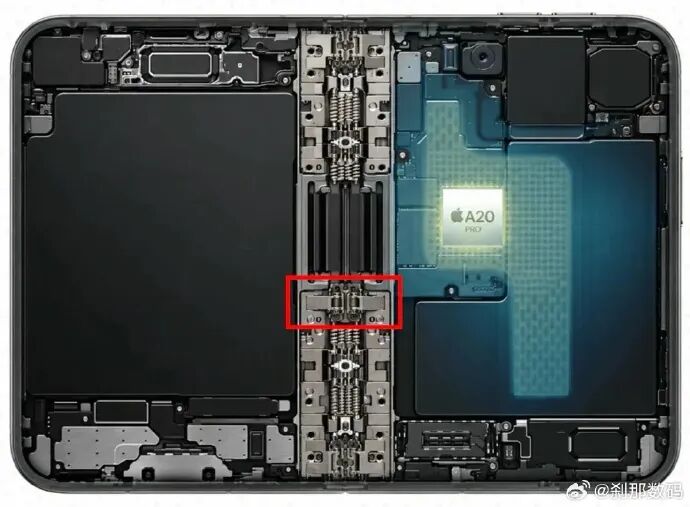
Domestic tech bloggers offered similar analysis, suspecting the limit steel piece in the hinge that protects the screen's flexible cable while providing support. Any deviation in assembly position or movement clearance could cause local pressure on the screen when unfolded. In other words, this was likely due to poor control of assembly tolerances or insufficient allowance in the structural design itself.
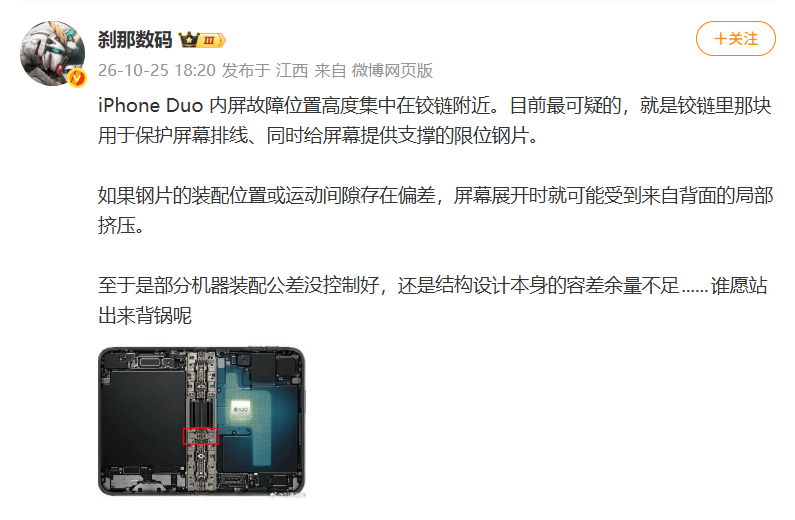

Through disassembly diagrams highlighting the internal structure with red boxes, we can clearly see the complex hinge mechanism and motherboard layout. The precision required for foldable screens is extremely high; any minor tolerance error can be amplified through repeated folding, ultimately causing the delicate flexible inner screen to crack under pressure.
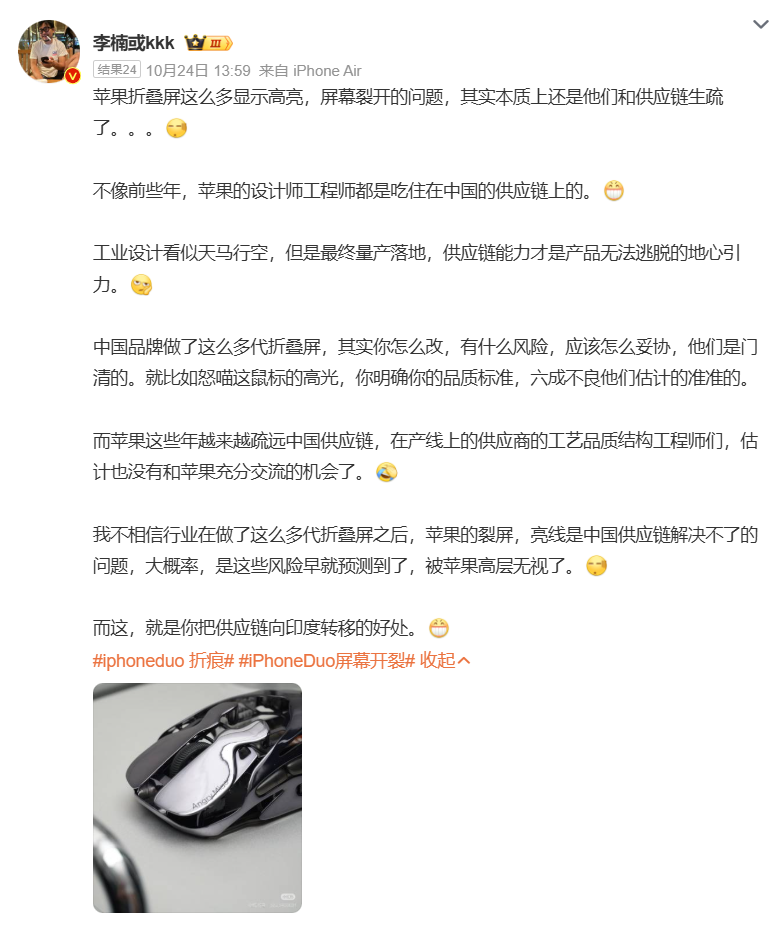
Delving into the crisis's roots, an analysis by Li Nan, former Meizu executive, resonated widely. He believed the failures essentially stemmed from Apple's estrangement from its supply chain. Chinese brands have produced many generations of foldable screens, knowing exactly how to modify them and what risks to avoid. However, Apple's recent supply chain shift to India has distanced it from China's mature supply chain, limiting communication between production-line engineers and leading to " out of control " (loss of control) during mass production.
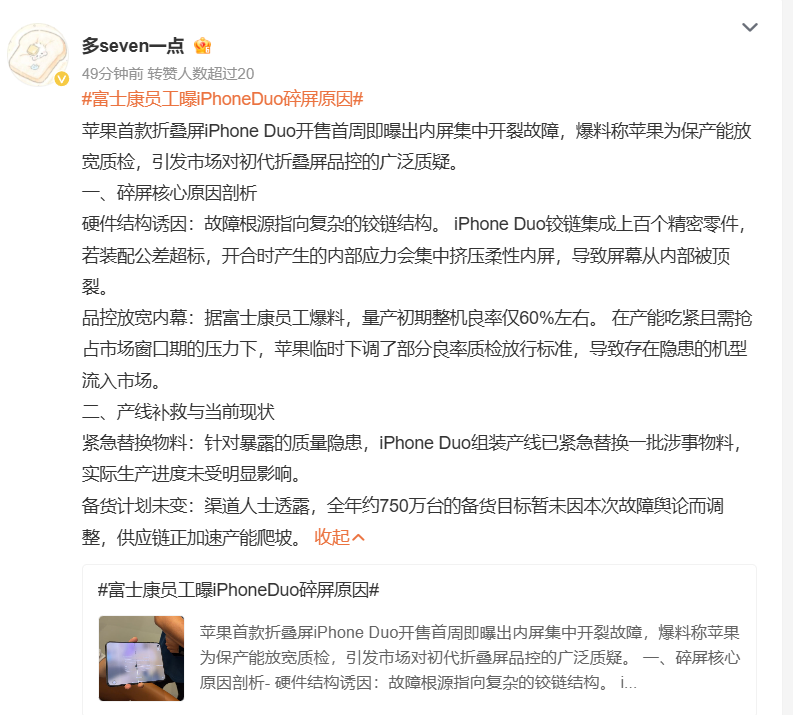
Even more explosive was a claim by a netizen identifying as a Foxconn employee, who alleged that during early iPhone Duo mass production, overall yield rates were only about 60%. Under pressure from tight capacity and market window competition, Apple temporarily lowered some yield inspection standards, allowing faulty models to enter the market.
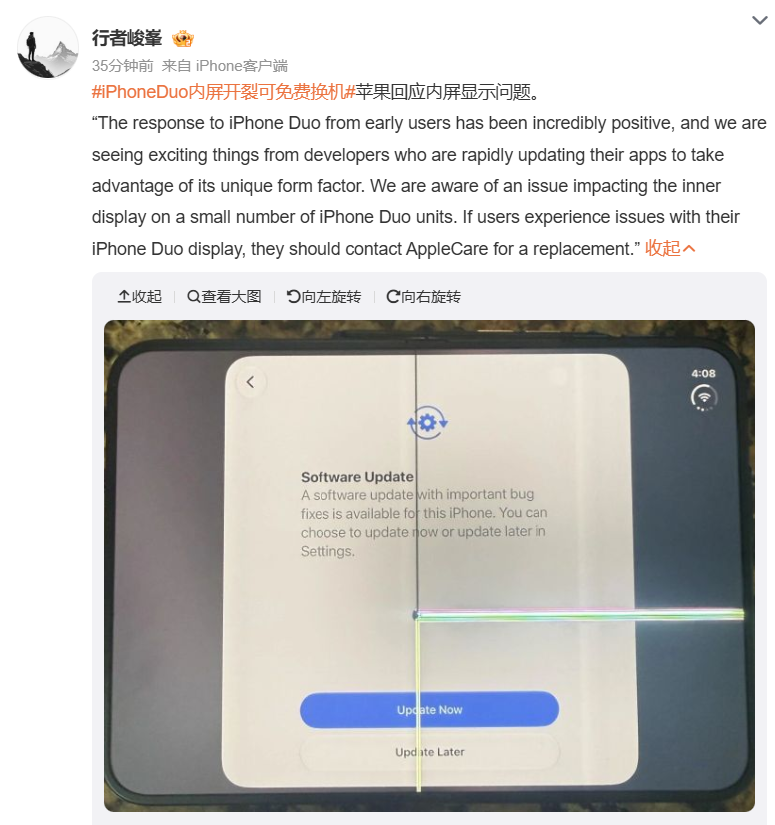
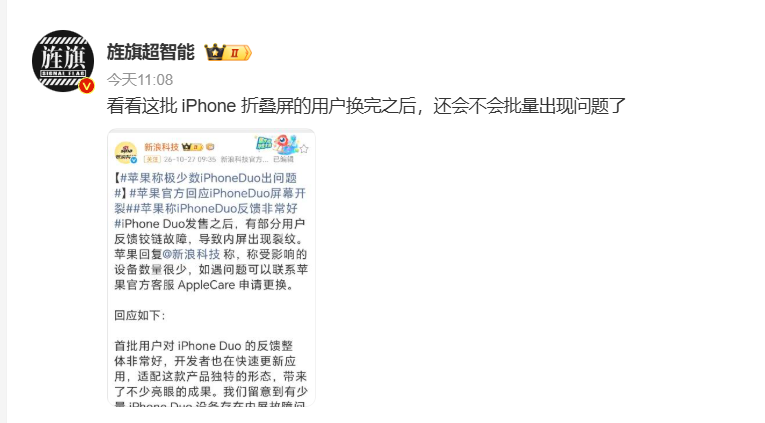
Faced with escalating public opinion, Apple officially responded, admitting that a "very small number" of iPhone Duo inner screens had issues and offering free replacements through AppleCare for affected users. However, this "very small number" claim seemed inconsistent with the large number of users reportedly waiting for replacements. Additionally, the high repair costs stung users without AppleCare+, leading many bloggers to worry that similar issues might recur in bulk after replacements.
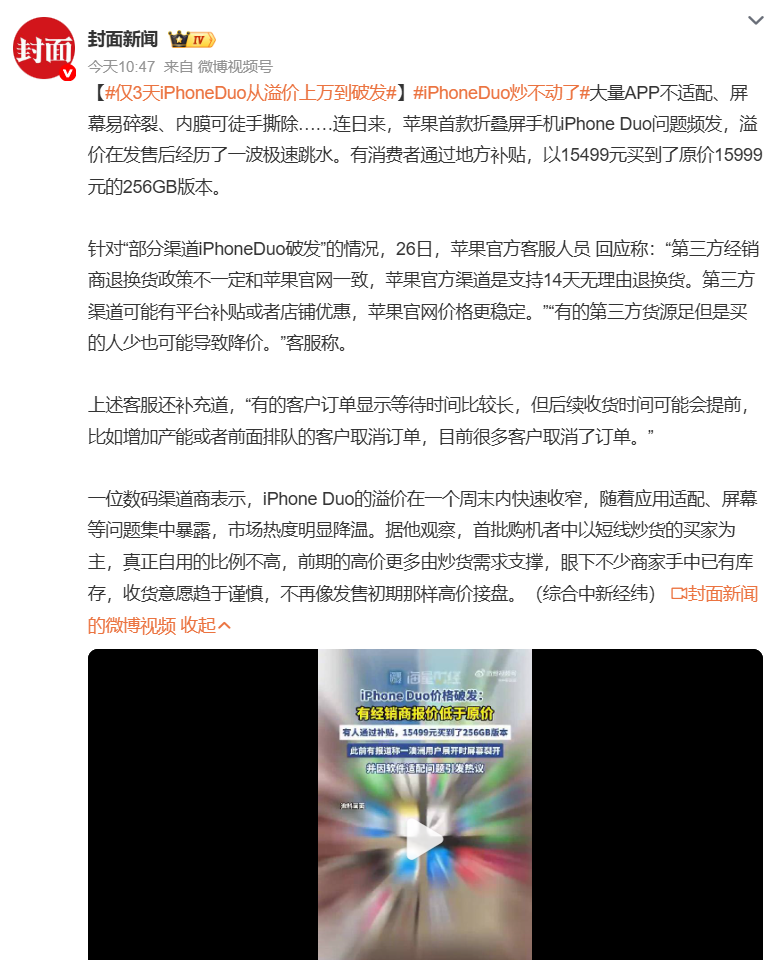
Market reaction was telling. As screen issues Concentrated exposure (concentrated exposure) and problems like poor app adaptation and severe overheating surfaced, iPhone Duo premiums quickly narrowed over a single weekend. From initial scarcity and premiums exceeding 10,000 yuan to consumers now buying spot goods (in-stock models) below the original price through subsidies, even seeing mass cancellations, this "price break" arrived unexpectedly.
Facing such large-scale (large-scale) quality control doubts at launch is undoubtedly a severe blow to Apple's first foldable phone. Despite offering replacement programs, the shadow of "will it crack again after replacement" lingers over consumers. In the realm of foldable screens—a feat of precision engineering—supply chain depth and tangible tolerance control matter far more than flashy marketing terms.
Disclaimer: This article is written based on publicly available information or details provided by interviewees. However, Caigou Business Review and the author do not guarantee the completeness or accuracy of the information or associations mentioned or displayed in this article, nor do they represent any organization's stance. In case of infringement, please contact us for deletion. Under no circumstances shall the information or opinions expressed in this article constitute investment advice to any individual.
▼
-END-
-
Could the Three-Row, All-Electric Flagship SUV BMW iX7, Equipped with an 8K Giant Screen and Produced in North America, Become a Bestseller?
-
![]()
WorkBuddy Ignites the AI Office Ecosystem Battle
-
![]()
Second Working Conference on Drafting the Group Standard “Test Method for Optical Parameters of Optical Waveguide Sheets” Held in Suzhou!
-
![]()
Q3 Net Profit Rises by Just 6%! Has Lante Optics Hit the Zenith of Prism-Driven Profits?
-
Hurun Rich List Released: AI Starts Creating Wealth - 1 in Every 10 Billionaires Owes Their Fortune to AI
-
![]()
Top 10 Provinces by GDP in the First Three Quarters of 2026: Diverging Growth Models
-
![]()
Why Is Mobile Phone RAM Shrinking?
-
![]()
Who is Investing in Anthropic?