Top 10 Provinces by GDP in the First Three Quarters of 2026: Diverging Growth Models
 10/28 2026
 408
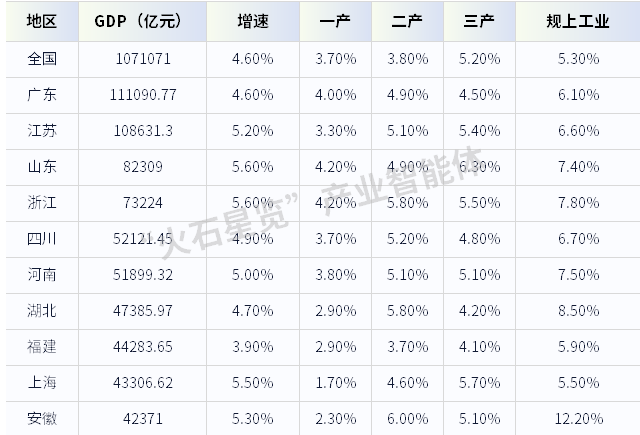
In the first three quarters of 2026, China's GDP reached RMB 107.11 trillion, up 4.6% year-on-year at constant prices. Data from the Huoshi Xinglan Industrial Intelligence Platform shows that as of October 27, economic data for all 31 provinces have been released. The top 10 provinces are Guangdong, Jiangsu, Shandong, Zhejiang, Sichuan, Henan, Hubei, Fujian, Shanghai, and Anhui, with a combined GDP of RMB 65.66 trillion, accounting for approximately 61.3% of the national total.
In terms of growth rates, Shandong and Zhejiang lead, while Guangdong lags behind. However, when zooming in on growth models, a more noteworthy signal emerges: competition among major economic provinces has shifted from "who runs faster" to "who completes structural transitions first."
Table: GDP and Sectoral Growth Rates of the Top 10 Provinces
Source: Huoshi Xinglan Industrial Intelligence Platform
01 Five Growth Models
Full-Chain Integrated Model - Guangdong, Jiangsu
Guangdong's industrial, financial, and information service sectors contributed over 70% to growth, with industry contributing 45.5% and industrial added value rising to 34% of GDP. Imports and exports exceeded RMB 8 trillion for the first time, up 24.5%, accounting for 21.8% of the national total. However, fixed asset investment fell by 9.2%, and retail sales grew by just 1.4%. The 4.6% growth rate matched the national average for the first time since Q3 2021.
Jiangsu's secondary sector accounted for 42.0% of GDP, the highest among the top 10 provinces. Equipment manufacturing grew by 9.7%, and railway, shipbuilding, aerospace, and aviation industries grew by 11.7%. Producer services revenue increased by 9.7%, contributing 80.7% to the growth of above-scale services revenue. However, retail sales grew by just 0.8%, the weakest consumption among the top 10. Both provinces excel in chain completeness rather than speed.
Service-Led Model - Shandong, Shanghai
Shandong's tertiary sector grew by 6.3%, significantly outpacing the secondary sector's 4.9%. Equipment manufacturing grew by 12.0%, 4.6 percentage points higher than all above-scale industries. Agricultural, forestry, animal husbandry, and fishery output value grew by 4.2%, and exports grew by 3.4%, making it a region with both high growth and a strong agricultural foundation.
Shanghai's tertiary sector grew by 5.7%, accounting for 79.4% of GDP. The financial sector grew by 9.5%, while information transmission, software, and IT services grew by 8.9%. Manufacturing output in three leading industries grew by 17.1%, and fixed asset investment grew by 4.3%. Shanghai is the only top-10 province combining the highest Service industry (services) weight, fastest growth in leading manufacturing, and continued positive investment growth.
High-Tech Manufacturing Breakthrough Model - Hubei, Anhui
Anhui's above-scale industrial added value grew by 12.2%, the highest among the top 10 provinces. Equipment manufacturing grew by 25.1%, and high-tech manufacturing grew by 50.3%, outpacing all above-scale industries by 12.9 and 38.1 percentage points, respectively. Computer, communication, and other electronic equipment manufacturing grew by 70.3%, automotive manufacturing grew by 29.1%, and new energy vehicle output grew by 24.7%.
Hubei's above-scale industrial growth reached 8.5%, with high-tech manufacturing growing by 45.5%, contributing 102.4% to industrial growth, meaning nearly all industrial growth came from high-tech manufacturing. Meanwhile, Hubei's fixed asset investment fell by 4.8% (excluding real estate, it fell by 2.4%), retail sales grew by 1.0%, and the tertiary sector grew by 4.2%, below the national average of 5.2%.
Dual-Wheel Model of External Demand and Emerging Industries - Zhejiang
Zhejiang's total import and export value reached RMB 4.57 trillion, with exports at RMB 3.48 trillion (up 10.2%) and imports at RMB 1.09 trillion (up 7.4%). Both import and export growth rates hit record highs for the same period since 2023. Above-scale industrial export delivery value grew by 11.8%, 1.2 percentage points faster than in the first half. Emerging industries grew even faster: service robot output surged by 91.0%, while industrial control computers and systems, and industrial robots grew by 50.6% and 37.5%, respectively. High-tech manufacturing and digital economy core industry manufacturing grew by 16.0% and 15.8%, respectively.
Agriculture and Equipment-Supported, New Materials-Driven Model - Henan, Sichuan
Henan's GDP grew by 5.0% in the first three quarters, with the primary sector growing by 3.8% and the secondary and tertiary sectors both growing by 5.1%. Above-scale industrial growth reached 7.5%, with equipment manufacturing growing by 16.8%, driving above-scale industrial added value growth by 4.6 percentage points. Lithium-ion battery output surged by 112.6%, and charging piles grew by 16.0%. Agriculture remained stable: summer grain output reached 75.529 billion jin, an increase of 528 million jin, accounting for over a quarter of the national increase. Pig, cattle, sheep, and poultry meat output reached 5.9239 million tons, up 10.5%.
Sichuan's GDP grew by 4.9%, 0.1 percentage points higher than in the first half. The primary, secondary, and tertiary sectors grew by 3.7%, 5.2%, and 4.8%, respectively. Above-scale industrial growth reached 6.7%, with high-tech manufacturing growing by 12.5% and green and low-carbon advantage industries growing by 10.7%, significantly outpacing above-scale industries. Lithium-ion battery output grew by 94.7%, and integrated circuits grew by 20.6%. However, energy resources weakened: natural gas output fell by 0.2%, and power generation grew by just 1.9%. Manufacturing investment grew rapidly, increasing its share of fixed asset investment by 3.1 percentage points year-on-year.
02 Converging Competition Dynamics and Investment Attraction Insights
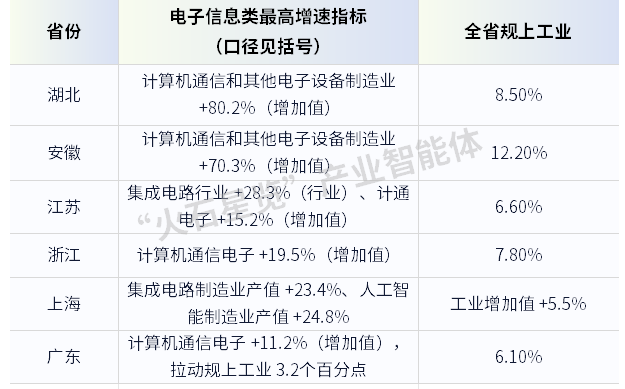
The growth drivers of the top 10 provinces are highly convergent: six provinces list electronic information as their primary growth engine.
Table: Electronic Information Sector Growth Rates by Province
Source: Huoshi Xinglan Industrial Intelligence Platform
The second overlapping sector is battery materials. National lithium-ion battery output grew by 39.5%, with Henan growing by 112.6%, Sichuan by 94.7%, and Hubei by 33.9%. Henan and Sichuan increased their national market share, while Hubei kept pace with the national average.
Against this backdrop, industrial investment attraction should focus on "segments/nodes" rather than entire industries. Given the high convergence of provincial growth engines, continuing to attract investments under broad categories like "integrated circuit industry" risks direct competition among provinces. Instead, attention should shift to specific nodes in the industrial chain, such as packaging and testing, wet electronic chemicals and polishing materials, thin-film deposition and etching/cleaning equipment in the electronics chain, and battery management system components, silicon carbide substrates, thermal management integrated modules, and cockpit electronics and vehicle connectivity terminals in the automotive chain. Only with comparable node positioning can this approach succeed.
Meanwhile, for segments gaining market share, the focus should shift from "comparing growth rates" to "comparing bases and progress." Taking lithium batteries as an example, does the share gain come from ramping up new capacity or increasing utilization of existing production lines? The former supports sustained investment, while the latter may peak soon.
-
Hurun Rich List Released: AI Starts Creating Wealth - 1 in Every 10 Billionaires Owes Their Fortune to AI
-
![]()
Top 10 Provinces by GDP in the First Three Quarters of 2026: Diverging Growth Models
-
![]()
Why Is Mobile Phone RAM Shrinking?
-
![]()
Who is Investing in Anthropic?
-
![]()
ThunderSoft Set to Relocate Within Dongsheng District
-
![]()
Empyrean Technology’s New 20,000-Square-Meter Headquarters Opens in Jiuxianqiao
-
![]()
Microsoft is Exchanging Labor Costs for a Ticket to the AI Era
-
![]()
DeepSeek Tops Global Rankings: A Victory of 'Billing Dominance'