DeepSeek Tops Global Rankings: A Victory of 'Billing Dominance'
 10/28 2026
 370


The Industry is Celebrating, AI is Soaring
Image Source | Internet (Please contact us for removal if infringement occurs) Partially AI-generated
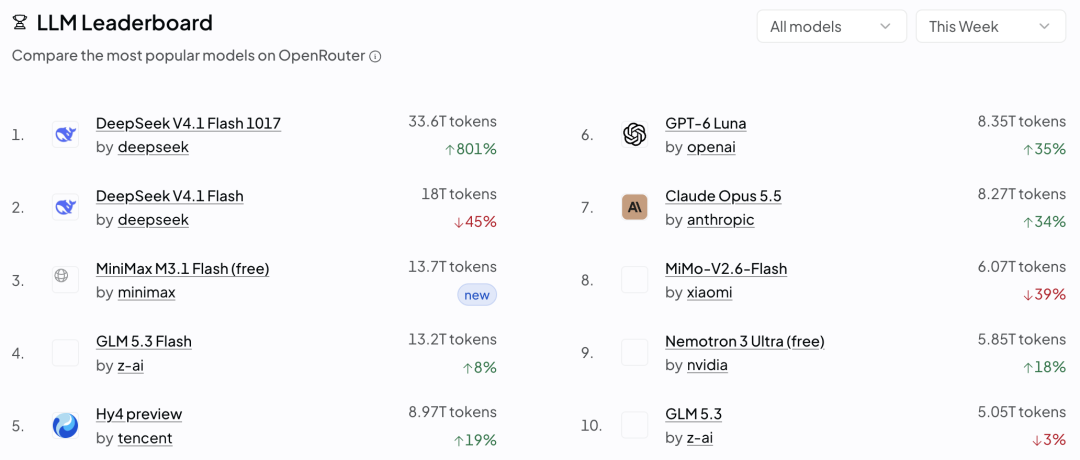
The latest data from OpenRouter shows that from October 19 to 25, DeepSeek V4.1-Flash-1017 topped the global rankings with a weekly invocation volume of 33.6 trillion tokens, marking an 801% increase week-over-week.
Chinese models occupied the top five positions, with a total weekly invocation volume of 93.54 trillion tokens, surpassing the U.S.'s 22.47 trillion tokens for the 26th consecutive week.
The industry is celebrating, and AI is soaring.
But if you only see the word 'first,' you're likely to misjudge the true significance of this achievement.
33.6 trillion tokens is a concrete figure, but it is not the result of 'technical dominance.' It merely represents a Periodic realization (interim realization) of 'billing dominance.'
More precisely, this reflects the cost-based decisions made by global developers and small-to-medium-sized enterprises (SMEs) in their real-world workflows with every API invocation. Understanding this point is far more important than celebrating the ranking itself.

Who's Better at Cost Calculation?
V4.1-Flash-1017 was released on October 17. In the same week, the invocation volume of the previous generation, V4.1 Flash, dropped from a higher level to 18 trillion tokens, a 45% decline week-over-week.
Users of the old version migrated to the new version, which absorbed almost all existing demand, coupled with a small number of truly incremental developers. This shift dramatically amplified the week-over-week figures.
The version migration itself demonstrates that users are highly sensitive to changes in price and performance, with migration costs low enough to make switching decisions almost instantaneous.
A model's ability to complete such a large-scale transition between old and new versions within a week after release proves that its user base is active, attentive, and ready to 'vote with their feet' at any time.
However, it must also be acknowledged that OpenRouter does not provide a complete picture of global large model invocation volumes. It only tracks traffic routed through this API aggregation gateway.
Vendor-owned APIs, enterprise-level deployments on Azure and Bedrock, private inference deployments, and direct-to-consumer apps and web products are not included in this pool.
The 33.6 trillion tokens prove that 'DeepSeek is the model developers are most willing to invoke on this open aggregation platform,' not that 'the global AI market is already dominated by DeepSeek.'
Separating these two points is essential to continue asking: Why is it being invoked so intensively on this platform?
The answer lies not at the top of the parameter table but in developers' cost calculations.
V4.1-Flash has a total of 552 billion parameters, but only 8 billion are activated per token during the Prefill stage, and 16 billion during the Decode stage.
This means its 'brain capacity' approaches that of a flagship model, but the computational resources actually used for each inference are kept at an extremely low level.
This efficiency is supported by an uncommon architectural choice: the 40-layer language backbone is split into 20 layers of causal encoders and 20 layers of decoders. After the prompt is encoded in the first half, the global KV needed for the second half is directly projected from the end of the encoder, eliminating the need for all historical tokens to repeatedly pass through the entire network.
The official report states that Prefill computation is nearly halved.
More critical is the handling of KV Cache. Agent workflows are characterized by 'reading far more than writing,' with every tool invocation injecting new web pages, code, and terminal outputs, causing the context to expand rapidly.
If all historical data had to be recomputed each time, costs would rise linearly or even exponentially.
DeepSeek's approach is to extract KV Cache from standalone memory and place it into an independent 3FS distributed storage cluster with a capacity of approximately 100 PiB. Agent traffic is retained for 3 days, and chat traffic for 7 days.
Repeated contexts no longer repeatedly consume computational resources, representing a structural improvement in inference economics for Agent scenarios.
These technical details ultimately point to the same conclusion: Between 'good enough' and 'affordable,' DeepSeek has pushed the balance to a point that is irresistible to a large number of SMEs.
Estimates show that the cost of completing similar Agent tasks with Anthropic's leading models is about 28 times higher.
V4.1-Flash-1017 maintains its original pricing despite performance improvements, at $0.15 per million input tokens and $0.60 per million output tokens, with an MIT-licensed open-source agreement.
In an earlier round of pricing adjustments, DeepSeek reduced the cache hit price for its entire API lineup to one-tenth of the original price, with V4-Flash's cache hit input price dropping to 0.02 yuan per million tokens.
This is not merely 'cheap' in a formal sense, as it represents pricing space created through architectural efficiency.
When a large number of real-world workflows, such as customer service classification, document tagging, code completion, and Agent tool invocations, are far more sensitive to 'cost per invocation' than to 'absolute intelligence ceiling,' the direction in which global developers vote with their tokens is almost predetermined.

The Open-Source Flywheel: Harder to Replicate Than Price Cuts
If it were merely about being cheap, DeepSeek's ascent could be interpreted as a short-term result of a price war.
But while anyone can engage in a price war, what transforms 'cheap' into a structural advantage is open source, which partially shifts pricing power from vendors to users.
On October 20, DeepSeek open-sourced its internal inference framework, DeepInfer, compatible with both NVIDIA and Huawei Ascend compute platforms.
The significance of this move lies not in 'adding another open-source project.' Previously, even if enterprises obtained the model weights for V3 or R1, it did not mean they could run them with the same efficiency as the official version.
Inference engines, parallelization strategies, cache management, scheduling logic—these are the 'tacit knowledge' that transforms model weights into low-cost services.
DeepInfer makes this tacit knowledge public: Any enterprise can deploy inference services close to official standards on its own clusters, SMEs do not need to build optimization capabilities from scratch, and university teams can validate their designs on Ascend.
This creates a virtuous cycle that is difficult to disrupt with a simple price cut: Open-source weights lower adoption barriers, open-source inference frameworks lower deployment barriers, and expanded deployment scales, in turn, feed model iteration and cost optimization.
When Chinese models already account for the majority of global downloads on open-source platforms, and when V4's million-token context and weights are freely available to global developers, the effectiveness of 'blockades' at the software level continues to decline.
You can ban an institutional account, but you cannot easily ban a set of weights and frameworks that have already entered the global developer toolbox.
That said, we must still view the situation more comprehensively.
After all, a high volume of tokens on OpenRouter does not equate to high profits.
On the same platform, when tasks are ranked by spending, high-value categories are still dominated by Claude Opus 5.5, GPT-5.6 Sol, and Gemini 3.1 Pro. The only Chinese model among the top spenders in categorized tasks is DeepSeek V4.1 Flash.
For high-complexity, high-risk, and high-value workflows, enterprises are still willing to pay a premium for 'the smartest option.' What DeepSeek has captured is the largest volume but relatively low unit value tier of real-world workflows.
This determines that its commercial position is not as comfortable as its invocation volume ranking suggests. Analysts point out that its actual blended gross margin is far below normal levels for the software industry, and the gap between its team size of around 200 and the thousands of personnel and tens of billions in revenue at leading closed-source labs cannot be bridged by a single ascent to the top.
API pricing has already begun to adjust in some segments, with 'extreme low pricing for scale' giving way to 'how to calculate unit economics beyond scale.'
Invocation volume is part of the moat, but the moat itself does not generate profits.
Questions about technical originality have not disappeared. Accusations of distillation have repeatedly surfaced, and while DeepSeek's previous R1 paper responded with verifiability of training data sources, debates over the 'originality' of its underlying architecture will not end with a single weekly ranking first-place finish.
More practical constraints come from computational power: Migration to domestic chips is a necessary step. While single-card cost-effectiveness can be calculated, communication stability at the scale of 10,000 cards and pre-training efficiency for next-generation models will determine whether it remains on the rankings next year.
Geopolitical pressures are also tightening. The U.S. Department of Homeland Security has requested federal civilian agencies to remove DeepSeek products and third-party services based on its models from their IT systems, expanding restrictions from defense and intelligence domains to nearly all federal civilian agencies.
Open source can bypass some commercial blockades but cannot circumvent institutional exclusion at the national level.

Over the past year, the share of Chinese models on OpenRouter has surged from single digits to a level rivaling overseas models, marking a directional shift in global developers' token allocations.
This shift is driven not by a single 'dominant' technological breakthrough but by a more fundamental and harder-to-replicate chain of capabilities: Architectural efficiency creates cost space, cost space supports pricing, pricing attracts developers, open source locks developers in as ecosystem participants, and the ecosystem feeds back into iteration.
However, every link in this chain has its limits. Leading in invocation volume can be won through cost-effectiveness, but leading in profitability requires irreplaceability, and leading in technological generations requires originality.
DeepSeek has won the first exam, but that does not mean it has aced all three.
33.6 trillion tokens are real, and global developers' choices are rational, but beneath the 'global first' data, what truly matters is the reason behind the ranking:
In an increasingly expensive industry, someone has chosen to make 'affordability' a core competitive advantage.
How far this path can go depends on whether it can continue to provide reasons for being 'indispensable' beyond 'cheapness.'
-
Hurun Rich List Released: AI Starts Creating Wealth - 1 in Every 10 Billionaires Owes Their Fortune to AI
-
![]()
Top 10 Provinces by GDP in the First Three Quarters of 2026: Diverging Growth Models
-
![]()
Why Is Mobile Phone RAM Shrinking?
-
![]()
Who is Investing in Anthropic?
-
![]()
ThunderSoft Set to Relocate Within Dongsheng District
-
![]()
Empyrean Technology’s New 20,000-Square-Meter Headquarters Opens in Jiuxianqiao
-
![]()
Microsoft is Exchanging Labor Costs for a Ticket to the AI Era
-
![]()
DeepSeek Tops Global Rankings: A Victory of 'Billing Dominance'