Fold 5 Times and It Leaks — ¥8,000 Repair Bill: Who Set Up Apple's Foldable Screen Scam?
 11/02 2026
 364
Spend ¥16,000 on a foldable-screen phone, open and close it normally fewer than 20 times, and the screen springs a liquid leak.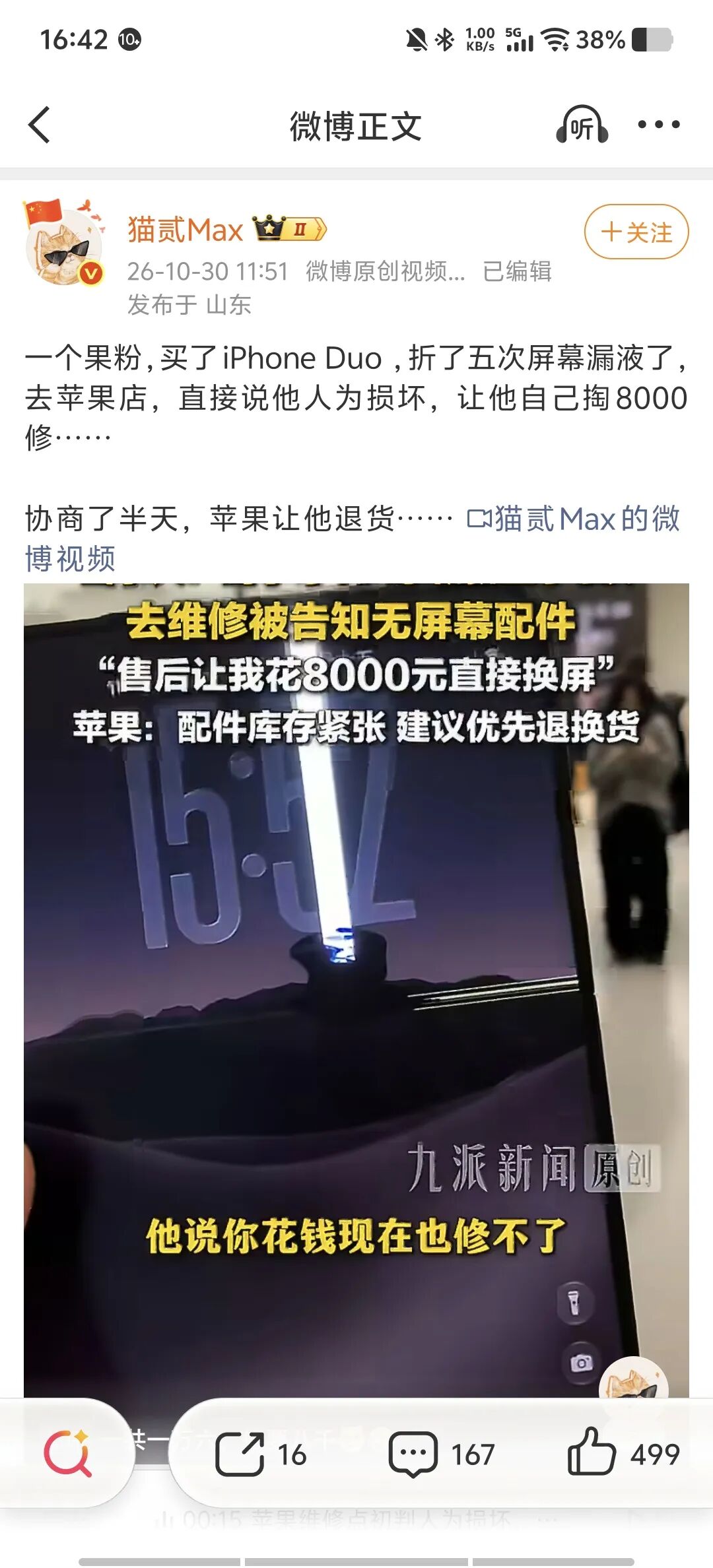
Take it in for repair, and the official quote is ¥7,998. Think that's too steep and want a replacement? Sorry — no stock. Your only option is a return. Apple's first foldable-screen iPhone, the iPhone Duo, has recently blown up online. Frankly, this isn't just Apple tripping itself up — it's a loss of face for the entire foldable-screen industry. 1. A liquid leak after just a few opens and closes is not bad luck. Many assume this is Apple's first foldable, so it simply lacks experience.
But after teardown crews took the device apart, they found that was not the case at all. The root cause lies in a central support rod in the hinge. When the phone is closed, this metal rod doesn't retract all the way, forming a tiny hard protrusion that cracks the flexible screen above it from behind. The test data is even more absurd: a new device leaves the factory with a crease of only 48 microns, but after three thousand open-close cycles it reaches 167 microns, and the structure is completely out of control.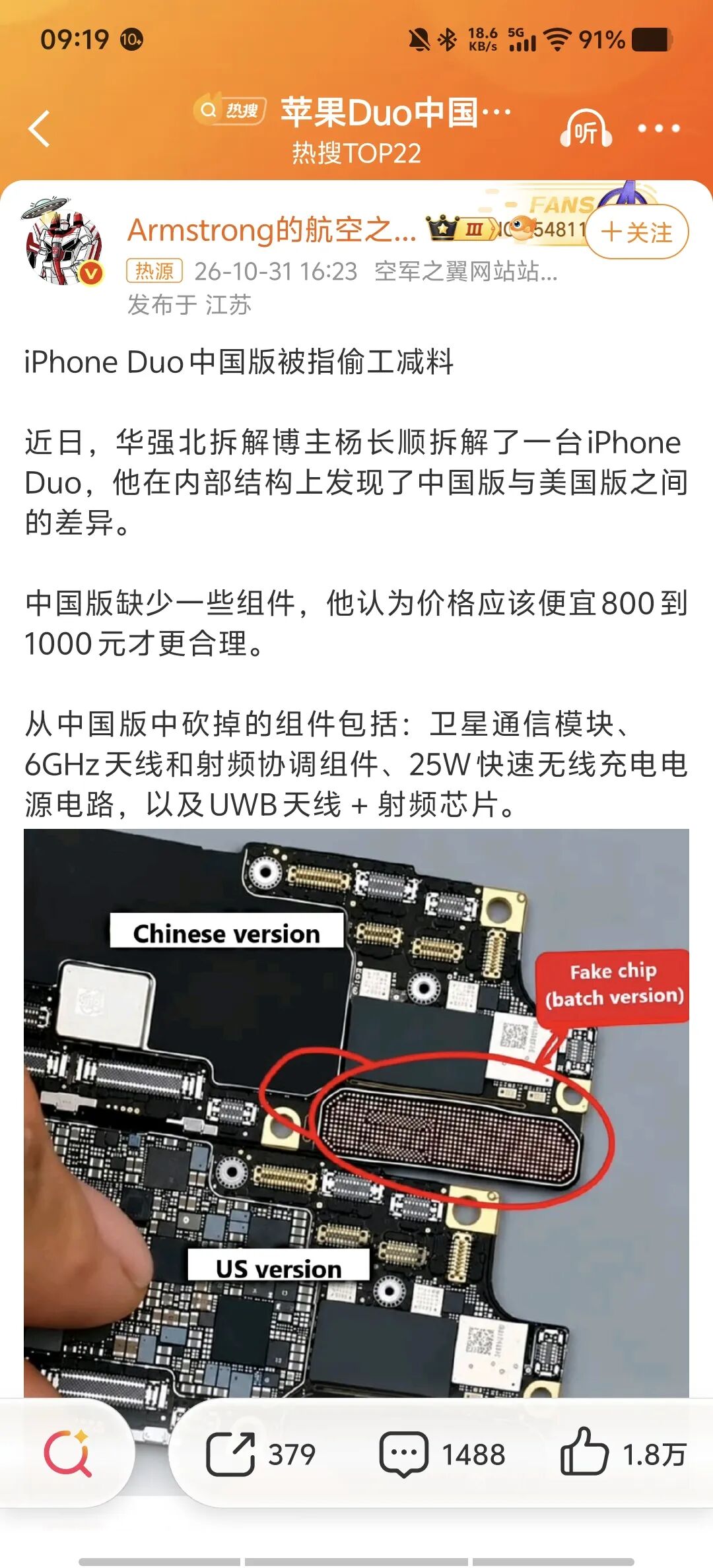
Why can't even the most basic tolerance be controlled? Blame Apple's repeated push in recent years for "supply chain de-sinicization." The most critical hinge was handed to manufacturers in the United States and Taiwan, China; the internal support plate was sourced from South Korea; and the screen uses Samsung. Manufacturers in the Chinese mainland can only follow along and make some of the most marginal parts. But the most embarrassing part is this: parts are bought from all over the world, yet final assembly still has to be honestly packed into Zhengzhou Foxconn.
Why? Because foldable screens are too delicate and must be manually assembled in top-tier cleanrooms — other places simply can't handle it. Parts flew around the globe, and when finally assembled together, with no one on site supervising and adjusting every day, those micron-level errors became fatal damage that cracked the screen. You want to cut ties with China in business, but the laws of industry won't indulge you. 2. When problems arise, look at how our domestic brands handle it. Foldable screens are precision products, and everyone can understand that first-generation products have issues.
But how you handle things after a problem arises is what creates the gap. Apple's behavior this time is indeed ugly. It immediately shifts the blame, calling it "man-made damage" — and if you want it repaired? Pay ¥7,998 for a screen replacement. You grit your teeth and prepare to pay, and then they say there are no parts, it cannot be repaired, so return it. Let's look at how domestic manufacturers provide fallback protection for users.
With Huawei's Care+, if the screen is dropped and broken, the service fee for replacing the original inner screen is only ¥468; Xiaomi directly offers screen protection — replacing the inner screen costs only ¥399, and the outer screen is simply free; Honor is even tougher — repairing the inner screen plus hinge costs just over ¥200. Compared with these domestic service fees of a few hundred yuan, Apple's ¥7,998 could buy half a phone.
Facing the same technical difficulties, domestic brands put real money into services to protect consumers, while Apple treats you like leeks to be harvested. 3. After all this criticism, why can scalpers still drive prices sky-high? This may be the most heartbreaking reality: the internet is already cursing up a storm, yet during pre-sales, scalpers still add tens of thousands in markup, and one device is hard to find. To put it plainly, this is living off past glory and precisely targeting Apple fans' need for "face."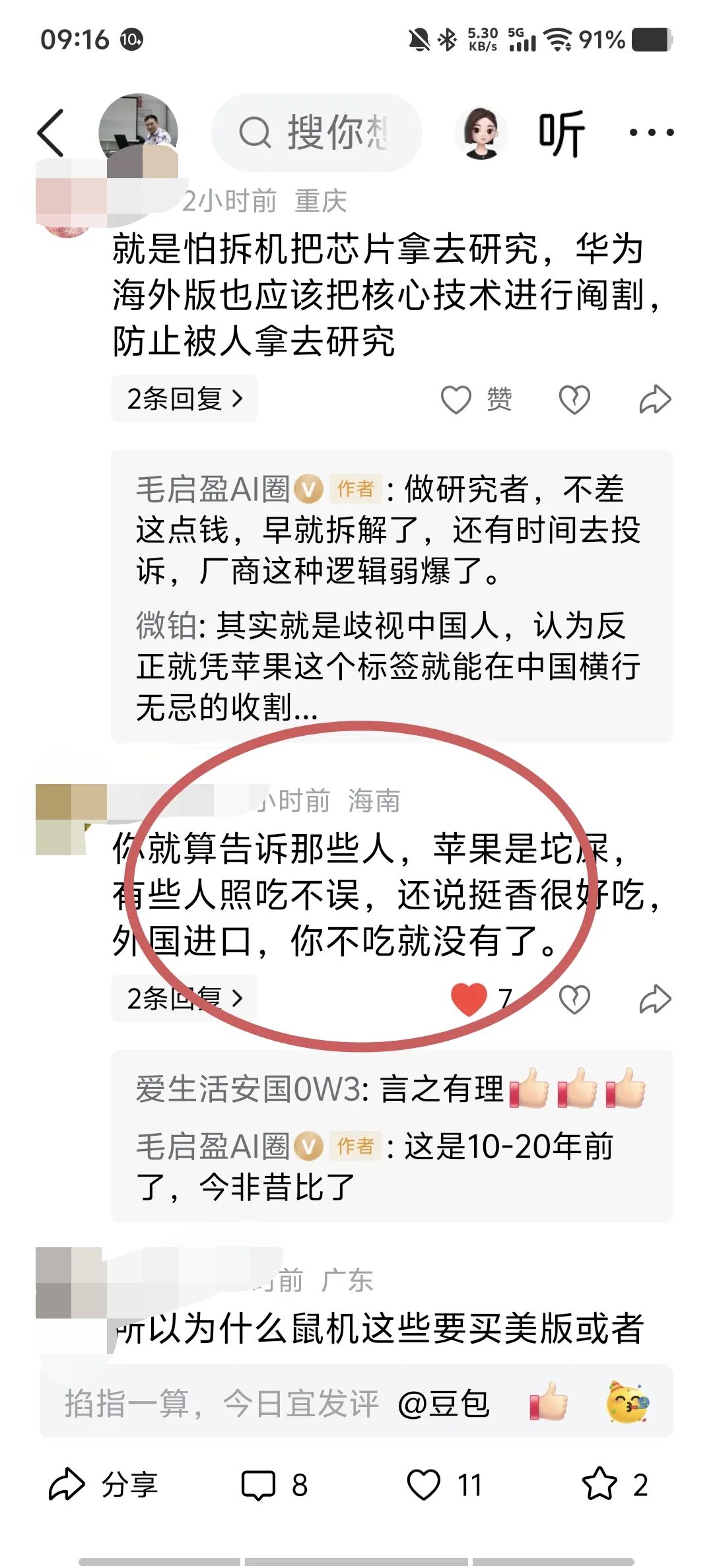
Taking out Apple's first foldable screen and posting it on Moments — that's called social currency. Just the four words "Apple's first" are enough to make a batch of loyal fans pay up. To buy early and enjoy early, and for this first-launch identity, even if quality control is a bit poor, they accept it. Add Apple's iOS ecosystem, and many people are tied down so tightly that they simply cannot leave. So scalpers aren't optimistic about this phone; they just understand all too well the human nature of those who "don't lack money, only lack an Apple logo."
However, leeks only have three seconds of memory. After this batch of loyal fans finishes buying, scalper markups quickly shrink or even fall below the issue price — because once ordinary people come to their senses, who would spend more than ¥10,000 to buy an ancestor to worship? 4. How many more days can Apple's arrogance last in the Chinese market? Let's check industry data, and this situation is actually quite surreal. Globally, Samsung is still the leader, with about 35%. Apple, in its first year, relied on its brand halo to grab nearly 25% of the share and parachute into second place.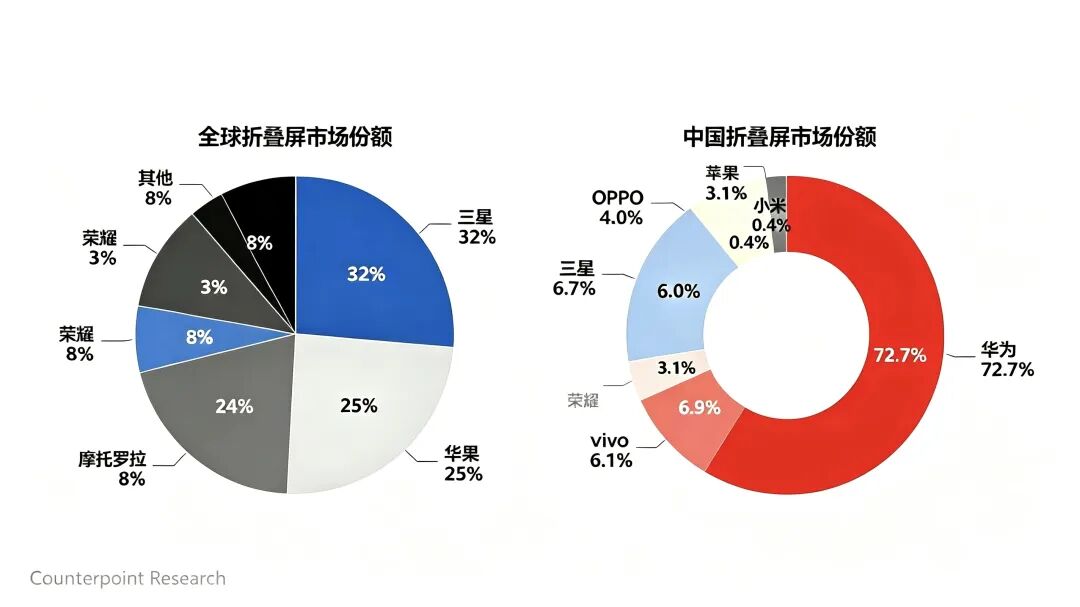
But looking back at our domestic market, it is a completely different picture. In the first half of 2026, Huawei alone ate up more than 70% of the domestic share — absolute dominance. The remaining Honor, vivo, OPPO, and Xiaomi are frantically competing on technology and services. Samsung is almost nowhere to be seen domestically. In such a fiercely competitive market where domestic brands are wildly involutionary, Apple enters with the halo of global second place, yet flips over on the most basic quality control and after-sales service.
Facing an opponent like Huawei that occupies 70% of the territory, how long can Apple's aloof attitude continue to fool people? In closing, the foldable-screen path was carved out by domestic manufacturers after seven or eight generations of relentless effort and suffering in workshops. Apple entering now could have worked together to make the cake bigger, but if it only wants to harvest based on brand halo and is unwilling to use services as fallback protection, then this collapse may have only just begun. On one side is the ¥7,998 screen replacement fee, and on the other are domestic few-hundred-yuan screen protection plans. Next time, will you still pay blindly for the "Apple logo"? Chat in the comments section.
#MaoQiyingAIcircle#iPhoneDuo#Appleafter-sales#foldablescreenliquidleakage#domesticfoldablescreen#supplychain
Data and image sources: TrendForce, Counterpoint, Sina Weibo, etc.
-
![]()
AI Office Track Head-to-Head: After the Battle for Entry Points, the Renewal Period Is the Real Test
-
![]()
Why Is the Eyebox Always "Bright in the Center, Dark at the Edges"? — The Polarization Multiplexing Solution
-
![]()
Why Can't the Smartest Coding Assistant Reply to Your Messages Instantly?
-
![]()
Half of Domestic Tokens Used to Make Wish-Fulfillment Dramas? Large Models Face a Compute Bloat Bubble
-
![]()
Apple Picks Qwen — and There's More to It Than Meets the Eye
-
No Blackening, No Fanning—Xiaomi Auto's Goal of Delivering 550,000 Vehicles This Year Is Easier Said Than Done
-
![]()
Automakers' KPI Collapse
-
![]()
The All-New Xiaomi SU7 Ultra Laps the 'Ring Undisguised — Can Chinese Performance Cars Earn a 'Seat at the Table'?