Apple: The Storage Backlash Finally Arrives — Is the "Safe Haven" Facing AI About to Spring a Leak?
 11/03 2026
 592
Apple (AAPL.O) released its Q4 fiscal 2026 earnings report (quarter ended September 2026) after the U.S. market close on the morning of November 3, 2026, Beijing time. Key takeaways are as follows:
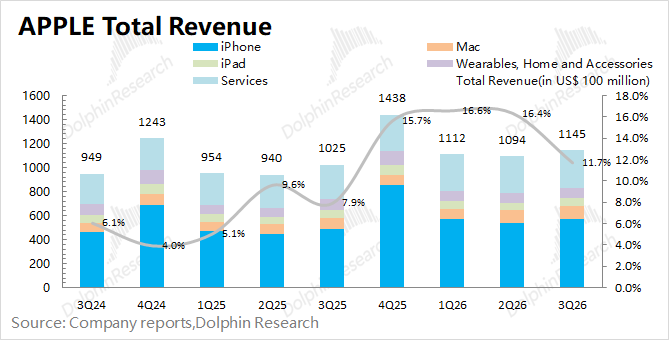
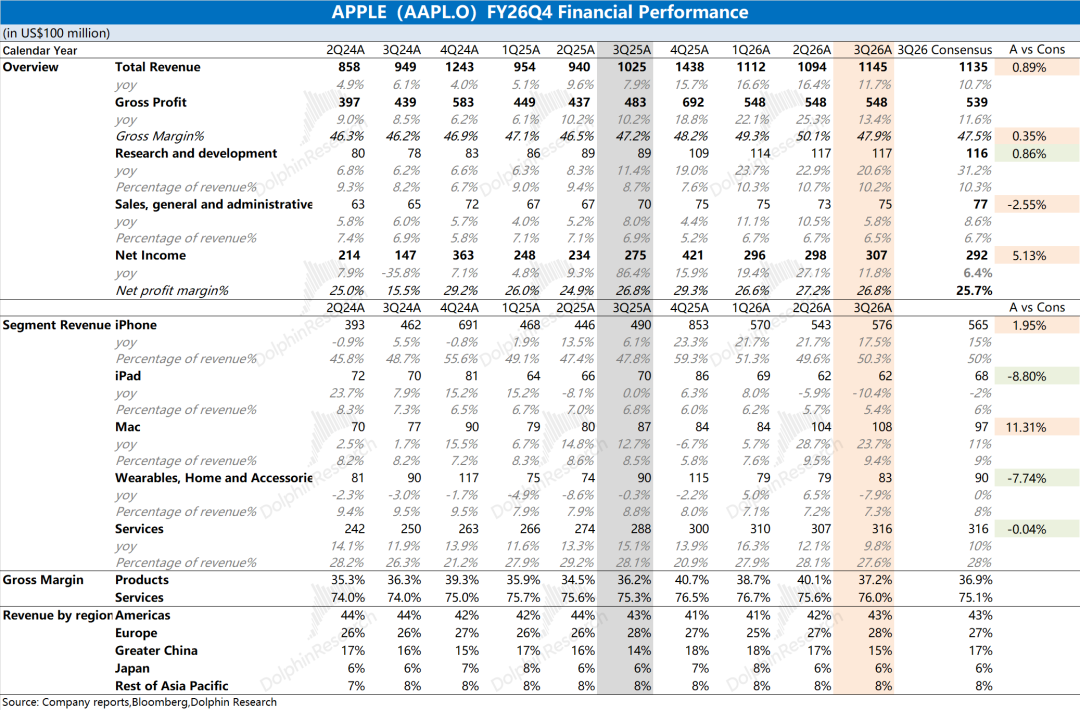
1. Overall performance: Apple posted revenue of $114.48 billion this quarter, up 11.7% year-over-year, beating market expectations of $113.5 billion and also topping the high end of the company's prior guidance (9–11% year-over-year growth).
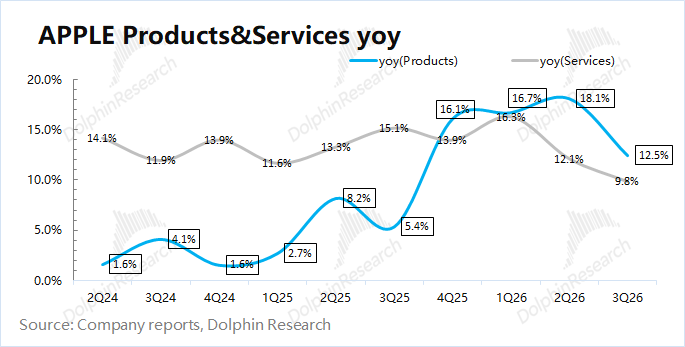
Revenue growth this quarter was driven mainly by the iPhone and Mac businesses. The iPhone 18 Pro series launched late in the quarter and began contributing revenue in mid-September. Software services grew 9.8% year-over-year, broadly in line with market expectations.
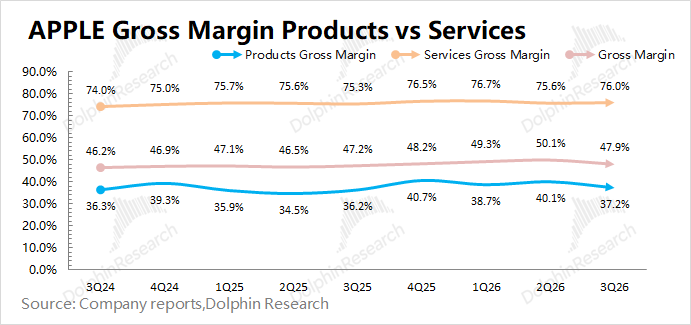
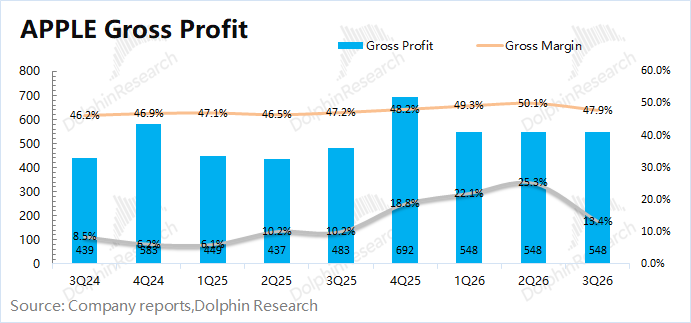
Gross margin came in at 47.9%, down 2.2 percentage points quarter-over-quarter but slightly better than the market's 47.6% expectation. That still includes roughly 1 percentage point of tariff-refund benefit; excluding it, gross margin was approximately 46.9%.
Software services gross margin was 76.0%, up 0.4pct quarter-over-quarter. Hardware gross margin was 37.2%, or roughly 36% excluding tariff refunds, down about 1pct quarter-over-quarter, mainly due to rising storage prices.
According to management's breakdown, after stripping out tariff refunds from the June and September quarters, both overall and hardware gross margins fell about 1 percentage point quarter-over-quarter, and nearly all of that came from storage. The actual hit from storage costs was even larger, but was partly offset by the consumption of low-priced inventory, cost reductions in non-storage components, and product price increases. As of this quarter, the company has recovered most of the tariff refunds already paid, and there will be no such tailwind in subsequent quarters.
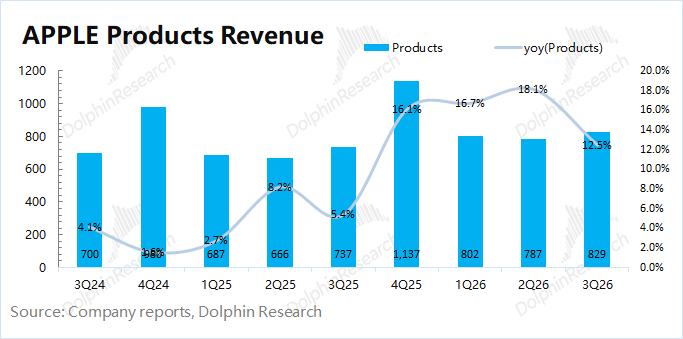
2. iPhone: The iPhone business generated $57.58 billion in revenue this quarter, up 17.5% year-over-year and above the market's $56.5 billion expectation. Despite supply constraints and currency headwinds, growth this quarter came mainly from higher average selling prices after the iPhone 18 Pro series price hike, as well as continued demand for the iPhone 17 series. Both the Americas and Greater China posted strong double-digit growth.
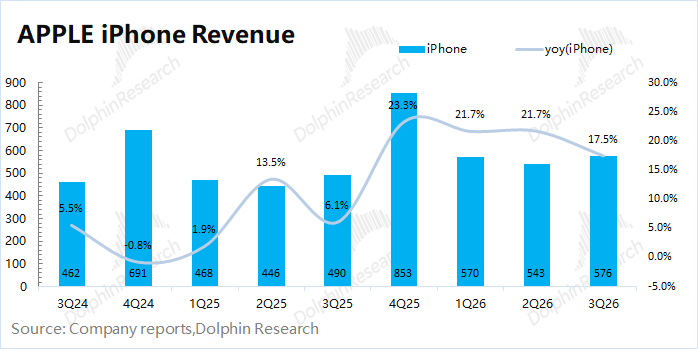
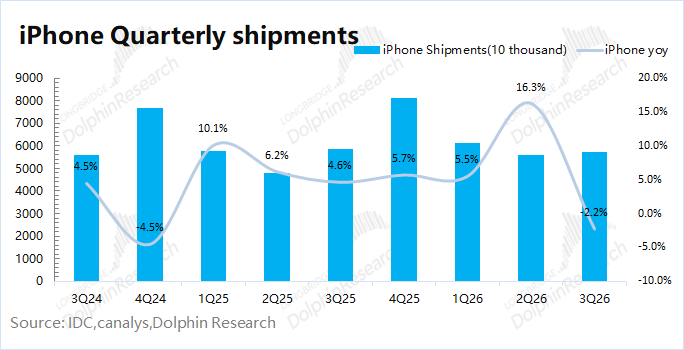
Dolphin Research takes a closer look at the volume-price relationship: growth in the iPhone business this quarter came mainly from higher average selling prices.
1) iPhone shipments: According to IDC, global smartphone shipments in Q3 2026 were about 255 million units, down 21% year-over-year. Apple's global shipments this quarter were about 57.3 million units, down 2% year-over-year, with market share rising from 18.2% a year earlier to 22.4%. The company's shipment performance was significantly better than the overall market.
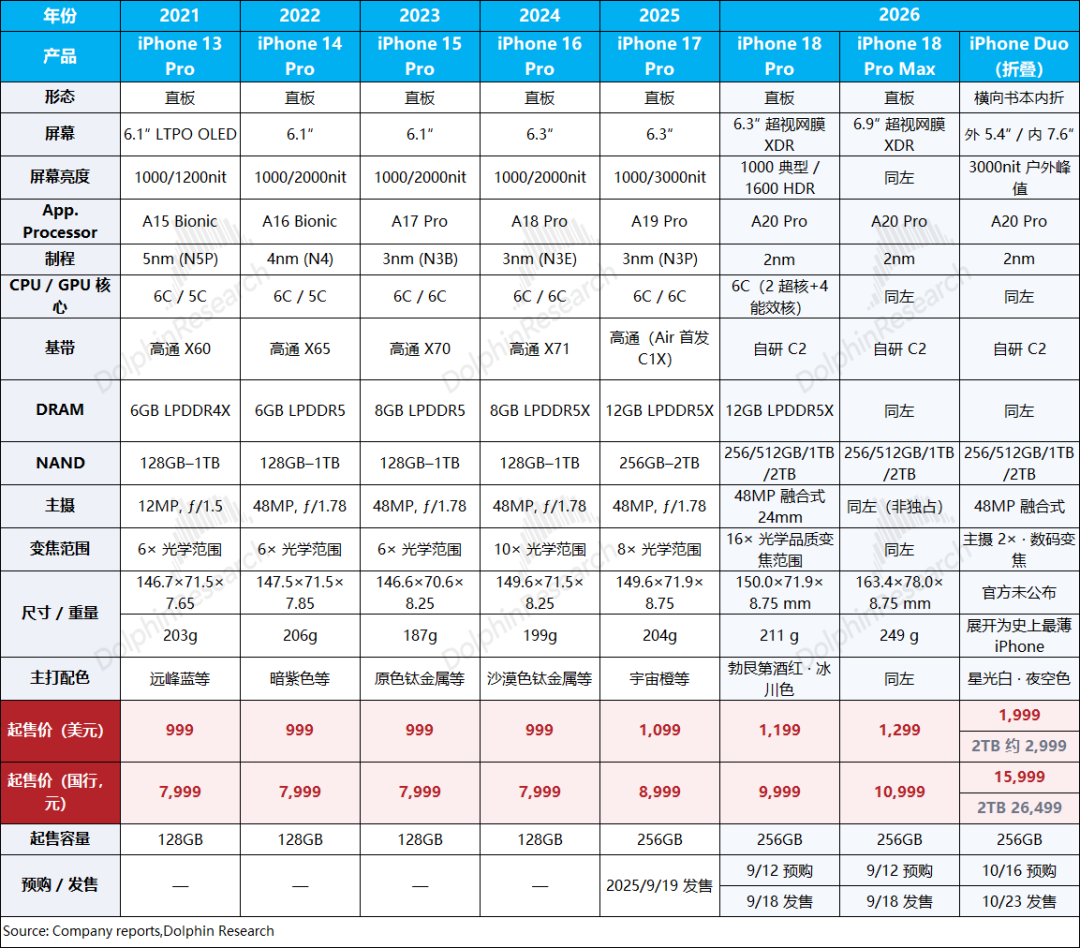
Storage price increases prompted Android brands to raise prices one after another, and Apple this time also chose to lift Pro-series prices by $100. Judging by delivery lead times, demand held up solidly after the price increase; by late October, delivery times for the iPhone 18 Pro/Pro Max had already caught up with the same period last year.
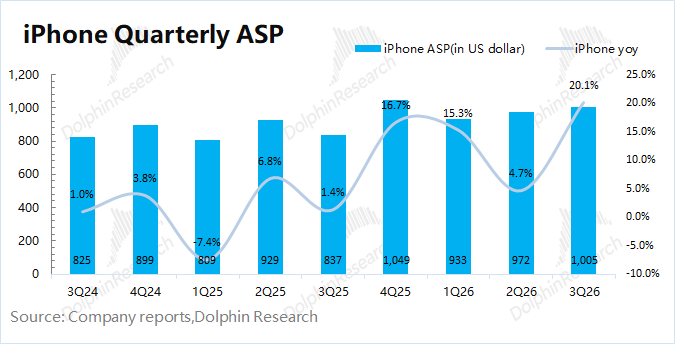
2) iPhone average selling price: Based on iPhone revenue and shipment volume, the average selling price this quarter was approximately $1,005, up about 20% year-over-year (approximately $837 in the same period last year).
Apple's price adjustments this time mainly involved raising the starting prices of the 18 Pro/Pro Max by $100 each, with the older iPhone 17 also up $100. Moreover, no base model was released this autumn, skewing the product mix toward Pro.
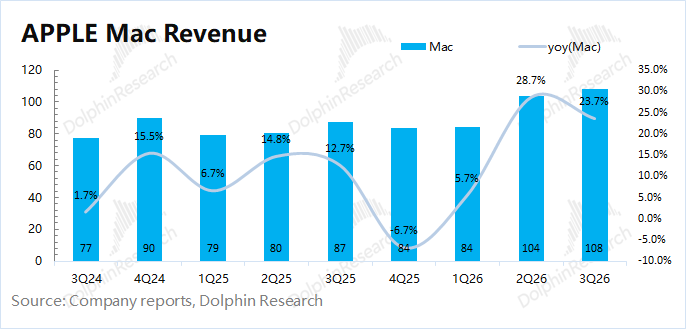
3. Other hardware beyond iPhone: Mac revenue was $10.79 billion this quarter, up 23.7% year-over-year and well above the market's $9.7 billion expectation. Mac continued to benefit from strong sales of the MacBook Neo and MacBook Pro, still achieving over 20% growth despite supply constraints (volume -13% year-over-year, price +42% year-over-year).
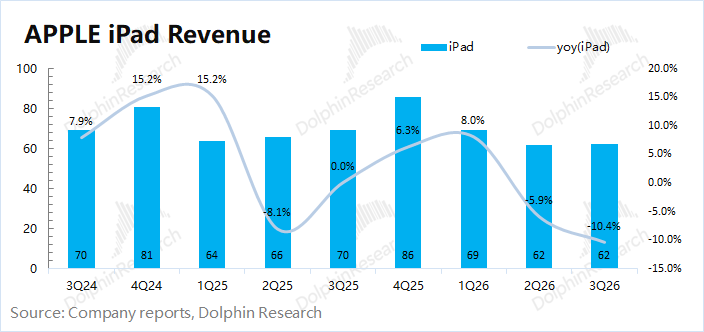
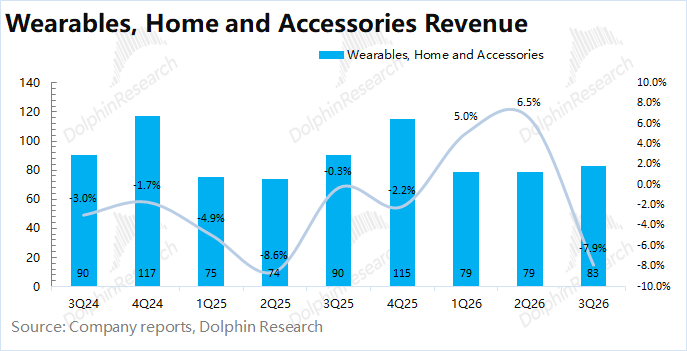
iPad revenue was $6.23 billion, down 10.4% year-over-year; wearables and other hardware revenue was $8.3 billion, down 7.9% year-over-year. Both fell short of market expectations ($6.8 billion and $9 billion, respectively).
iPad was dragged down by supply constraints and a high base in the year-ago period. Wearables faced a high base from last year's Watch SE3 and AirPods Pro 3 launches, with the new Watch S12/Ultra 4 and AirPods 5 only launching in mid-September, limiting their contribution this quarter.
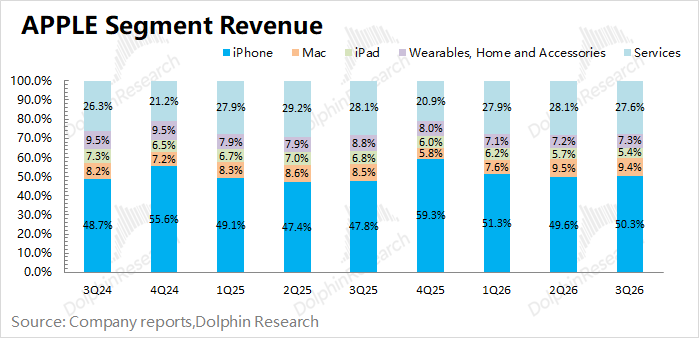
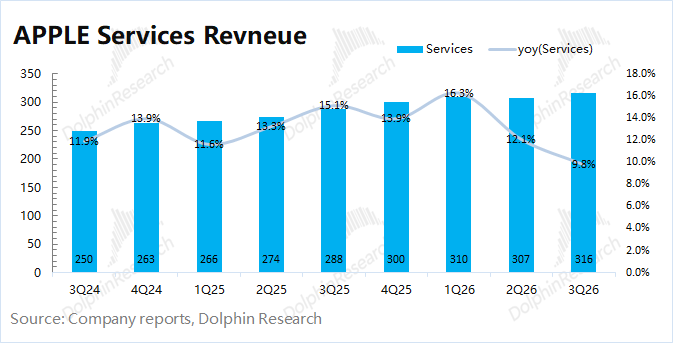
4. Software services: Software services revenue reached $31.57 billion this quarter, in line with the market's $31.6 billion expectation, up 9.8% year-over-year. With a gross margin of 76.0%, the software business, at 27.6% of revenue, generated 43.7% of the company's gross profit.
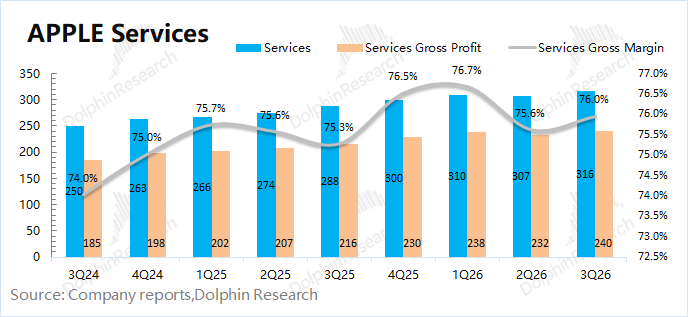
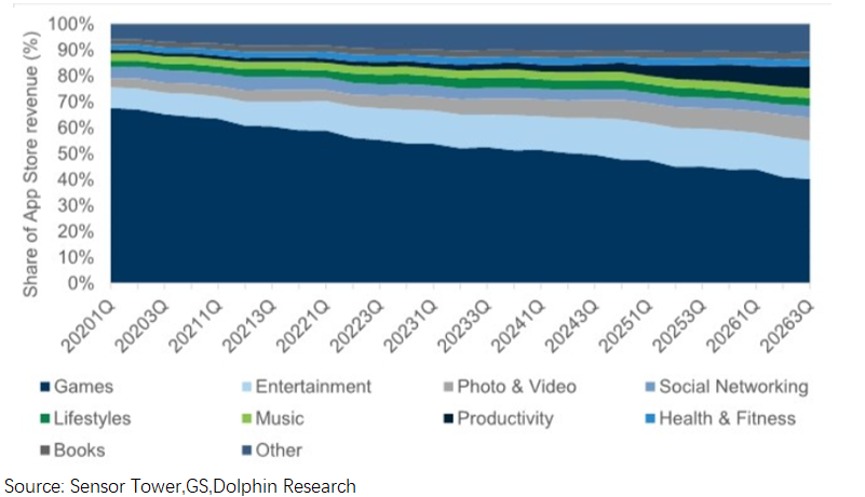
By segment, video, cloud services, payments and advertising all hit record highs, while music set a September-quarter record. App Store performance was similar to the same period last year, with mobile gaming still a drag. Exchange rates were the main reason for the slowdown in services growth: from the March quarter to the September quarter, about 4 percentage points of the decline in services year-over-year growth came from currency. The EU App Store fee cut (from 30% to 26%) took effect on October 1, with the impact mainly falling in the next quarter.
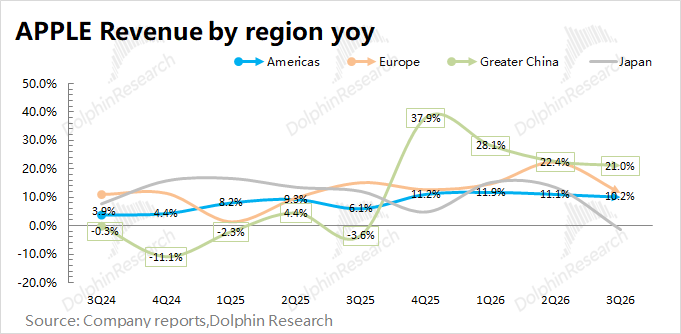
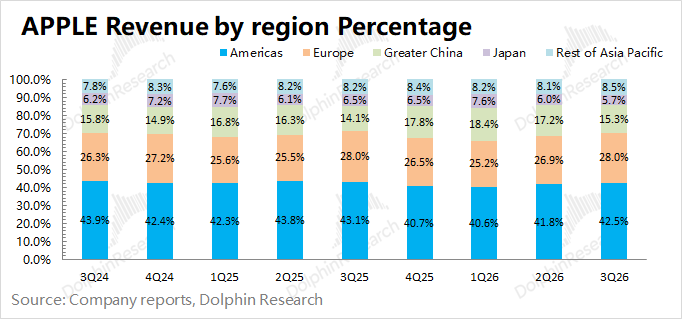
5. Revenue by region: The Americas remains the company's cornerstone, with revenue of $48.68 billion, accounting for 42.5% of the total, up 10.2% year-over-year. Europe revenue was $32.01 billion, up 11.5% year-over-year. Greater China revenue was $17.54 billion, up 21.0% year-over-year, still the fastest-growing region. Japan declined 1.4% year-over-year, while the rest of Asia-Pacific grew 15.0% year-over-year.
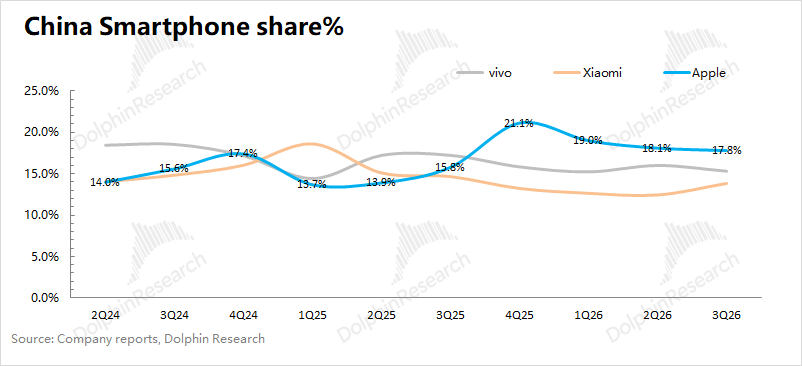
iPhone shipments in the Chinese market this quarter were about 10.33 million units, down 4% year-over-year, while the overall Chinese smartphone market fell 15% year-over-year. Storage price increases squeezed low-end Android, and iPhone's market share rose 2 percentage points year-over-year.
Dolphin Research's overall view: Revenue "passed steadily," but profit was eaten by storage.
Apple's report card this quarter is good, with revenue even exceeding the company's own highest guidance. However, gross margin still includes tariff refunds; excluding that factor, the pressure from storage price increases has already begun to show.
Revenue growth was basically entirely due to iPhones and Macs selling at higher prices, not selling more — sales volume actually declined slightly. This year the Pro series raised prices directly, and no base model was released in autumn, so sales were naturally dominated by the expensive models.
Profit was not so easy. Storage prices soared, and the extra cost of the new Pro Max was almost entirely spent on storage; management itself called the increase "unprecedented." This quarter was propped up by cheap old inventory and price increases, but inventory is being used up and procurement prices are still rising. Fortunately, Apple already sells mid-to-high-end products and has already raised prices, making it more resilient than competitors.
Beyond this quarter's data, management also provided guidance for the next quarter: the company expects December-quarter revenue to grow 7–10% year-over-year, corresponding to approximately $153.8–158.1 billion, slightly above the market's $152.6 billion expectation. Of that, software services are expected to grow 8–9% year-over-year (approximately $32.4–32.7 billion), below the market's +12% expectation, mainly dragged down by a quarter-over-quarter weakening of third-party licensing revenue (mainly Google's payment to Apple for default search engine placement) and currency headwinds.
Services revenue growth is entering a high single-digit range. Third-party licensing mainly comes from the "rent" paid by Google and others to Apple for default search placement. It cannot be ruled out that the slowdown in Google's traditional search revenue has also affected the share paid to Apple.
The company expects next quarter's gross margin to be 45–46%, below the market's 46.7% expectation, with the midpoint down about 1.4 percentage points from this quarter's 46.9% after excluding tariff refunds, mainly due to storage cost increases and Siri AI-related cloud costs.
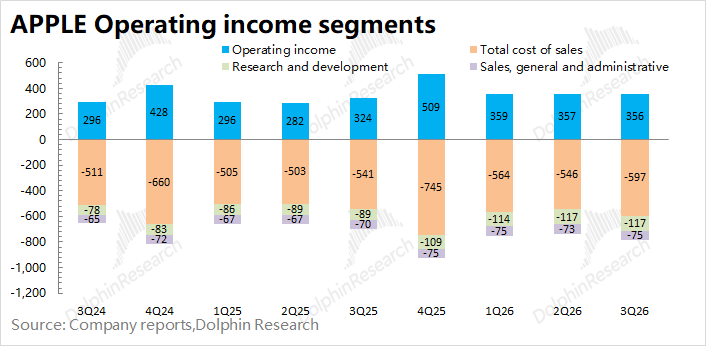
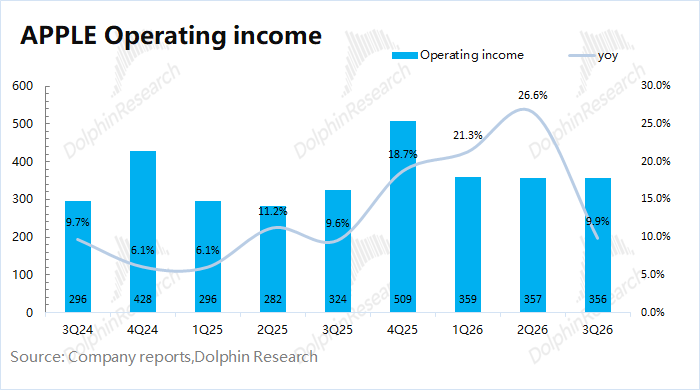
Based on guidance, Dolphin Research estimates December-quarter operating profit at approximately $50 billion, possibly even lower than the same period last year ($50.9 billion). In other words, "revenue grew at a high single-digit rate, but profit declined," with the extra revenue basically eaten up by storage costs.
Management stated that supply-side constraints in the September quarter mainly came from advanced processes, which are already easing as more products shift to the 2nm node; the main constraint in the December quarter will shift to storage.
To improve supply, the company's manufacturing purchase commitments increased by $33 billion from the June quarter to the September quarter, and period-end inventory also rose from $11.1 billion at the end of last quarter to $14.5 billion ($5.7 billion in the same period last year), clearly indicating an intent to lock in materials in advance.
Beyond Apple's earnings report, the market is also focused on the following aspects:
a) China market: Share defended, total volume declined
Greater China revenue grew 21% year-over-year this quarter, mainly driven by iPhone and Mac. From a shipment perspective, the Chinese phone market was clearly hit by storage price increases: Q3 2026 China smartphone shipments were about 58.06 million units, down 15% year-over-year; iPhone shipments were about 10.33 million units, down 4% year-over-year, with share around 18%, still outperforming the overall market.
b) iPhone 18 cycle: Demand "resilient" after price increases
At its September 9 launch event, Apple unveiled the iPhone 18 Pro/Pro Max (starting at $1,199/$1,299, each up $100), the first foldable iPhone Duo (starting at $1,999), the self-developed A20 Pro chip and C2 modem, with the base model postponed to next spring. High-frequency data suggests demand is "not bad but not strong": global Pro/Pro Max delivery times in week 7 were 7 and 21 days respectively, exactly flat with the same period last year; the Duo's delivery time is about 94 days, with in-store pickup unavailable in all regions, clearly in short supply.
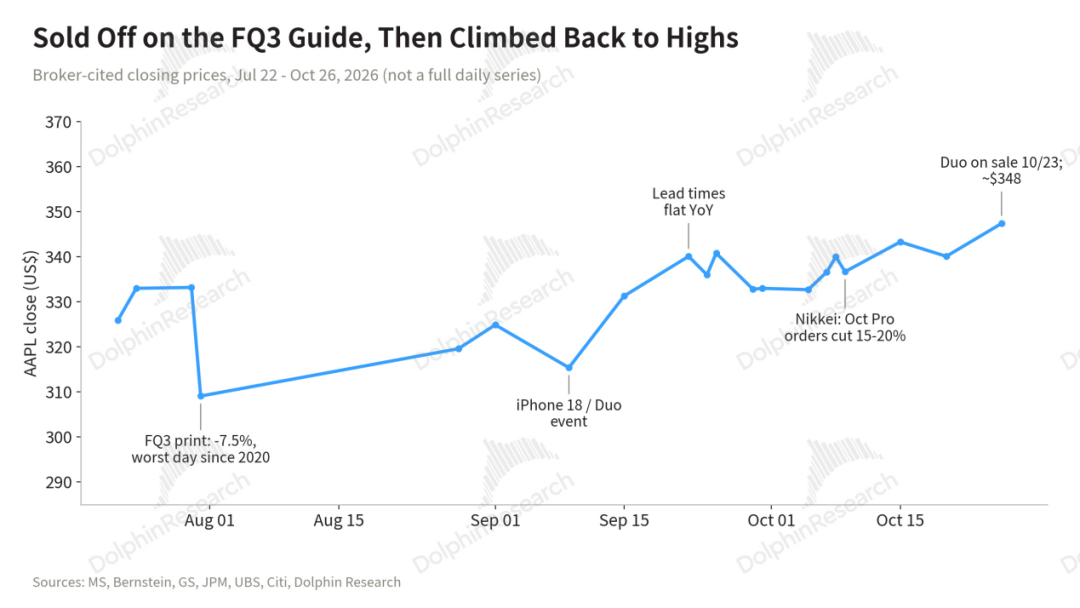
There has also been negative news recently (Nikkei): Pro component orders were cut in October, and Largan stated that customers cut orders shortly after launch, down 15–20% from original plans. On the earnings call, management said iPhone had just raised prices and it was "too early" to assess price elasticity; asked why no base model was released in autumn, management did not respond directly, only saying that the iPhone 17, iPhone Air and iPhone 17e would form the holiday-season lineup together with the 18 Pro series.
c) AI strategy: Siri upgrade launched, but absent in China and Europe
The new Siri (Siri AI) promised at WWDC launched in beta for U.S. English users in September and expanded to French, Japanese, Korean, Portuguese and Spanish in October, but the initial rollout does not cover the EU or China.
Features relying on server-side models (such as Siri AI and intelligent photo editing) will have usage limits, and users needing more quota can pay for expansion in the future, opening an AI monetization path for subscriptions such as iCloud+. Management disclosed that Siri handles over 2.5 billion requests per day, currently still mainly "request-based" interaction, but the underlying architecture is built on a scalable orchestration framework, and agent capabilities will gradually expand in the future.

In China, "Apple Intelligence" passed generative AI service filing in July, with the company partnering with Alibaba to provide local model capabilities. On the cost side, management clarified for the first time the financial impact of Siri AI: cloud costs for server-side inference are included in cost of services, and Siri AI bundled with hardware sales will defer a portion of revenue — both will drag on gross margin, which is one reason the December-quarter gross margin guidance is weak.
On capital expenditure, Apple remains restrained, with capex of about $2.2 billion this quarter (-31% YoY), in sharp contrast to other major players spending hundreds of billions of dollars per quarter.
Last quarter was a "slight beat, weak guidance" quarter: the September-quarter revenue guidance given at the time (+9–11%) was below consensus (+12%), services missed expectations two quarters in a row, and the stock fell 7.5% the next day.
After the iPhone 18 launch event on September 9, pricing did not have much impact, delivery cycles were flat versus last year, and the stock recovered and neared a new high of $348 in late October. But recent market chatter about supply chain order cuts, falling delivery cycles, and weakening carrier upgrade rates has begun to heat up concerns about the December quarter.
In the previous quarter, Dolphin noted that Apple had already become a "safe haven" in the AI correction, with its valuation rising from 29x PE to above 35x PE. Even though the market believes the company's growth will slow (memory pressure and demand concerns), over the past three months the market's valuation of Apple has risen rather than fallen.
Dolphin believes this quarter's earnings and next quarter's revenue guidance "passed steadily" and were slightly better than expected, indicating that the logic of "price increases for growth" has been validated on the revenue side. But the problem is on the profit side: gross margin guidance of 45–46% is below consensus, with memory price increases combined with Siri AI cloud costs eating into the revenue elasticity brought by price increases; service growth guidance also fell to 8–9%, likewise below market expectations.
With FY2027 still at 36x PE, the market is paying a "certainty premium" for Apple, while this guidance delivers "revenue is fine, profit is uncertain." Items to track going forward: ① hardware gross margin after low-priced inventory is exhausted; ② the ramp-up pace of iPhone Duo; ③ whether Siri AI paid monetization can stabilize service growth.
Dolphin judges that this earnings report cannot drive valuation further upward, and the stock is more likely to enter a "stable but lacking upward momentum" valuation digestion period.
But this earnings report is not enough for the market to change its positioning as a hedging asset opposite AI trades. After all, among the major players, only it and Nvidia still maintain decent positive cash flow.
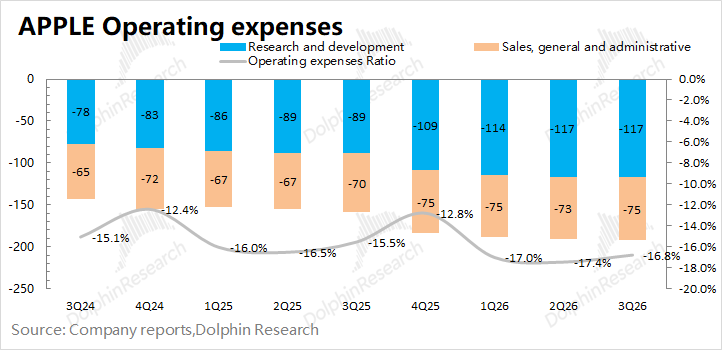
Dolphin's detailed data and charts on Apple's earnings:
- END -
// Reprint permission
This article is an original piece by Dolphin Research. Authorization is required for reprinting.
// Disclaimer and general disclosure notice
This report is intended for general consolidated data purposes only, aimed at general reading and data reference for users of Dolphin Research and its affiliates, and does not consider the specific investment objectives, investment product preferences, risk tolerance, financial situation, and special needs of any person receiving this report. Investors must consult independent professional advisors before making investments based on this report. Anyone who makes investment decisions based on the use or reference of the content or information mentioned in this report must bear the risk themselves. Dolphin Research shall not be liable for any direct or indirect liability or loss that may arise from the use of the data contained in this report. The information and data contained in this report are based on publicly available materials and are for reference only. Dolphin Research strives for but does not guarantee the reliability, accuracy, and completeness of the relevant information and data.
The information mentioned or views expressed in this report shall not be construed or deemed, under any jurisdiction, as an offer to sell securities or an invitation to buy or sell securities, nor do they constitute advice, solicitation, or recommendation regarding the relevant securities or related financial instruments. The information, tools, and materials contained in this report are not intended or meant for distribution to citizens or residents of any jurisdiction where the distribution, publication, provision, or use of the relevant information, tools, and materials would contravene applicable laws or regulations, or would cause Dolphin Research and/or its subsidiaries or affiliates to be subject to any registration or licensing requirements in that jurisdiction.
This report reflects only the personal views, opinions, and analytical methods of the relevant creators and does not represent the position of Dolphin Research and/or its affiliates.
This report is produced by Dolphin Research, and the copyright belongs solely to Dolphin Research. Without the prior written consent of Dolphin Research, no institution or individual may (i) produce, copy, reproduce, replicate, forward, or otherwise create any form of photocopy or reproduction in any way, and/or (ii) directly or indirectly redistribute or transfer it to other unauthorized persons. Dolphin Research reserves all related rights.
-
Privacy Disputes, Experience Bottlenecks, and Commercialization Confusion: Has the AI Glasses Industry Still Not Escaped the Novelty Trap?
-
Apple's Q3 Was a Warm-Up: The iPhone 18 Pro Plays It Safe While the iPhone Duo Steals the Show
-
![]()
Daoming Optics Q3 Report: Net Profit Plunges 56.54% YoY
-
![]()
$115 Billion Bet on Light Sources: Why Marvell Had to Buy
-
Farewell to Half-Baked Products: AI Apps Finally "Fly Into Ordinary Homes"
-
![]()
Quarterly Report | China's Smart Projector Sales Fell 26% in Q3 2026, Full-Year Forecast Lowered to Below 4 Million Units
-
![]()
NVIDIA, Google, and Intel Make Their Moves in Succession as Physical AI Sparks an Infrastructure Battle
-
NXP to Adjust Prices for Select Chips as Automotive Business Returns to Growth