Apple's Quarterly Net Profit Tops $30 Billion: AI Strategy Set — No Arms Race, Everything for Profit
 11/04 2026
 465
Apple wants to profit from AI, but it has no intention of burning cash on it.
On the morning of November 3, Beijing time, Apple released its fourth fiscal quarter earnings report. Under Apple's fiscal calendar, the company was actually reporting results for July–September 2026.
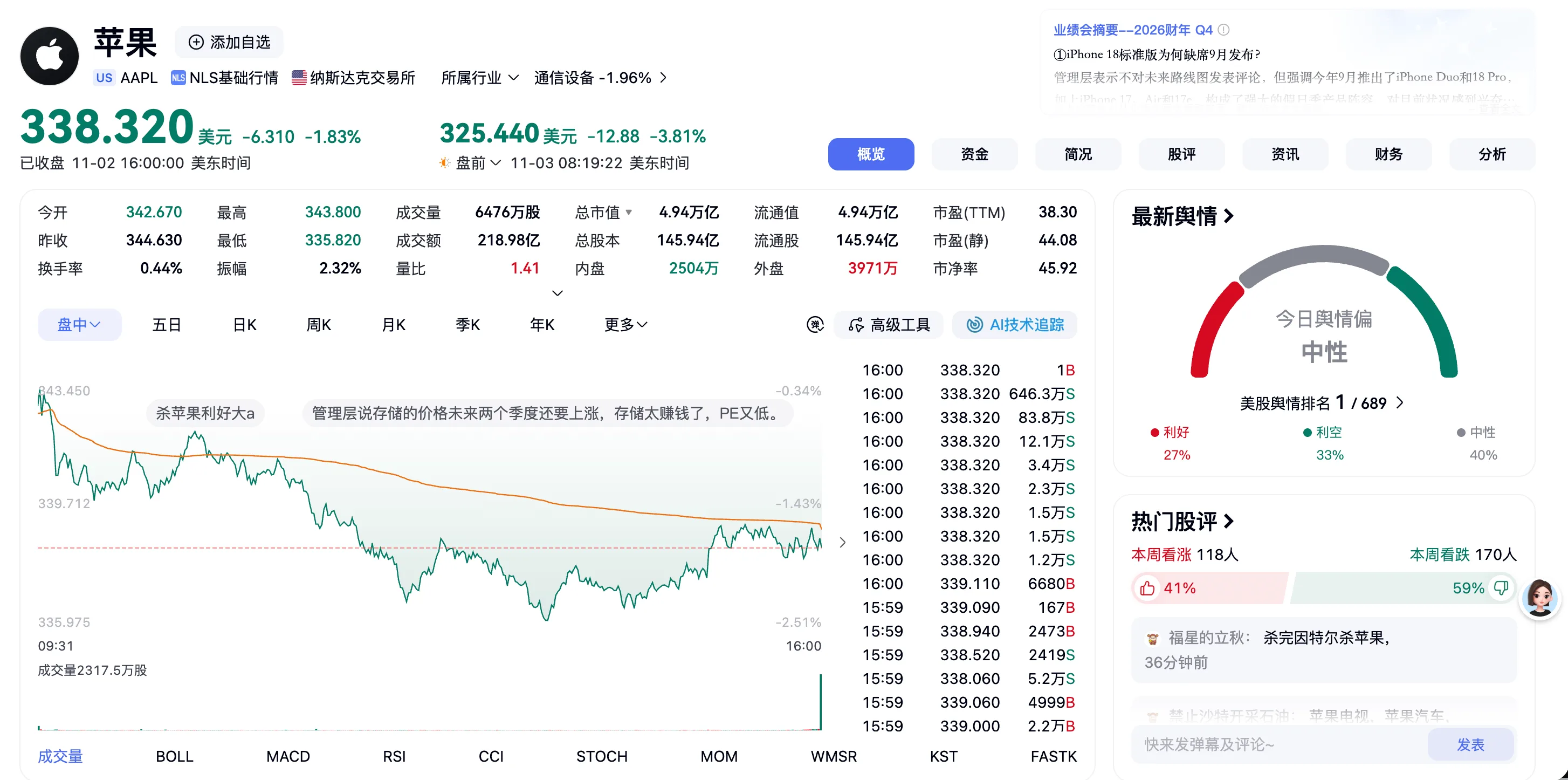
As the first earnings report since Ternus took over as CEO, the numbers were still impressive: total revenue came in at $114.48 billion, up 12% year over year, while profit reached $30.711 billion, also up 12% year over year. Meanwhile, despite headwinds such as rising memory prices, Apple's gross margin remained as high as 47.9%. Yet even after delivering what it called "the most impressive fiscal year in history," Apple's stock performance left something to be desired, falling more than 3.8% in premarket trading as of publication.
(Image source: Baidu Finance)
In Leitech's (ID: leitech) view, however, the part of this earnings report concerning the Chinese market also deserves attention. Apple's revenue in the Chinese market continued to grow this quarter, and Apple Intelligence for China is set to be fully rolled out.
China Market Revenue Surges, with iPhone Still the Biggest Contributor
Apple's earnings data show that revenue in Greater China reached $17.5 billion from July to September, up 21% year over year, making it the fastest-growing statistical region. On the earnings call, Ternus was highly satisfied with Apple's performance in the Chinese market. He attributed the revenue growth there mainly to iPhone sales, followed by Mac.
Data from third-party research firms confirm this. According to an IDC report, overall smartphone shipments in China reached 58.06 million units in Q3 this year, down 15.2% year over year, while iPhone shipments exceeded 10.33 million units, down 4.3% year over year. Although Apple's phone sales were lower than in the same period last year, the decline was far smaller than that of the overall market, and its market share actually rose from 15.8% to 17.8%.
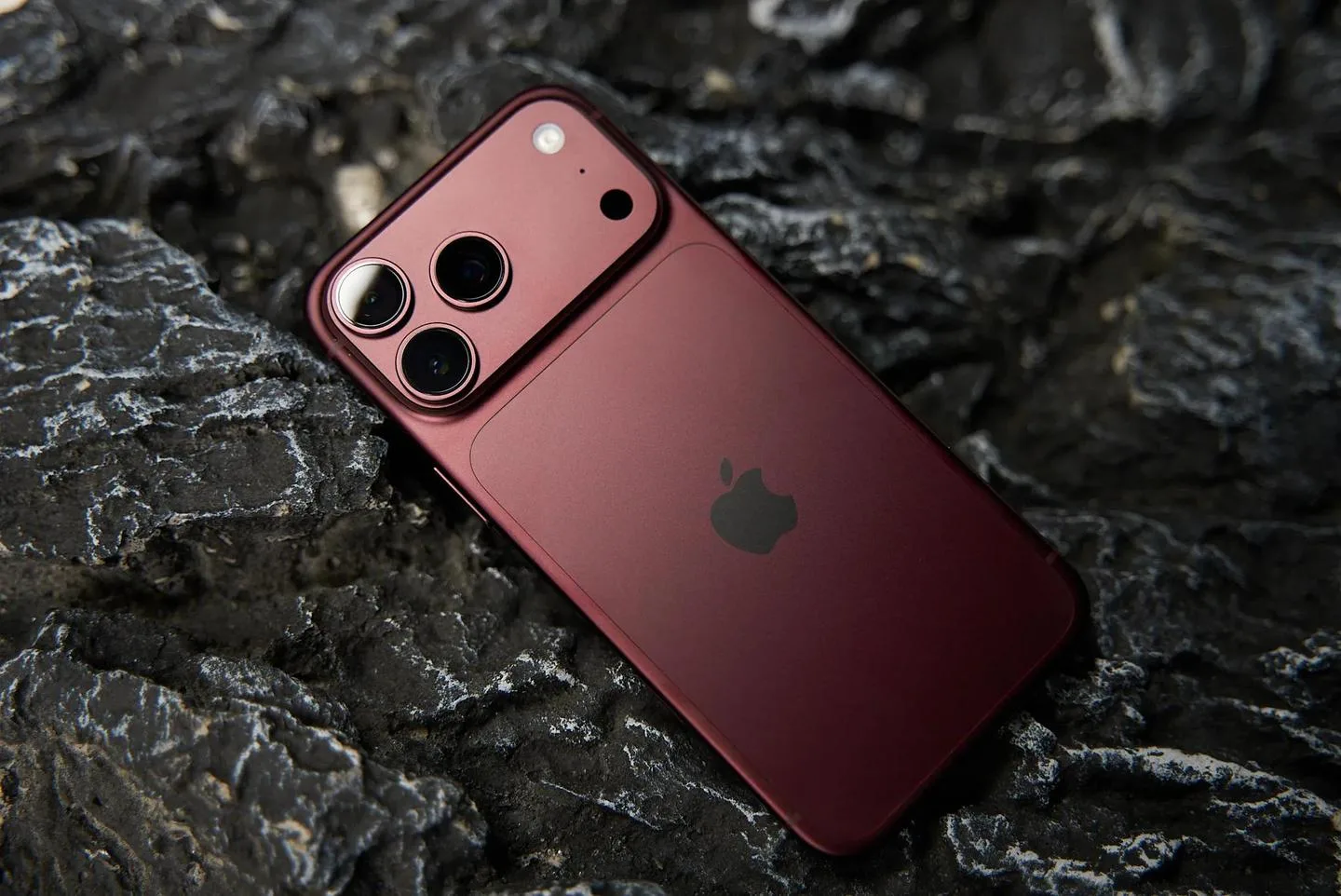
It is also worth noting that the new iPhone models released in September this year were only the iPhone 18 Pro and iPhone 18 Pro Max. The absence of the standard version weighed on Apple's autumn phone shipments to some extent. However, thanks to the higher proportion of high-end models, iPhone sales still drove Apple's revenue growth.
(Image source: Leitech)
On the PC side, Apple released multiple new Mac products this year, including the new Mac mini, new Mac Studio, MacBook Neo, and MacBook Air (M5 version), forming a relatively complete product matrix spanning multiple price segments. Among them, the MacBook Neo is itself a newly emerged product category positioned for the entry-level market. After memory price increases pushed up PC prices this year, the cost-effectiveness of the affordable MacBook Neo became even more pronounced, and it achieved solid sales.
The rise of agent tools represented by "Lobster" since the beginning of the year has given Mac sales a major boost. Although Apple has not done much in the AI PC space, the Mac's unified memory architecture, low power consumption, and high stability make it naturally better suited as a carrier for Claw tools. In this way, Apple, which missed the AI wave, benefited from it in another form.
Still, Apple's long-standing lag in the AI field will ultimately take a toll on sales of its hardware devices. After all, in 2026, AI phones, AI PCs, and even agent phones and agent PCs are gradually becoming the norm. In the Chinese market, Apple Intelligence for China has long failed to launch, leaving the iPhone and Mac with persistent competitive weaknesses.
Now, however, with the AI partnership between Apple and Alibaba finally bearing fruit, the problem has at last been solved.
Joining Forces with Qwen: Apple Intelligence for China Fully Rolled Out
Over the past two years, China-market iPhones have been a blank spot for the global version of Apple Intelligence. Due to compliance requirements, the overseas version of Apple Intelligence cannot be used on China-market devices. For Apple, the simplest and most effective solution is to partner with a leading domestic AI company.
Rumors of cooperation between Apple and Alibaba in the AI field have circulated for some time. In August this year, a document titled "Use Qwen with Apple Intelligence on Mac" appeared in the Mac user guide on Apple's China website, stating that Apple Intelligence for China can integrate with Qwen. However, the document was taken down less than a day after it went online, and Apple did not officially respond.
By October 31, everything was finally settled. Apple announced that the first developer beta of iOS 27.3 would be released on November 4, enabling some Apple Intelligence features in mainland China, with the official version to roll out in December. On the same day, Alibaba officially announced that it had reached a cooperation agreement with Apple, with Qwen integrated into Apple Intelligence.
According to relevant introductions, the specific AI functions of Apple Intelligence for China are distributed across various scenarios. Users can invoke Qwen's text and image understanding and content generation capabilities through three entry points: Siri, Writing Tools, and Visual Intelligence. Other core AI features enabled in the first batch include real-time translation and the Clean Up tool in the Photos app.

(Image source: Apple)
Alibaba's announcement indicates that Apple Intelligence for China is intended for China-market iPhones and "users whose device location and Apple Account country/region are both set to mainland China." That is, in addition to China-market iPhones, overseas-version iPhones also have a chance to use the China AI, but they need to sign in with a China region ID and use the device in the mainland.
In addition, regarding the privacy and security issues that everyone cares about, Apple and Alibaba have provided further explanations. Specifically, Apple users can independently choose whether to bind their Qwen accounts. At the same time, all data must obtain user permission before being transmitted externally. More importantly, users' instructions to Qwen, conversations between the two parties, and AI-generated content will not be stored by Alibaba or used for subsequent model training.
From this perspective, the AI cooperation model between Apple and Alibaba is quite similar to that between Apple and Google. Simply put, Apple devices will not connect directly to these AI giants' cloud models. Apple will purchase their model technology outright and then build cloud services on its own servers based on it. In this way, it can obtain advanced AI capabilities while ensuring the security of private data.
For Alibaba Qwen, this cooperation is a victory at both the technical and commercial levels. In addition to standalone apps and API calls, its large model has now entered the system-level entry point of the world's number one brand's phone terminals. For Apple, by choosing Alibaba—which has localized computing power, ecosystem resources, and compliance experience—as a partner, it can fill the AI shortcomings of China-market devices in a very short time while ensuring the overall product experience and market competitiveness.
Apple AI Is Not Joining the Arms Race; It Only Wants to Make Money
Since Apple announced its entry into the AI field, there have always been reports about Apple's own large model research and development. But Apple's self-developed large model capabilities have consistently lagged, with an obvious gap compared with AI giants' models. Therefore, Apple successively reached cooperation with OpenAI, Google, and Alibaba. Given Apple's usual style, in such situations it should invest heavily to catch up and keep the initiative in its own hands. Apple previously took this attitude on issues such as chips, basebands, and systems.
When it comes to AI, however, Apple seems to have lost such strong ambition and cares more about profit.
First, Apple has not engaged in a computing power arms race and still chooses to maintain an asset-light, high-profit model.
In the current AI competition, AI giants and internet majors have spent massive amounts of money on AI infrastructure, with annual GPU spending often reaching tens of billions of dollars. Apple has no such plan. Its self-developed AI focuses more on the device side. The neural engine computing power of A-series and M-series chips increases with each iteration, and high-frequency tasks that do not require much computing power—such as text summarization, photo cleanup, and real-time translation—are basically completed locally offline.
Of course, for generative tasks requiring large computing power, Apple will also solve them through cloud models. But as mentioned earlier, Apple directly purchases AI giants' technical solutions, and its own investment is basically just maintaining server operations. At present, Apple still holds more than $100 billion in cash flow, and its AI investment is far behind companies such as Google, Amazon, Meta, and Microsoft.
Second, Apple is already planning how to make money through AI features.
On the earnings call, the AI monetization model expressed by Ternus is very simple and direct: AI features on devices such as iPhone are offered to users for free as a basic version, and those who want more quota and stronger features have to pay. Judging from the information Apple has disclosed so far, Apple's AI paid projects will be integrated into the existing subscription model and may be merged with iCloud+.
Services including iCloud, Apple Music, and App Store commissions have always been Apple's high-profit cash cows. The Q4 earnings report shows that in the past quarter, Apple's services revenue reached $31.57 billion, up 9.8% year over year, with growth already slowing compared with previous years. If the AI payment path can be successfully established, Apple's services revenue can be further expanded while also covering part of Apple's AI investment costs.

(Image source: Apple)
In addition, Apple's AI features will certainly not be limited to iPhone and will comprehensively cover almost all hardware devices.
Before becoming CEO, Ternus worked in the hardware department for a long time and led the development of multiple products. Compared with Cook, Ternus has shown a more aggressive hardware route since taking the helm. This year, Apple "revived" multiple product lines that had been dormant for years, including HomePod, Apple TV, and iPad mini, while also bringing new products such as HomeView and touchscreen MacBook.
Apple has updated multiple products largely to give them the hardware foundation for accessing Apple Intelligence. The earliest models supporting AI features are the iPhone 15 Pro released in 2023, and there is still a considerable installed base of older iPhones that cannot access Apple Intelligence. Apple is expanding its hardware matrix and connecting more devices beyond phones to Apple Intelligence, especially Siri AI. In addition to consolidating ecosystem advantages and improving experience, it is probably also intended to lay the foundation for AI monetization.
Overall, this earnings report delivered by Ternus is enough to prove that Apple still has terrifying money-making ability after Cook stepped down. In Leitech's (ID: leitech) view, Apple's strategy in the AI era is already very clear: it neither wants to be drawn into cloud computing power arms races often involving tens of billions of dollars, nor intends to stubbornly pursue self-developed large models. Instead, it fills the AI experience gap through an asset-light model by joining hands with Alibaba Qwen in China and partnering with OpenAI and Google overseas.
Frankly speaking, this approach is very consistent with Apple's long-standing profit-maximization strategy. Whether launching new-form hardware such as HomeView or trying to integrate advanced AI features into iCloud subscriptions for monetization, both show that Apple is trying to use its huge hardware ecosystem to build an AI money tree.
Amid this wave of memory price increases brought by AI, Apple can still maintain an exaggerated gross margin of nearly 48%, which is enough to show the dominance of its brand and products. However, as the AI wave impacts countless industries today, Apple is still unwilling to place heavy bets on AI and remains conservative overall. Although this can protect its currently impressive financial performance, it also means giving up the possibility of leading the AI phone industry in the future.
Source: Leitech
Images in this article are from: 123RF licensed image library Source: Leitech
-
Capturing Over Half of the AI Server ODM Market: Foxconn Industrial Internet's Stellar Performance, But Can It Shed the Contract Manufacturer Label?
-
Embarrassing: Apple Paid an Extra 16.7 Billion Yuan in "Memory Tax" This Quarter!
-
![]()
Musk and Gates's Feud Escalates!
-
![]()
ZTE Rumored to Sell Phone Business at 40 Billion Yuan Valuation, with a Major Internet Company Set to Take Over? Official Response Arrives
-
![]()
Prompt Engineering in Practice: Giving Six AI Characters Distinct Speaking Styles
-
![]()
Xingyu Co., Ltd.'s Q3 Net Profit Falls Nearly 40%: Chinese Automotive Lighting Has Won on Styling, but the Profits Are Gone
-
![]()
More like twins: the growth paths of these two automakers are strikingly similar
-
![]()
Chinese Automakers Go Global: Entering the "Export Quota Competition" Phase