Xingyu Co., Ltd.'s Q3 Net Profit Falls Nearly 40%: Chinese Automotive Lighting Has Won on Styling, but the Profits Are Gone
 11/04 2026
 566
Intelligent automotive lighting represents a breakthrough by Chinese automakers in automotive exterior design. Headlights can now project images, avoid oncoming vehicles, display welcome patterns, and even communicate with pedestrians through lighting.
Automotive lighting has become one of the tech features most easily perceived by consumers, but the suppliers behind it are beginning to feel the pressure.
Xingyu Co., Ltd., a domestic leader in automotive lighting, reported Q3 2026 revenue of 3.610 billion yuan, down 8.67% year on year; net profit attributable to shareholders of 262 million yuan, down 39.62% year on year; and net profit after deducting non-recurring gains and losses of 231 million yuan, down 45.86%.
In the first three quarters, revenue was 10.494 billion yuan and net profit attributable to shareholders was 932 million yuan, both declining, while R&D expenses reached 720 million yuan, up about 12.4% year on year.
As vehicle styling and lighting functions continue to upgrade, suppliers are simultaneously bearing the brunt of price competition, rising raw material prices, R&D investment, and fluctuations in capacity utilization.
This year, Xingyu also sparked controversy by terminating labor contracts for 107 newly hired graduates, which became a turning point for the company's reputation.
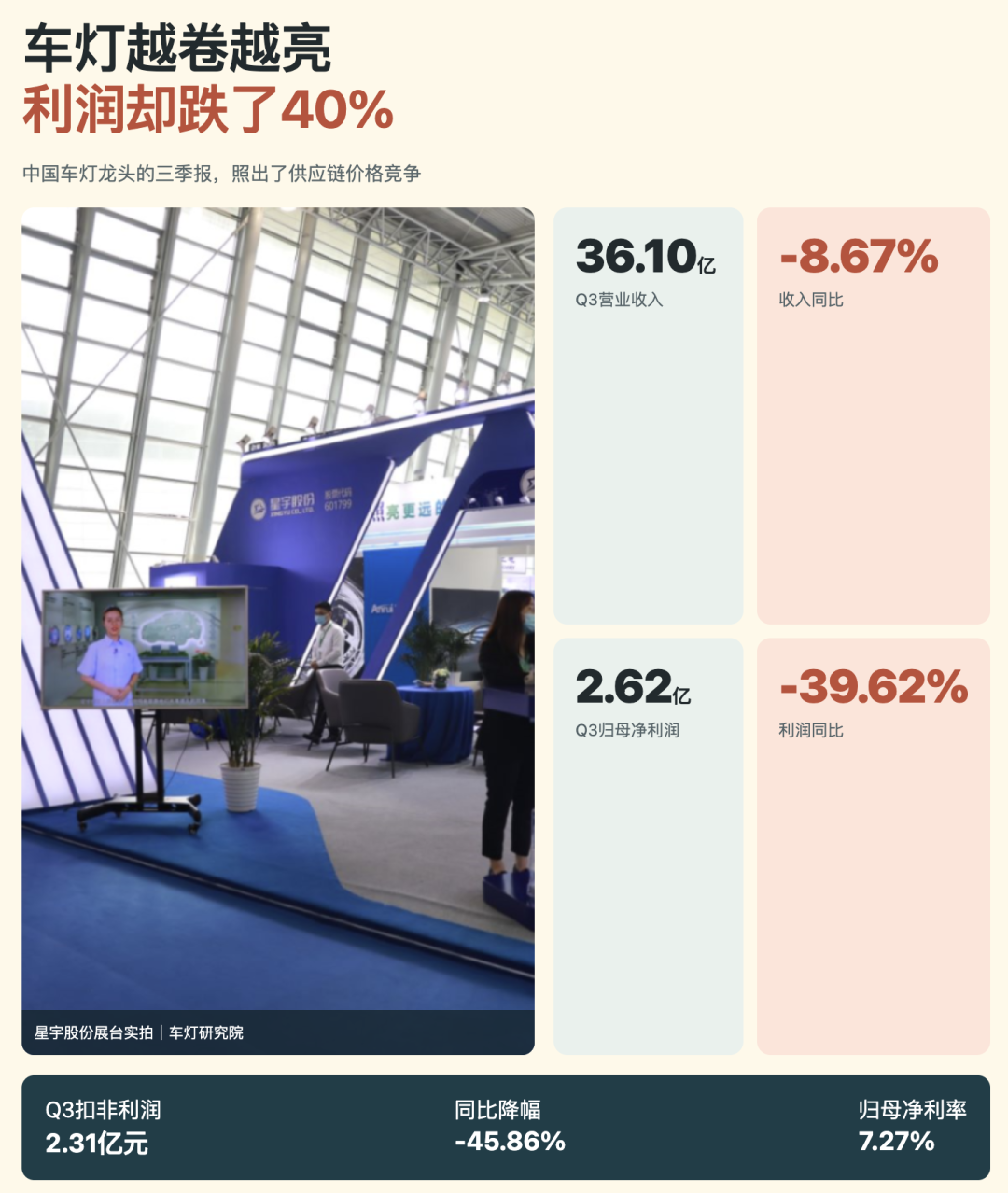
Part 1: Lamps Are Becoming More and More Complex, and Profits Are Falling Fast
Xingyu's Q3 financial report:
◎ Revenue fell 8.67% year on year, and net profit attributable to shareholders fell 39.62%. The decline in net profit was more than four times the decline in revenue, indicating a clear weakening of profit elasticity.
◎ Q3 net margin attributable to shareholders was about 7.27%. In the same period of 2025, revenue was about 3.953 billion yuan and net profit attributable to shareholders was about 435 million yuan, with a net margin of about 11.0%. Within one year, the single-quarter net margin attributable to shareholders fell by about 3.7 percentage points.
◎ The decline in net profit after deducting non-recurring gains and losses was even larger. Q3 net profit after deducting non-recurring gains and losses was 231 million yuan, down 45.86% year on year, about 31.52 million yuan less than the 262 million yuan net profit attributable to shareholders, thinning the profit buffer from core operations.
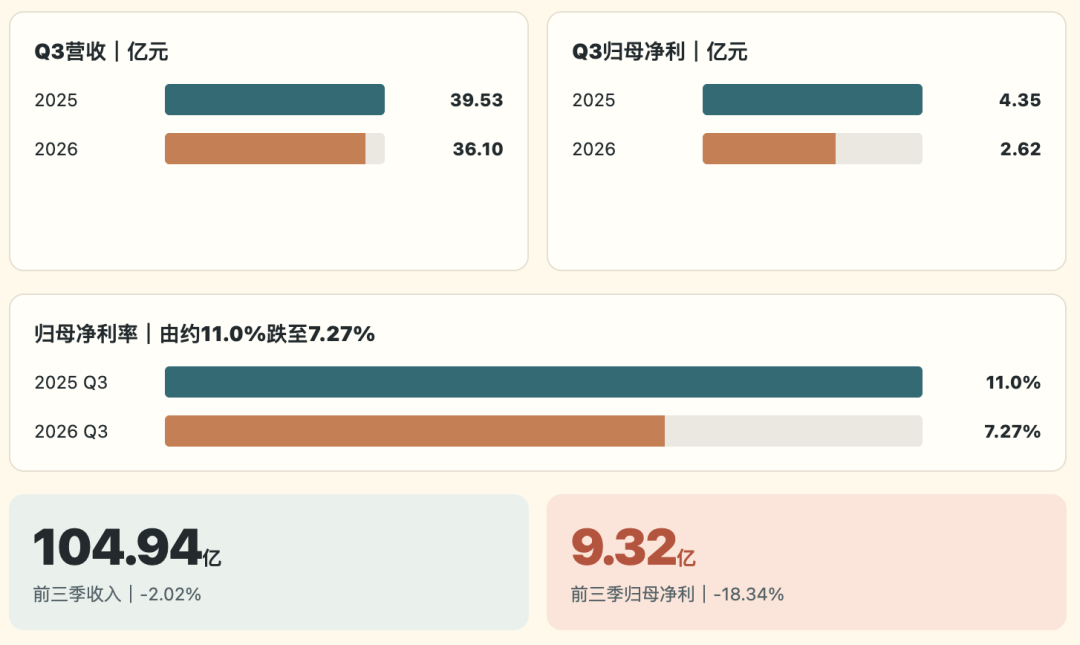
First three quarters:
◎ Revenue was 10.494 billion yuan, down 2.02% year on year;
◎ Net profit attributable to shareholders was 932 million yuan, down 18.34% year on year.
Pressure in the first half was still manageable but deepened markedly in the third quarter: subtracting Q3 from the first three quarters, first-half revenue was about 6.884 billion yuan and net profit attributable to shareholders was about 669 million yuan. Q3 revenue of 3.610 billion yuan failed to lift the full-year revenue curve.
Xingyu's explanation is that prices of some raw materials rose significantly year on year and R&D expenses increased. With these three factors combined, sales volume, unit costs, and upfront investment are all squeezing profits.
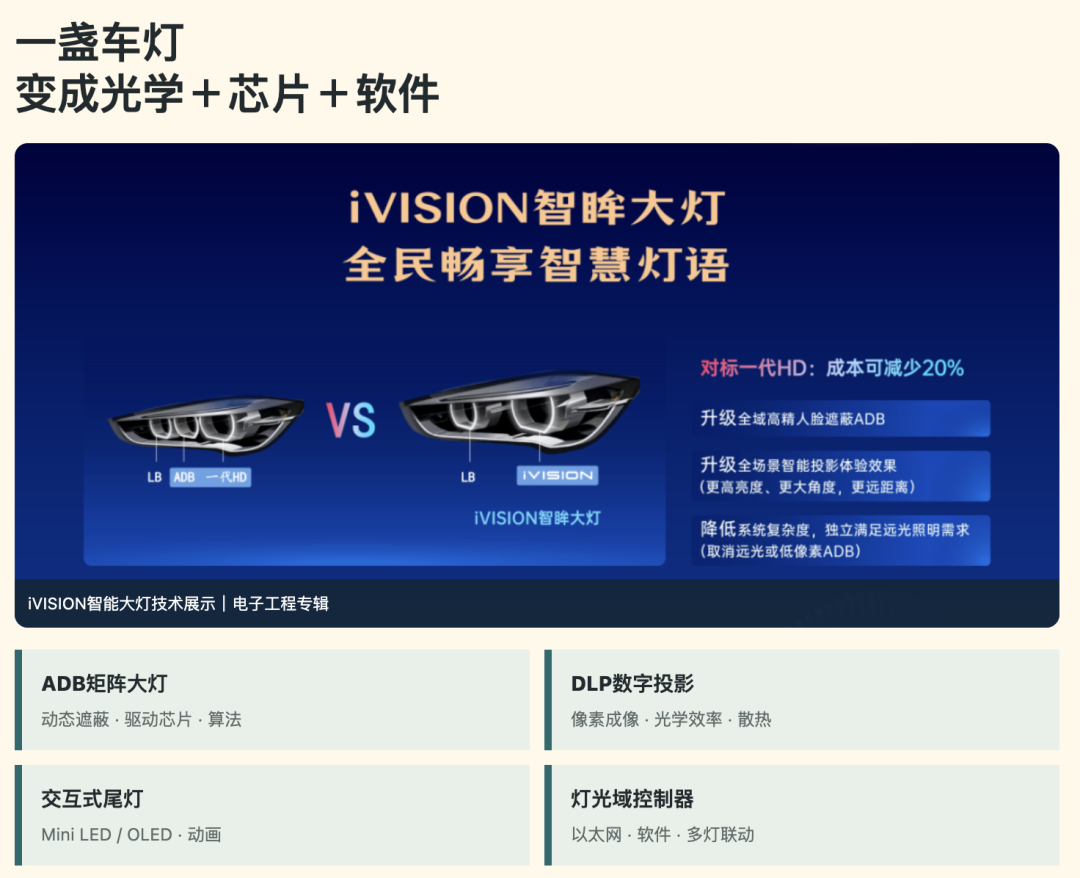
Ten years ago, the most important indicators for a set of automotive lights were illumination, reliability, styling, and cost.
Now, when automakers launch new cars, lighting often appears on the first screen of intelligent selling points: full-width light strips, matrix ADB, megapixel DLP projection, interactive taillights, dynamic welcome light animations, and even complete lighting domain controllers.
Products listed on Xingyu's official website already cover smart headlights, display lighting, grille lights, DLP digital projection, ADB, self-developed digital headlight controllers, and lighting domain controllers.
The smart lighting system of the AITO M9 is a representative case. Xingyu has publicly stated that it participated in the design and development of the front and rear lights and lighting controllers, and worked with partners to advance projection solutions.
As intelligent functions move down from high-end models to cars priced at 200,000 yuan, 150,000 yuan, or even lower, suppliers must break down technologies originally from high-end cars into modules that can be mass-produced, cost-reduced, and reused.
The cost structure is also changing: traditional automotive lights rely on plastic parts, reflectors, lenses, light sources, and structural components, while intelligent automotive lights add LED drivers, control chips, sensor communications, software algorithms, thermal management, and precision optics.
The more functions there are, the more complex engineering validation becomes, and the longer the bill of materials.
Suppliers also have to develop unique light animations, styling, and mounting structures for different brands, and economies of scale are often offset by customization.
What consumers see are larger full-width lights, finer pixels, and richer animations; what suppliers face are more development projects, shorter launch cycles, and stricter annual cost-reduction targets.
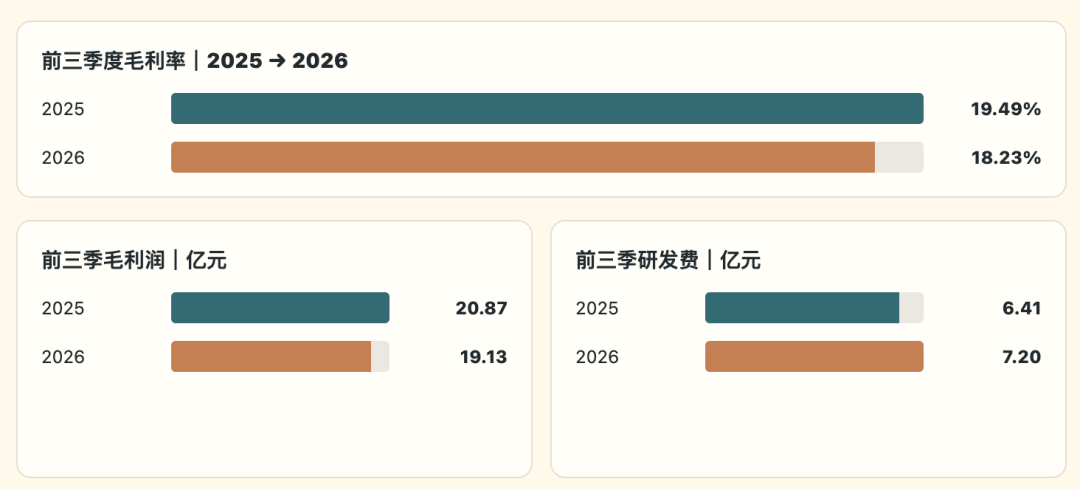
In the first three quarters, operating revenue decreased by about 216 million yuan year on year, while operating costs decreased by only about 42 million yuan.
In the first three quarters of 2026, operating costs were 8.580 billion yuan and gross profit was about 1.913 billion yuan; in the same period of 2025, operating costs were 8.623 billion yuan and gross profit was about 2.087 billion yuan. Gross profit fell by about 174 million yuan year on year. Gross margin dropped from about 19.49% to 18.23%, down about 1.26 percentage points.
In the first three quarters, R&D expenses increased from 641 million yuan to 720 million yuan, an increase of about 79.16 million yuan, or about 12.4%. The R&D expense ratio rose from about 5.98% to 6.86%, equivalent to about 77% of net profit attributable to shareholders in the first three quarters.
ADB must solve the speed and precision of dynamic masking, DLP must solve optical efficiency, pixel projection, heat dissipation, and durability, and interactive lights must solve software control, communications, and functional safety. Every technological upgrade requires new hardware platforms, testing equipment, and algorithm engineers.
Automotive lighting projects span multiple years from nomination, R&D, mold development, trial production, and validation to SOP mass production. Revenue has not yet been released on a large scale, while R&D expenses have already entered the income statement; after a project enters mass production, if an automaker's sales fall short of expectations, the development and fixed manufacturing costs allocated to each set of lights will rise further.
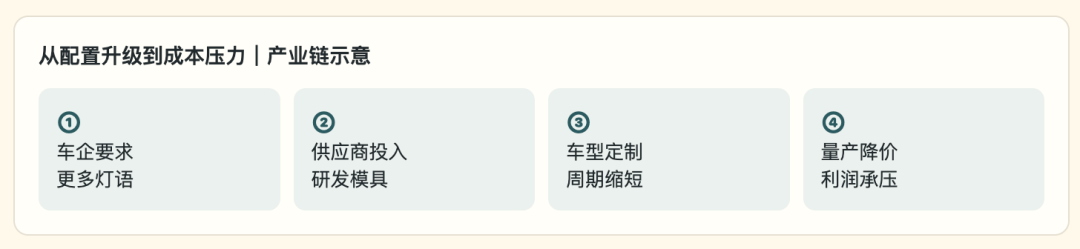
Automotive lights contain electronic components, plastic resins, optical materials, and metal parts. Any price increase squeezes gross margin, while contract prices from automakers cannot keep up. Under price wars, suppliers have very weak ability to pass on costs.
Part 2: How to Move On from the Graduate Incident
Xingyu's most closely watched issue this year was the concentrated termination of contracts with newly hired graduates.
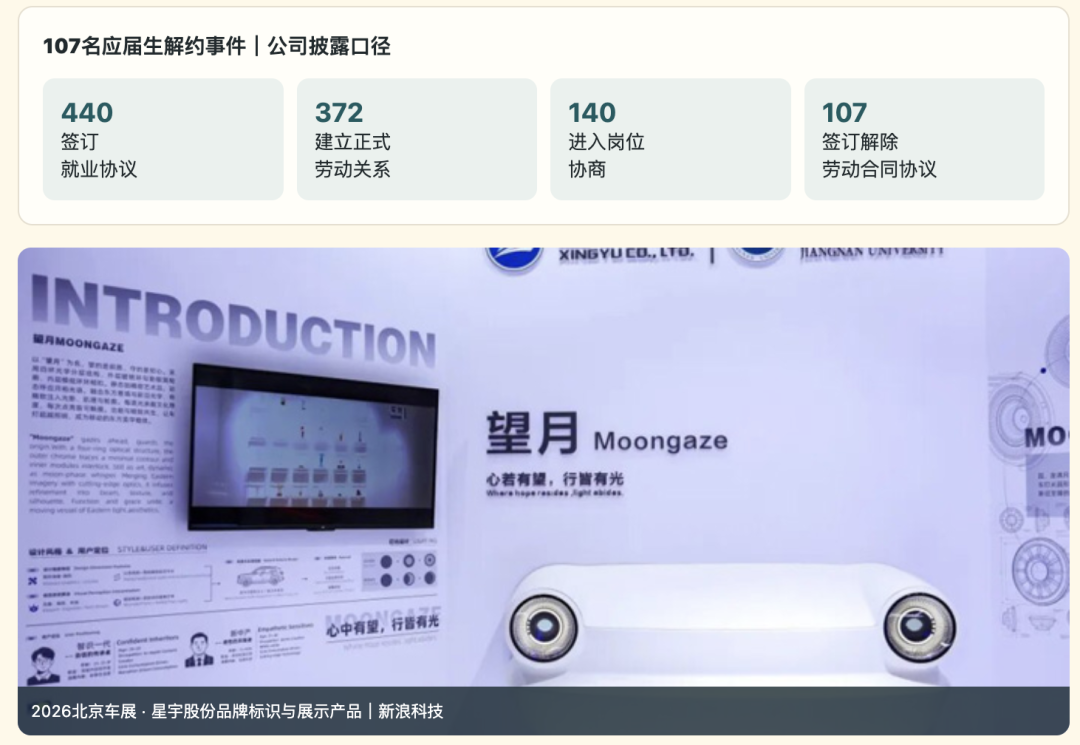
According to the company's disclosure on September 7:
◎ During the 2025 autumn recruitment and 2026 spring recruitment, Xingyu signed employment agreements with 440 graduates from the Class of 2026, of whom 372 established formal labor relations after graduation;
◎ In July 2026, management proposed a position optimization plan based on subsequent orders and labor demand;
◎ In early August, it consulted with 140 employees; 33 retained their original positions, and 107 signed labor contract termination agreements.
Xingyu subsequently acknowledged problems with the relevant decisions and announced rectification measures.
Operating pressure is not an excuse for exemption. The accounts for graduate rights, recruitment commitments, and organizational management must be calculated separately.
Manpower plans for automotive lighting suppliers are often determined half a year or even a year in advance, while the mass-production pace of vehicle projects may adjust suddenly.
Delayed launches of new models, sales of supporting models falling short of expectations, and automakers temporarily changing configurations can all change demand for production lines and engineering teams.
In the past, during rapid industry growth, advance hiring and capacity expansion had room for error; today, orders change faster and model life cycles are shorter, making forecast deviations more likely to turn into organizational conflicts.
The more technical talent is needed to support intelligent upgrading, the more finely recruitment, project forecasting, and employee rights management must be handled.
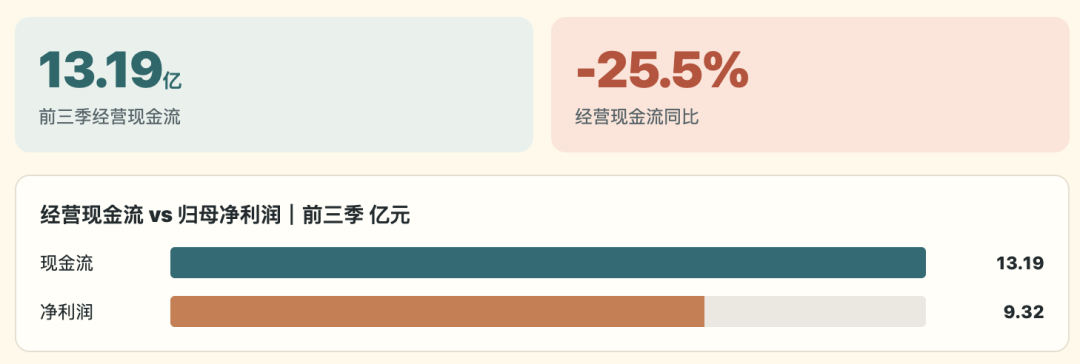
In the first three quarters, net cash flow from operating activities was 1.319 billion yuan, down 25.50% year on year, still higher than the 932 million yuan net profit attributable to shareholders in the same period.
Longer-cycle investment continues: Xingyu currently has manufacturing capacity of about 80 million automotive lights of various types per year. Public project documents in Changzhou show that the company plans to build a new intelligent automotive electronics and vision systems industrial center with total investment of about 5 billion yuan, intended to form an annual production capacity of 15 million dynamic smart interactive automotive lights.
In this round of automotive lighting competition, automakers have mainly entered the field themselves. On the one hand, they develop in-house; on the other hand, they support many suppliers to participate, turning expensive new technologies into mass-produced products with large scale and stable profitability. Competition has expanded from the lamps themselves to controllers, software, optical design, and system integration.
Conclusion
In China, any component without strong barriers will face pressure, and this result is quite normal.
-
Capturing Over Half of the AI Server ODM Market: Foxconn Industrial Internet's Stellar Performance, But Can It Shed the Contract Manufacturer Label?
-
Embarrassing: Apple Paid an Extra 16.7 Billion Yuan in "Memory Tax" This Quarter!
-
![]()
Musk and Gates's Feud Escalates!
-
![]()
ZTE Rumored to Sell Phone Business at 40 Billion Yuan Valuation, with a Major Internet Company Set to Take Over? Official Response Arrives
-
![]()
Prompt Engineering in Practice: Giving Six AI Characters Distinct Speaking Styles
-
![]()
Xingyu Co., Ltd.'s Q3 Net Profit Falls Nearly 40%: Chinese Automotive Lighting Has Won on Styling, but the Profits Are Gone
-
![]()
More like twins: the growth paths of these two automakers are strikingly similar
-
![]()
Chinese Automakers Go Global: Entering the "Export Quota Competition" Phase