China’s Premier Independent Token Factory: Secures 2.9 Billion Yuan in Funding
 09/22 2026
 441
441
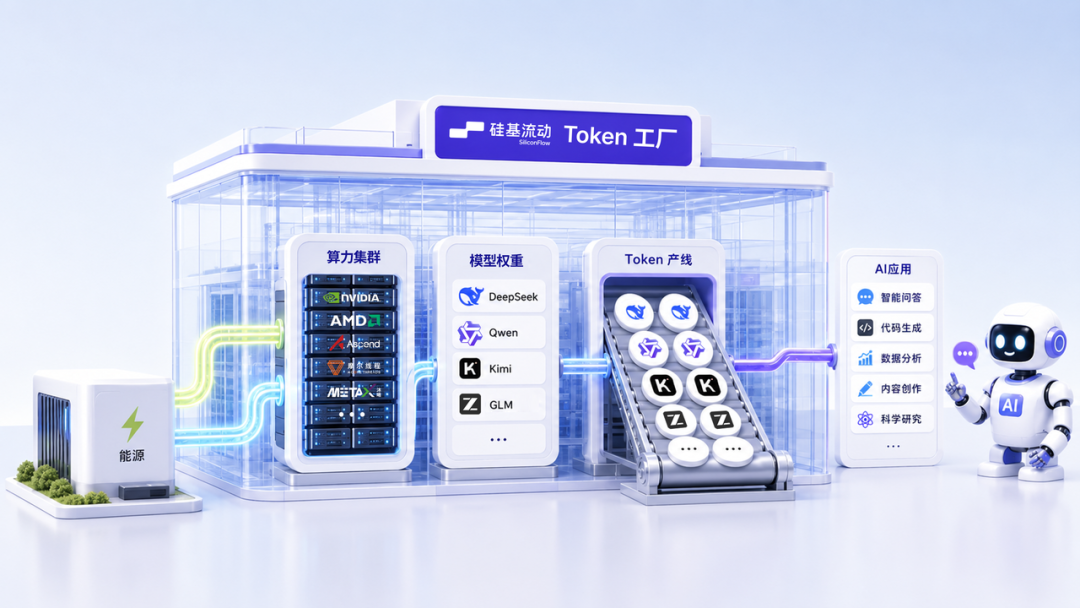
Cover Image 丨 Silicon Flow
According to Pencil News, on September 20, Silicon Flow, known as 'China’s largest independent Token supplier,' announced the completion of its Series B+ second-phase and Series C funding rounds. Including its earlier Series B round, the company’s total funding for 2026 has reached nearly 2.9 billion yuan.
This year, Tokens have emerged as the new 'hard currency' in the AI sector. In March, China’s Token consumption exceeded 140 trillion, marking an over 1,000-fold increase in just two years.
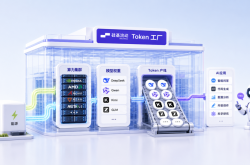
Silicon Flow’s business model involves efficiently running models from various companies on GPUs and AI chips from multiple vendors, then selling the resulting Tokens to developers and enterprises.
China now has no shortage of platforms capable of deploying large models. What Silicon Flow demonstrates is different: amid a market dominated by internet giants and cloud providers, an independent 'Token factory' can still thrive.
How did it manage to break through?
- 01 - Breaking Through in a Market Dominated by Giants
Let’s first examine the competitive landscape in which Silicon Flow operates.
According to Frost & Sullivan data, considering the entire market—including major cloud providers—Silicon Flow holds only about a 1.5% share. Leading the pack are Volcano Engine (42.7%), Alibaba Cloud (32.5%), and Baidu Intelligent Cloud (11.8%), which together account for approximately 87% of the market.
Silicon Flow stands out as the 'top independent player outside the cloud providers.' By 2025, based on annual Token throughput, it ranks as China’s largest independent ecological Token supplier and among the top five Token providers overall.
In front of it, Volcano Engine, Alibaba Cloud, and Baidu Intelligent Cloud each boast their own clouds, models, and extensive application ecosystems. Volcano Engine can bundle Doubao models, ByteDance applications, and cloud computing for sale; Alibaba Cloud leverages Tongyi, and Baidu utilizes Wenxin.
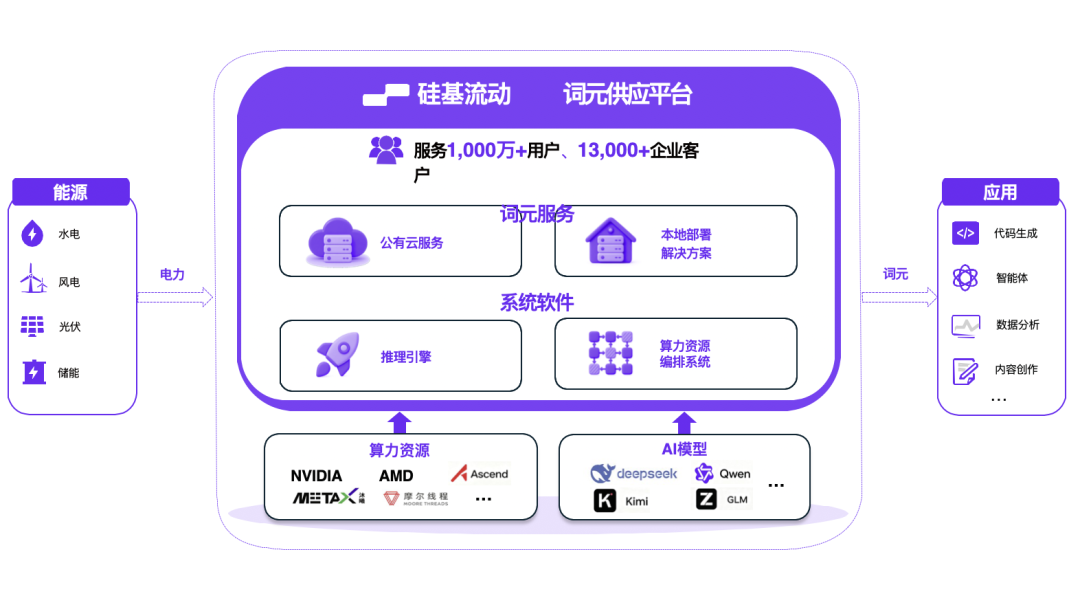
Silicon Flow lacks its own super app and does not rely on a single model. Instead, it offers choice. Using a unified interface, it aggregates over a dozen chips from NVIDIA, Huawei Ascend, Moore Threads, and others, enabling customers to access over 170 mainstream models with a single account.
Today, customers can run DeepSeek, switch to Qwen the next day, and move to GLM the following week; the underlying hardware can also transition from NVIDIA to domestic GPUs. For enterprises unwilling to fully commit their AI operations to a single major player, this flexibility is precisely why independent platforms like Silicon Flow exist.
As of June this year, Silicon Flow has served over 13,000 enterprise clients, supported over 170 mainstream AI models, and adapted to more than 10 chip models from vendors such as NVIDIA, Huawei Ascend, and Moore Threads.
Since Silicon Flow does not rely on selling chips or leasing its own computing power, it earns its revenue at the 'system software layer'—through inference engine optimization, heterogeneous computing power scheduling, and model-to-chip adaptation. These tasks are technically challenging, difficult to scale, and almost guaranteed to incur losses initially.
- 02 - Why Another Funding Round Now?
Participants in the Series B+ second-phase and Series C funding rounds include national-level funds such as the China Internet Investment Fund, Guoxin Fund, China Mobile Chain Leader Fund, and China Orient Asset Management International, along with a group of central and local state-owned assets, industrial capital, and professional institutions. Existing shareholders Glorious Capital, Shengyi Capital, and Guotai Ventures also continued to increase their investments.
This year, Token consumption has surged, transforming AI business models: inference is becoming increasingly costly.
The more widespread models become, the more Tokens resemble 'electricity' in the AI era.
This explains why Silicon Flow’s latest funding round attracted capital from China Mobile Chain Leader Fund, Jingneng Fund, and Shanghai Yidian Intelligent Computing Fund. Their behind-the-scenes resources span telecommunications networks, energy, computing centers, and industrial infrastructure.
Timing-wise, this funding round occurred less than three months after Silicon Flow submitted its Hong Kong Stock Exchange application (Chapter 18C) on June 30. Why raise such a substantial sum at this precise moment?
Because the inference era is just beginning, and Tokens are becoming a long-term, stable, and predictable necessity. When AI agents start autonomously breaking down tasks, deploying tools, and verifying results, Token consumption for a single task could be 10 times or even higher than simple Q&A interactions; when AI moves from chatbots into enterprise production workflows, Tokens become an endless consumable.
For Silicon Flow, the destination for this capital is clear: intensify R&D in core technologies like inference engines, heterogeneous computing power scheduling, and model-to-chip adaptation; strengthen Token supply platform construction; and accelerate overseas market expansion.
Every dollar is aimed at the same goal—increasing Token throughput while driving down unit costs, transforming the 'factory' from scale to profitability.
- 03 - Token Factories: Profitability Remains Elusive
Surging Token volumes do not immediately translate to profitability for Token sellers. Dreams aside, the numbers must add up.
Public data shows Silicon Flow generated 55.33 million yuan in revenue in 2025, a 653% year-over-year increase, with commercial growth visibly accelerating.
However, net losses reached 345 million yuan during the same period, with a gross margin of -24%. Computing power was the heaviest burden—costs reached approximately 59.63 million yuan in 2025, accounting for nearly 87% of sales costs.
The main issue lies in the public cloud business, which most closely resembles a 'Token factory.' In 2025, Silicon Flow’s public cloud revenue hit 29.26 million yuan, accounting for 52.9% of company revenue and surpassing on-premises deployment for the first time; yet, this segment’s gross margin reached -119% that year.
The more the business expands, the greater the upfront investment required. 'Increasing revenue without increasing profits' is an unavoidable reality in this sector.
This highlights an industry-wide paradox: Token unit prices are plummeting, yet total demand has surged a thousandfold. This mirrors the 'Jevons Paradox' from economics—when 19th-century steam engine efficiency improved, coal consumption was expected to decline but instead skyrocketed.
The Token market is reliving this scenario, only faster. Whether suppliers can achieve profitability through massive scale amid falling unit prices is a life-or-death question for every player.
For Silicon Flow, three hurdles remain: first, driving unit costs low enough—a long-term refinement of inference engines and scheduling capabilities;
second, building customer loyalty—without giant ecosystem support, independent platforms must retain clients through products and pricing;
third, making overseas markets a second growth engine—while competing with cloud providers domestically, going global is its escape from close-quarters combat.
Entering 2026, growth in coding, AI agents, and enterprise production workloads has accelerated serverless Tokens, dedicated instances, and on-premises deployments. Silicon Flow claims that with client structure optimization, Token scale expansion, and computing utilization improvements, its revenue mix and gross margin performance are improving.
Judging by this financing, Silicon Flow has received signals that its strategic direction is validated. From an industry perspective, this nearly 2.9 billion yuan funding round signifies that beyond 'who controls models' and 'who controls chips,' 'who efficiently produces Tokens' is emerging as a new narrative embraced by capital.
With China’s daily Token consumption at 140 trillion and still rising, after the model wars, a battle over 'who can produce Tokens more cheaply' has begun.
This article does not constitute any investment advice.
-
RSI: How Much Valuation Can It Support for Zhipu?
-
Young People Are Secretly Enjoying 4399 Game Suite on Xiaohongshu
-
![]()
China’s Premier Independent Token Factory: Secures 2.9 Billion Yuan in Funding
-
FAW and GAC Toyota: Collaborating Without Full Merger?
-
Honor Expands Partnership with Alibaba: Who Will Lead the AI Smartphone Revolution?
-
![]()
Yunqi Conference Heralds Computing Power Growth: Alibaba Cloud’s Data Center Capacity to Surpass 20GW by 2032, T-Head Reveals AI Chip Zhenwu V900
-
![]()
Singapore Hardware Veteran Creates an AI Golf Personal Trainer
-
![]()
Data Integration Throughout the Production Chain! Haomi Optics Initiates MES and ERP System Upgrade Project