Sales Plummet, Auto Industry Titans Slash Jobs! Are Gasoline Cars Doomed?
 09/10 2026
 549
549
Author | Guanchejun
New energy vehicles are taking the lead!
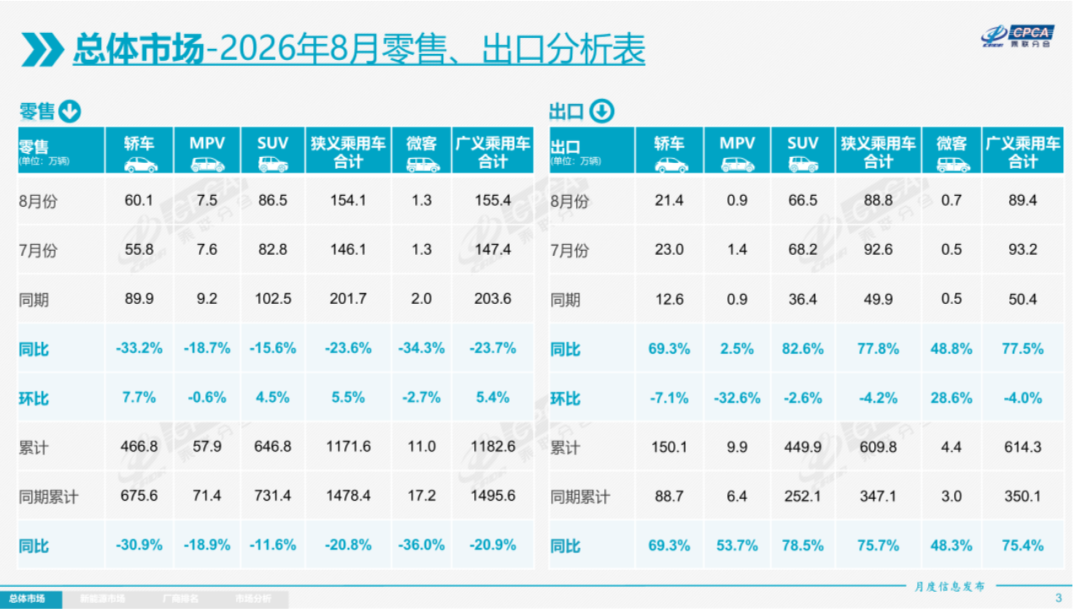
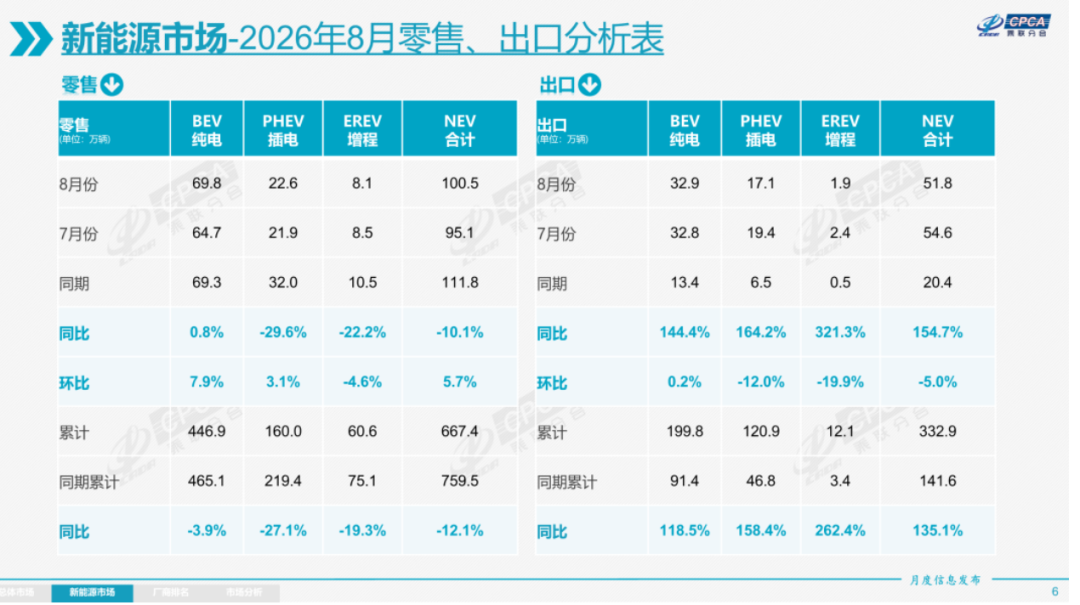
On September 8, a set of data released by the China Passenger Car Association (CPCA) sparked widespread discussion across the internet. In August 2026, retail sales of traditional gasoline-powered passenger cars in China reached 540,000 units, marking a 40% year-on-year decline and nearly halving compared to the previous year. Meanwhile, retail sales of new energy vehicles (NEVs) soared to 1.005 million units, with the market penetration rate climbing to 65.2%, setting a new record high.
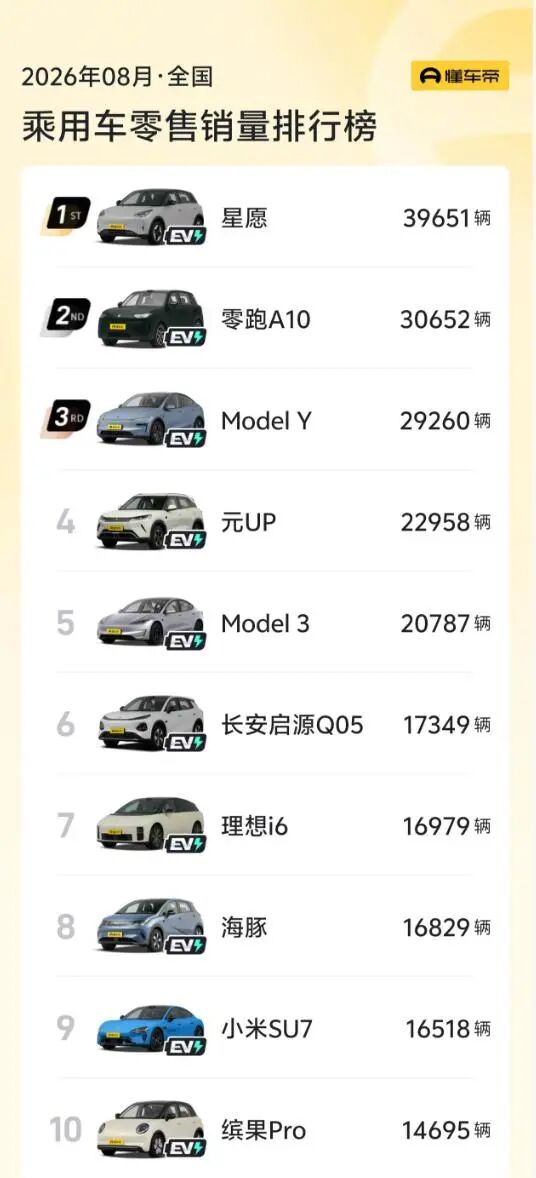
Notably, all top ten models in passenger vehicle retail sales for August were new energy vehicles. To Guanchejun's memory, this is the second time this year that gasoline vehicles have been completely excluded from the top ten. In January, gasoline vehicles still held seven spots in the top ten, but by May they were completely absent for the first time, and again in August.
Whether domestic, joint venture, or luxury brands; whether low-end, mid-end, or high-end, no segment is immune to this wave of disruption.
01
Why have gasoline vehicles suddenly become 'hard to sell'?
Some attribute it to soaring fuel prices. By 2026, domestic gasoline prices have risen by more than 1,720 yuan per ton cumulatively.
However, in Guanchejun's view, fuel prices are merely a catalyst, not the root cause. The plight of gasoline vehicles stems from their own declining competitiveness.
First, there is a product gap. Domestic new energy companies generally maintain a rapid iteration pace, with facelifts every year and model replacements every three years. In contrast, gasoline vehicles have seen no substantial technological breakthroughs in their main models for years, with intelligence and connectivity levels falling increasingly behind those of new energy vehicles.
Second, there are shifts in consumer psychology. In the current environment, the weight of operating costs in consumers' vehicle purchase decisions has risen. New energy vehicles hold a comprehensive advantage in terms of purchase tax, vehicle and vessel tax, and operating costs, leaving gasoline vehicles with only the advantage of convenient refueling.
Third, price cuts have been ineffective. Gasoline vehicles have not been without their struggles. Since the beginning of this year, major gasoline vehicle companies have launched large-scale price cuts and promotions, but the effects seem limited.
China's former top auto dealer, Grand Auto, once had nearly 700 4S dealerships and a market value exceeding 100 billion yuan at its peak. By March 2026, Grand Auto had completely terminated its new vehicle sales business, with nearly all 700 4S dealerships withdrawing from the network, retaining only a small number of after-sales maintenance outlets.
02
Against this backdrop, traditional automotive giants have also been unable to escape unscathed. From China to the global stage, a wave of layoffs has swept through.
Not long ago, Guanchejun noted that Volkswagen Group has initiated the largest-scale restructuring in the automotive industry's history: planning to cut up to 100,000 jobs globally, while also planning to gradually halt complete vehicle production at four German factories between 2031 and 2034.
BMW has finalized plans to lay off 7,700 employees globally by the end of the year, accounting for 5% of its total workforce, while significantly downgrading its profit forecast. Management admitted that weakness in the Chinese and Asia-Pacific markets is the core reason for the profit pressure.
Mercedes-Benz has been continuously streamlining its workforce since 2025, with its latest cost-cutting plan proposing to cancel annual special bonuses for 90,000 German employees. In the Chinese market, Beijing Mercedes-Benz Sales Service Co., Ltd. is pushing forward with a second round of structural staff optimization, planning to reduce its workforce from about 900 to fewer than 600.
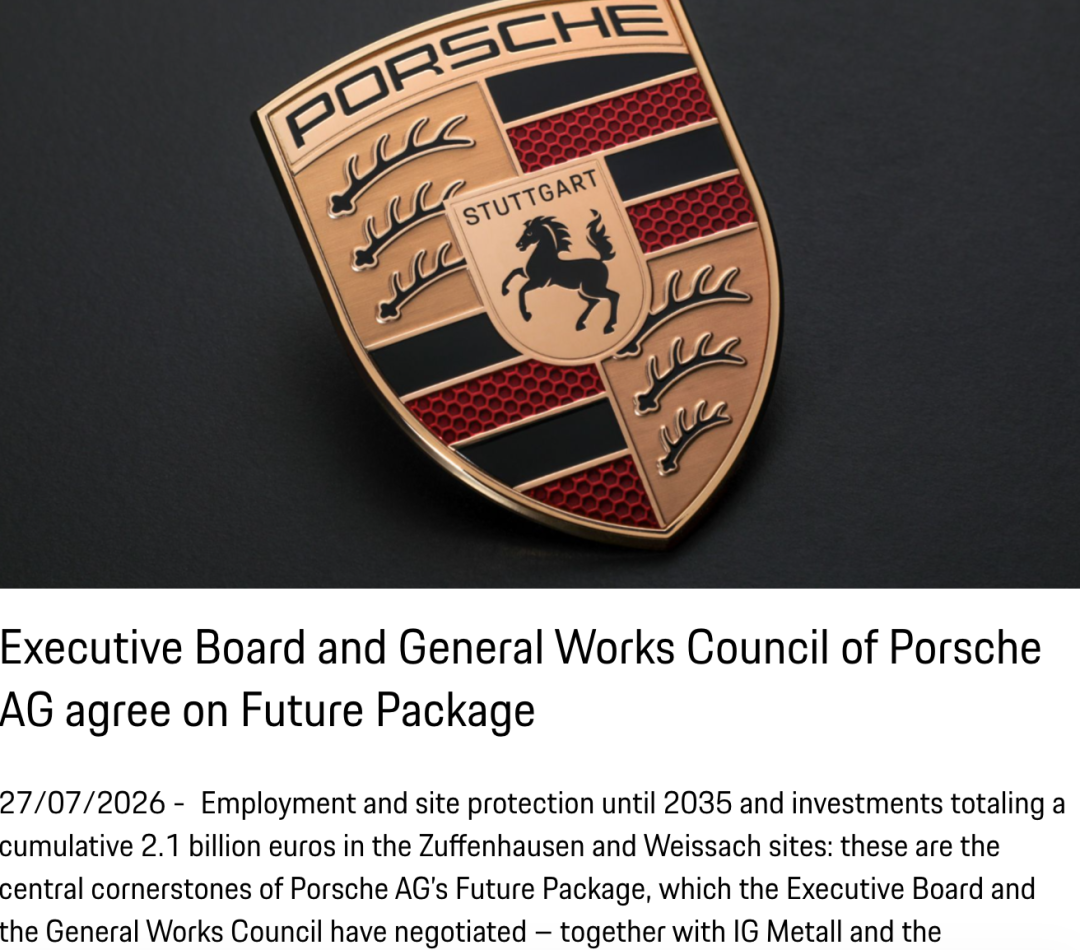
Porsche was reported in July to be considering laying off another 4,000 employees, later officially confirming plans to cut 5,000 more jobs by 2035.
Nissan has implemented its global 'Re:Nissan' restructuring, closing seven factories and laying off 20,000 employees. Jaguar Land Rover has confirmed plans to cut about 4,000 jobs globally over the next two years...
Yet on the other side of the picture, while traditional giants are massively laying off staff and contracting, Chinese automakers are rapidly expanding globally.
To Guanchejun's memory, Chery has completed the acquisition and takeover of Nissan's South African factory, while also signing a memorandum of intent for contract manufacturing at a UK factory, ramping up localized manufacturing in Africa and Europe.
BYD and Great Wall Motors have established overseas complete vehicle factories in Thailand, Brazil, and Russia through acquisitions and self-construction.
Geely, XPeng, and GAC Group are adopting asset-light models of joint ventures and contract manufacturing to enter the European and U.S. markets. As one side declines and the other rises, the global automotive industry landscape seems to be being rewritten.
03
Returning to the original question: Are gasoline vehicles truly completely unsellable?
Guanchejun's answer is: In the mainstream market, they are indeed hard to sell. A 65.2% new energy penetration rate means that for every three vehicles sold, two are new energy. Gasoline vehicles are basically being marginalized.
However, gasoline vehicles will undoubtedly retain a basic market in specific scenarios and among certain consumer groups.
For example, in scenarios such as hardcore off-roading, long-haul commercial freight, travel in extremely cold regions, and high-displacement performance and recreational use, the stability, range anxiety-free operation, and unrestricted refueling advantages of gasoline vehicles remain irreplaceable.
Additionally, in wholesale sales data (including exports), gasoline vehicles like the Geely BinYue and Chery Tiggo 7 still make the list, indicating that export markets are becoming a second front for gasoline vehicles.

Guanchejun also noticed another data point: in August, sales of conventional hybrid models still maintained a 54% year-on-year growth, the only positive growth category within the broader gasoline vehicle segment.
This perhaps suggests that consumers are not unwilling to buy fuel-powered vehicles per se, but rather those traditional pure gasoline vehicles that are fuel-inefficient, outdated in configuration, lagging in intelligence, and still selling at high prices due to brand premiums.
In conclusion, the mainstream status of new energy vehicles is beyond any doubt. Moreover, this is likely not just a simple cyclical adjustment but more akin to a seismic shift in industrial structure.
The current pain of layoffs, factory closures, and model culls is a necessary path for industrial upgrading. Brands that transform promptly and decisively streamline their operations will gain a foothold in the new track; automakers that cling to the dividends of the old era and hesitate will be thoroughly eliminated by the market.
The charts in this article, unless otherwise noted, are sourced from public disclosures across various channels. We hereby acknowledge and express our gratitude. The views expressed herein are for reference only and do not constitute investment advice.
This article is original content from Leverage Auto Observations and is prohibited from reproduction without authorization. For reproduction, please obtain authorization. Additionally, when authorized for reproduction, please also indicate the source and author at the beginning of the article. Thank you!
-
![]()
The Loss Conundrum and the High-End Wager: Xiang Xingchu Declares, 'JAC Embarks on Its Third Trailblazing Journey'
-
![]()
'Problematic Stock' Plummets for a Decade, Then Suddenly Surges to Limit Up for Two Straight Days! Is the Auto Sector Making a Resurgence?
-
Value and Cost: Validations from Anthropic and Zhipu
-
![]()
Eliminating Set-Top Boxes: A Panacea for the TV Industry’s Woes?
-
Who Defines 'AGI' Defines the Future
-
![]()
What Unfolded Following Tesla's Substantial Price Reduction?
-
![]()
4-Minute Surge: 10,000 Orders Secured for Xiaomi Pengcheng, Sparking Hot Search Trend. Lei Jun: Extended-Range Vehicles Hold Immense Promise
-
The Future Trajectory of AI Large Models