Customer Loss Drives Japanese Auto Parts Suppliers to Look Towards China
 09/10 2026
 391
391
Introduction
Introduction
For the first time, the number of Chinese companies on the global top 100 auto parts suppliers list has surpassed those from the United States and Germany.
Amid the rise of China's new energy vehicle (NEV) sector, the auto parts industry is undergoing significant transformation.
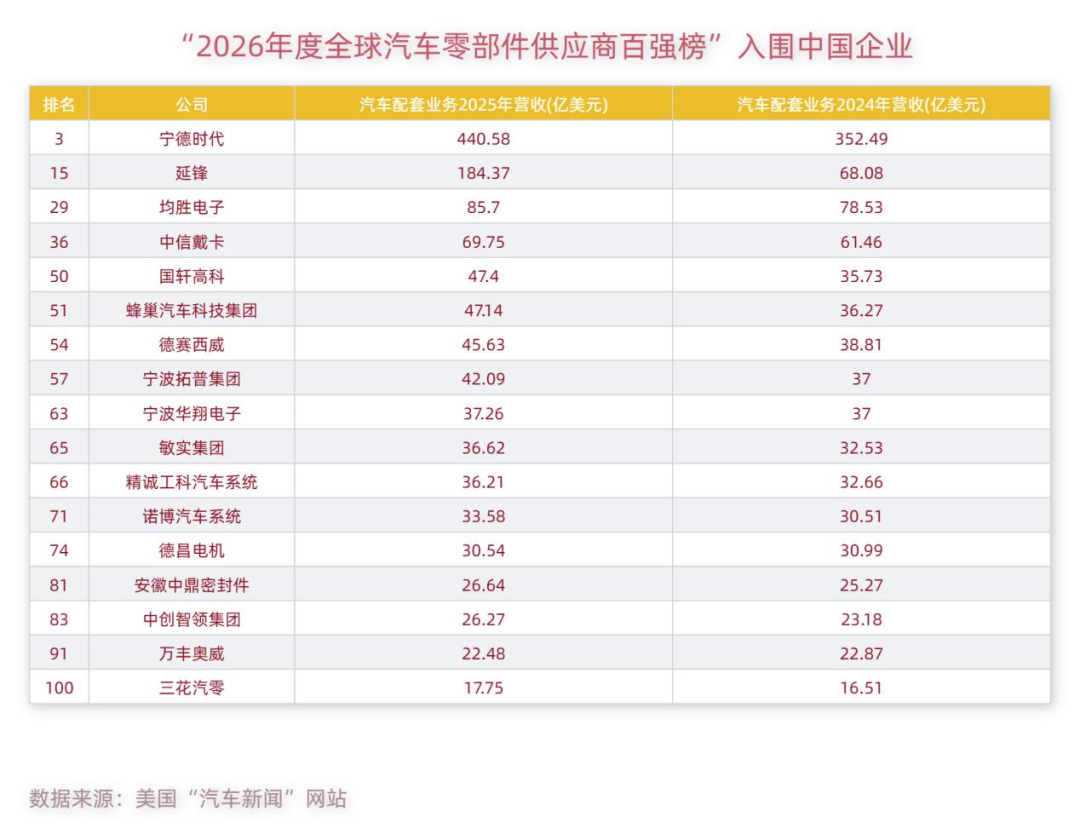
According to the latest '2026 Global Top 100 Auto Parts Suppliers' list released by Automotive News, a total of 17 Chinese parts companies made the ranking, surpassing the United States and Germany for the first time, and ranking second only to Japan.
Despite their numerical advantage, Japanese companies remain anxious. Phrases like 'operating at full capacity,' 'facing difficulties,' and 'barely holding on' were used by Japanese media to summarize statements from over 10 auto parts companies during their earnings calls, suggesting they are at a 'make-or-break' moment in China.
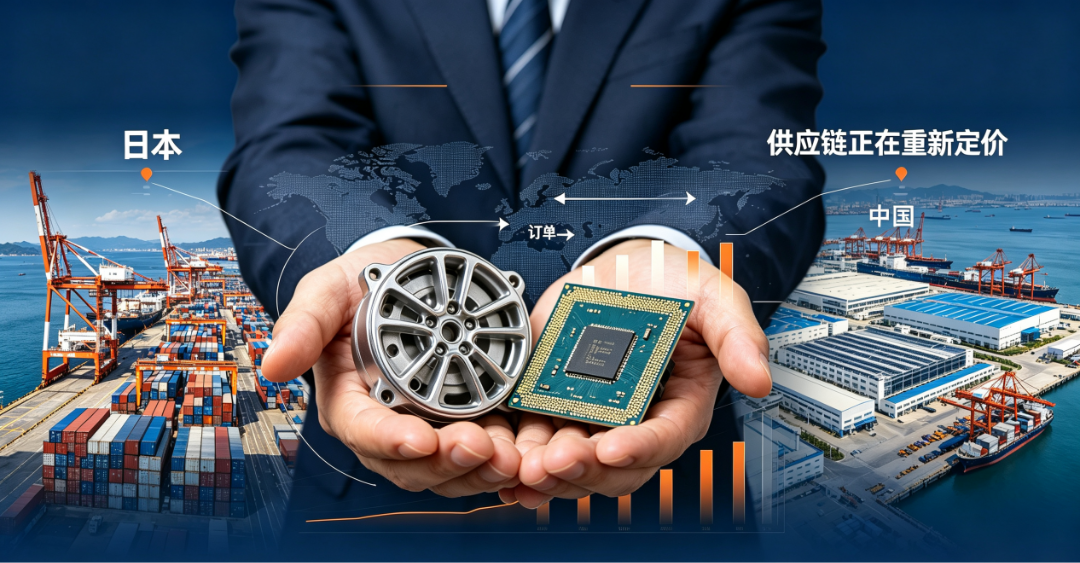
Due to the reduced number of components in NEV models and shifts in procurement strategies by Japanese automakers in China, Japanese parts suppliers are being forced to reduce their reliance on Japanese automakers and instead seek opportunities with Chinese domestic automakers.
The situation for German counterparts is equally concerning, with stagnant revenue growth persisting. A 2026 survey by the European Association of Automotive Suppliers revealed that 76% of European automotive suppliers expect profit margins to fall below 5%—the minimum required to sustain long-term R&D and industrial investment—while the remaining 24% face losses.
In contrast, Chinese suppliers are faring significantly better. Multiple listed companies on the top 100 list have seen improvements in both revenue and rankings. Through overseas factory construction, deeper integration into local supply chains, and capital-level M&A, Chinese parts companies are broadening their operational channels and accelerating global expansion.
01 Customer Loss: Japanese Suppliers Seek Opportunities in China
Japanese auto parts companies are currently under multiple pressures.
The first pressure comes from shrinking demand. NEV models require 30-40% fewer parts than fuel-powered vehicles, directly compressing the market for traditional components. Take Jatco, a transmission supplier, as an example: pure electric vehicles (EVs) generally no longer use multi-speed transmissions, with only a few exceptions like Mercedes-Benz's electric GLC. This has significantly impacted Jatco's order volume.
At the same time, long-relied-upon Japanese automaker clients are also in a downturn. Toyota's global sales reached 912,000 units in July, down 5.35% year-on-year, marking the sixth consecutive month of decline. Global production stood at 934,000 units, also beginning to trend downward year-on-year. Weak production and sales at automakers have quickly rippled up the supply chain, further tightening demand for Japanese parts.
More challenging is the declining preference of Japanese automakers for domestic suppliers. Historically, Japanese parts suppliers and Japanese brands have shared extremely close ties, with a single automaker sometimes contributing nearly 90% of a supplier's sales. For instance, J-MAX, which specializes in vehicle body frames, derived 87% of its sales from Honda in FY2014.
However, in China—the world's most aggressive NEV market—procurement strategies of Japanese automakers like Toyota and Honda are undergoing structural shifts. Toyota's China-exclusive electric model, the 'bZ3X,' significantly increased the proportion of locally sourced parts, while Honda explicitly stated it would expand procurement of 'standardized parts' developed by Chinese suppliers and validated in the market.
The chain that has long supported the stability of the Japanese supply chain is loosening, with visible cracks emerging in the cooperative relationships between Japanese parts suppliers and automakers.
Beyond reduced orders from existing Japanese clients, Japanese suppliers have also struggled to expand their Chinese customer base. 'The Chinese market is declining. Besides Japanese companies, foreign automakers are also facing difficulties. Chinese automakers have achieved leapfrog development. How to develop Chinese customers in the future is an operational challenge for us,' admitted Yasushi Matsui, Vice President of Denso, when discussing operational difficulties.
TS TECH, a major Japanese automotive seat supplier that once derived 90% of its revenue from Honda, is now turning its attention to GAC Group and Changan Mazda. The company's president even suggested that through Changan Mazda, they could potentially extend supply to its parent company, Changan Automobile Group. This indicates that Japanese suppliers are beginning to attempt 'piggybacking' on joint venture partners to penetrate China's independent brand ecosystem.
Even as Japanese suppliers proactively pivot, the road ahead is not smooth. They face Chinese domestic parts manufacturers who are seizing market share with faster development cycles, more efficient supply chain responses, and the geographical advantage of operating on home turf. Chinese parts companies are simultaneously ramping up product exports and overseas factory construction. From January to July 2026, China's auto parts exports totaled $60.36 billion, up 8.5% year-on-year, with Asia and Europe as the two core destinations. Chinese manufacturers are not only squeezing Japanese rivals' market share domestically but also following automakers like BYD and Great Wall to simultaneously export production capacity and products to ASEAN, Europe, and beyond.
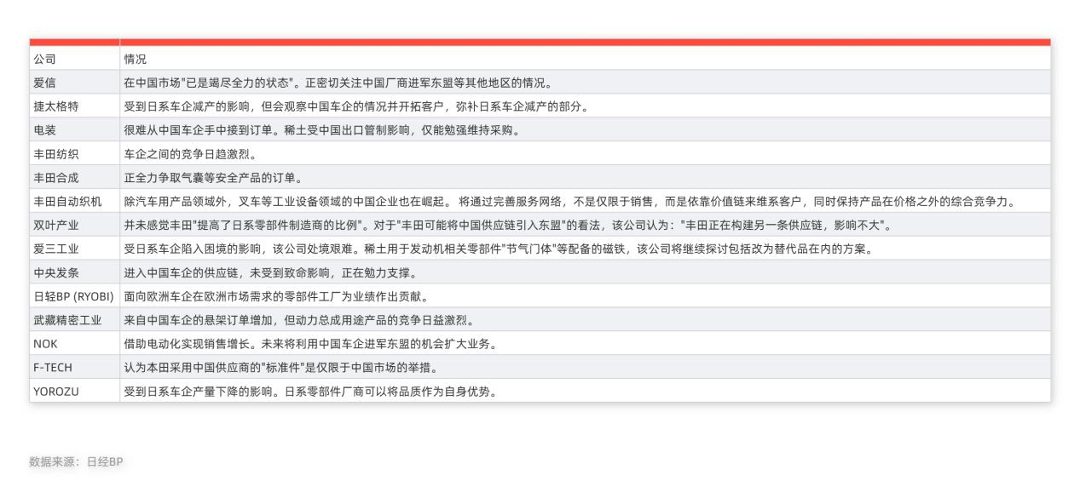
Nikkei BP, a Japanese media outlet, compiled statements from 14 Japanese parts companies during their earnings calls, revealing clear anxiety and urgency. Aisin, a Toyota subsidiary, admitted it was 'operating at full capacity' in China and expressed particular concern about Chinese parts manufacturers' moves into ASEAN and other regions, as it signaled that competition was spreading from China to Japanese suppliers' 'backyard.'
02 Debt Burden: German Suppliers Face Sluggish Growth
While Japanese parts companies' predicament (difficulties—kept in pinyin for context, but should ideally be translated as 'plight' or 'challenges') stem primarily from external factors like customer loss and intensified competition, German parts companies' growth struggles originate mainly from internal financial issues.
A 2026 survey by the European Association of Automotive Suppliers revealed that 76% of European suppliers expect profit margins to fall below 5%, with the remaining 24% anticipating losses. Sluggish revenue growth and narrowing profits have become the norm for the German parts industry.
Funding pressures are equally acute. High-leverage mergers and acquisitions prevalent during the internal combustion engine era, combined with the sustained capital investment required for electrification transitions and the Multiple strikes (multiple blows—translated as ' Multiple strikes ' or 'compound impacts') of reduced sales from upstream clients, have caused German suppliers' debt to snowball.
Research by Strategy&, a PwC subsidiary, showed that in 2025, the average interest expense for major German automotive suppliers equated to 102% of operating income—a ratio climbing for the fourth consecutive year—meaning nearly all operating profits were consumed by interest payments.
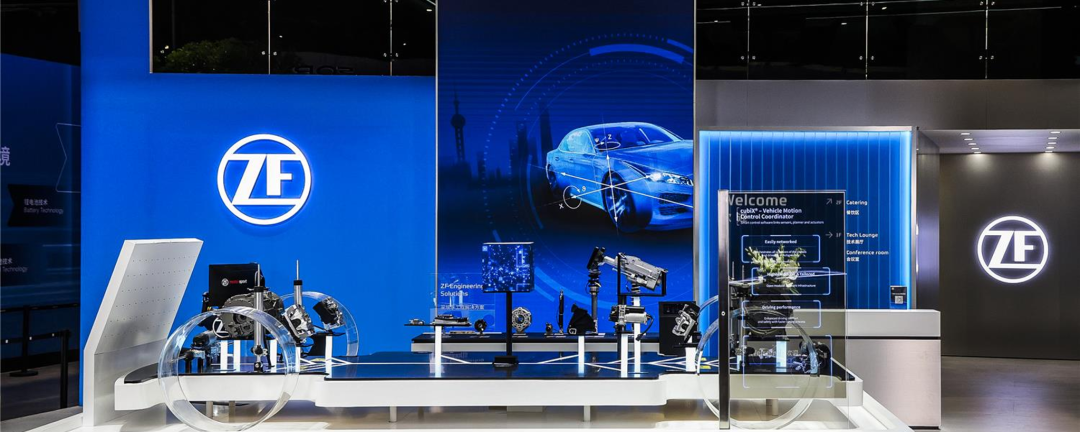
Looking at specific companies, ZF, the second-highest-ranked German parts company on the top 100 list, saw its net debt slightly decline to €9.814 billion in the first half of the year, but its leverage ratio remained high at 2.75, far exceeding the industry safety range of 0 to 1.5. Continental's net debt exceeded €5.5 billion with a leverage ratio of 2, while Schaeffler's debt scale was comparable to Continental's, with a post-adjustment leverage ratio of 2.4, nearing the risk warning line.
Beyond debt, German parts companies' cost competitiveness is also weakening. An industry research report obtained by Reuters showed that the cost gap between German and Chinese parts companies widened continuously from 2019 to 2025. Over six years, German companies' management expense ratios deteriorated, while Chinese counterparts optimized operational efficiency, with both management and manufacturing costs as a share of revenue declining.
With tight funds, scarce orders, and insufficient support for transformation, German parts companies are beginning to seek external solutions. Meanwhile, a group of Chinese companies—eager to gain local production status, European certification, and mass-production capabilities while retaining European employees—find their needs aligning perfectly with those of German suppliers.
For Chinese companies, acquiring established German brands offers an efficient shortcut for going global. Not only can they inherit existing European customer relationships, mature engineering talent, and complete production systems to prevent closures, but they can also significantly shorten the time needed to build trust and cooperation with core automakers like Volkswagen, BMW, and Mercedes-Benz.
This approach follows similar logic to Geely's acquisition of Volvo and SAIC's acquisition of MG, leveraging existing brand resources to facilitate smoother integration into local markets.
In 2025, Chinese investment flowing into Europe's automotive industry reached €7.6 billion, up 46% year-on-year, with 93% concentrated in the EV supply chain. Germany absorbed approximately €2.5 billion in Chinese investment, ranking second in Europe after Hungary, with EV-related investment reaching €783 million, up 88% year-on-year.
Data provided by Rhodium Group to the Financial Times further showed that since the mid-2000s, Chinese companies have invested in over 130 European auto parts companies, primarily in Germany and France, covering core automotive sectors such as electronic systems, wiring harnesses, castings, seals, autonomous driving, and wireless connectivity.
03 Three Paths for Chinese Parts Companies to Go Global—and Three Challenges to Overcome
Contrasting the situations of Japanese and German suppliers reveals several strategies for Chinese parts companies' global expansion.
The most fundamental approach is traditional parts exports. According to customs data compiled by the China Association of Automobile Manufacturers, auto parts exports reached $9.34 billion in July 2026, up 13.9% year-on-year.
The second path, which concerns Japanese parts companies, involves Chinese firms following automakers overseas. Take Thailand, ASEAN's largest automotive manufacturing country, as an example: as of March last year, 165 Chinese auto parts companies had established operations there, supporting the Vehicle production capacity layout (vehicle production capacity Layout —translated as 'vehicle production capacity Layout ' or 'vehicle manufacturing footprint') of independent brands like BYD, Great Wall, SAIC, GAC, and Chery.
This 'going global in groups' model reduces the risk for parts companies in independently expand the market (developing markets—translated as 'developing markets' or 'market penetration') while providing automakers with stable, familiar supply chain support, creating a mutually beneficial cycle. Especially amid this year's surge in automotive exports, the synergy between vehicle exports and parts localization is accelerating.
The third path involves acquisitions, mergers, and capital injections, particularly evident in Europe. As previously discussed, Chinese companies are acquiring established parts brands in Germany and France to gain ready-made customer relationships, technical expertise, and production qualifications.
From product exports to capacity outputs to capital expansions, these three paths work in tandem to form a complete picture of Chinese parts companies' global expansion.
However, concerns linger within China's supply chain.
Payment terms have long been a chronic issue. Earnings reports from over 10 mainstream automakers in the first half of the year showed that average payment terms to suppliers rebounded to 187 days, an increase of 23 days year-on-year and far exceeding the 60-day target. Recently, two ministries reissued the 'Notice on Promoting Standardized Supplier Payment Practices and Optimizing Payment Terms in the Automotive Industry,' but the issue of automakers delaying payments and extending terms remains unresolved.
Workforce-related concerns have also surfaced frequently. As industry competition intensifies and cost-cutting pressures mount, some companies have faced issues in labor compliance and employee welfare, affecting both staff stability and corporate reputation.
Profitability squeezes pose another constraint. Media reports revealed that one parts supplier voluntarily abandoned a €500 million order, reasoning that accepting it at current pricing would result in losses. Amid intensifying price wars among automakers, OEMs continue to pressure upstream suppliers for cost reductions, Layer by layer compression (layer-by-layer compression—translated as 'layer-by-layer compression' or 'relentless squeezing') parts profit margins, hindering healthy industry development.
Japanese suppliers are pivoting, German giants are gasping for breath, and Chinese companies face both favorable winds and hidden reefs on their global voyage. The window of opportunity created by independent Chinese NEVs offers the best launchpad for China's parts industry to transition from chasing to leading.
Editor-in-Chief: Yang Jing Editor: He Zengrong

THE END
-
![]()
The Loss Conundrum and the High-End Wager: Xiang Xingchu Declares, 'JAC Embarks on Its Third Trailblazing Journey'
-
![]()
'Problematic Stock' Plummets for a Decade, Then Suddenly Surges to Limit Up for Two Straight Days! Is the Auto Sector Making a Resurgence?
-
Value and Cost: Validations from Anthropic and Zhipu
-
![]()
Eliminating Set-Top Boxes: A Panacea for the TV Industry’s Woes?
-
Who Defines 'AGI' Defines the Future
-
![]()
What Unfolded Following Tesla's Substantial Price Reduction?
-
![]()
4-Minute Surge: 10,000 Orders Secured for Xiaomi Pengcheng, Sparking Hot Search Trend. Lei Jun: Extended-Range Vehicles Hold Immense Promise
-
The Future Trajectory of AI Large Models