Breakthrough! China Issues First National-Level Document on Account Period Management for Automotive Industry
 09/10 2026
 522
522
The Notice on Promoting Standardized Supplier Account Payments and Optimizing Account Period Management in the Automotive Industry marks China's inaugural national-level policy framework specifically targeting account period management in the automotive sector. This document serves as a cornerstone initiative for fostering a healthy industrial ecosystem.
In recent years, certain automotive companies have attempted to alleviate competitive pressures by reducing procurement costs and extending payment cycles, a practice that has disrupted the stability of industrial and supply chains. To incentivize timely supplier settlements, safeguard legitimate rights of suppliers, and cultivate a robust industrial ecosystem, the Ministry of Industry and Information Technology (MIIT) and the State Administration for Market Regulation (SAMR) jointly issued the Notice on September 7. The policy outlines specific measures, including transparent account period calculations, streamlined acceptance procedures, prompt and full payments, compliant and convenient payment methods, advance payments during price negotiations, and prioritized support for small and medium-sized enterprises (SMEs).
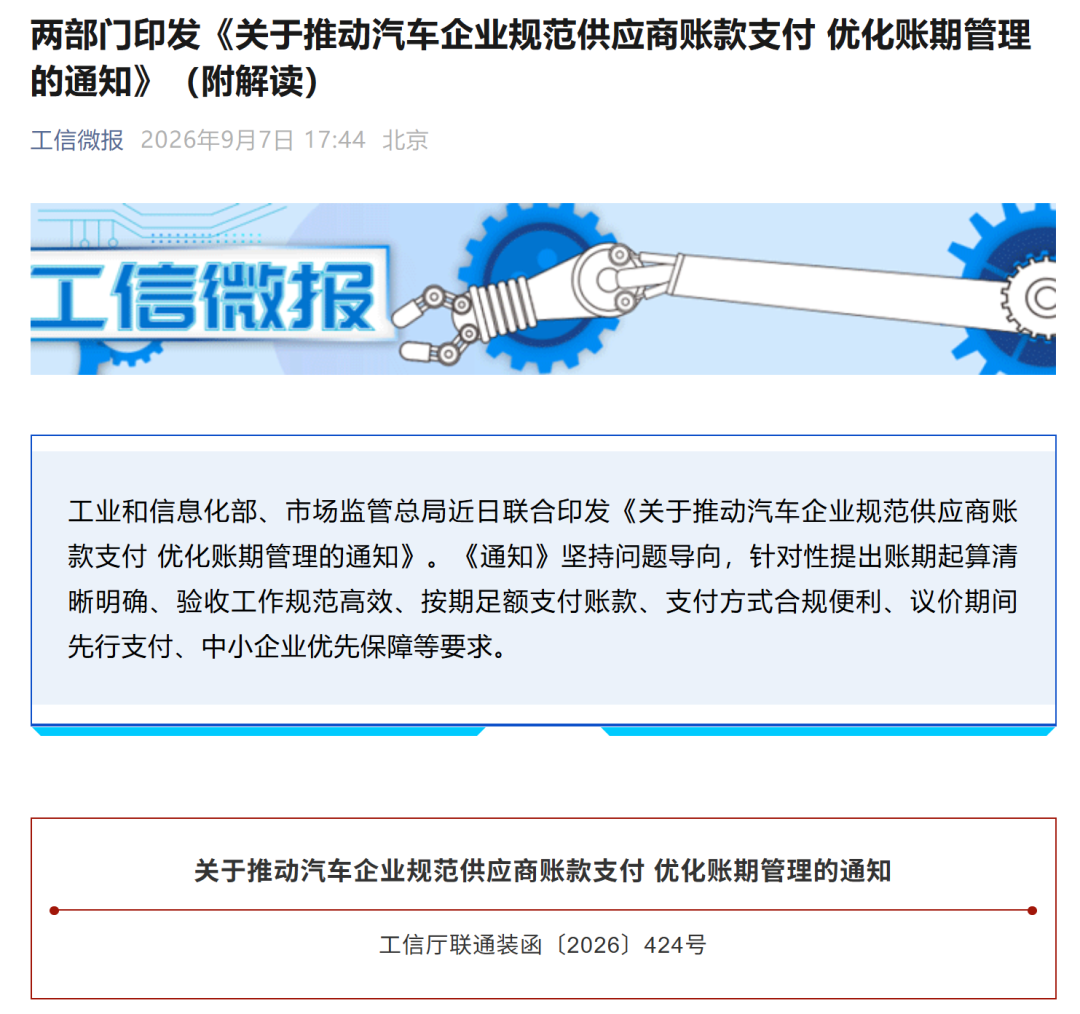
"This represents China's first national-level document on account period management for the automotive industry and a pivotal step toward building a sustainable industrial ecosystem," stated the China Association of Automobile Manufacturers (CAAM). The Notice addresses critical needs for regulating internal competition, proposes actionable measures for account payments, and optimizes account period management. It holds significant implications for guiding fair competition and advancing high-quality development of the automotive supply chain.
Bridging Regulatory Gaps and Standardizing Payment Practices
"The Notice completes the 'last mile' of account period management implementation in the automotive industry," emphasized CAAM. In March 2025, the State Council revised the Regulations on Safeguarding Payments to Small and Medium-sized Enterprises to strengthen protections for SME suppliers. However, the automotive sector's complex supply chains, involving numerous upstream and downstream enterprises of varying scales, necessitated industry-specific guidelines. As China's first sector-focused account period management document, the Notice fills a critical regulatory void and introduces three key innovations:
1. **Clarifying Account Period Definitions**: The Notice resolves ambiguities in account period calculations by specifying that the supplier's account period commences from the date of delivery, project completion, or service provision and acceptance. For continuous supplies (exceeding two deliveries per month), both parties may negotiate a continuous supply cycle, which should not exceed one month in principle. Additional guidelines address efficient acceptance procedures, timely payments, compliant payment methods, advance payments during negotiations, and handling exceptional cases.
2. **Strengthening SME Support**: The policy encourages cash payments for SME suppliers, recommends settlement cycles of no more than 60 days, and provides guidelines for verifying SME status in supply chains. For instance, it mandates cash payments for SMEs when contracts lack specified payment methods, prohibits substitutes like commercial bills, and urges automotive companies to establish robust risk control systems to ensure timely payments by subsidiaries and major suppliers.
3. **Introducing Collaborative Governance**: The Notice reflects a collaborative approach between government and industry. Third-party agencies will assess automotive companies' payment practices and publicly release findings, while relevant departments will jointly establish a supervision mechanism to promote continuous account period optimization.
From Voluntary Commitments to Systemic Reforms
Prolonged payment terms by automotive companies reflect irrational competition, straining suppliers—particularly SMEs—and destabilizing supply chains. Urgent reforms are needed to address this issue.
As an industry advocate, CAAM has long championed healthy development and rational competition. Last year, under MIIT guidance, CAAM issued the Initiative on Standardizing Supplier Account Payments for Automobile Manufacturers, the industry's first self-regulatory document on supplier payments. The initiative secured commitments from 17 major automotive companies, demonstrating corporate responsibility and laying groundwork for systemic account period management. Over the past year, leading firms have significantly shortened average account periods, increased cash payments, and improved payment practices.
In February 2026, CAAM's survey revealed that most leading automotive companies now maintain account periods within 60 days, averaging approximately 54 days (a 10-day year-on-year reduction), with four firms averaging below 50 days. Leading companies have prioritized fulfilling commitments by establishing dedicated task forces, issuing institutional documents, and implementing long-term mechanisms. Many have adjusted account periods for existing contracts, optimized financial processes, upgraded IT systems for automated payments, and reduced manual delays. Some shifted the payment start date from posting to delivery acceptance and increased settlement frequency from monthly to decadal, enhancing efficiency. Several companies allocated over RMB 10 billion in dedicated funds to improve payment terms.
However, challenges persist due to complex payment processes and variations among subsidiaries. Some suppliers still feel underserved. To further standardize practices, shorten account periods, and strengthen enforcement against deliberate delays, MIIT and SAMR formulated the Notice. Based on extensive research and consultations, the document clarifies requirements, enhances assessments, and promotes institutionalized payments to foster a collaborative "automaker-supplier" ecosystem.
Collaborative Governance for Long-Term Industry Health
The Notice adopts a multi-pronged approach combining corporate self-assessments, third-party evaluations, and government oversight:
1. **Reporting Mechanism**: Automotive companies must submit semi-annual and annual payment reports to MIIT by the end of July and January, respectively.
2. **Public Evaluation Results**: Third-party agencies, commissioned by the government, will conduct annual assessments and publish findings to highlight best practices and drive industry-wide improvements.
3. **Collaborative Supervision**: Third-party agencies will ensure transparency in evaluations and address inquiries, fostering accountability.

In response, CAAM stated that the Notice's reliance on third-party evaluations aligns with international practices and sets high standards for such agencies. CAAM proposes two recommendations:
1. **Scientific Evaluation Mechanism**: Develop multi-dimensional, tiered standards covering institutional safeguards, account period compliance, payment methods, and pricing mechanisms. Conduct regular specialized assessments, gather insights from industry experts, and analyze actual account periods, payment methods, payable scales, and SME protections to ensure transparency and fairness.
2. **Regular Reporting and Supervision**: Publicly release tiered evaluation results based on rigorous assessments to promote accountability. Additionally, suggest that third-party agencies create channels for suppliers to report payment issues, facilitating timely resolution through coordination between automakers and suppliers and strengthening the agencies' intermediary role.
Excessively long account periods represent an unreasonable transfer of risks and costs. Optimizing supplier payments is a systemic endeavor that impacts industrial development and societal well-being, requiring collaboration among regulators, industry bodies, and automotive companies. Through joint efforts, a stronger sense of collective responsibility can be fostered, enhancing supply chain resilience and safety while accelerating the creation of a fair, trustworthy, and mutually beneficial industrial ecosystem.

Image: Sourced from the Internet
Article: Auto Review
Layout: Auto Review
-
![]()
The Loss Conundrum and the High-End Wager: Xiang Xingchu Declares, 'JAC Embarks on Its Third Trailblazing Journey'
-
![]()
'Problematic Stock' Plummets for a Decade, Then Suddenly Surges to Limit Up for Two Straight Days! Is the Auto Sector Making a Resurgence?
-
Value and Cost: Validations from Anthropic and Zhipu
-
![]()
Eliminating Set-Top Boxes: A Panacea for the TV Industry’s Woes?
-
Who Defines 'AGI' Defines the Future
-
![]()
What Unfolded Following Tesla's Substantial Price Reduction?
-
![]()
4-Minute Surge: 10,000 Orders Secured for Xiaomi Pengcheng, Sparking Hot Search Trend. Lei Jun: Extended-Range Vehicles Hold Immense Promise
-
The Future Trajectory of AI Large Models