Unable to Compete, U.S. Auto Industry Petitions: Ban Chinese Cars from the U.S. Market
 09/22 2026
 348
348
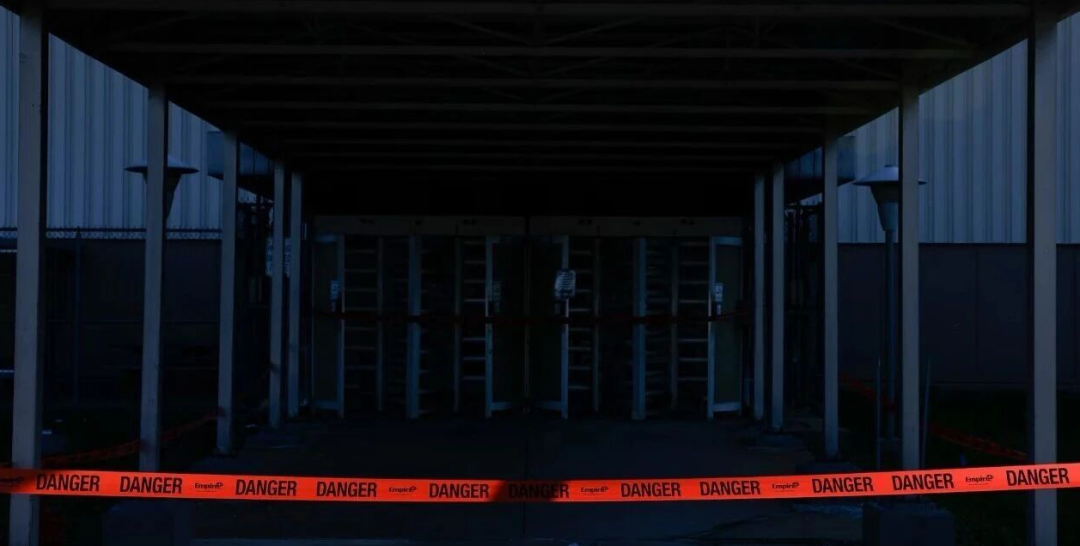
Even the construction of factories is met with resistance.
"
Author|Wang Lei
Editor|Qin Zhangyong
U.S. automakers are on edge.
Recently, the six major U.S. auto industry associations, which represent the interests of nearly all major U.S. automakers, suppliers, and dealers, took a significant step—they jointly submitted a petition to the Trump administration.
The petition, titled "Appeal to the Trump Administration to Uphold the U.S. Ban on Chinese Cars," clearly states its intent.
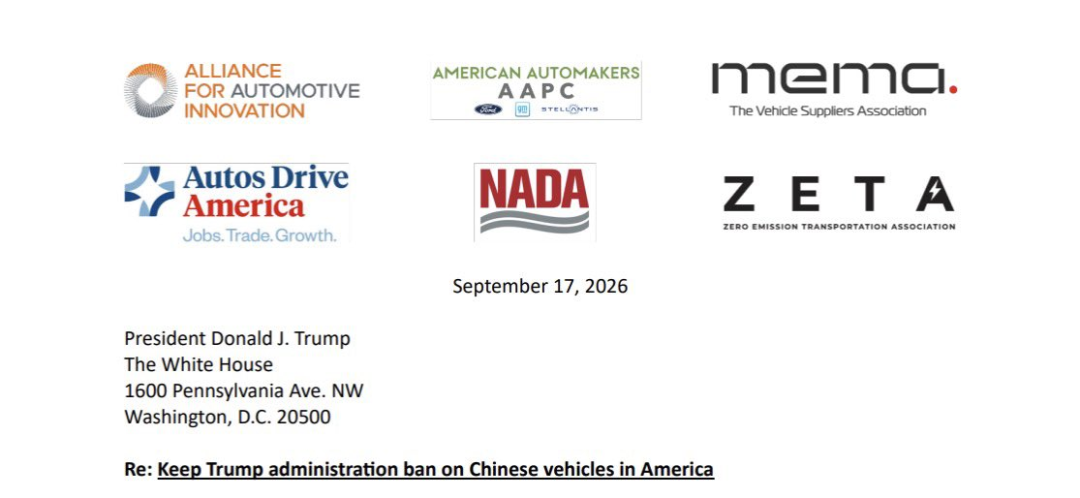
They called for a "resolute closure" to Chinese automakers, openly advocating for trade barriers and unfair competition in the petition, urging the Trump administration to continue policies that "categorically prohibit Chinese automakers from selling, importing, or producing cars in the U.S."
Not only do they seek to maintain restrictions on imports and sales, but they also demand a ban on Chinese companies establishing factories in the U.S. for vehicle production.
These associations, which once championed "free market" and "fair competition," have abandoned all pretenses in the face of Trump's mere "verbal commitment"...
01 Trump Yields to Pressure
The origin of this petition traces back 20 days to Trump's interview on Fox News' The Ingraham Angle.
During the interview, host Laura Ingraham questioned Trump about the possibility of Chinese automakers building factories in the U.S.
Trump initially dismissed reports suggesting he might allow Chinese-made cars to be imported into the U.S., stating that lifting current restrictions could "overwhelm" the domestic market.
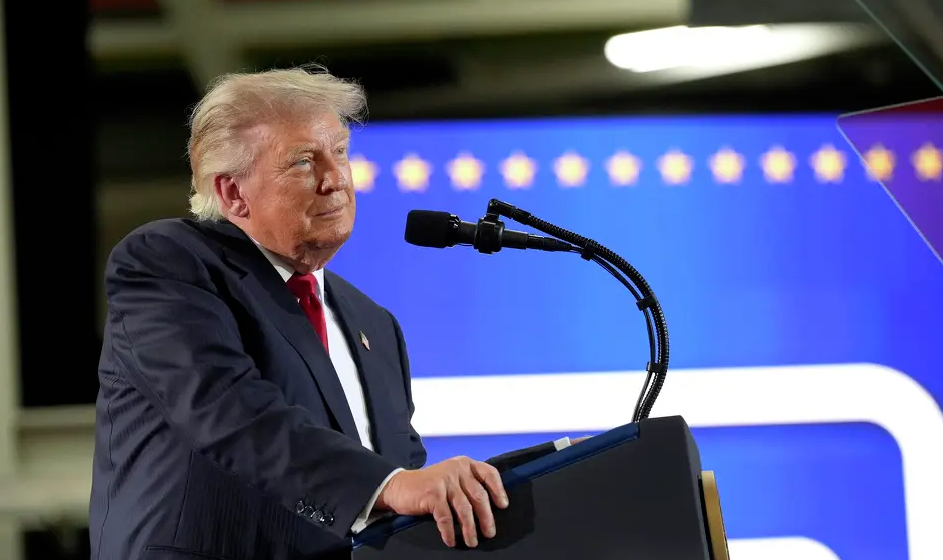
He quickly added that if China were willing to build factories in the U.S. and manufacture cars locally, he would be open to the idea ("I'd be OK with it"). He also mentioned, "Japan does the same thing; the key is that they hire our people." He specifically expressed his opposition to Chinese automakers building factories in Mexico and then shipping cars into the U.S. He clarified that he was not disparaging Chinese cars.
However, this single verbal commitment sparked an uproar within the U.S. auto industry. Shortly after, the petition landed on Trump's desk, fueled by fears that he might actually yield...
The signatories of this petition represent the most unified front between the U.S. auto industry and the White House in recent years. The petition was jointly signed by the heads of six core associations, including the Alliance for Automotive Innovation, the American Automotive Policy Council, Autos Drive America, the Motor & Equipment Manufacturers Association (MEMA), the National Automobile Dealers Association, and the Zero Emission Transportation Association.
Behind them stand nearly all U.S.-based automakers and industrial chain forces—no need to list them all; every major U.S. automaker you can think of is included.
It's worth noting that the leading "Alliance for Automotive Innovation" had previously taken a "pathetic" stance.
It wrote to top congressional leaders from both parties, demanding that permanent legislation be passed before the current Congress adjourns to completely ban the import and sale of Chinese connected cars and related hardware and software in the U.S., even restricting Chinese automakers from building factories in the U.S. for vehicle production.
The core issue of this petition is much the same, urging the maintenance of import restrictions on Chinese cars, even if they are built in the U.S.
In fact, with escalating market access barriers against Chinese cars in the U.S., Chinese vehicles have already vanished from the U.S. market.
In early 2025, the Biden administration, citing so-called "data security" concerns, effectively banned all Chinese automakers from selling or producing passenger vehicles in the U.S.
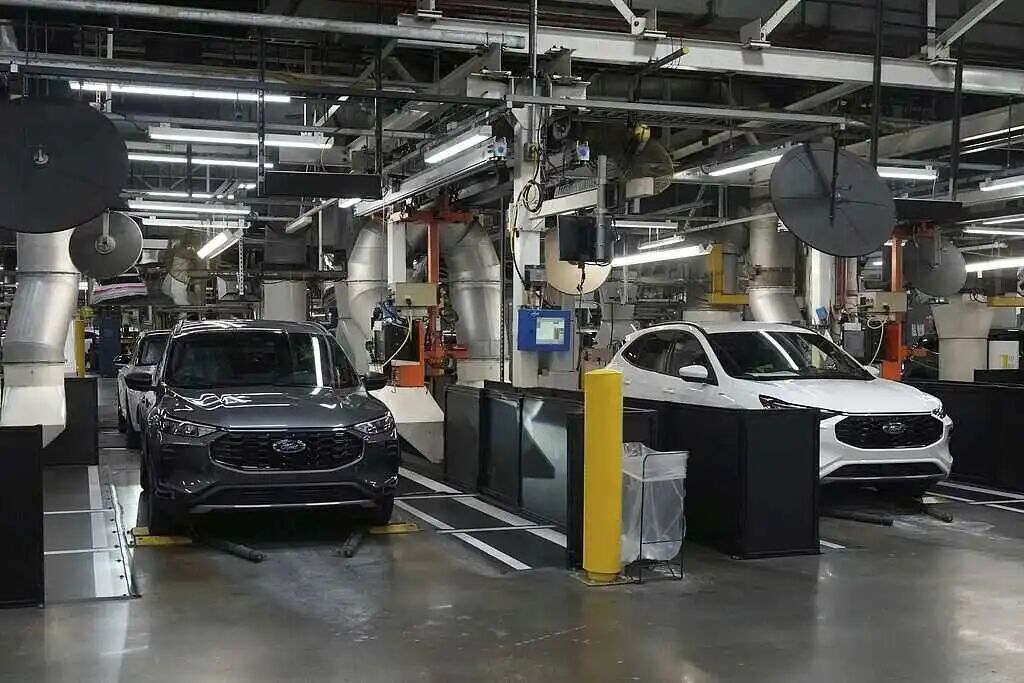
That's not enough—they also face a barrage of tariffs: a 2.5% most-favored-nation baseline tariff, plus a 25% Section 232 auto tariff, plus a 100% Section 301 tariff specifically targeting Chinese electric vehicles, and an additional 10% tariff previously imposed under the International Emergency Economic Powers Act; the combined tax rate for Chinese cars entering the U.S. can exceed 137.5%.
The result is that Chinese cars now hold a 0% market share in the U.S.
As of now, the only automaker directly tied to China's new energy vehicle industry in the U.S. market is Polestar, which will also be forced to exit the U.S. market by 2027 due to "national security risks" and its Chinese majority ownership. Once Polestar leaves, no Chinese automakers will be selling in the U.S.
02 The "0% Share is Guilty" Fallacy
Precisely because of this 0% market share, these U.S. auto associations have concocted a so-called reason to block Chinese automakers from building factories:
The petition argues that since Chinese cars currently have a 0% market share in the U.S., allowing Chinese-funded automakers to build factories and gain a foothold in the U.S. market would come at the expense of existing automakers. In their view, this wouldn't create jobs—it would steal them.
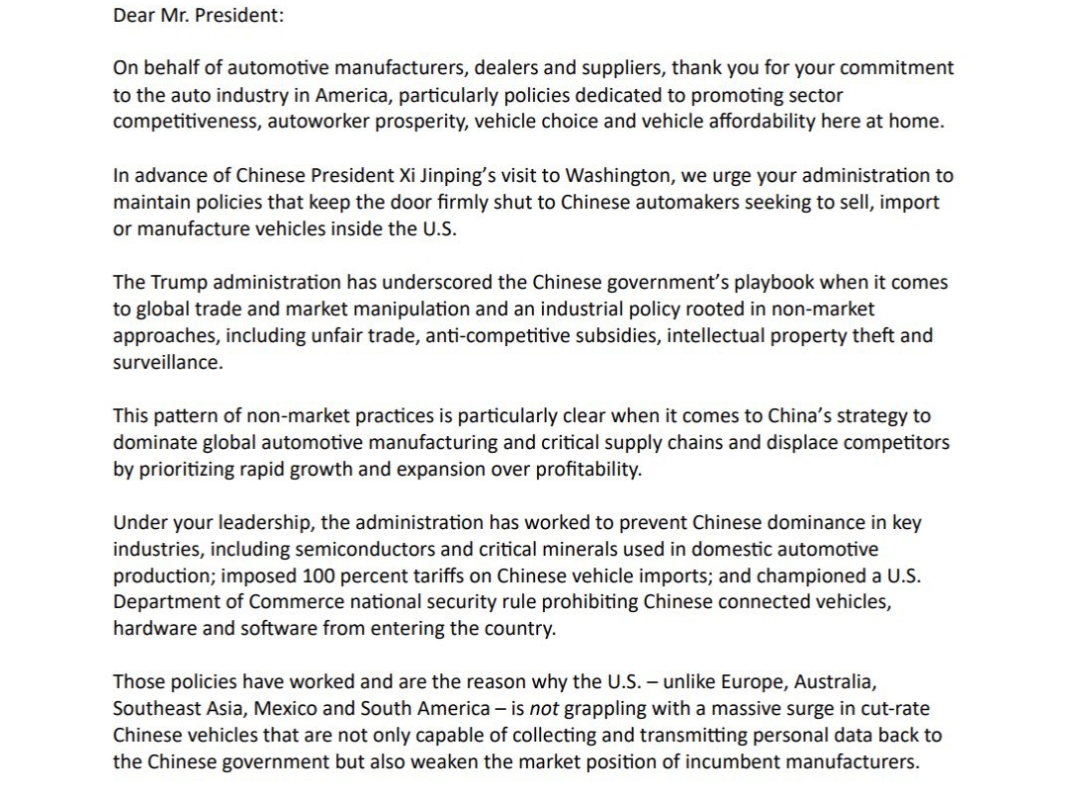
The petition states that Chinese automakers' investments would not create new U.S. jobs but would instead "shift employment opportunities from manufacturers that have invested for generations in the U.S. to companies owned and operated by China." This would harm the interests of all 17,000 auto dealerships in the U.S.
Additionally, these associations argue that even if Chinese-funded automakers assemble vehicles domestically in the U.S., they cannot resolve connected-car-related security risks because, even if produced in the U.S., the supply chain would still heavily rely on Chinese suppliers and components.
The petition later escalates to the level of industrial security: "The automotive industry is the foundation of America's advanced manufacturing and defense industrial base, requiring reliance on domestic production capacity and industrial workers to meet demand during national emergencies. Once the domestic industrial base is hollowed out, it cannot be rebuilt quickly."
After donning these "big hats," the demands of the U.S. auto associations become clear: continue to block Chinese automakers from selling, importing, or producing cars in the U.S.; maintain the 100% tariff and existing national security restrictions on Chinese cars; continue implementing restrictions on Chinese connected cars, related hardware, and software.
They also reject the logic that "local production in the U.S. avoids security risks," treating Chinese cars entering the U.S. market as an issue of industrial security, supply chain security, and national security—not just a trade issue.
Logically, a 0% share shouldn't make U.S. automakers this nervous. Even Trump's factory-building rhetoric is essentially just following the path taken by Japanese and Korean automakers when they entered the U.S. market—Toyota, Honda, and Hyundai all broke in this way.
The reaction of U.S. automakers precisely shows that they believe Chinese automakers, if they take this route, would have an even more severe impact than Japanese and Korean cars. They know better than anyone that once tariff barriers loosen, or if Chinese automakers enter the North American market via Canada or Mexico, consumers will vote with their wallets.
This has already been validated by consumer market attitudes. Affected by the average new car price in the U.S. exceeding $50,000 for the first time and the growing scarcity of entry-level economy models, Cox Automotive conducted a survey.
The survey showed that 49% of U.S. consumers believe Chinese cars offer "very high" or "high" value for money, with nearly 40% saying they are "extremely likely" or "very likely" to consider buying a Chinese brand. Among Gen Z respondents, this proportion reached as high as 69%.
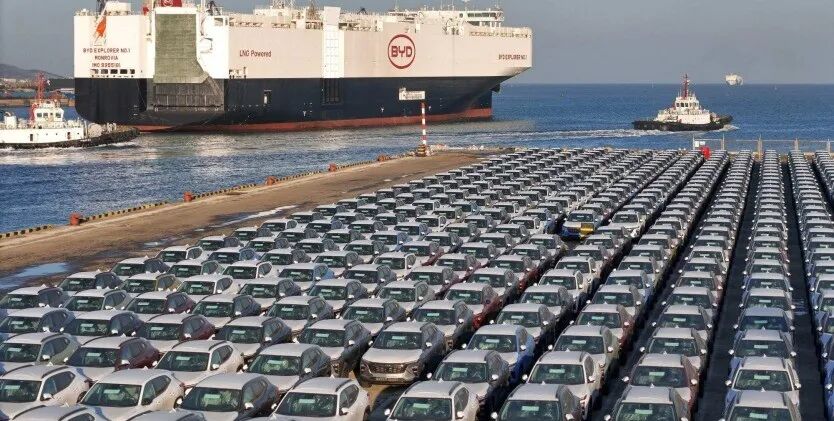
Moreover, the anxious attitude of the U.S. auto industry precisely reflects the speed of Chinese cars going global. In 2025, Chinese auto exports surpassed 10 million vehicles, ranking first globally for the second consecutive year, with 6 out of every 10 new energy vehicles sold globally coming from China. In the first half of 2026, exports reached 5.096 million vehicles, up 65.3% year-on-year, including 2.355 million new energy vehicles, more than doubling year-on-year.
BYD topped sales charts in over a dozen countries, including Thailand, Italy, Brazil, and Saudi Arabia. In May, Chinese automakers' monthly registrations in Europe historically surpassed the combined total of Japanese brands. Chery also topped the monthly bestseller list in the UK and deepened its roots in Russia and Brazil. Xiaomi signed a German distributor and will enter Europe next year. BYD's overseas target has been revised to: 1.9 million to 2 million vehicles in 2026, over 2.5 million in 2027, with overseas sales accounting for more than half.
A truly confident market wouldn't treat a competitor with less than a 1% market share as an existential threat. Just as General Motors and Ford once dominated globally by winning over competitors with superior products, not by erecting political barriers to keep them out.
Yet now, the joint resistance from the six major U.S. auto associations amounts to a public admission—they can't compete with Chinese cars on a level playing field.
-
RSI: How Much Valuation Can It Support for Zhipu?
-
Young People Are Secretly Enjoying 4399 Game Suite on Xiaohongshu
-
![]()
China’s Premier Independent Token Factory: Secures 2.9 Billion Yuan in Funding
-
FAW and GAC Toyota: Collaborating Without Full Merger?
-
Honor Expands Partnership with Alibaba: Who Will Lead the AI Smartphone Revolution?
-
![]()
Yunqi Conference Heralds Computing Power Growth: Alibaba Cloud’s Data Center Capacity to Surpass 20GW by 2032, T-Head Reveals AI Chip Zhenwu V900
-
![]()
Singapore Hardware Veteran Creates an AI Golf Personal Trainer
-
![]()
Data Integration Throughout the Production Chain! Haomi Optics Initiates MES and ERP System Upgrade Project