High-Profile Collaboration Unveiled! GAC, FAW, and Toyota Forge Major Partnership in Guangzhou
 10/09 2026
 414
414
Authored by | Auto Observer
Efficiency at its finest!
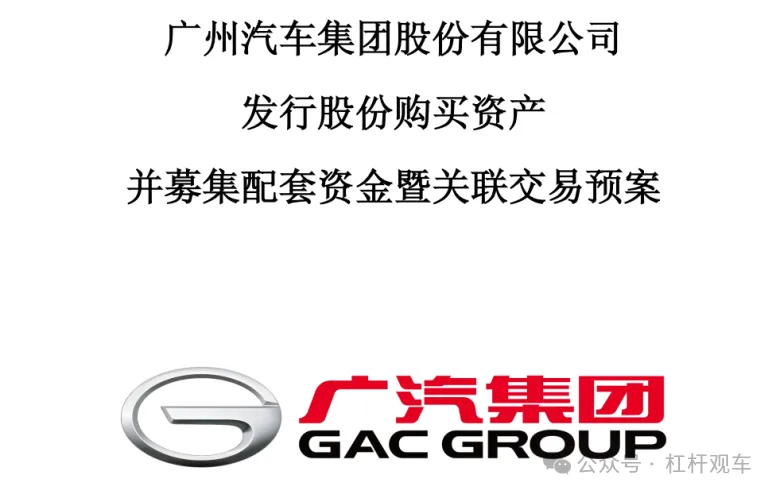
Right before the holiday hiatus, GAC Group recommenced trading and unveiled its restructuring blueprint. The very first day post-holiday, another significant stride was made.
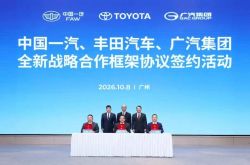
According to reports, on October 8 in Guangzhou, China, FAW Group, Toyota Motor Corporation, and GAC Group inked a new strategic cooperation framework agreement. Feng Zhonghua, the Secretary of the Guangzhou Municipal Party Committee, and Mayor Sun Zhiyang were on hand to witness this pivotal moment. Toyota Motor Corporation's President, Kon Tada, made a special trip from Japan to Guangzhou, and China FAW Group's General Manager, Liu Yigong, also participated.
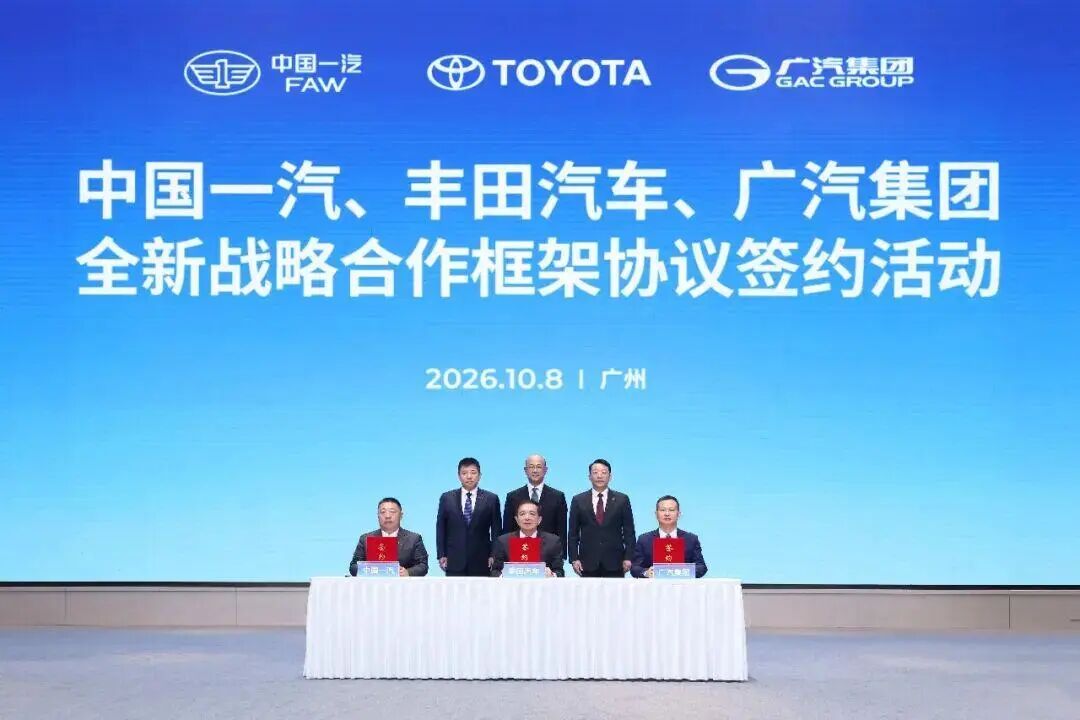
Auto Observer observed that the official press release from Guangzhou Daily employed robust language: "landmark significance," "1+1+1>3," "a model of central-local collaboration and cross-border cooperation," and so forth.
Furthermore, the signing was of a high caliber. Although Guangzhou Daily referred to it as a 'strategic cooperation framework agreement,' rather than a 'cooperation agreement' or a 'transaction agreement.' A framework agreement signifies that the direction has been established, yet numerous details remain to be ironed out.
More intriguingly, on the same day, during a discussion involving Guangzhou Municipal Party Secretary Feng Zhonghua, Mayor Sun Zhiyang, Kon Tada, and Liu Yigong, the Guangzhou side specifically underscored: "Taking Guangzhou as a strategic pivot." The significance of this statement merits contemplation.
From Auto Observer's perspective, Guangzhou stands as a formidable contender for China's premier automotive production hub. GAC Group serves as the cornerstone of Guangzhou's industrial landscape, and GAC Toyota acts as the linchpin of GAC Group's profitability.
According to BOC International's calculations, following the completion of this transaction with FAW, GAC Group will witness additional investment income from its 50% stake in FAW Toyota, thereby "enhancing financial metrics such as investment income and net profit."
Guangzhou's geographical advantages are undeniable: it serves as a core engine of the Guangdong-Hong Kong-Macao Greater Bay Area, boasts a comprehensive automotive industry chain, and possesses robust manufacturing capabilities. However, whether these geographical advantages can be translated into industrial competitiveness hinges on Toyota's willingness to allocate more resources here.
In the official press release, China FAW Group's General Manager, Liu Yigong, articulated a well-crafted statement: each party brings its unique strengths to the table, particularly with China FAW Group and GAC Group complementing each other in terms of location, resources, and capabilities.
Some observers suggest that FAW is 'retreating without exiting,' as it will become the second-largest shareholder of GAC Group, thereby indirectly retaining influence over Toyota's joint venture operations. This assessment holds true at the capital level, but operationally, FAW relinquishes its direct seat in major decision-making at FAW Toyota.
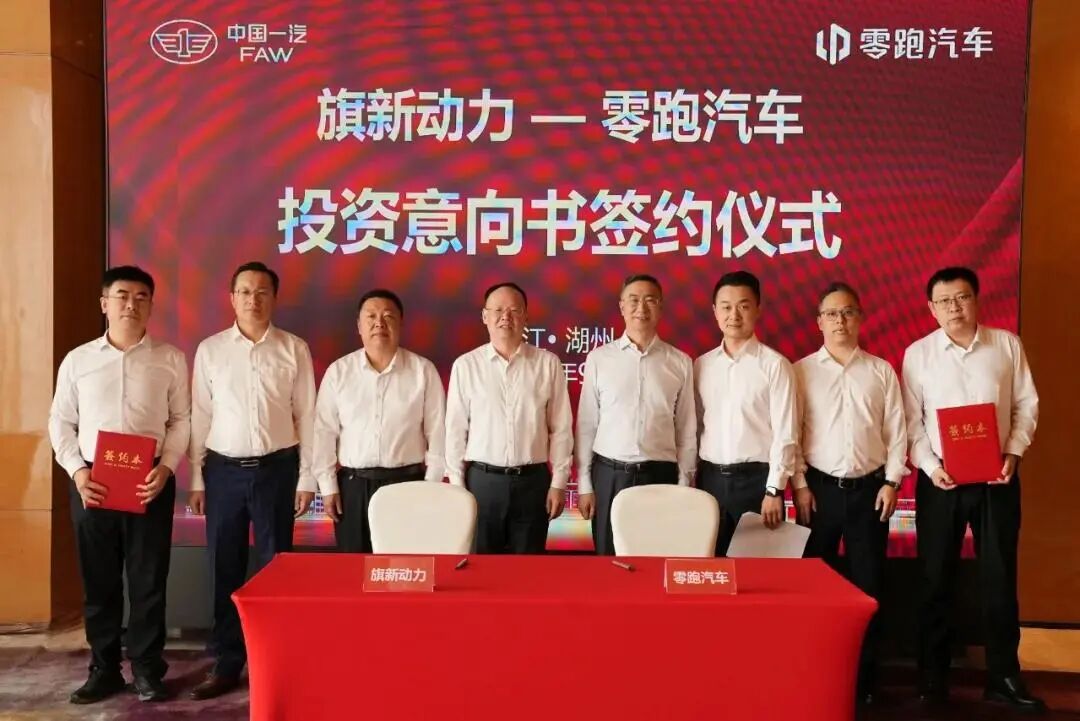
Additionally, Auto Observer noted that when FAW previously forged a strategic cooperation with Leapmotor, FAW's Chairman, Qiu Xiandong, personally attended; for this signing, however, Kon Tada traversed the ocean to participate, while Qiu Xiandong was notably absent.
If FAW is 'retreating without exiting' and GAC is 'advancing without merging,' then Toyota is 'gaining without giving.'
According to Citigroup's research report, after integrating North and South Toyota into a unified platform with an annual production capacity of 1.2 to 1.3 million vehicles, model streamlining and joint procurement alone could slash sales costs by 2 to 3 percentage points and sales and administrative expenses by 1 to 2 percentage points. Based on the combined production and sales scale of nearly 1.6 million vehicles from the two joint ventures, this translates to cost savings in the billions.
Toyota reaps these cost dividends without relinquishing any equity or disbursing any cash.
Lastly, it's noteworthy that from the signing of the letter of intent on September 14 to the signing of the strategic cooperation framework agreement, less than a month elapsed—a remarkably swift pace.
Indeed, in today's automotive market, time equates to money. In August, the penetration rate of new energy vehicles among mainstream joint venture brands stood at a mere 13.4%, while Toyota's new vehicle sales in China have declined for at least seven consecutive months—change is imperative.
More significantly, the deep tripartite alignment of FAW, Toyota, and GAC marks a symbolic turning point in China's automotive joint venture model and serves as a case study for collaborative upgrading in domestic advanced manufacturing.
For decades, the extensive joint venture model of 'foreign capital providing technology and Chinese parties providing the market' ushered in a golden era for the industry. Today, with escalating competition in the existing market, the robust ascent of domestic brands, and new energy vehicles disrupting the industry, traditional joint venture automakers must adapt to survive and flourish.
In conclusion, from Auto Observer's vantage point, there are no absolute winners or absolute concessions in this cooperation between FAW, GAC, and Toyota. Each party fulfills its own needs and achieves mutual success—the most rational choice for collaboration amid industry upheaval.
That said, capital binding is merely the beginning; the true test lies in implementation. Now that the initial steps have been taken, we eagerly await the outcomes!
Charts in this article without cited sources are derived from public disclosures through various channels. We hereby acknowledge and express our gratitude! The views expressed herein are for reference only and do not constitute investment advice.
This article represents original content from Leverage Auto Observer and is prohibited from reproduction without authorization. For reproduction, please obtain authorization. Additionally, when reproducing with authorization, please indicate the source and author at the beginning of the article. Thank you!
-
![]()
A Leap in Dimensionality Reduction: Why Both Meta and EssilorLuxottica Are Venturing into Hearing Aid Glasses
-
Reevaluating the Value of a Hundred-Billion-Dollar Track Through the Lens of Utopai Studios, the World's Largest Independent AI Film and Television Company
-
![]()
High-Profile Collaboration Unveiled! GAC, FAW, and Toyota Forge Major Partnership in Guangzhou
-
![]()
Analysis of Opportunities for Relocation of the Low-Altitude Economy Industry under Dual Control of Airspace and Equipment
-
![]()
JAC Motors Owes DCD Auto a Debt of Gratitude for Pushing It to the Limit
-
![]()
Over 70,000 Orders Confirmed in the First Month! How Did Xiaomi Pengcheng Achieve Instant Success Amid a Sluggish Extended-Range Vehicle Market?
-
![]()
Zunjie Issues Response, Dongchedi Releases Clarification
-
![]()
September Sales Figures Revealed for Up-and-Coming Auto Brands: 11 Players Including Xiaomi, HiMode Intelligent Travel, Li Auto, Leapmotor, NIO, Zeekr, and Shenlan