Analysis of Opportunities for Relocation of the Low-Altitude Economy Industry under Dual Control of Airspace and Equipment
 10/09 2026
 420
420
In September, two significant policies related to the low-altitude economy were implemented, sparking widespread discussions within the industrial community.
First, the activation of the 'Capital No-Fly Zone,' which covers a controlled airspace with a radius of 300 kilometers centered on Beijing, extending from the ground to unlimited height (flight activities such as civil aviation passenger flights and emergency rescues are not affected).
Second, the 26th session of the Standing Committee of the 16th Beijing Municipal People's Congress voted to pass the newly revised 'Regulations on the Management of Unmanned Aircraft in Beijing,' designating the entire city as a controlled airspace starting from November 15, imposing strict restrictions on the flight, possession, storage, transportation, and carrying of unmanned aircraft.
What impact will this 'dual-track' structure have on the low-altitude economy industry within Beijing? Which links might relocate? Which regions have opportunities for undertaking? We posed these questions to the Huoshi Xinglan Industrial Intelligence Agent.
It is worth noting that this is not an isolated regional event. Across the country, the industrial landscape of the low-altitude economy has been dynamically adjusting in response to the pace of airspace liberalization, scenario resources, and factor costs—Shenzhen's operational ecosystem, Chengdu's flight test bases, and Jingdezhen's complete aircraft support are all products of this process. Beijing's recent policies simply lay the trend of 'airspace redefining industrial geography' more clearly on the table.
01 Nationwide Reallocation of Links
The uniqueness of the low-altitude economy lies in its simultaneous reliance on two factors: airspace and physical facilities. This means that any adjustment to regional airspace policies will trigger the relocation of relevant links in the industrial chain. This is a common challenge for all low-altitude industrial cities.
Based on the criterion of 'whether both airspace and physical facilities need to be present locally,' industrial chain links can be divided into three categories:
1. Strong airspace-dependent links, likely to seek new locations
Four types of links—complete aircraft final assembly and factory flight tests, model certification flight tests, low-altitude operations, and flight training—have rigid demands for flyable airspace. These activities are difficult to sustain within controlled airspace, making relocation or the establishment of backup bases a rational choice. In fact, such migrations have already occurred—the dense (Note: ' dense ' is translated as 'intensive' to convey the concentration of activities) landing of flight test and training bases in Chengdu, Xi'an, Hefei, and other places in recent years is the result of nationwide reallocation of low-altitude resources.
2. Warehousing and some production capacity links, likely to adjust following others
In manufacturing, the mere inability to 'fly' does not pose a fatal constraint—final assembly lines do not rely on airspace, and delivery flight tests can be arranged off-site. The real variable is warehousing: restricted stocking and distribution capabilities within controlled airspace make it likely that warehousing links for core components such as airframe structures, flight control, communication, and power systems will need to relocate along with downstream customers.
Similarly, links such as the batch production of aviation composite structural parts, onboard verification of power batteries and electric drives, and the operation and maintenance of general aviation and low-altitude infrastructure, while not directly consuming airspace, may relocate following downstream customers or due to the need to transport samples to off-site locations. The essence of such adjustments is 'staying close to customers,' rather than industrial loss.
3. Non-airspace-dependent links, forming the industrial foundation
This link is crucial for assessing the resilience of a city's low-altitude industry. Links such as overall design, aerodynamic and structural design, onboard software, chips and avionics, and ground testing and verification do not substantially consume airspace resources. Their layout is determined by talent, research, and capital density—precisely the areas where leading cities hold the greatest comparative advantages.
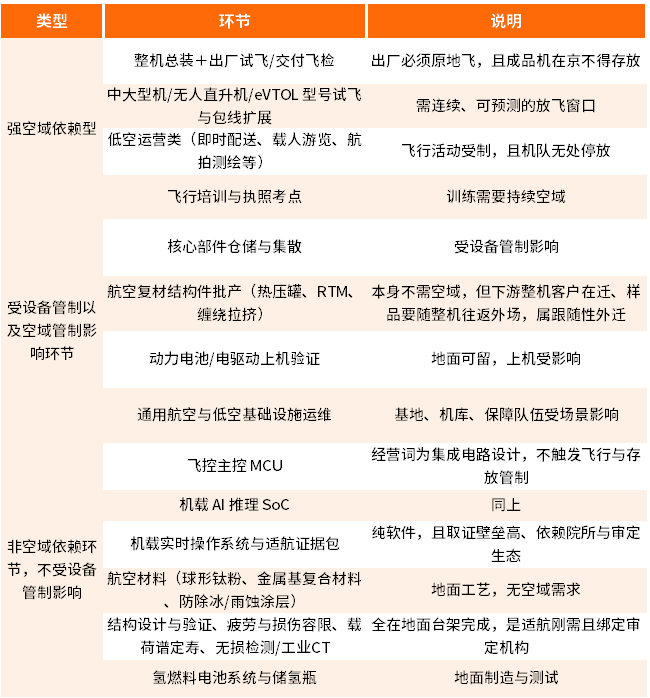 Source: Huoshi Xinglan Industrial Intelligence Agent
Overall, the low-altitude industry is unlikely to experience wholesale relocation. Instead, it is most likely to undergo a geographical split along two lines: 'R&D—design—chips—software—ground testing' and 'final assembly—warehousing—flight testing—operations—training,' gradually evolving into a dual-point collaboration model of 'R&D centers + off-site flight test and certification bases.' This model also represents the common evolutionary direction of the national low-altitude economy.
02 Undertaking Competition: Airspace Factors Take Precedence
Judging by recent actions across regions, the logic of competition for undertaking low-altitude economic industries has become very clear: flyability > supporting infrastructure density > policy subsidies.
On September 11, Shanghai Jiumi Aviation signed an agreement with Chengdu Chongzhou Economic Development Zone to establish its western headquarters base, with the eVTOL testing and flight test base set to commence construction as early as November and expected to commence operations in the first half of 2027, generating an estimated annual output value of approximately 50 million yuan. Chongzhou's investment attraction framework is structured as '1+3+5+4+N,' with '1 high-quality airspace' taking the top spot, followed by 3 specialized parks and 5 types of scientific and technological innovation platforms.
Guangzhou Huadu directly outlines three prerequisites: without dedicated airspace, flight testing is impossible; without wind tunnel laboratories, airworthiness certification is unattainable; without high-standard factories, large-scale assembly of complete aircraft and components is unfeasible.
Nationwide, three types of regions warrant attention:
1. Boundary-zone cities. One of the core factors in low-altitude site selection is flyable airspace. The boundary of the 300-kilometer controlled circle means that most cities around Beijing are unlikely to undertake strong airspace-dependent links such as flight testing, delivery flight inspections, operations, and training. However, they can undertake non-flight-dependent links such as component manufacturing, structural part forming, warehousing and logistics, and regional headquarters and settlement.
Cities at a moderate distance from the controlled boundary, allowing for day trips, are suitable for undertaking training, custody, light operations, and collaborative links under a 'design—off-site flight test' dual-point system. For example, Liaocheng in Shandong, entirely outside the circle, has already landed a CAAC training base with an annual training capacity of over 1,000 people; cities like Xingtai and Handan in Hebei, approximately 50 kilometers from the boundary, are also entering the market for certification training.
The collaborative pattern of 'R&D in central cities, manufacturing and flight testing in the periphery' is also healthier than past single-point agglomeration.
2. Cities with both industrial foundations and dedicated airspace. Chengdu has demonstrated a clear proactive stance, recently hosting a low-altitude investment promotion event in Beijing. Cities like Nanjing, Wuxi, and Jingdezhen, with deep accumulations in rotor systems, hub and composite drive components, and a concentration of unmanned helicopter and tonnage-class aircraft nodes, are also key candidates for undertaking industries.
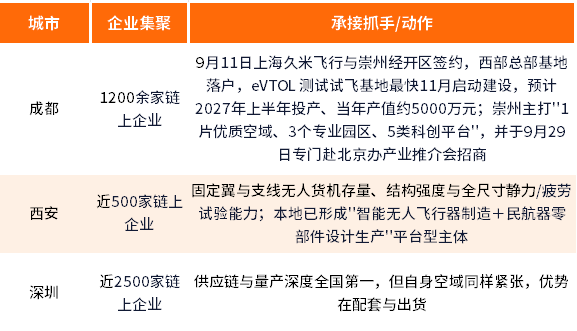 Source: Huoshi Xinglan Industrial Intelligence Agent
3. Scenario-based cities. Certified operators are highly concentrated in Shenzhen, Hangzhou, Shanghai, Hefei, and other places, where mature application ecosystems serve as the strongest magnets for undertaking industries.
03 Comparative Advantages Become Clearer Under Pressure
From the industrial chain map of the Huoshi Xinglan Industrial Intelligence Agent, Beijing still boasts a dense concentration of advantageous nodes: flight control main control MCUs, onboard AI inference SoCs, onboard real-time operating systems and airworthiness evidence packages, aviation spherical titanium powder and metal matrix composites, anti-icing and anti-rain erosion coatings, semi-solid power batteries, hydrogen fuel cell systems, and a complete ground testing chain of 'structural design—fatigue and damage tolerance—load spectrum life prediction—non-destructive testing.'
The compression of controlled airspace affects the 'flight' links but allows Beijing to focus on its truly barrier (Note: ' barrier ' is translated as 'barriers' to convey competitive moats) areas—overall design, onboard software, aviation components, and verification capabilities. This forms a complementarity with other cities across the country: Beijing 'defines the products,' while peripheral cities 'build and fly them,' creating a symbiotic relationship.
The 300-kilometer circle will not drive the low-altitude industry away; it merely returns the industry to positions where respective comparative advantages lie. This adjustment serves as a stress test for Beijing, an entry ticket for cities outside the circle, and a reoptimization of factor efficiency nationwide.
The real question is not 'who loses what,' but whether each city has clearly identified its seat in the 'design—manufacturing—flight testing—operations' chain when airspace becomes the first scarce resource.
-
![]()
A Leap in Dimensionality Reduction: Why Both Meta and EssilorLuxottica Are Venturing into Hearing Aid Glasses
-
Reevaluating the Value of a Hundred-Billion-Dollar Track Through the Lens of Utopai Studios, the World's Largest Independent AI Film and Television Company
-
![]()
High-Profile Collaboration Unveiled! GAC, FAW, and Toyota Forge Major Partnership in Guangzhou
-
![]()
Analysis of Opportunities for Relocation of the Low-Altitude Economy Industry under Dual Control of Airspace and Equipment
-
![]()
JAC Motors Owes DCD Auto a Debt of Gratitude for Pushing It to the Limit
-
![]()
Over 70,000 Orders Confirmed in the First Month! How Did Xiaomi Pengcheng Achieve Instant Success Amid a Sluggish Extended-Range Vehicle Market?
-
![]()
Zunjie Issues Response, Dongchedi Releases Clarification
-
![]()
September Sales Figures Revealed for Up-and-Coming Auto Brands: 11 Players Including Xiaomi, HiMode Intelligent Travel, Li Auto, Leapmotor, NIO, Zeekr, and Shenlan