The Integration of North and South Toyota: A New Model for Chinese and Foreign Automakers
 10/09 2026
 562
562
Introduction
Introduction
Toyota, FAW, and GAC are jointly creating a 'China ONE TOYOTA,' setting a new precedent: not only exploring a path for joint venture transformation but also providing a reference for the integration of independent groups and the layout of multinational automakers in China.
The grand plan to synergize the joint ventures of North and South Toyota has finally reached the signing stage.
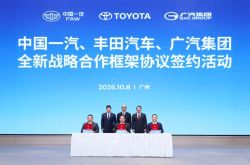
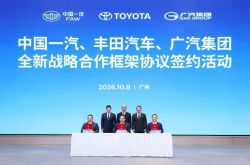
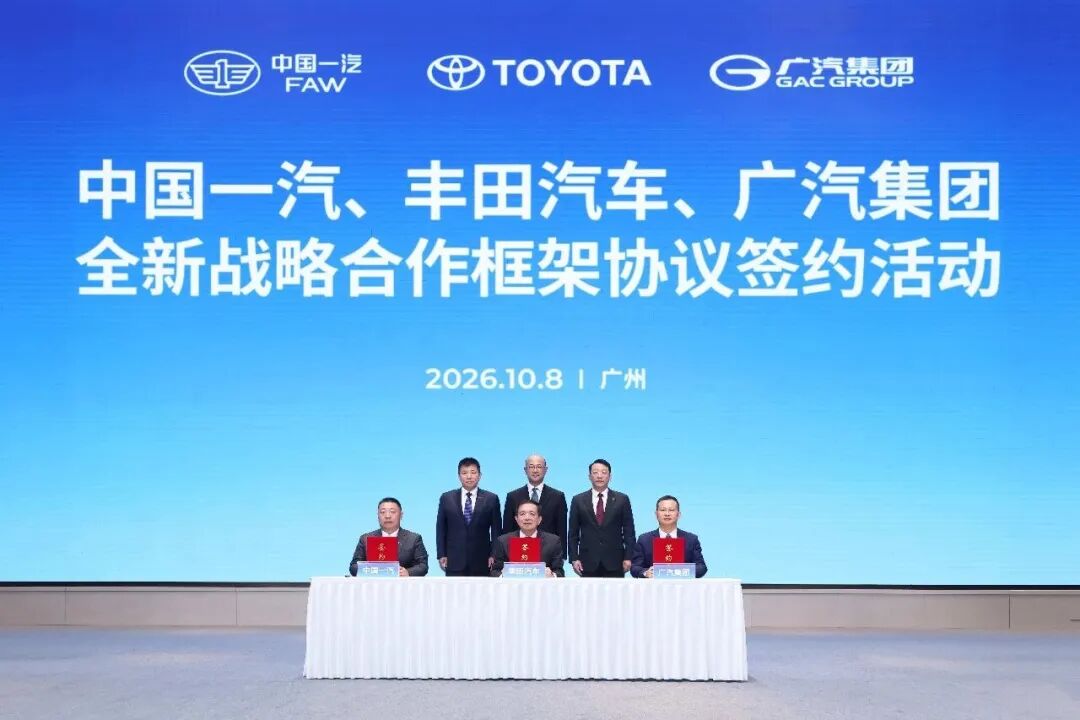
On the afternoon of October 8th, China FAW Group, Toyota Motor Corporation, and GAC signed a new strategic cooperation framework agreement in Guangzhou. Near Kenta, Toyota's president, making his first visit to China since taking office half a year ago, witnessed the signing alongside Liu Yigong, General Manager of China FAW Group, and Feng Xingya, Chairman of GAC.
According to the agreement, GAC plans to acquire a 50% stake in FAW Toyota held by China FAW Group through the issuance of shares. After the transaction, FAW Toyota will continue to operate as an independent entity, and China FAW will become a significant strategic shareholder of GAC.
Describing it as the 'optimal solution under current conditions,' Near Kenta, the helmsman of the world's largest automaker, gave high praise to the tripartite agreement and saw this day as a new starting point for Toyota's cooperation in China.
Auto Business commune recalled that when Toyota's Changshu R&D Center commenced operations in 2011, Akio Toyoda, in Chinese, exclaimed, 'China is the most important!' Since then, Toyota has embarked on a new chapter of localization in China.
As the automotive industry undergoes a sweeping transformation towards electrification and intelligence, the third decade of this century indeed calls for another new starting point, for Toyota, FAW, GAC, and their joint ventures alike.
The core content lies in the fact that FAW Toyota and GAC Toyota will jointly undertake the functions of R&D, procurement, production, and sales in their joint ventures, transitioning towards a structure where synergy outweighs competition. The tripartite agreement names this transformation 'China ONE TOYOTA.'
This is not merely a crude 'merger of two joint ventures' nor 'solely for Toyota to cope with internal competition in China.' Instead, it represents a new precedent jointly set by Toyota, FAW, and GAC: not only exploring a path for joint venture transformation but also providing a reference for the integration of independent groups and the layout of multinational automakers in China.
Looking back on this moment years later, when Liu Changqing, Assistant General Manager of China FAW Group, Tetsuro Ueda, Chief Representative of Toyota Motor China, and Ge Xianqing, General Manager of GAC, signed on behalf of the three parties, it might well deserve the phrase 'a new journey begins today.'
01 Understanding 'One Toyota'
If interpreted solely through a superficial lens, 'China ONE TOYOTA' could easily be mistaken as the 'forcible merger of FAW Toyota and GAC Toyota into a single entity.' However, this is merely a superficial 'method' and fails to address the challenges posed by complexity.
Toyota, FAW, and GAC have finally managed to address issues at their core—reversing competition and internal friction into synergy.
This signing did not happen overnight. Two years ago in Tokyo, Akio Toyoda, Chairman of Toyota, met face-to-face with key leaders from China FAW Group and GAC to discuss a new framework for tripartite cooperation. Over the past two-plus years, the three parties have continuously refined their plans, a process that was not easy but ultimately did not end in abandonment.
To understand the significance of synergy outweighing competition, one must first understand the value that competition once created.
In 2000 and 2004, Toyota successively partnered with FAW and GAC. During the golden age of growth, this north-south layout was textbook-perfect: twin models like the Corolla and Levin, RAV4 and Wildlander, launched separately, using internal competition to achieve dense coverage of market segments.
By 2025, FAW Toyota sold 805,500 units, GAC Toyota sold 756,000 units, and Toyota's sales in China surpassed 1.78 million units, up 0.23% year-on-year, making it the only Japanese brand to achieve positive growth that year. According to CAAM data, the combined sales of North and South Toyota accounted for 17.03% of joint venture passenger vehicle sales.
However, in an era of stock competition (market saturation), the same logic began to backfire. During the growth era, two separate systems meant coverage; in a saturated market, they meant redundancy. Two R&D setups, supply chains, channels, and marketing efforts led to product homogenization and cannibalization.
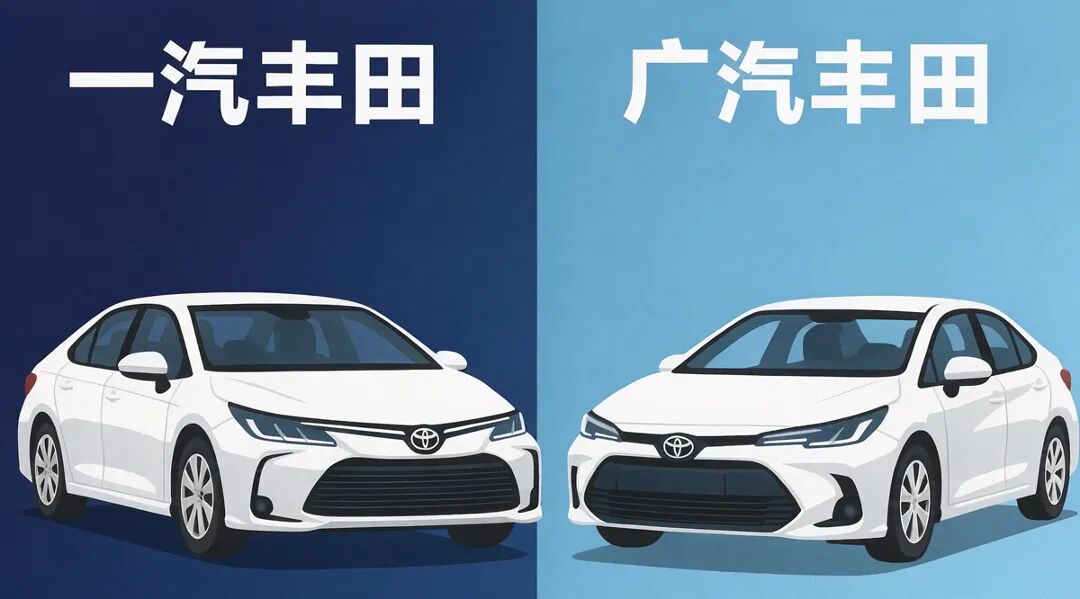
Data from the first half of 2026 best illustrates the issue. According to Toyota's sales figures in China, FAW Toyota sold 273,700 units, down 27.4% year-on-year, while GAC Toyota sold 341,100 units, down 6.3%. GAC's interim report showed GAC Toyota at 356,000 units, up 3.29%, due to differences in wholesale and retail figures, but FAW Toyota's significant pressure was evident under both metrics.
Thus, synergy outweighing competition is not a denial of the past but a calibration amid cyclical shifts. Near Kenta put it bluntly in interviews: the goal is to reduce internal friction, consolidate dispersed resources, and invest them where they truly determine market success.
More interestingly, integration has already been happening behind the scenes.
At the 2025 Shanghai Auto Show, Toyota China introduced the ONE R&D system, integrating R&D resources in China and establishing a Chief Engineer system for China. By the 2026 Beijing Auto Show, the number of Regional Chief Engineers (RCEs) had expanded from four to seven. Some engineers simultaneously oversaw the RAV4 and Wildlander, while others handled the Sienna and Granvia. In other words, before the equity transaction, the definition rights for similar models had already been consolidated under the same engineers. Product-level integration preceded capital-level changes.
Currently, positive signals have begun to emerge. Toyota's financial report showed 142,000 units sold in China in September, with the year-on-year decline narrowing from 17.1% in the first half to 1.6%. GAC Toyota sold 71,200 units, up 0.9%, while FAW Toyota sold 71,000 units, down slightly by 0.9%.
It was revealed that in terms of products, FAW Toyota and GAC Toyota will shift from competition to synergy, with layouts more closely aligned with the multi-technology route demands of the Chinese market. New models led by RCEs will be launched faster, with a more dense (frequent) rhythm of new car introductions. In a few weeks, the three parties will also hold a meeting with dealers to clarify these changes.
Regarding talent, Tetsuro Ueda provided a clear direction: reducing the scale of expatriate staff, offering more opportunities to local employees, and truly unleashing the capabilities of local teams. With R&D, products, and talent advancing in tandem, the new starting point has a concrete roadmap.
Once, ONE FORD saved Ford Motor Company globally; now, China ONE TOYOTA aims to enable Toyota, in collaboration with FAW and GAC, to break through in an extremely competitive industry landscape.
02 '3+3' Insight into the Essence
Let's dissect this transformation from three levels.
The first level is equity: FAW's Chinese stake in FAW Toyota will transfer from China FAW to GAC; China FAW will not exit but become a significant strategic shareholder of GAC. One 'buys,' the other 'stays,' aligning the interests of the two state-owned automakers through capital.
The second level is relationships: the two joint ventures will jointly undertake R&D, procurement, production, and sales functions, redefining their past competitive relationship.
The third level is the system: after equity optimization, a new operational system covering the entire chain, with faster response and higher efficiency, will be rebuilt. These three layers converge on a single keyword—synergy. Near Kenta also clarified that FAW Toyota and GAC Toyota will not undergo a full merger; both will remain independent entities but will transition from competition to synergy.
There are three layers of change, and within the history of Chinese automotive joint ventures, the milestone significance of this signing carries three layers of 'industry firsts.'
The first 'industry first': This is the first case since the full liberalization of joint venture equity ratios in 2022 where two major Chinese state-owned automakers have reconstructed their joint venture landscape through equity integration.
On January 1, 2022, the nearly 30-year-old 50% equity cap for foreign automakers in passenger vehicles was lifted, and the restriction of a maximum of two joint ventures per foreign company was simultaneously removed. After the policy gates opened, the entire industry watched to see how joint ventures would proceed. This time, the three parties provided the first answer with a framework agreement.
The second 'industry first': For the first time, two joint ventures under the same foreign parent have been officially guided towards a new structure where synergy outweighs competition.
Over the past two decades, the two joint ventures have promoted each other through healthy competition; however, the resource dispersion caused by parallel R&D, procurement, and sales systems is also a fact. As competition enters a phase of system and efficiency, 'brothers working together' carries more weight than 'brothers racing.'
The third 'industry first': For the first time, three previously separate threads—strategic restructuring of state-owned enterprises, foreign investment deepening in China, and full-chain efficiency reconstruction—have been interconnected within a single framework.
For China FAW and GAC, this is a practice of cross-regional synergy for state-owned assets; for Toyota, it is a proactive reshaping of its business architecture in China; for the entire industry, it signifies that the joint venture model is evolving from a traditional format to a new model of a community of shared interests.
Now, let's consider the individual accounts of the three parties.
For GAC, it gains an additional anchor. FAW Toyota operates three major bases in Tianjin, Changchun, and Chengdu, with a net profit of 4.234 billion yuan in 2025, providing investment returns that will feed back into its independent segment.
For FAW, it secures a second major shareholder position in GAC and a seat on the sales company board, benefiting the group's profit and sales scale while gaining access to GAC's electrification technology.
As for Toyota, it achieves its most significant structural gain in over two decades, transitioning from a minority shareholder in two systems to the controlling shareholder of a proposed unified sales company, finally gaining channel dominance.
Each party gets what it needs, which is why this operation has navigated through complex obstacles to reach today's signing.
03 'Opening the Window'
In his signing speech, Near Kenta recounted a detail—when Toyoda Sakichi came to China over a century ago to engage in the textile business, he convinced skeptics with a single phrase: 'Open the window and see how vast the world outside is.'
The collaboration between FAW and GAC this time extends far beyond Toyota's joint ventures themselves. It represents the first major breakthrough in exploring methods for restructuring and merging central and local state-owned automakers, setting a precedent in capital operations and cross-regional synergy. At a deeper level, it embodies the essence of 'opening the window' by shifting from competition to synergy.
Thus, Auto Business commune evaluates this signing as 'a new model for transformation across three camps: independent groups, joint ventures, and overseas leaders.'
Originally, how difficult was integration?
Looking back at 2025, the group-level restructuring between Dongfeng and Changan ultimately stalled after over 100 days of negotiations. Administrative levels, headquarters and tax locations, control rights, and employment placement (resettlement) were all zero-sum games.
FAW and GAC chose a different path: they did not touch group control rights but focused on equity binding around their joint venture assets; they avoided cash acquisitions, opting instead for share swaps to deeply bind mutual interests over the long term. Integration targets shifted from the group level to specific assets, transaction methods from cash acquisitions to equity swaps, and integration logic from expanding asset scale to activating existing assets and improving efficiency.
This is a smarter and more sustainable approach: first, align interests, then grow businesses together. For FAW and GAC, the value of this cooperation extends beyond Toyota's joint venture business; it pioneers a new path for 'non-consolidation, non-seizure of power, and business synergy through capital ties' among central and local state-owned automakers.
Meanwhile, the synergy between North and South Toyota provides a quantifiable, verifiable synergy model for industry integration: how much cost savings are achieved through centralized procurement, how much capacity utilization improves, and how many redundant models are reduced—these figures are all calculable.
Once synergy effects are validated, the potential for expansion is considerable.
FAW has deep roots in Northeast and North China, with a dealership network covering the north and strong market presence in commercial vehicles and government/enterprise clients. GAC is entrenched in South China, excelling in new energy vehicle technology and market-driven mechanisms, with access to the Greater Bay Area's industrial and talent ecosystem and South China's export hubs.
The complementary strengths of northern manufacturing heritage and southern market-driven vitality, joint research in key areas like solid-state batteries, intelligent assisted driving, in-vehicle operating systems, and automotive-grade chips, and shared overseas channel resources are all promising prospects. For independent groups, this is not just about activating existing assets but also about restructuring capabilities for the next phase of competition.
'The three parties hope to make this cooperation a model referenceable—and even emulatable—by the global automotive industry,' Near Kenta declared, elevating the impact of this precedent to a global level.
We often say that Chinese automakers need to successfully export overseas. The methods of export range from finished vehicles as the foundation, to supply chains and technology as the intermediate stage, with brand, culture, and industrial philosophy representing the advanced stage.
If this tripartite synergy becomes a global model, as Near Kenta suggests, it will mark a milestone in China's automotive industry achieving high-level global output.
An anecdote mentioned by Near Kenta carries significant symbolic weight: while staying at a hotel in Guangzhou, he joined a Toyota board meeting via video link—the first time in Toyota's history that a board meeting was held outside company premises, with the Guangzhou Tower visible through the window.
For China's automotive industry, that most crucial window has clearly been pushed open.
Editor-in-Chief: Shi Jie Editor: He Zhengrong

THE END
-
![]()
Zunjie V800 Rolls Out Free Upgrades Following Three Brake Pedal Malfunctions
-
![]()
FAW Toyota to Maintain Operations; FAW, GAC, and Toyota Forge New Partnership
-
![]()
Automotive Consumption Policy: Transitioning from Short-Term Boosts to Long-Term Ecosystem Development
-
![]()
QianWen N1 Pro and Wigain Flow Enhance Eye Perception, AI Glasses Complete Personal Context Entry
-
![]()
The Integration of North and South Toyota: A New Model for Chinese and Foreign Automakers
-
![]()
Why Does Mass Production Spell Doom? The Price Dilemma of Micro-Optical Engines from a Supply Chain Perspective
-
![]()
A Leap in Dimensionality Reduction: Why Both Meta and EssilorLuxottica Are Venturing into Hearing Aid Glasses
-
Reevaluating the Value of a Hundred-Billion-Dollar Track Through the Lens of Utopai Studios, the World's Largest Independent AI Film and Television Company