Can Leapmotor Truly ‘Lead the Charge’? The Cost-Quality Trade-off Behind Export Profits
 10/20 2026
 507
On the 16th of this month (Beijing Time), the first European-produced Leapmotor B10 compact all-electric SUV officially rolled off the assembly line at the former Opel factory in Zaragoza, Spain. Leapmotor’s perceived “lead” seemed to send a message to rivals eyeing the European market: “Don’t even try—you can’t compete with our balance of affordability and quality.”
But beneath this boast lies a genuine question: How does Leapmotor manage to keep prices so low? Is it by undercutting costs at a loss, much like Chinese motorcycles did two decades ago, or by genuinely reshaping the entire cost structure?
To answer this, we must first understand: Prices don’t have an absolute floor—only a limit to how far they can drop without compromising quality.
A “scissor effect” comes into play: as list prices decline, hidden costs from defects, warranty claims, and recalls rise. The point where these two lines intersect marks the price floor. Crossing it means every dollar saved today is borrowed against tomorrow’s brand reputation or product integrity.
Thus, the boundary for cost-cutting isn’t a specific figure but a judgment call: when the only way to reduce costs further is by downgrading materials or skipping processes, the limit has been reached.
The lingering shadow of Vietnam’s motorcycle collapse
In the 1990s, Chinese motorcycles flooded Vietnam at less than half the price of Japanese models, capturing over 80% of the market within years. Prices then nosedived from $800 to $200 per unit, with profits dwindling to just $30 per bike. To stay afloat, manufacturers resorted to using substandard parts, skipping inspections, and assembling bikes under Japanese brand labels. Once the “breaks in two years” reputation took hold, Japanese brands struck back with affordable models, reducing China’s market share to nearly zero by 2016.
The pattern was clear: profit squeeze → forced cost-cutting → widespread quality failures → reputation damage → market exit.
Price wars don’t kill companies outright. They first trap firms into a downward spiral of survival-through-degradation, leaving consumers and time to finish the job. The issue wasn’t that Chinese products were inherently inferior, but that companies treated low prices as their only competitive edge, sacrificing quality and brand credibility for short-term gains—dragging the entire industry into a race to the bottom.
As a bus exporter in Xiamen noted this year: “Indonesian clients still distrust our products due to past experiences.” Reputations have long memories. The motorcycle industry’s debts are still being paid by the automotive sector.
But today’s auto industry isn’t repeating that playbook.
Leapmotor reshapes the cost structure
Unlike Vietnam’s motorcycle market, Leapmotor takes a fundamentally different approach.
It has established 18 in-house component factories, with self-developed core parts accounting for over 65% of total vehicle BOM costs.
Founder Zhu Jiangming explains, “We build cars factory-direct, earning margins on components.” Self-manufacturing saves roughly 10% in vehicle costs. More critically, it enables tight quality control and continuous innovation: 100% in-house battery packs, 90% platform commonality—achievements impossible through mere price pressure alone.
An analysis of new car filings by Dianchehui reveals: For power batteries, Leapmotor produces all battery packs in-house via Lingxiao Energy, sourcing only cells externally.
From 2023–2026 MIIT filings, Leapmotor’s cell suppliers broke down as follows: 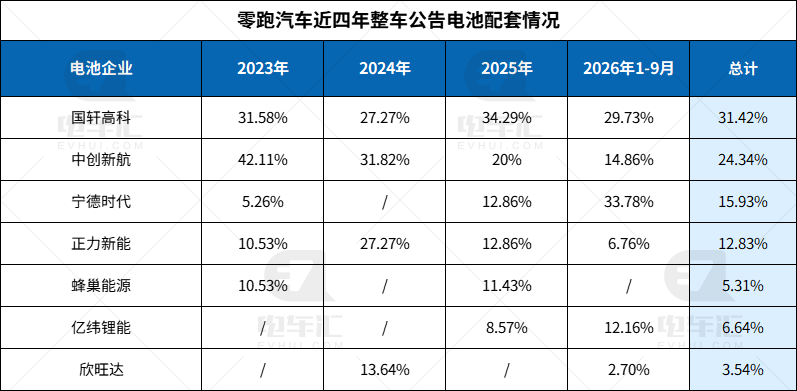
Across 113 new car filings, CATL accounted for just 15.9% (3rd place). Guoxuan High-Tech led with 31.4%, followed by CALB (24.3%), Zenergy (12.8%), SVOLT (5.3%), EVE (6.6%), and Sunwoda (3.5%). By 2026, cell suppliers numbered six—highly diversified by industry standards.
The focus isn’t on who replaces whom but on in-house battery pack production. While cells make up 80% of battery pack costs, BMS, thermal management, structural parts, and PACK assembly account for the remaining 20%.
Automakers outsourcing battery packs cede this 20%+ value to suppliers. Leapmotor’s in-house PACK production retains this margin internally. Combined with seven+ switchable cell suppliers, no single provider can dictate terms.
Multi-sourcing ensures bargaining power; in-house PACK prevents value leakage. Together, they form the complete picture of battery cost reduction. 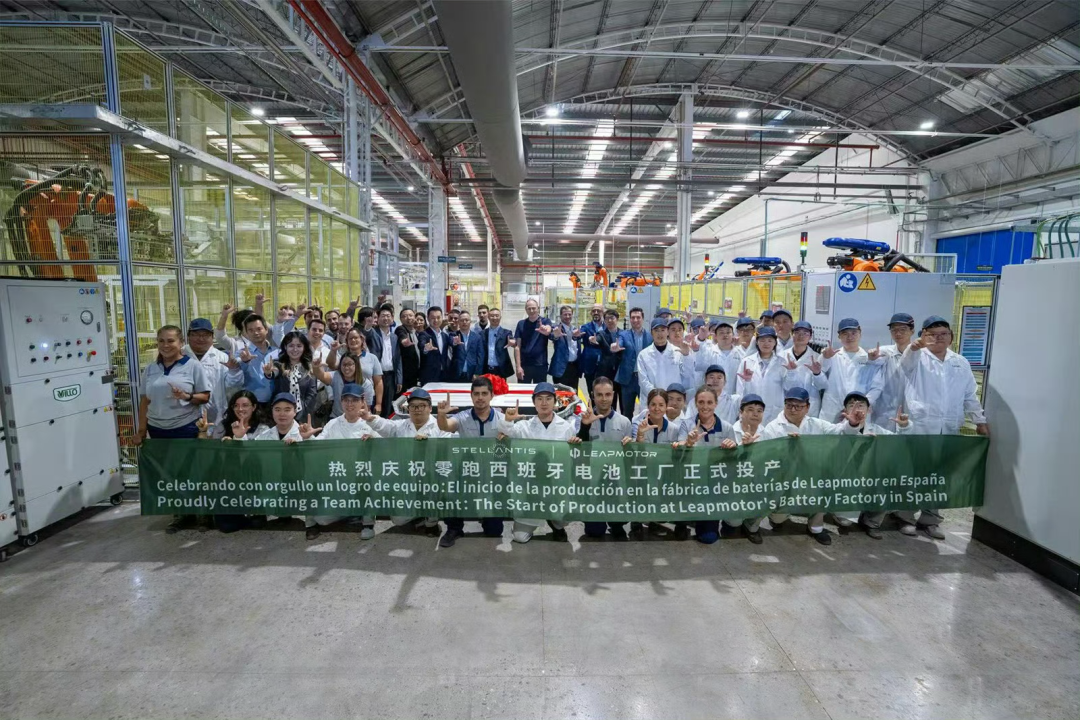
Leapmotor trades higher management complexity for lower procurement costs and stronger supplier leverage. It draws a precise line: standardized, competitive segments go to multiple suppliers, while integrated, vehicle-coupled components remain in-house.
The market rewards are clear. Leapmotor delivered 105,656 units in September 2026 (+58.5% YoY), with 666,539 units in Jan-Sep (+68.5% YoY), maintaining 100,000+ monthly deliveries for three consecutive months. First full-year profitability arrived in 2025, proving cost reductions deliver tangible financial results.
Yet reality must be acknowledged. Profits remain thin, with gross margins dipping post-2025 due to upstream price hikes and product mix shifts. Current per-unit net profit remains in the low thousands.
So how far can cost-cutting go? The answer is clear.
Further reductions will come from engineering efficiency, platform commonality, production localization, economies of scale, and technology licensing—areas competitors can’t replicate and are insulated from upstream inflation.
What must not be cut are materials, processes, testing, and warranties. Every dollar saved here mortgages future reputation.
Leapmotor’s strategy prioritizes core strengths: technological self-reliance, quality/service foundations, then global expansion through tech licensing and local production. Not the fastest path, but the surest.
-
![]()
Self-Developed Chip Valued at 10 Billion Yuan: Can Li Auto’s Second Growth Curve Succeed?
-
![]()
The Year of High-Intensity Action: What Is Ant Group Betting On?
-
![]()
DeepSeek V4 Pro Officially Launches with Price Increase Effective August 17
-
![]()
Keynote Speaker | Li Yanming, Volcano Engine’s Senior Enterprise Solution Expert, Confirmed for WAIE (10th) 2026 AI Industry Conference & AI Agent Industry Application Conference
-
![]()
Nvidia Brings in Wall Street, Potentially Revolutionizing Valuation Logic for Computing Power
-
![]()
High-Profile Guest | Qiao Yuchuan, Director of Embodied Intelligence Solutions at SenseTime, Confirmed to Attend WAIE (10th) 2026 AI Industry Conference & AI Agent Industry Application Conference
-
![]()
Conant Optical Claims Spot in Alibaba’s Qianwen AI Glasses Core Optical Supply Chain!
-
![]()
Breaking Away from Integrated Assembly: What’s the Wager of This Domestic FTIR ‘Little Giant’?