Profits Plummet by 40%, Yet Musk's AI Ambitions Remain Undeterred
 10/23 2026
 336
Accelerating FSD's Entry into China
”
Author|Wang Lei
Editor|Qin Zhangyong
After reviewing Tesla's financial results, I suddenly understand why Musk is eager to merge with SpaceX.
Over the past two trading days, two trillion-dollar companies under Musk's name have released their financial results. First, SpaceX published its second quarterly report since going public, showing a staggering 161% year-over-year revenue increase, achieving single-quarter profitability for the first time, with an 8% post-market stock price surge.
However, 24 hours later, Tesla's Q3 results painted a different picture:
Operating profit stood at $718 million, a sharp 56% year-over-year decline, with the operating profit margin sliding from 5.8% in the same period last year to 2.6%. GAAP net profit was $787 million, down 43% year-over-year, marking Tesla's least impressive set of profit figures in recent years.
Nevertheless, the comprehensive gross profit margin, indicative of profitability, reached 19.6%, with overall gross profit hitting $5.494 billion, a 9% year-over-year increase. The automotive business gross profit margin also rebounded to 18.5%, slightly higher than market expectations.
Thus, the profit decline cannot be simply attributed to "Tesla not making money from selling cars." On the contrary, it is precisely "selling cars" that maintains its current dignity.
01 Cars Generate Profit, Money Spent Elsewhere
How did Tesla deliver such a contradictory Q3 performance?
The reason is not difficult to summarize: Musk is increasingly investing the money earned from selling cars into autonomous driving, humanoid robots, and AI.
Let's first look at the fundamentals. Tesla achieved revenue of $28.046 billion in the third quarter, roughly in line with $28.09 billion in the same period last year and slightly below market expectations of $28.13 billion.
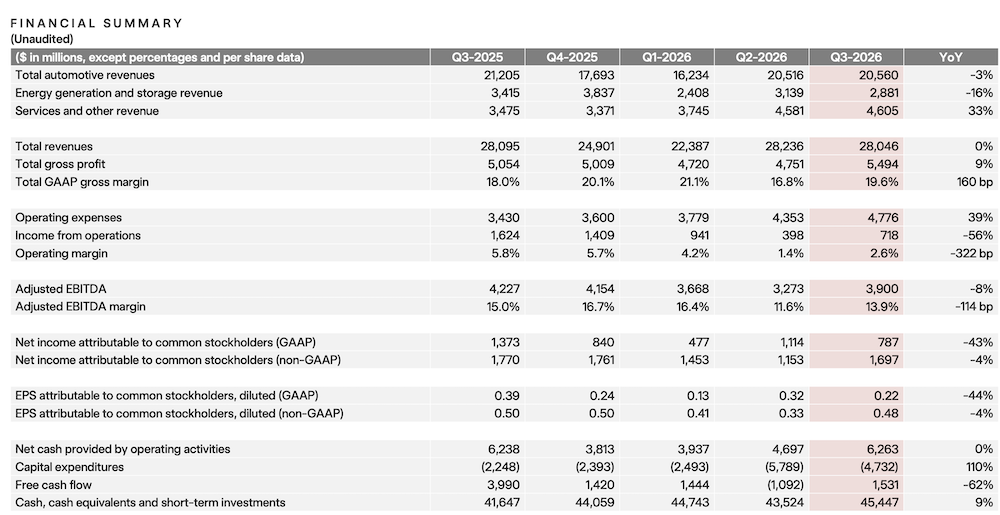
Revenue remained relatively stable, with the issue lying in profits.
GAAP net profit was $787 million, a significant 43% year-over-year drop, with adjusted net profit at $1.697 billion, down 4% year-over-year. Adjusted earnings per share were $0.48, higher than market expectations of $0.44. Operating profit was $718 million, more than halving year-over-year, with the operating profit margin sliding from 5.8% in the same period last year to 2.6%.
With profits plummeting, many's first reaction is that Tesla is struggling to sell cars, but that's not the case.
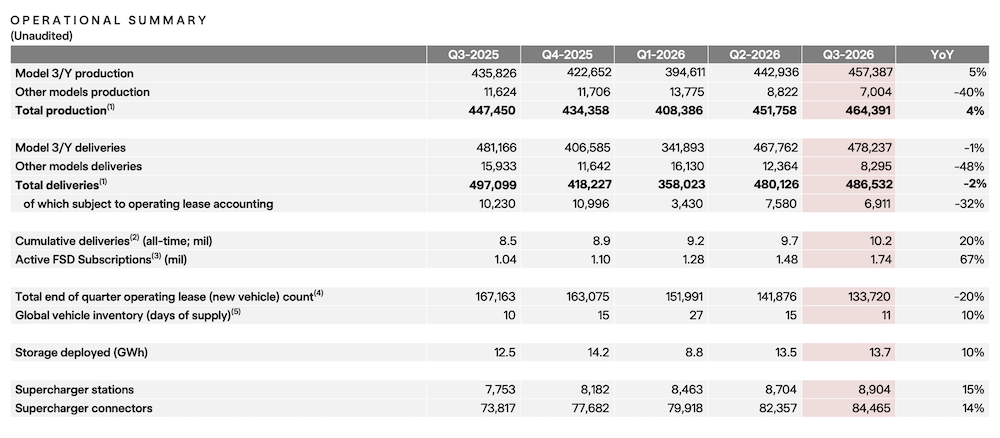
In the third quarter, the automotive segment, still the core pillar, generated revenue of $20.56 billion. Although down 3% year-over-year, 486,500 vehicles were delivered globally, marking two consecutive quarters of over 480,000 deliveries. Moreover, the automotive business gross profit margin further rebounded to 18.5%.
Meanwhile, vehicle inventory supply days dropped from 15 days in the previous quarter to 11 days, well below the 27 days in the first quarter. Additionally, the financial results showed that passenger car backlog orders reached their highest level in four years.
This sufficiently demonstrates that Tesla's cars were in high demand in the third quarter. Even Musk stated during the earnings call that the company's current automotive demand exceeds production capacity, and efforts are underway to increase output at various factories.
The issue lies with regulatory credits. Previously, these credits provided high-profit supplements for Tesla, but this dividend (dividend) is rapidly diminishing. In Q3 this year, Tesla's automotive regulatory credit revenue was just $113 million, a staggering 73% drop from $417 million in the same period last year, offsetting some of the gains from improved production efficiency.
Therefore, after excluding regulatory credit revenue, the automotive business gross profit margin remained at 18.1%, up 1.8 percentage points from 16.3% in the second quarter and higher than 15.4% in the same period last year.
In other words, the money earned from selling cars itself has not decreased; in fact, it has increased.
So why, despite growing demand and gross profit, did operating profit and net profit decline significantly? The answer lies in expenses.
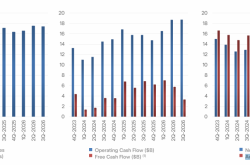
Tesla's capital expenditures surged by 110% in the third quarter, reaching $4.732 billion (approximately RMB 31.590 billion), directly causing free cash flow to shrink significantly to $1.531 billion (approximately RMB 10.221 billion), a sharp 62% year-over-year decrease.
In the third quarter, Tesla's operating expenses reached $4.776 billion, a 39% year-over-year increase. Research and development expenses alone rose by 69% to $2.76 billion.
Musk's "$1 trillion compensation plan," which drew much attention last year, has also begun to appear in the financial statements. Stock-based compensation for the entire company reached $1.165 billion in the third quarter, a 76% year-over-year increase, which is a significant reason for the 29% growth in selling, general, and administrative expenses.
Tesla does not shy away from revealing where this money is going in its financial results—almost all of it is being poured into AI, the Optimus humanoid robot, and the Cybercab self-driving taxi.
Tesla stated that increased investments in AI, superintelligence, and other R&D projects, rising equity incentive expenses, and growing sales and administrative expenses are significant reasons for the decline in operating profit. Meanwhile, reduced regulatory credit revenue and a decline in gross profit from the energy storage business have also had negative impacts.
It is evident that cars remain the main business, but Tesla is already preparing for its next path, which explains the seemingly contradictory performance in Q3.
Moreover, it is worth noting that Tesla has proactively lowered its full-year capital expenditure guidance from $25 billion to $20 billion while securing a $30 billion borrowing capacity for future expansion.
On one hand, it is reining in investment pace; on the other, it is preparing ammunition in advance, indicating that Robotaxi, Optimus, and the chip factory—these money-consuming ventures—are about to enter a protracted battle.
02 Musk Clams Up on "Merger"
Perhaps due to the uninspiring nature of the financial results themselves or to quell shareholders' doubts about the lack of visible results from heavy investments, during this earnings call, Musk unusually provided a more definitive commercialization timeline for various business lines.
Firstly, FSD is beginning to turn into a business. From management's perspective, the most significant change in the third quarter was not the number of additional vehicles delivered but the increasing number of vehicles delivered with FSD subscriptions already Binding (bundled).
As of the third quarter, Tesla's global active paid FSD users reached 1.74 million, with half being subscribers. Additionally, over 75% of new car deliveries in North America included paid FSD, up nearly 20 percentage points from the second quarter.
This means Tesla is attempting to extend automotive profits from one-time sales to ongoing software revenue.
During the earnings call, CFO Tanejha specifically explained that each new car comes with a one-month free FSD trial, and the proportion mentioned refers to customers still choosing to pay for a subscription despite the free trial, also hinting at future disclosures of more indicators regarding FSD revenue, renewal rates, and churn rates.
Notably, an analyst on the call estimated that FSD's annual recurring revenue is approaching $1 billion, an estimate that Tanejha acknowledged.
However, regulatory issues remain the biggest constraint. Musk stated that FSD has currently been approved in nine EU countries. He expects EU-wide approval to come within a few months and said he would be surprised if it is later than the first quarter of 2027.
Regarding the Chinese market, there was also new discussion during the call. Tesla believes its technology still holds an advantage and is actively pushing for broader FSD market approval in China.
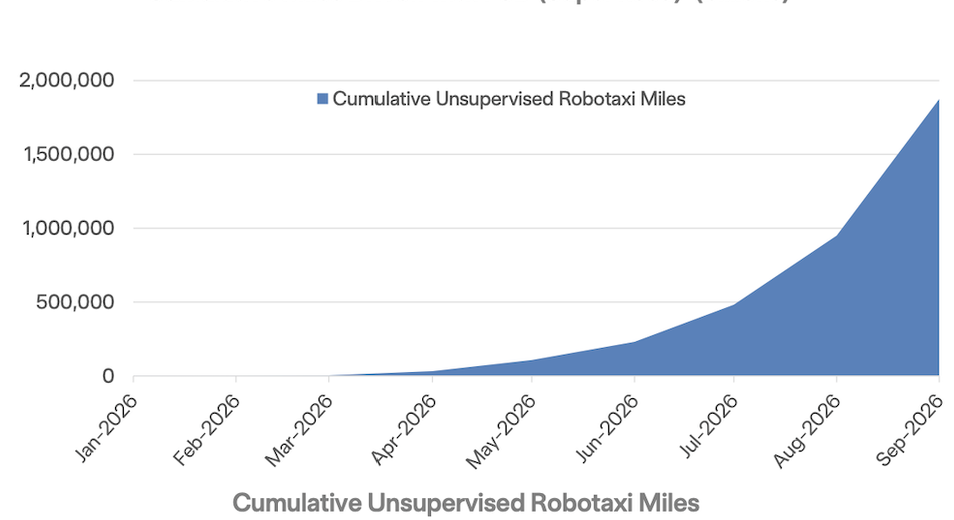
Compared to the growth of FSD, Musk described the progress of Robotaxi as "like a rocket entering orbit." By the end of the third quarter, Tesla Robotaxi's cumulative unsupervised driving mileage had approached 2 million miles, increasing eightfold from the end of the second quarter.
Musk stated that the scale of Austin's Cybercab fleet has grown about tenfold since going online a month ago, with plans to launch Cybercab in Dallas in November and expand it to other cities by the end of the year.
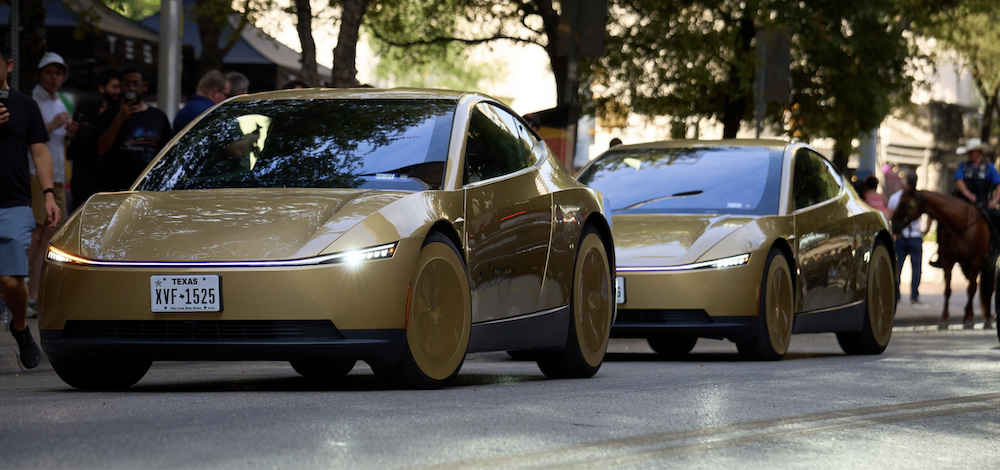
Not only expanding operational scope but also increasing operational hours, aiming to achieve 24/7 operations and expand to highways by the end of the year. Ordinary car owners' vehicles are expected to be able to join the Robotaxi fleet around the second quarter of 2027, provided they meet conditions such as geofencing, vehicle management, and regulatory approval.
After a burst of praise, Musk still didn't forget to add a blunt truth, stating that Robotaxi's actual contribution to financial statements will not begin to show until after the second quarter of 2027, and it will not become a significant profit source until the third or fourth quarter.
In other words, investors will have to wait another three to four quarters before seeing this story materialize in numbers.
The robot, on which even greater hopes are pinned, requires an even longer investment cycle. Although in the third quarter, Optimus has begun early production on the mass production line at Fremont Factory, and even the first batch of robots meeting mass production quality standards has rolled off the line.
However, achieving the goal of producing 1 million units annually or 20,000 units per week "will take at least a year, perhaps longer," Musk admitted, with hand design remaining the main hardware challenge. Musk stated that robot fingers must be soft enough to pick up fragile items while withstanding repetitive motions and long-term wear, all while protecting internal sensors, increasing design difficulty.
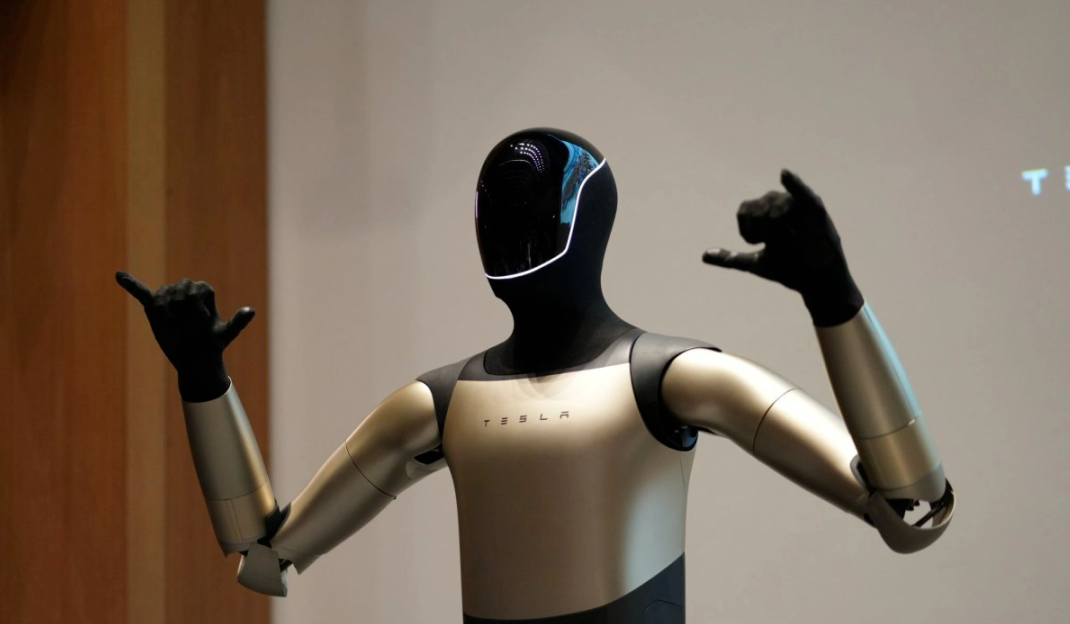
AI capabilities and reliability also need simultaneous improvement. According to Musk's expectations, Optimus plans to integrate the next-generation AI5 chip around April 2027, further enhancing the robot's computing power.
He also previewed that a demonstration video of Optimus would be released in about a month, specifically emphasizing that "he does not want the movements to be preset (preset)." This statement is notably more restrained compared to his previous boast of "mass-producing a million units next year."
Moreover, the delivery timeline has also been shifted by Musk to around the end of 2027 before external customer deliveries can begin.
The chip manufacturing plan supporting the automotive and robot businesses is also advancing concurrently. Musk expects equipment debugging to begin in the first half of 2027, with attempts to manufacture the first chip in May or June, and the true mass production goal pointing to the end of 2028.
The most unusual scene of the day occurred when, during SpaceX's financial results call the previous day, Musk stated that a merger between SpaceX and Tesla was under discussion and that a special committee had been formed.
However, during Tesla's financial results call a day later, he remained silent on the matter. "Regarding the potential merger with SpaceX, I think I've said everything that needed to be said yesterday (Tuesday)," Musk said.
He also left a cryptic remark—"dancing the tap dance in a minefield, that's it"—before refusing to elaborate further.
-
![]()
Profits Plunge by 40%, Yet Musk's AI Vision Stays the Course
-
![]()
Profits Plummet by 40%, Yet Musk's AI Ambitions Remain Undeterred
-
The Second Half of AI: The Crucial Battle for Trust
-
![]()
Japanese Car Companies' Local Alliance Faces Disintegration Amid Emulation of China's Rapid Development
-
![]()
When Each Car Brings Only 3,000 Yuan in Profit, How Long Can Upstream Auto Parts Suppliers Hold On?
-
![]()
Net Profit Tumbles! Musk Persists in Investing, Tesla Faces a ‘Crucial Challenge’ in 2027
-
![]()
Post-National Day Sales of Xiaomi Revealed, Netizens: Pengcheng's Sales Take a Dive!
-
![]()
Understanding NVIDIA GTC Berlin at a Glance: AI in Manufacturing, Physical AI, and Three Key Strategies