BYD's 490,000 Vehicles Dominate the Field as Joint-Venture Automakers Beat a Hastier Retreat: October Auto Market Undergoes Major Shakeup
 11/04 2026
 568
Written by | Guancheshi
China Auto Data Research recently released its October automaker and brand sales rankings—and the results make for fascinating reading.
October marks the final month of the Golden September and Silver October period, and the last normal selling month before the year-end sales push. With the peak-season filter applied, it becomes clearer who is truly growing and who is barely holding on.
01
First, something many voices have discussed: the cards at the emerging forces table are being reshuffled.
Take Leapmotor first. 106,127 vehicles, a slight month-on-month increase of 0.4%, a massive year-on-year surge of 51%, and a cumulative total of about 773,000 vehicles in the first ten months.
What does this volume mean? In horizontal comparison, it is roughly the combined sales of XPeng, NIO, and Li Auto in October.
Leapmotor's cumulative result of 770,000 vehicles in the first 10 months, placed two years ago, would have been a number that the top emerging-force brands would not have dared to imagine for a full year.
In Guancheshi's view, Leapmotor's approach is not novel: in the 100,000 to 150,000 yuan price range, it rolls out both extended-range and pure electric lines, bringing features from others' 300,000-yuan class down to the 100,000-yuan class, and is dubbed the 'half-price Li Auto.'
This price point is precisely the greatest common denominator for Chinese family car purchases. The thin profits others disdain have been turned into scale by Leapmotor.
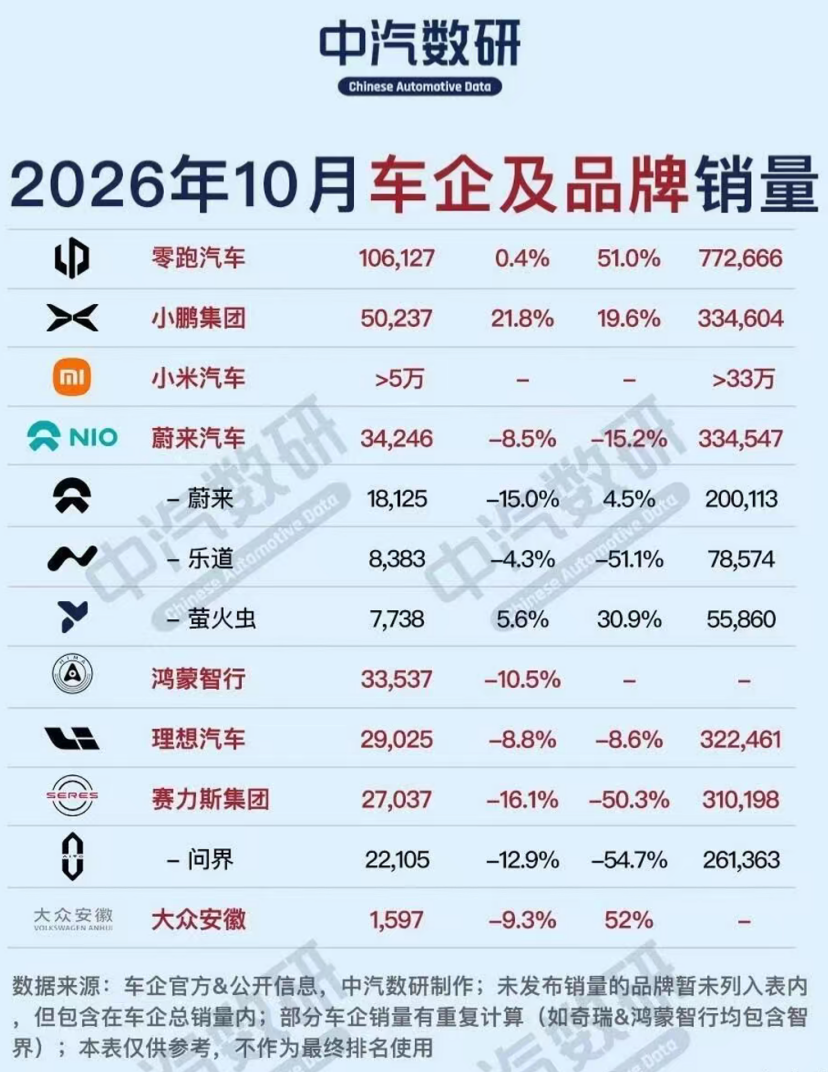
Xiaomi Auto's October deliveries continued to exceed 50,000 vehicles, with cumulative deliveries exceeding 330,000 in the first ten months. Monthly deliveries have already surpassed NIO, Li Auto, and AITO. It can sell as many as its production capacity can reach, and it has continuously become a presence that emerging forces cannot ignore.
In contrast, the traditional emerging forces are becoming less and less visible: XPeng 50,200 vehicles, up 19.6% year-on-year, still climbing. NIO's entire lineup combined 34,700 vehicles, down 15.2% year-on-year, with Onvo down by half year-on-year, and Firefly still ramping up volume. Li Auto's growth rate is also declining.
02
Now looking at the high-end segment. AITO sold 22,100 vehicles in October, down 54.7% year-on-year; Harmony Intelligent Mobility Alliance sold 33,500 vehicles, down another 10.5% month-on-month.
Within HIMA, Zhijie, Xiangjie, and Zunjie combined account for about 11,000. The volume AITO has given up is currently not being picked up by any other 'Jie.'
High-end new energy vehicles above 300,000 yuan were still an incremental market last year, but this year they have become a stock market battle. The cake has not grown larger, but the number of competitors dividing it has doubled.
The middle ground is not idle either. Hyper Aion BU about 42,400 vehicles, up 56.8% year-on-year; Changan Qiyuan 63,600 vehicles, up 22.2% month-on-month; BAIC New Energy 32,500 vehicles, up 35% month-on-month.
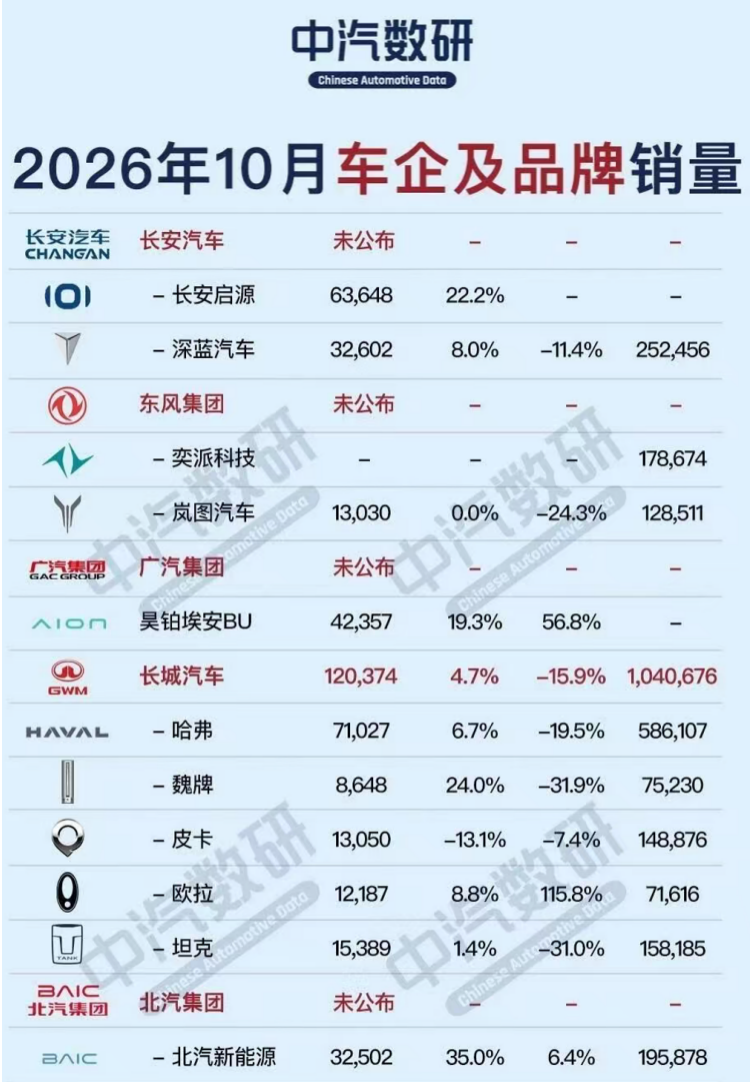
The new energy sub-brands of traditional major automakers are squeezing in from both ends toward the middle. The 150,000 to 250,000 yuan meat that emerging forces once had is now being fought over by more and more players.
03
The most eye-catching is none other than BYD. It sold 490,168 vehicles in a single month, up 11% year-on-year, and 3.62 million in the first ten months. In terms of scale, it still has no rival.
In Guancheshi's view, BYD's three high-end brands are taking three different paths.
Fang Cheng Bao has secured its position through the single opening of hardcore off-road vehicles, with 43,900 vehicles, up 41.3% year-on-year, making it the most stable in volume among the three.
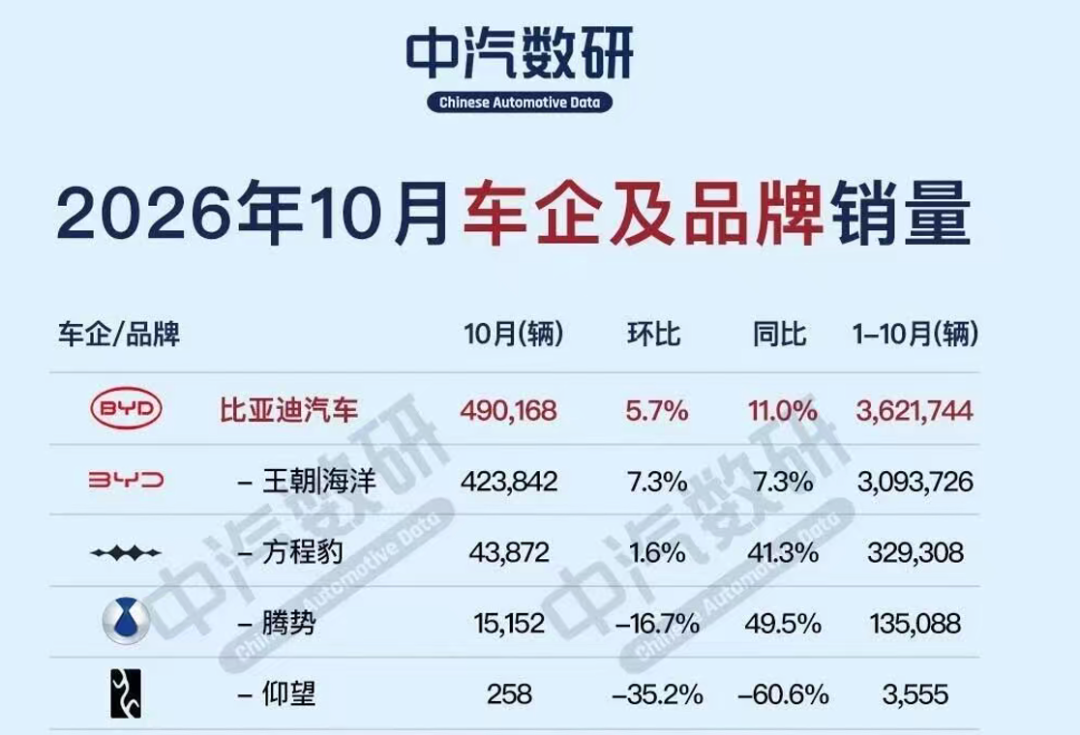
Denza 15,200 vehicles, up 49.5% year-on-year, but down 16.7% month-on-month. Too many competitors have squeezed into the high-end MPV and luxury SUV segments this year, and its space is being gradually thinned out.
Yangwang only 258 vehicles, down 60.6% year-on-year.
04
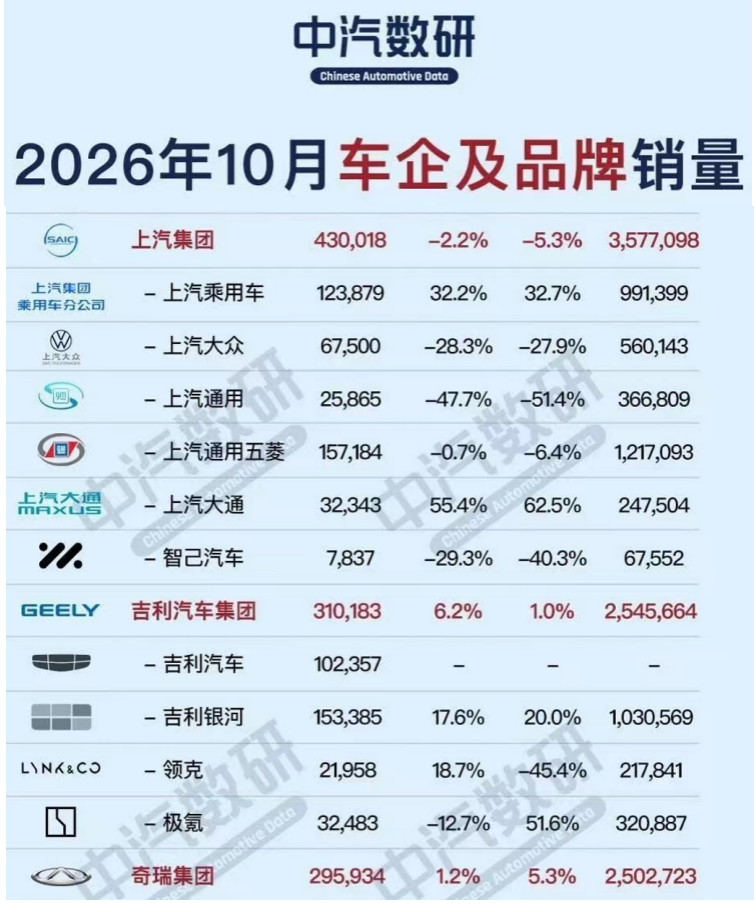
In the traditional camp, SAIC Motor's 430,000 vehicles in October still ranks first, but the quality of that number needs to be broken down.
Among them, SAIC Passenger Vehicle about 124,000 vehicles, up 32.7% year-on-year; Wuling about 157,000 vehicles to hold the base; SAIC Maxus about 32,000 vehicles, up 62.5% year-on-year. The self-owned segment and commercial vehicles are growing.
The two joint-venture carriages are collapsing: SAIC Volkswagen 67,500 vehicles, down 27.9% year-on-year; SAIC General Motors about 25,900 vehicles, down 51.4% year-on-year, halving for consecutive periods; IM Motors 7,837 vehicles, down 40.3% year-on-year, and high-end self-owned brands have also failed to break through.
Geely about 310,000 vehicles and Chery about 300,000 vehicles, steady with slight growth.
Great Wall about 120,000 vehicles, down 15.9% year-on-year; Haval down 19.5% year-on-year, with its base shrinking severely; Ora's 115.8% year-on-year surge sounds intimidating, but a volume of 12,000 vehicles cannot support the entire group's transformation.
Dongfeng's Voyah about 13,000 vehicles, down 24.3% year-on-year; Deepal about 32,600 vehicles, down 11.4% year-on-year. The new energy pieces of central SOEs are not moving very fast.
Guancheshi's summary is that among the vehicles sold by traditional giants, the share of self-owned brands is rising while that of joint ventures is falling. The rankings look like they have not moved much, but what is inside them has already changed.
October's ranking is not the final outcome, but the direction is now clear: those competing on scale will ultimately have to return to cost, and those competing on high-end are competing over whether old users are still willing to stay. Those who are caught in neither will face a long winter.
In the coming November and December, there will still be two rounds of extra time with year-end sales pushes and policy continuity. How the rankings will change is something we will wait and see.
Charts in this article without indicated sources are all from China Auto Data Research disclosures, hereby noted and thanked! Views in this article are for reference only and do not constitute investment advice.
This article is original by Leverage Guancheshi and may not be reproduced without authorization! If reproduction is needed, please obtain authorization. In addition, when reproducing with authorization, please indicate the source and author at the beginning of the article. Thank you!
-
Capturing Over Half of the AI Server ODM Market: Foxconn Industrial Internet's Stellar Performance, But Can It Shed the Contract Manufacturer Label?
-
Embarrassing: Apple Paid an Extra 16.7 Billion Yuan in "Memory Tax" This Quarter!
-
![]()
Musk and Gates's Feud Escalates!
-
![]()
ZTE Rumored to Sell Phone Business at 40 Billion Yuan Valuation, with a Major Internet Company Set to Take Over? Official Response Arrives
-
![]()
Prompt Engineering in Practice: Giving Six AI Characters Distinct Speaking Styles
-
![]()
Xingyu Co., Ltd.'s Q3 Net Profit Falls Nearly 40%: Chinese Automotive Lighting Has Won on Styling, but the Profits Are Gone
-
![]()
More like twins: the growth paths of these two automakers are strikingly similar
-
![]()
Chinese Automakers Go Global: Entering the "Export Quota Competition" Phase