Revenue Drops 40%, Gross Margin Holds at 22.55%: Seres' Mixed Q3 Report Card
 11/04 2026
 541
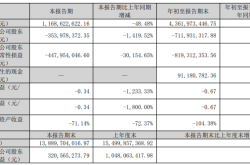
Seres recently released its Q3 2026 financial report, revealing a mixed picture: single-quarter operating revenue came in at 28.08 billion yuan, down 41.66% year-on-year, while net profit attributable to shareholders reached 1.42 billion yuan—a turnaround from a loss of 2.471 billion yuan in Q2. Yet looking at the first three quarters as a whole, the company's revenue stood at 85.573 billion yuan, down 22.58% year-on-year, and net profit attributable to shareholders remained a loss of 297 million yuan, down 105.59% year-on-year.
On one hand, a single-quarter turnaround; on the other, a cumulative loss. Between the positive and the negative, what exactly happened at Seres in the third quarter?

Where Did the 2.785 Billion Yuan in Non-Recurring Gains Come From?
The answer lies in the structure of the income statement. The Q3 report shows that Seres' non-recurring gains for the quarter totaled 2.785 billion yuan. After deducting this portion, the quarter's net profit attributable to shareholders after non-recurring items was -1.365 billion yuan, down 159.54% year-on-year. In other words, the core vehicle business was actually loss-making this quarter, and what propped up the 1.42 billion yuan net profit was an equity transaction.
The protagonist of this deal is Saidou Technology. In July this year, Saidou Technology completed a capital increase of approximately 6.671 billion yuan, bringing in external investors such as Chongqing state-owned capital, Xingyu, Bojun, and an employee shareholding platform.
After the capital increase was completed, Seres Automobile (Hubei)'s stake in Saidou Technology dropped to 32.96%, and Chongqing Shaci Zhiyuan became the largest shareholder with a 34.5% stake. Seres lost control, Saidou Technology was no longer consolidated into the financial statements, and the accounting method changed from the cost method to the equity method.
The effect of deconsolidation was immediate: losses from Landian Auto no longer dragged down the consolidated statements, while a considerable book gain was recognized.
Cash flow data offers another perspective. According to iFinD data, Seres' net cash flow from operating activities in the first three quarters was -14.51 billion yuan, and net cash flow from investing activities was -22.04 billion yuan.
In fact, funding pressure had already emerged in the first half. In H1 this year, the company posted a net loss of 1.72 billion yuan and net operating cash outflow of 12.38 billion yuan, compared with a net inflow of 14.44 billion yuan in the same period of 2025. For investors, in a quarter of contracting revenue, when the core business's ability to generate cash will recover is an indicator more worth tracking than single-quarter net profit.

Model-Change Gap Combined with Channel Handover: Sales Face Dual Pressure
The root cause of the revenue decline is sales. In the first three quarters, Seres' cumulative sales were approximately 283,200 vehicles, down 16.88% year-on-year. The pressure was concentrated in Q3, when vehicle sales were 86,581 units, down 40% year-on-year, of which the Seres brand accounted for 66,581 units, a drop of 46%. In September alone, sales fell 38.5% year-on-year to 25,000 vehicles.
But this is not a full-scale retreat; it is severe structural divergence. The AITO M9 sold 30,449 units in Q3 and ranked first in sales among models priced above 500,000 yuan for four consecutive months; the AITO M6 sold 21,986 units, with cumulative deliveries exceeding 60,000 units. What really held things back was the former volume driver, the AITO M8—sales continued to decline after entering 2026, with only 5,460 units sold in Q3. AITO did not launch any all-new products during the entire quarter, and its main models happened to be in a model-change gap period.
Another backdrop to the sales pressure is the historic adjustment of Seres' cooperation model with Huawei. On September 15, the two sides announced that Seres would lead product definition, design, marketing, channel retail, and the service system for the AITO brand, while Huawei Terminal would shift from "full-chain operation" to participating in empowerment.
This is a dual test for sales. On one hand, after the expansion of HarmonyOS Intelligent Mobility, Zhijie, Xiangjie, Zunjie, and Shangjie are diverting Huawei channel resources; on the other hand, AITO is about to exit Huawei phone stores, its most important traffic entrance, and move to exclusive channels, facing short-term pain from switching traffic entrances. The channel switch has already substantively begun—starting September 16, the signing entity for dealer agreements changed from Huawei Terminal to a Seres affiliate, and service fees for new orders are now settled by Seres. On September 30, the new AITO M8 started pre-sales under Seres' leadership, and publicly disclosed order performance was weaker than during the period when Huawei Terminal led.
It is worth noting that although sales nearly halved, gross margin did not collapse in tandem. According to iFinD data, the company's gross margin in the first three quarters remained at 22.55%, sales expense ratio was 14.36%, and R&D expense ratio was 6.65%, corresponding to approximately 5.69 billion yuan in R&D investment. Self-developed achievements such as the Magic Cube technology platform 2.0 and the new-generation super range-extender system were launched during this period. The high-end product structure led by the M9 became the most important support for gross margin.
However, the company also admitted that, affected by industry cycles, rising prices of core components have brought phased cost pressure, and it will not compress costs by lowering supply chain standards. Gross margin recovery "will not happen overnight."
New Five-Year Agreement Finalized: The Market Awaits the New M8's Answer
The cooperation adjustment in Q3 once sparked speculation of a "breakup," but the storyline quickly reversed.
On October 1, Seres and Huawei HarmonyOS Intelligent Mobility announced the signing of a new five-year cooperation agreement. The two sides will form a dedicated team for the AITO business to further upgrade AITO operations. Seres Chairman Zhang Xinghai and Huawei Terminal Chairman Yu Chengdong both attended the signing ceremony.
An investor relations activity record disclosed on November 2 showed that Seres once again responded to the relationship, calling it a "long-term, stable, and mutually trusting strategic cooperative relationship" with Huawei. The two sides have jointly established a dedicated exclusive team for the AITO business to upgrade AITO operations through an exclusive operating approach. According to the company's statement, exclusive operation is about improving quality and efficiency on the channel side, which can not only achieve a sales recovery but also improve model mix and enhance profitability.
It should be noted that the direction of "Seres-led" has not changed, but the boundaries of execution are still being worked out. The new five-year agreement did not clarify the final ownership of product definition rights and marketing channel leadership. People familiar with the matter said the two sides will continue negotiations on details; during the transition period, new AITO models launching in 2026 will still be designed under Huawei team leadership, and the new M8 itself is a "transition-period product." In other words, what was handed over on September 15 was "nominal leadership," while the actual switch on the product side will lag by one to two product cycles. The real hard deadline is January 1, 2027—when Huawei exclusive stores will officially split into two types: one selling only AITO, and one selling the other four Jie brands alongside other products.
On the product side, all eyes are on Q4. On November 13, the new AITO M8, which has completed six major experience upgrades, will officially launch and is regarded by the company as the key model to start a new product cycle. The outside world widely expects this to be a launch event led by Seres, with Yu Chengdong no longer appearing on stage. Before that, the AITO M9 Ultimate Extended Edition had already begun deliveries.
A longer-term move is overseas—AITO recently showcased its full model lineup at the Paris Motor Show and announced that it will enter the European market in autumn 2027. Supporting globalization is last November's Hong Kong listing. At that time, Seres raised net proceeds of HK$14.016 billion, making it the largest automaker IPO in Hong Kong in 2025, with about 70% directed to R&D and 20% to overseas channels and charging networks.
Capital-level actions are also proceeding in parallel. Since the beginning of this year, Seres has cumulatively repurchased 17.5357 million shares for a total amount of approximately 983 million yuan; the company's directors, executives, and core team have completed 148 million yuan in A-share and H-share increases, and the controlling shareholder's increase is still ongoing.
The company's latest operating policy also explains where this "high-end positioning" comes from. At the aforementioned investor relations activity, Seres made clear that it will adhere to profitability quality as its core orientation, not participate in price wars or scale involution, not pursue sales scale without profit support, adhere to a high-end operating route, and pursue long-term operation for every product; the focus of operations is shifting from one-time transactions to user full-lifecycle management.
Sell-side institutions' expectations are clearly running ahead of the fundamentals. Western Securities forecasts that Seres' revenue from 2026 to 2028 will reach 146.7 billion yuan, 160.3 billion yuan, and 184.4 billion yuan, respectively, with net profit attributable to shareholders of 1.5 billion yuan, 4.4 billion yuan, and 5.4 billion yuan. Compared with the 85.573 billion yuan revenue and 297 million yuan cumulative loss in the first three quarters, this set of forecasts implies quite aggressive volume assumptions for Q4—that is, the premise for their realization rests almost entirely on the order and delivery pace of the new M8.
Judging from the state presented in the third-quarter report, Seres is in a stage where "statement repair precedes operating repair." The deconsolidation of Saidou Technology completed asset-side burden reduction, the new five-year agreement stabilized the foundation of Huawei cooperation, and the M9 verified the profitability resilience of high-end products. But the three hurdles—turning the core business profitable, turning cash flow positive, and stabilizing sales—must be verified one by one only after the new M8 is delivered. After November 13, the suspense left by this third-quarter report will have a real answer.
-
![]()
Baidu AI Redraws Its Battle Lines
-
![]()
Memory Prices Are Soaring, and Better Days Are Coming for Longcheer Technology and Its Peers
-
![]()
Audi's North-South Split: Volkswagen Can't Afford to Wait
-
![]()
Doubao Phone Hits the Market: ByteDance's Bigger Game on the Phone Ecosystem
-
![]()
OpenAI's Mysterious Ghost Model Briefly Appears, API Pulled Within Minutes
-
![]()
Shenzhen Computing Power Chip Company Secures Nearly 2 Billion Yuan in Back-to-Back Financing
-
![]()
Najing Technology Secures Series A+ Funding in the Tens of Millions of Yuan!
-
![]()
Q3 Net Profit Plunges 30,154.65%: Lianchuang Electronics' Cracks Can No Longer Be Hidden