3.56 Billion Yuan in Overdue Payments and Unpaid Salaries! What’s Ailing Lianchuang Electronic’s Automotive Optics Business?
 09/22 2026
 565
565
On September 17, Lianchuang Electronic acknowledged on an interactive platform that, due to short-term financial constraints, salaries for some employees for July 2026 were not disbursed on schedule. Just days before, the company had announced that its subsidiary had accumulated an additional 46.67 million yuan in overdue debt, bringing the total to 360 million yuan, which accounts for 33.92% of its most recently audited net assets.
Debt overdue and unpaid salaries should not be dismissed as mere superficial issues. A more comprehensive causal chain unfolds as follows: Early-stage expansion and financing strategies, combined with weak profitability, escalating storage chip prices, and dwindling downstream demand, have strained the company’s capital chain. Financial pressures have compelled the company to scale back operations, dragging down automotive optics revenue, capacity utilization, and fixed cost amortization, while eroding gross margins and further diminishing debt repayment capacity. The slowdown in automotive optics is both a consequence of capital constraints and a catalyst exacerbating the financial crisis, creating a vicious cycle between the two.
In the first half of 2026, Lianchuang Electronic’s automotive optics revenue stood at 1.313 billion yuan, a 19.43% year-on-year decline, with gross margins plummeting from 18.39% for the full year of 2025 to 10.15%. For the full year of 2025, automotive optics revenue surged by 49.10% year-on-year, automotive lens revenue by 83.88%, and smart sensing optics revenue by 88.61%, making it the company’s sole growth engine. The company attributed the downturn to a “proactive scaling back of overall business to safeguard cash flow,” along with rising storage chip prices and weakening terminal demand.
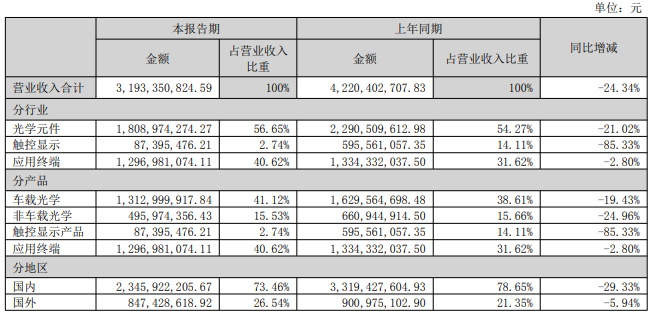
More precisely, the interplay between proactive scaling back and external shocks makes it challenging to pinpoint their relative impacts. The long-term upward trajectory in automotive optics penetration rates still suggests a high-growth trend, but short-term weakening demand, rising costs, and intensifying competition will directly squeeze revenue and gross margins. This fosters a negative feedback loop: financial strain—scaling back and declining capacity utilization—falling revenue and worsening fixed cost amortization—pressure on gross margins—weaker debt repayment capacity.
At the strategic level, the company is transitioning from a growth-first to a profit-first approach, though a more accurate description currently would be “profit-oriented while profits have yet to materialize.” The 2025 annual report outlined a strategy to “concentrate resources on developing the optics industry” and “maximize profits”; the 2026 interim report proposed transforming automotive optics into a “high-yield field,” while realigning touch display to be “customer-centric and profit-oriented.” The scaling-back trajectory is clear: in the first half of 2026, touch display revenue was 87.3955 million yuan, an 85.33% year-on-year decline, accounting for just 2.74% of total revenue, effectively phasing it out.
Practical contradictions also arise in production capacity planning. The Hefei Automotive Optics Industrial Park aims for an annual capacity of 50 million units, with monthly capacity reaching approximately 3 million units as of March 2025. The company anticipated achieving full capacity by the end of 2025 or early 2026. However, in the first half of 2026, automotive revenue declined, funds were tight, and unpaid salaries persisted. Continuing to ramp up production requires capital, and if capacity utilization remains low, depreciation and fixed costs will depress gross margins; halting expansion could jeopardize future order acquisition. Balancing capacity expansion with cash flow constraints is an urgent challenge.
The real external variable stems from the change in control. In July 2026, Shouxian state-owned assets acquired a 7.27% stake for 630 million yuan, making the Shouxian State-owned Assets Supervision and Administration Commission (SASAC) the de facto controller. However, labeling this a “strategic safety net” warrants caution: the 630 million yuan is modest compared to the 3 billion yuan precondition for debt resolution, and its role is more likely to manifest in state-backed credit, debt restructuring coordination, and future financing arrangements.
The agreement stipulates that 2 billion yuan in debt must be resolved within six months of signing, or the transferee may terminate the agreement; an additional 1 billion yuan must be resolved within four months of closing, after which the transferee will pay part of the remaining balance. It also includes a valuation adjustment: automotive optics revenue must reach 3.1 billion yuan with gross margins no lower than 589 million yuan in 2026; in 2027, revenue must hit 4 billion yuan with gross margins no lower than 800 million yuan.
Based on first-half data, automotive revenue was 1.313 billion yuan with gross margins of 10.15%, translating to gross profits of approximately 133 million yuan. To achieve 3.1 billion yuan in revenue and 589 million yuan in gross profits for the full year, second-half revenue must reach roughly 1.787 billion yuan with gross profits of about 456 million yuan, implying a gross margin of approximately 25.5%—far exceeding the first half’s 10.15%. For 2027, achieving 4 billion yuan in revenue and 800 million yuan in gross profits implies a gross margin of 20%, a significant gap from current levels.
More critically, the company emphasizes “profit maximization,” but the valuation adjustment demands rapid revenue growth: continuing to scale back makes it difficult to meet revenue targets; expanding to meet targets may compromise profits and cash flow.
Shouxian state-owned assets’ takeover serves dual purposes: “bailout” and “supply chain complementarity.” Hefei has already cultivated an industrial cluster centered on “chip-display-auto integration,” yet it lacks a large-scale listed platform for optical lenses and imaging modules, which could enhance local supply chain synergy. However, the 3 billion yuan debt resolution precondition underscores that bailout remains a primary motive.
If Lianchuang Electronic can capitalize on Anhui’s new energy vehicle cluster to drive volume growth, there is still potential to evolve from an “optical component supplier” to an “automotive optics platform.” However, with unresolved debt pressure, unrealized profit recovery, and the overlapping challenges of debt resolution and valuation adjustments, every strategic move leaves little margin for error.
-
RSI: How Much Valuation Can It Support for Zhipu?
-
Young People Are Secretly Enjoying 4399 Game Suite on Xiaohongshu
-
![]()
China’s Premier Independent Token Factory: Secures 2.9 Billion Yuan in Funding
-
FAW and GAC Toyota: Collaborating Without Full Merger?
-
Honor Expands Partnership with Alibaba: Who Will Lead the AI Smartphone Revolution?
-
![]()
Yunqi Conference Heralds Computing Power Growth: Alibaba Cloud’s Data Center Capacity to Surpass 20GW by 2032, T-Head Reveals AI Chip Zhenwu V900
-
![]()
Singapore Hardware Veteran Creates an AI Golf Personal Trainer
-
![]()
Data Integration Throughout the Production Chain! Haomi Optics Initiates MES and ERP System Upgrade Project