How Does Eye Tracking Decode Your Gaze?
 10/08 2026
 378
378
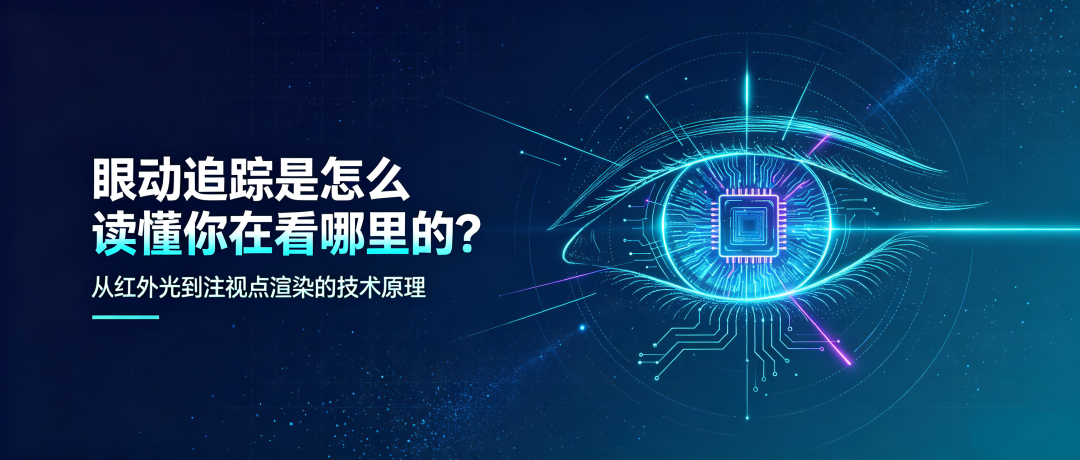
Abstract: At the heart of AR eye tracking lies the PCCR (Pupil Center Corneal Reflection) technique, which harnesses the synergy of invisible near-infrared light, infrared cameras, IMU sensors, and sophisticated algorithms to precisely capture the eye's geometric transformations.
By computing gaze direction through a 3D eye model, it enables accurate gaze point rendering and intuitive interaction, forming the bedrock of AR device intelligence. As AR glasses grow smarter, have you pondered how they pinpoint your gaze with such precision?
Contrary to popular belief, it's not the device's guesswork but meticulous calculation. The cornerstone of eye tracking technology is PCCR.
In layman's terms: The device emits invisible near-infrared light to illuminate the eyes, while the camera simultaneously captures the pupil and corneal reflection spots. The algorithm then leverages the geometric interplay between these elements to accurately determine the user's true gaze direction.
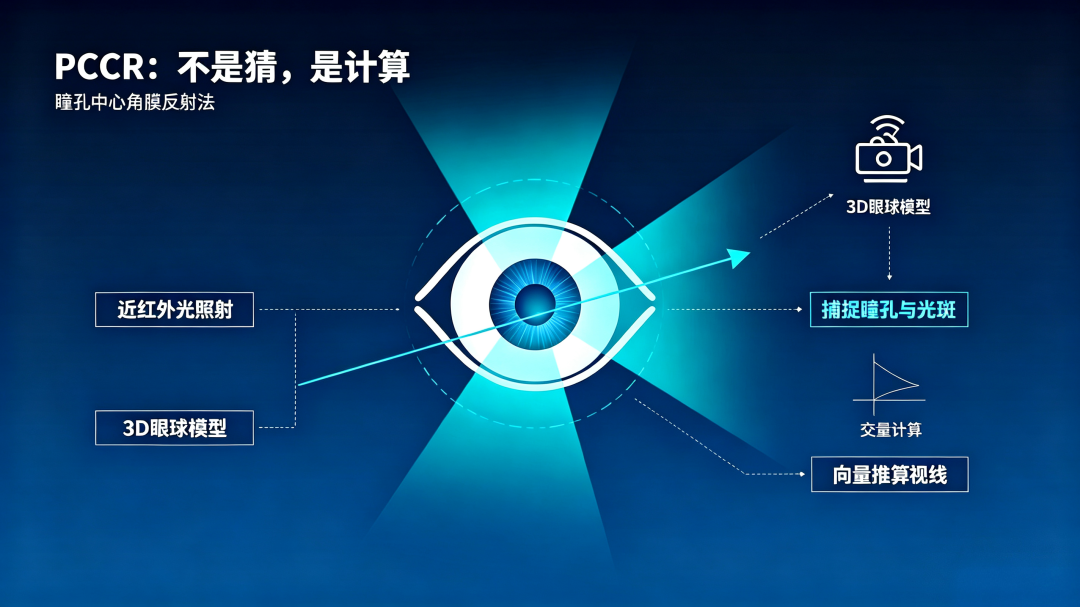
Core Insight: The essence of eye tracking is the PCCR method—near-infrared light generates reflection spots on the eyes, the camera captures the positional interplay between the pupil and these spots, and gaze direction is precisely computed via a 3D eye model.
It's not merely about 'looking at the eyes' but about calculating them with precision.
1. Near-Infrared Light: Illuminating Eyes Unobtrusively
The first step in eye tracking is ensuring the eyes are in a state conducive to accurate capture and stable tracking.
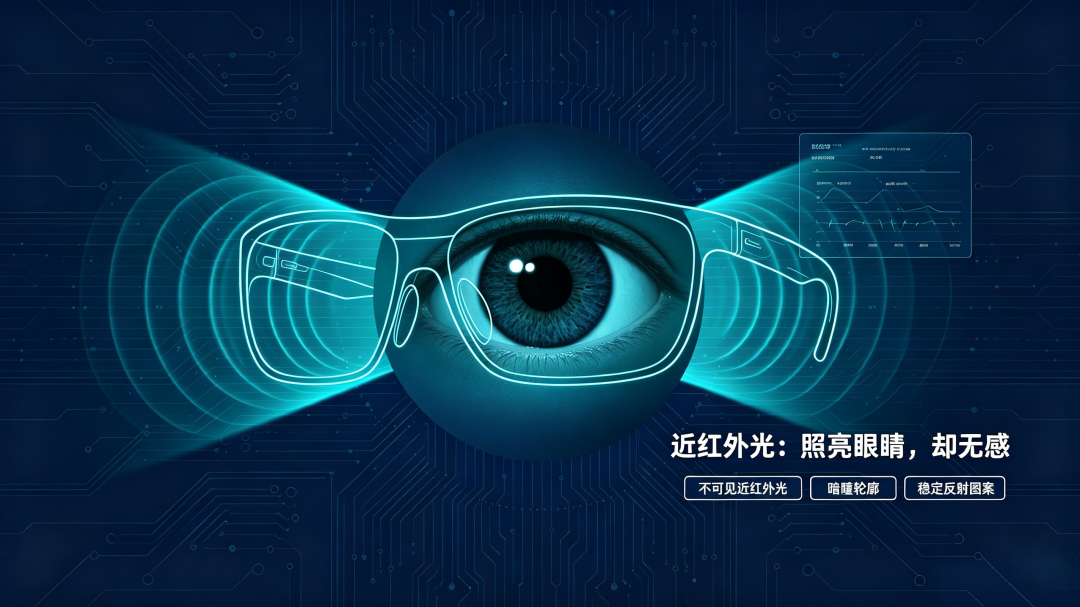
Take Tobii Pro Glasses 3 as an example: The frame is equipped with 16 infrared light sources that continuously emit near-infrared light, invisible to the human eye.
Upon illuminating the eyeball, this light forms regular and clear reflection patterns on the pupil and the corneal surface, providing precise imagery for subsequent tracking calculations. The primary advantage of near-infrared light is its lack of visual interference, ensuring it doesn't disrupt the user's normal vision.
Simultaneously, near-infrared light clearly delineates the dark pupil contour, significantly easing the device's recognition task. This dark pupil tracking approach is also a mainstream method in wearable eye tracking today.
2. Multi-Sensors: Multi-Angle Tracking, Unaffected by Motion
Tobii Pro Glasses 3 incorporates four dedicated eye-tracking cameras in the lenses, employing a dual-camera setup per eye for synchronous tracking from dual angles.
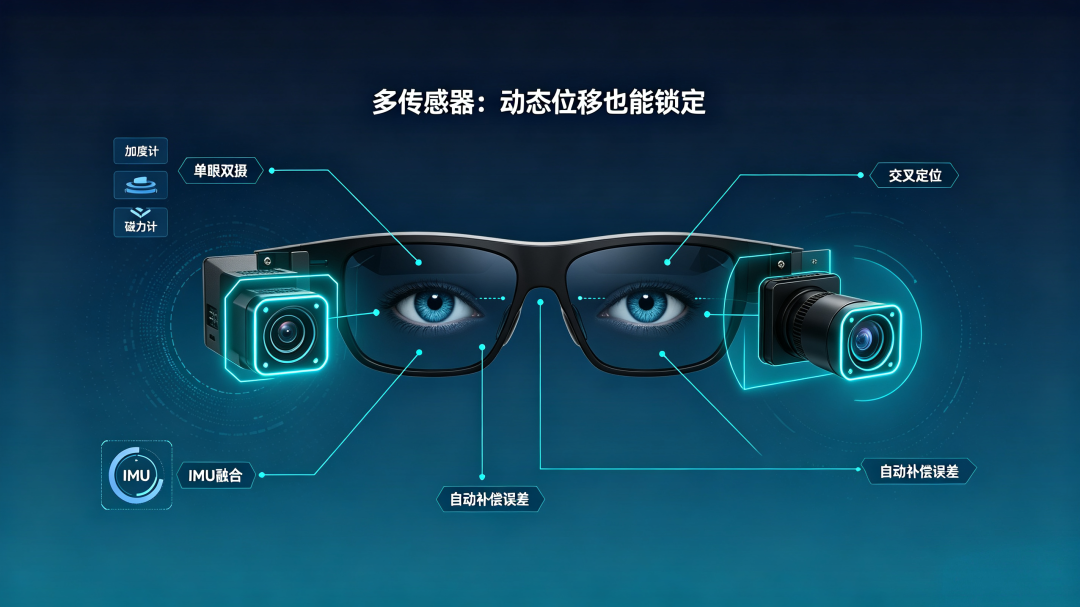
During everyday use, head movements, gaze shifts, and slight glasses slippage are common. Single-perspective tracking is prone to drift, disconnection, and data distortion.
Dual-camera cross-positioning enables real-time collection of multi-dimensional eye data, ensuring tracking stability from the outset.
The device integrates IMU (Inertial Measurement Unit) data (accelerometer, gyroscope, magnetometer) and combines it with a 3D eye model for multi-dimensional data fusion calculations.
Even with slight device displacement or free body movement, the system automatically compensates for errors, ensuring accurate and drift-free tracking data throughout.
3. Core Algorithm: Precise Gaze Calculation Through Vector Analysis
While hardware handles image capture, the algorithm is the linchpin of eye tracking, transforming 'eye images' into 'precise gaze' data.
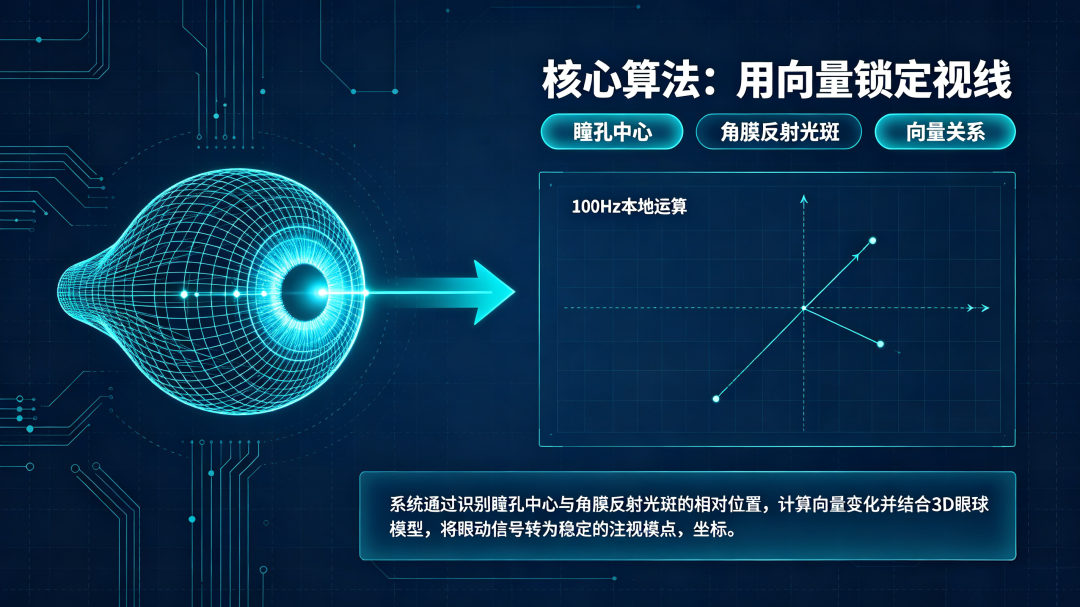
The algorithm's core logic is simple yet effective: The corneal reflection spot remains relatively stationary, while the pupil center moves in real-time with eye rotation. The vector relationship between these two points is the key to determining gaze direction.
The system accurately identifies the pupil center and corneal reflection spot, calculating their relative vector in real-time. As the eyeball rotates, the pupil shifts while the spot remains largely fixed, allowing the vector data to change accordingly and precisely match the user's real-time gaze direction.
Constructing a 3D eye model effectively decouples eyeball position, head posture, and gaze direction, adapting to various wearing positions and head angles.
All calculations can be performed locally on the device, supporting up to a 100Hz ultra-high sampling rate for seamless gaze tracking and responsive interaction.
4. Beyond Novelty: Eye Tracking as AR Interaction's Core
Eye tracking is not merely a flashy feature for device showmanship; it's the core infrastructure underpinning AR glasses' ultimate interactive experience. Its most critical application is gaze point rendering (Foveated Rendering).
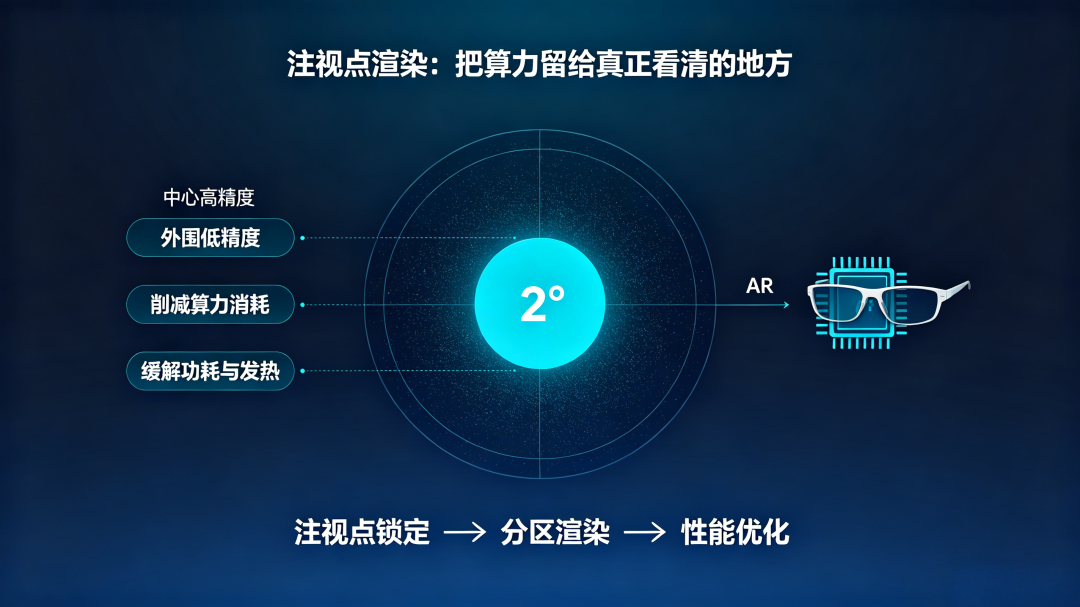
Human eye physiology dictates that only the central 2° visual field can perceive fine details, while peripheral vision is naturally blurred.
By relying on eye tracking to pinpoint the gaze point, the device renders only the core area with high precision, reducing rendering accuracy in the periphery. This significantly reduces the device's computational load, effectively mitigating power consumption and heat issues in AR devices.
Simultaneously, eye tracking establishes an interaction logic that aligns with human instinct: gaze at a target + blink/button confirmation, making operations intuitive and natural.
Moreover, precise pupil data can be utilized for cognitive load and emotional response analysis, widely applied in commercial insights and user behavior research to help brands optimize product displays and packaging designs.
Supplementary Note: When the user blinks or closes their eyes, the device pauses data generation. This is not a device malfunction but a normal physiological limitation caused by the absence of reflection spots.
Conclusion
The essence of eye tracking is not about 'reading minds' but about precisely calculating where one is looking.
The complete logic of PCCR technology: near-infrared light illumination → camera capture of pupil and spot images → 3D eye model reconstruction → vector calculation to determine gaze.
The intelligence of AR glasses is not solely reflected in hardware upgrades like display quality and computational power but also in their ability to understand user attention.
And the starting point for all this intelligent interaction is an invisible infrared light and a sophisticated geometric algorithm. Interactive Topic: Have you experienced AR/VR devices with eye tracking? Can you perceive the performance improvements brought by gaze point rendering? Feel free to leave a comment and share your experience.
— AR Andy | Focused on waveguide and AR microdisplay technologies, deeply dissecting the underlying logic of the optical industry
【Risk Disclaimer】This article is for industry educational purposes only. Technical principles and product parameters are sourced from publicly available technical materials and official manufacturer information. It is intended solely for industry learning and technical exchange, not as a basis for investment decisions, product selection, or commercial strategies.
-
![]()
[Electric Equipment] BRETON Eyes African Mining Sectors: Venturing into Electric Mining Truck Sales
-
Anthropic is Going Public: Valued at 2 Trillion in 5 Years, Who’s Paying for the AI Bubble?
-
![]()
Going to work! Let's meet the new colleague: available 24/7, works hard for little pay, and has a great attitude.
-
![]()
Why Has NVIDIA Become the Biggest Winner in the AI Computing Power Race?
-
![]()
Day 4 of National Day: How are new energy vehicles performing for travel?
-
![]()
O-film Tech Becomes the Exclusive Supplier of Main Camera and 200MP Periscope Telephoto Lenses for Huawei Pura 90 Pro Series
-
![]()
Why is Baidu's AI large model rarely mentioned anymore?
-
![]()
In-Depth Guide to Car Purchase Incentives: Can You Really Save Nearly 10,000 Yuan on the Spot?