3.3 Million 'Eureka' Moments: AI is Ushering in the Era of 'Everyone Can Develop'
 12/08 2025
 634
634
By Wang Huiying
Edited by Ziye
Over more than two decades of internet development, we have grown accustomed to easily accessing all services from our phones: from shopping, travel, and socializing to entertainment. These universal and common needs are supported by a handful of super apps, becoming indispensable in our daily lives.
However, there are always moments in life when, despite scrolling through countless apps on your phone, you still cannot find one that perfectly meets your needs.
For example, when you want to create a customized travel planner that integrates weather forecasts, travel itineraries, and shared expense tracking, you’ll find few apps that simultaneously satisfy such diverse requirements. Or, when studying for exams and needing a smart error log that dynamically tracks weak areas, you often cannot find an app that meets your personalized needs among the hundreds installed on your phone.
These specific yet small desires are not pseudo-needs; they are simply too fragmented and personalized to justify the development cycles, costs, and returns of traditional apps. As a result, they remain overlooked outside of app stores.
Yet, the advancement of AI is making it possible to address these fragmented needs scattered throughout daily life.
Recently, Ant Group’s all-modal general AI assistant, Lingguang, has sparked a wave of enthusiasm across the internet with its 'one sentence, 30-second app generation' feature. Anyone, without any programming knowledge, can express their needs in natural language and generate an interactive, editable, and shareable mini-app in about 30 seconds.
A set of data illustrates users' enthusiasm for creating 'flash applications' with Lingguang: In just two weeks since its launch, users have successfully created 3.3 million 'flash applications,' most of which are practical tools deeply integrated into daily life, ranging from emotional stress relief and language learning check-ins to food fortune-telling and travel planning, permeating every subtle aspect of life.
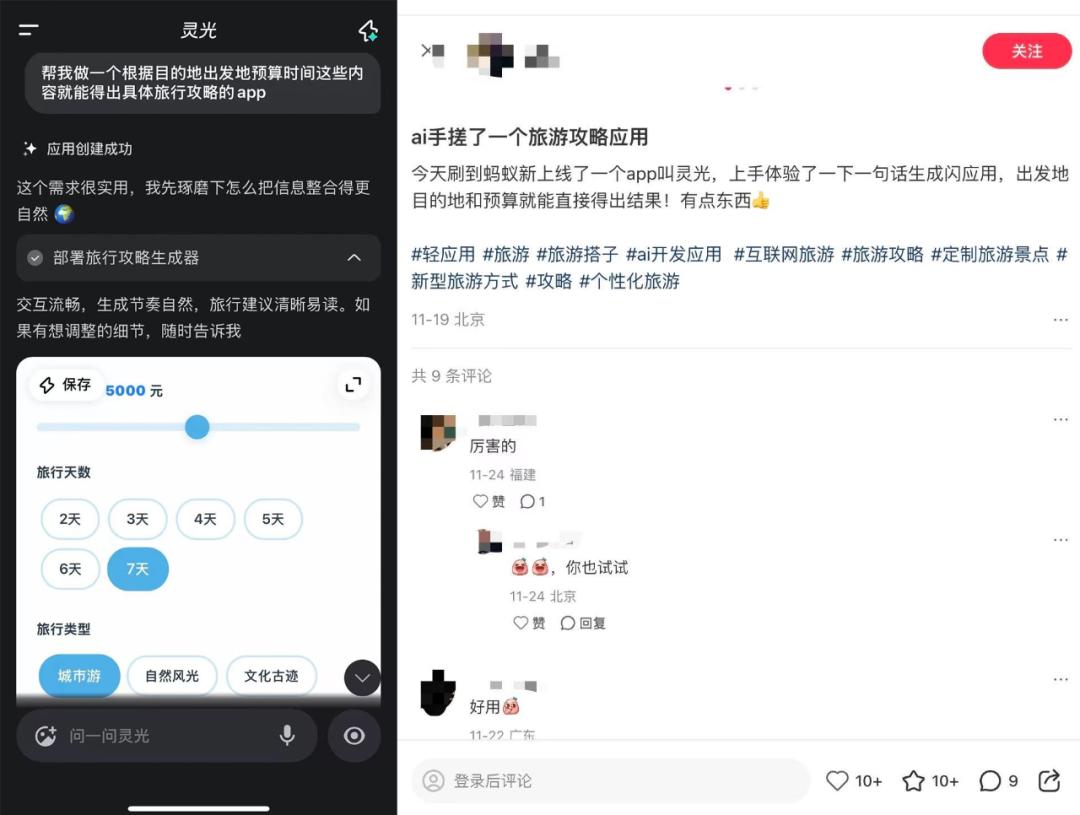
Netizens share their self-made travel guide apps
An era of 'everyone can develop,' led by users, is knocking on the door through AI.
1. Why Do People Still Feel 'Underserved' Despite the Proliferation of Apps?
Although the number of apps on our phones continues to grow, many users' personalized, immediate, and fragmented needs remain inadequately met in real life.
For instance, preparing for a simple family outing requires checking the weather, planning routes, booking accommodations, budgeting, and recording the itinerary.
The conventional approach involves repeatedly switching between weather apps, map apps, travel platforms, expense trackers, and note-taking software to manually integrate information.
While this process may yield a decent travel plan and initially satisfy your needs, it is labor-intensive and inefficient.
Similar scenarios and needs are ubiquitous in daily life:
How can working adults ensure their elderly parents take medication on time while focusing on their jobs? How can new parents maintain harmony while helping their children with homework and improving efficiency? How can exam students desire an intelligent assistant that automatically recommends similar practice questions based on error types?
These needs are not overly complex, yet finding a truly suitable app in the market is challenging.
To some extent, this is because these needs are highly personalized, customized, and niche.
Why Can't Traditional App Development Models Solve These 'Small Problems'?
Fundamentally, this reflects a fundamental mismatch between traditional development models and 'micro-niche' needs. Commercial logic dictates that the market only serves the lowest common denominator.
First, traditional app development has high barriers to entry. Developing a fully functional mobile app requires product design, front-end development, back-end architecture, testing, operations, marketing, and more. Even the simplest tool app takes weeks to go from conception to launch, with costs ranging from tens of thousands to hundreds of thousands of dollars.
Second, the commercial logic of general-purpose apps dictates that only products with a sufficient user base to generate revenue through advertising, in-app purchases, or subscriptions can survive.
This creates a 'cost paradox.' The more fragmented and personalized a need, the smaller its potential user base, making it unable to support the costs of traditional development.
In other words, commercial rationality drives developers to pursue scale and universality, resulting in a highly homogenized app market. For example, while there may be hundreds of expense-tracking apps, none perfectly solve the real-time shared expense tracking needs of you and your friends during travel.
The emergence of Lingguang's 'flash applications' is changing this landscape. Ant Group’s all-modal general AI assistant, Lingguang, enables 'natural language generation of mini-apps in 30 seconds' on mobile devices, which are editable, interactive, and shareable.
Since its launch on November 18, users have created 3.3 million flash applications in just two weeks. For reference, according to Business of Apps, as of November 2025, the iOS App Store had 2.1 million apps globally, while the Android market had between 2.1 and 2.6 million apps.
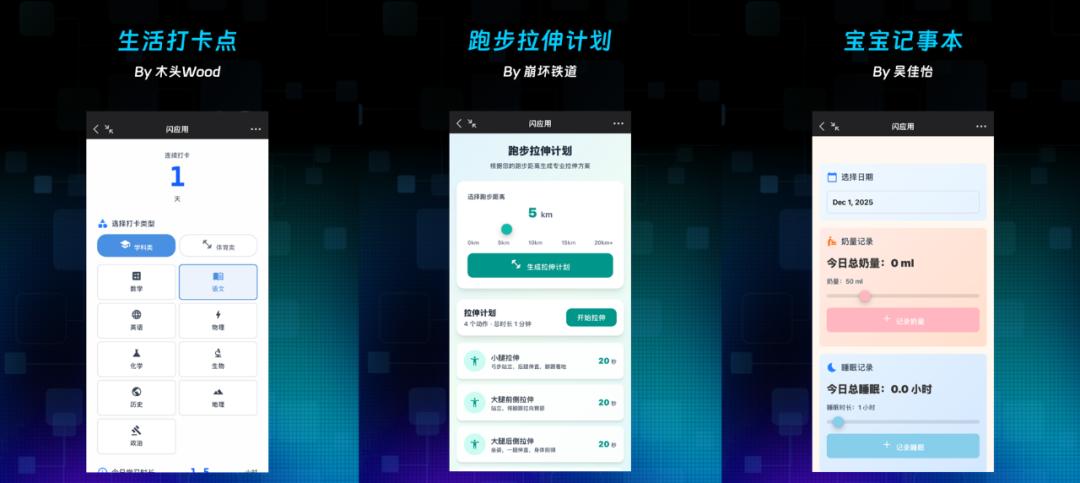
This fully demonstrates that when ordinary people have access to zero-barrier app creation tools, their creative potential is limitless. As AI lowers technical barriers to the cognitive plain, Lingguang’s flash applications ignite a universal spark of 'everyone can develop.'
2. How Do Zero-Barrier 'Handcrafted' Apps Fill Every Gap in Life?
On social media, netizens have been sharing the everyday mini-apps they created with Lingguang: A finance blogger crafted a mutual fund investment calculator, someone generated a 'dinner lottery picker' during a gathering, pet owners created Exclusive Diary (a dedicated diary) to track their pets' moods, and users built personalized study aids based on their error logs...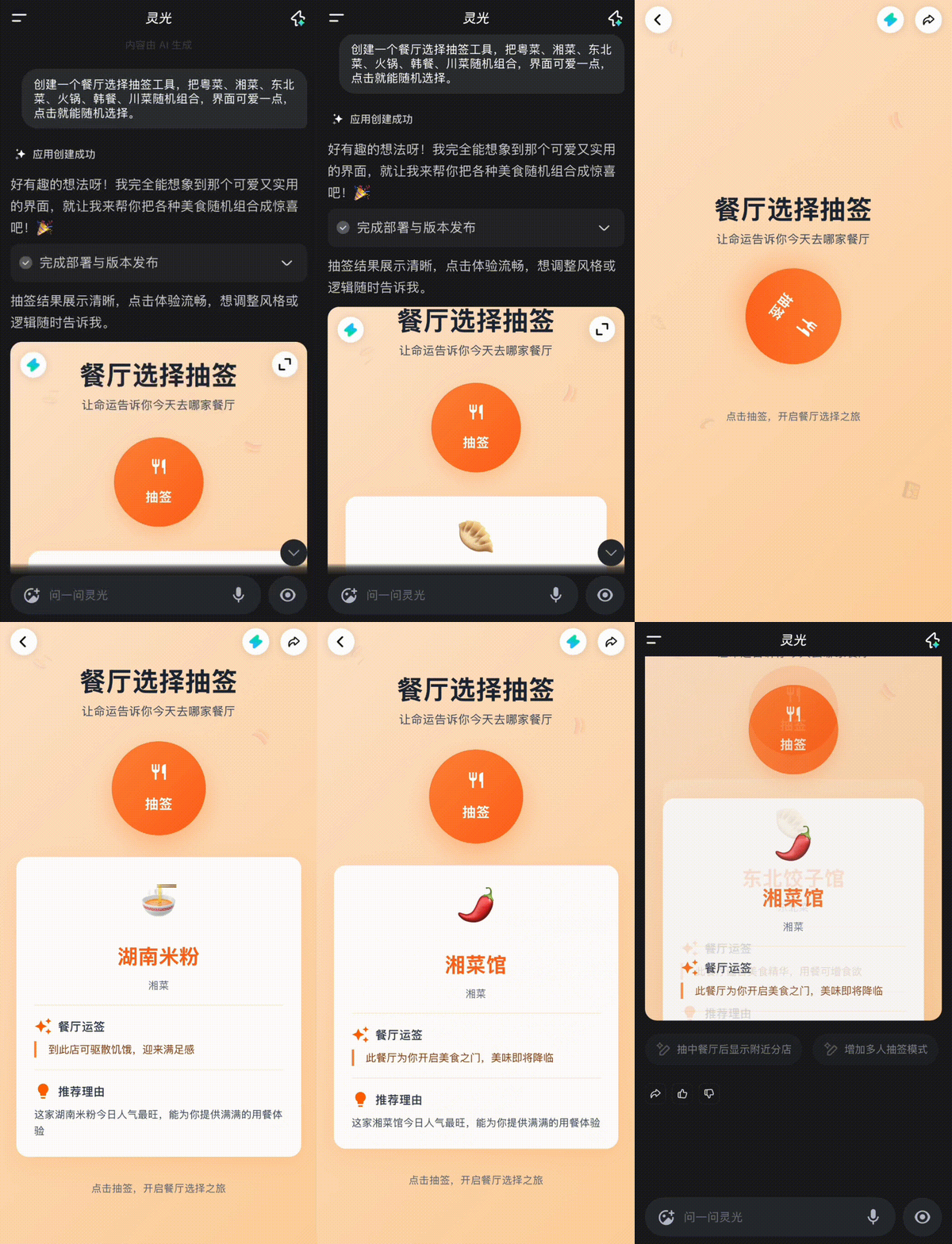
The commonality of these apps is that they would almost never become traditional 'apps' due to their small user bases and specific use cases. Under past app development logic, such needs were long overlooked for being 'too niche' or 'not commercially viable.'
The emergence of Lingguang's 'flash applications' essentially provides a zero-barrier outlet for these vast, dispersed, personalized long-tail needs. Each ingenious flash application represents a digitally optimized solution for a micro-scenario in daily life.
Traditional app development resembles constructing a building, requiring systematic design, construction, and long cycles. In contrast, 'handcrafted' apps are more akin to instant creation—users simply describe what they want in a few sentences, such as 'create a cute, feedable kitten game,' and within seconds, a fully functional app appears.
Lingguang achieves this through technological and product design innovations.
First, one of its core technological breakthroughs is multi-agent collaboration (Agentic Architecture). Simply put, when a user makes a request, the system dynamically orchestrates multiple specialized 'agents' to work together: interpreting user needs, breaking them down into subtasks, and simultaneously completing the entire workflow, including interface design, animation, and interaction testing. This achieves the effect of generating an app in 30 seconds, delivering exactly what the user envisions.
In terms of product design, Lingguang’s ability to generate apps with a single sentence minimizes user barriers. As long as users can express themselves, they receive a complete app, transforming app development from a specialized skill into an everyday activity accessible to ordinary people.
Additionally, high interactivity is a standout feature of Lingguang’s flash applications. From users' 'handcrafted' shares on social media, it is evident that with Lingguang, users can adjust their apps in real-time as their needs evolve, turning ideas into reality. For example, modifying a parameter or function in the initial app requires only a natural language instruction, without coding, complex operations, or even leaving the chat interface.
In other words, Lingguang’s 'handcrafted' app capability extends beyond simple 'app creation' and 'usage.' Its high interactivity empowers users to unleash greater imagination.
Data shows that users typically engage in multiple rounds of dialogue with Lingguang to refine and perfect their app concepts. Some users have modified a single app over 100 times, and hundreds have even attempted to create their own versions of 'Alipay,' 'Taobao,' or 'WeChat.'
3. From Super Apps to Flash Applications: AI is Reshaping the App Ecosystem
Lingguang is not an isolated case; the trend of 'everyone creating apps' is emerging globally. For instance, Google’s latest model supports users in generating functional apps through simple descriptions, while other tech companies are exploring similar directions.
This heralds the dawn of a new AI-driven app ecosystem paradigm.
The most direct change may occur on the production side. Traditionally, app development has been a profession requiring specialized training. However, Lingguang suggests a future where development skills become as fundamental as reading and writing.
As technical barriers disappear, future competition in apps will no longer revolve around coding prowess but rather on scenario insight, capturing subtle user pain points, and rapidly productizing needs. A mother deeply familiar with parenting challenges may create a more popular parenting tool than a seasoned product manager.
On the demand side, a new realm of personalized, scenario-based services will emerge beyond standardized, scalable offerings.
Currently, mainstream app forms like app marketplaces and mini-programs excel at covering universal needs through standardized services. However, Lingguang’s 'flash applications' adopt an 'on-demand generation, scenario-driven' model, constructing a personal toolbox of countless precise, lightweight, and exclusive 'micro-apps' to fill the gaps of countless fragmented, long-tail needs.
Moreover, the 'use-and-go' nature of flash applications may foster entirely new business models. For example, flash apps solving specific professional problems could adopt 'one-time purchase' or 'subscription-based' micro-payment models. Additionally, Lingguang could stimulate a creator economy, where outstanding flash apps are shared and traded as templates, forming a new creator incentive loop.
Admittedly, the current handcrafted mini-apps still lag behind mature apps in technical capabilities and user experience. However, their 'on-demand generation, instant service' model reveals new possibilities: a vast new market driven by microscopic needs is emerging, where countless customized, lightweight micro-apps will better serve users' specific needs.
The ultimate value of technology lies in serving ordinary people's specific and small needs. Whether it’s a sudden 'eureka' moment or a subtle daily desire, AI provides the key to unlocking solutions. This transformation—'empowering everyone to become a creator and ensuring every need is seen'—is the most vivid testament to AI’s promise of inclusivity.
-
![]()
Why Hasn’t AI-Driven Payment Flourished Despite Tech Giants’ Push?
-
![]()
Intensify Efforts in the High-End Optoelectronic Semiconductor Sector! Aipu Dingchun and Jiangsu Meidong Forge a New Joint Venture
-
![]()
From Endoscopes to Optical Interconnects for AI Computing Power: A Veteran Optical Company's Strategic Shift
-
![]()
Behind the Scenes of Token Factories' Rise as a Capital Market Sensation
-
![]()
What Does MaaS Ultimately Bring to Chinese Cloud Providers? | In-Depth Industry Analysis
-
![]()
China’s Auto Resale Value Report Unveiled: AITO M9 Electric and Hybrid Variants Dominate Rankings
-
![]()
Dialogue with Huang Yangming: On the Eve of the Physical AI Boom, the Value of Data Infrastructure Begins to Materialize
-
![]()
The Experience is a Bit Unusual! Logitech G Cloud Review: Great Feel, but Not Ideal for Cloud Gaming