AI Sanguosha: Qianwen 'Copies' Doubao, Yuanbao 'Pastes' WeChat
 02/10 2026
 756
756
Since Doubao became the first to surpass 100 million DAU last year, domestic internet giants have been spurred into action, not only increasing their investment in AI but also gearing up to make a comeback during this year's Spring Festival.
But catching up from behind is no easy feat.
As a result, Doubao, which has raced ahead, has become the best research sample for the AI industry.

In response, Qianwen has chosen to 'copy' Doubao (mobile), enabling users to order food delivery and purchase groceries with a single AI command.
Yuanbao, on the other hand, has started to 'paste' WeChat, but it has chosen social networking instead of following Doubao's example of integrating with Douyin short videos through video accounts.
The results are clear: those who learn from Doubao have become phenomenal AI 'influencers,' while those who abandon Doubao are now being overshadowed by Qianwen...
So, will Yuanbao now take Doubao as its teacher? Why is the AI + short videos approach better than AI + social networking?
And has Qianwen, which has followed in Doubao's footsteps, truly grasped the essence of Doubao's success?
Let's examine these questions one by one.
Yuanbao's Best Path Forward: Not WeChat Social Networking, but Video Accounts?
Why has Yuanbao encountered so many issues during the red packet drainage (user acquisition) phase?
While the 'less money, more work' (compared to Qianwen) Spring Festival event tactics are a surface-level issue, the core problem lies in its unsuitable path forward.
From the start, Tencent should not have had Yuanbao compete with WeChat in social networking. Instead, it should have focused on video accounts, following Doubao's gradual penetration of Douyin's user base.
First, let's consider social networking. For many, WeChat is a personal, private space. Whether it's one-on-one chats or group conversations, it fosters relatively intimate relationships.
As a result, most WeChat users are highly sensitive and negative toward the flood of red packet-sharing links from apps like Yuanbao.
The tolerance level for such interruptions is similar to that of small advertisements posted on one's doorstep.
For most people, the inside and outside of their home are two different worlds. While noise and small ads may be tolerated outside, they are generally unacceptable within one's personal space.
People may occasionally tolerate the noise of festive gatherings, but they certainly cannot endure having their homes filled with red packet-sharing links from various individuals and groups throughout the Spring Festival.
If that were to happen, while the home might remain unchanged, WeChat could very well be replaced.
This user mindset of protecting one's personal mental space is something Zhang Xiaolong has consistently adhered to and is one of the reasons WeChat's social barriers have remained so formidable in the past.
As a result, Yuanbao's first wave of red packet-based user acquisition faced significant negative feedback in public opinion, with even media professionals commenting that Tencent's marketing tactics were stuck in the past...
Second, social networking is subject to network effects, where both positive and negative developments can quickly spread, leading to a Matthew effect in public perception.
For example, at the start of the Spring Festival battle, no matter how controversial Yuanbao's user acquisition tactics were, as long as people participated, the platform offering 1 billion yuan in red packets would be more attractive than the one offering 500 million.
Similarly, when users learned that downloading the Qianwen app came with a 25 yuan free order card, the simple perception that Qianwen's red packets were larger and Yuanbao's were smaller quickly spread through social sharing channels.
The result? The good only seems better, while the poor performers appear even worse. Eventually, even the most avid deal-hunters may lose interest in Yuanbao's meager offerings.
Overall, the user acquisition effectiveness gradually widens...
Now, let's consider video accounts. Why do we believe short videos are the best path forward for Yuanbao?
Unlike social networking, short video communities are more public spaces. Users do not share highly intimate relationships but are more like individuals strolling through a vast, lively park marketplace. Therefore, creating various AI-related promotional 'noise' here will not immediately affect everyone or collectively generate negative emotions.
Instead, new and intriguing AI features and content may attract countless users to actively onlookers and download the app for a try.
After all, many people watch short videos for novelty, entertainment, and to gain new insights. Therefore, both extremely down-to-earth and uniquely unconventional content have the potential to become trends.
This is already evident with Doubao and Douyin.
If you frequently browse Douyin, you may have noticed that various AI-driven antics, such as users asking Doubao to help care for pets, inquire about fashion trends, or supervise children's homework, have been emerging and gaining significant attention and interest from user groups.
For instance, I genuinely found using Doubao to supervise children's homework quite interesting, so I not only downloaded the Doubao app myself but also shared it with friends who have children...
This may also be one of the reasons why Doubao became ByteDance's product with the lowest promotional expenses to surpass 100 million DAU.
After all, while this AI marketing approach in short videos may not directly reach everyone like Spring Festival red packets do, it boasts high user conversion rates and quickly builds active demand stickiness. Users download the app to solve practical problems, increasing the likelihood of subsequent retention.
It is evident that the difference between Doubao and other AI players now lies in the following:
Doubao's AI application scenarios have been continuously explored, and the future focus is on increasing visibility and user recall. Therefore, ByteDance chose to partner with CCTV's Spring Festival Gala rather than distribute red packets.
Qianwen and others, however, need to first gain visibility and user recall before exploring or validating subsequent AI demand scenarios, facing two layers of uncertainty...
As for Yuanbao, the pros and cons of its two AI paths forward are now clear:
1. Pursuing the WeChat social networking path may lean more toward a KPI-driven approach, focusing on key metrics like user acquisition and daily active users.
However, amid intense competition, Yuanbao's current user acquisition efforts are highly purposeful, and users are equally motivated by incentives. As a result, relationships built solely on monetary incentives are difficult to maintain when competitors like Qianwen enter the scene.
Overall, this approach has yielded strong social networking performance but weak results.
2. The video account content path, on the other hand, is more ROI-driven, focusing on returns while also emphasizing the investment process. It starts from the user demand side and may not achieve rapid, massive growth but offers a more stable and natural AI conversion path.
In the future, it may even replicate Doubao's performance of weak social networking but strong results.
Therefore, on a positive note, while Yuanbao may appear to be under significant pressure now, Tencent still has many cards to play. Short-term exploratory pressure does not determine the ultimate outcome of this AI era's gateway battle...
Qianwen's Explosive Growth, But One Question Remains
After discussing Yuanbao, let's examine Qianwen's learning from Doubao.
There is no need to elaborate further on how popular Qianwen has become.
Moreover, Qianwen's rise has also propelled Alibaba's business and strategy to new heights, achieving a dual benefit:
First, it has boosted and driven traffic to Alibaba's grand consumption strategy centered around Taobao Flash Sales.
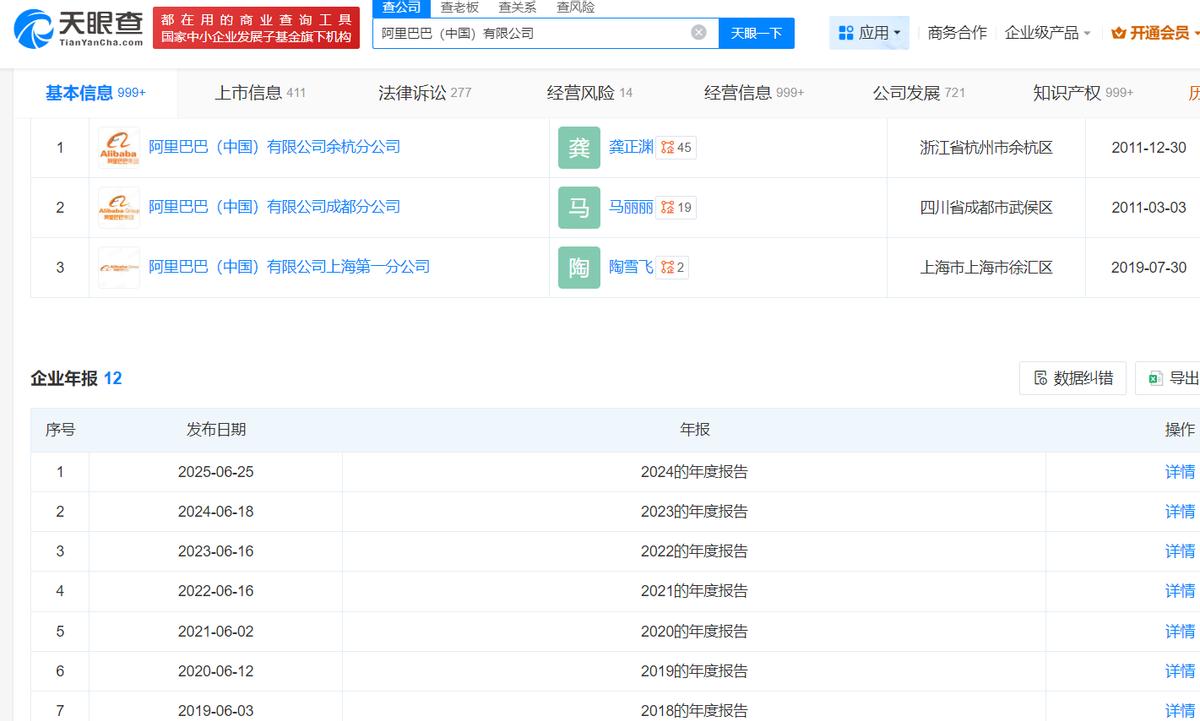
According to Tianyancha APP, after the food delivery wars in the middle of last year, regulators repeatedly intervened to prevent cutthroat competition. Now, Qianwen, through Spring Festival events and direct free orders, while somewhat disrupting the normal operating rhythms of food delivery merchants (e.g., some milk tea shops had to temporarily close due to exceeding order limits), has generally bypassed these restrictions.
Not only has it brought tremendous traffic to Taobao Flash Sales in the instant retail battleground, but it will also collaborate with Damai, Fliggy, Hema, and Gaode to feed traffic back to the entire Alibaba grand consumption ecosystem.
In this back-and-forth process, Alibaba has effectively repurposed the money it originally spent on buying traffic into Qianwen free order cards. As a result, Qianwen has become popular, and everyone has gained widespread exposure...
Second, it represents an attempt to preemptively occupy the entry point for AI and AI-powered consumption and shopping.
Among the current homogenized AI feature experiences, Qianwen's novel approaches, such as free orders and AI-powered food delivery, are virtually unique.
While Doubao Mobile has demonstrated similar functionalities, its popularity has remained confined to niche circles. It was Alibaba's Qianwen that truly allowed the general public to experience AI-era living in a nearly zero-threshold manner for the first time.
Therefore, just as Doubao Mobile shocked the tech circle, Qianwen now strongly disrupts public perception. The AI scenarios once seen only in sci-fi movies are now nearly realized within Qianwen...
However, a reality check is needed: even if AI marketing is highly successful, Qianwen's subsequent user retention remains a significant challenge.
This is primarily reflected in two aspects:
On the one hand, retention performance may be poor. While using Qianwen for food delivery is currently novel, if subsequent discounts are insufficient or if food delivery platforms engage in price wars, this seemingly strong attraction will undoubtedly be broken.
The main issue is that AI consumption habits have not yet been established, and most people are still sensitive to price discounts. Otherwise, Spring Festival red packet activities offering mere cents or a few yuan would not have become so popular. Therefore, Qianwen's future remains uncertain in this regard.
On the other hand, retention performance could be excellent, even achieving the red packet-like phenomenon that Ma Huateng once hoped to recreate, instantly transforming China's AI landscape overnight.
If so, new questions arise:
It is evident that Yuanbao AI currently has little impact on Tencent's main business, and the Yuanbao faction appears to be more of an exploratory development, hence the additional invitation code requirement.
Baidu's Wenxin Assistant remains embedded within the Baidu APP, following an empowerment route where AI is responsible for summarization and generation, while traditional search listings provide 'information sources' and verification.
As for Doubao, it has not significantly disrupted ByteDance's business...
However, Qianwen is different. What it does is essentially dismantling Alibaba's consumer internet empire, interrupting its own path forward.
The traditional internet industry has three primary monetization methods: advertising, e-commerce, and gaming.
Advertising thrives on diverse choices, with both search and e-commerce platforms aiming to fill every page with ad placements for multiple clicks.
However, AI prioritizes precision and delivering the most relevant answer in one strike.
These two approaches are diametrically opposed. The better Qianwen performs and the more users it retains, the greater Alibaba's investment becomes, and the more pressure Flash Sales and other advertising-driven businesses may face...
Nevertheless, the decline of Kodak, which invented the world's first digital camera, and Nokia's fall from grace serve as warnings to Alibaba not to miss out on this AI era's opportunities.
Therefore, the current contradiction lies in the fact that while we believe new commercial monetization models will emerge in the AI era, the various uncertainties, along with the endless turning points, pain, and anxiety, remain ever-present.
This complex sentiment may only be truly understood by Kodak when it faced the digital camera wave...
In Conclusion:
The outcomes for Doubao, Qianwen, and Yuanbao reveal a fundamental truth: the value of AI lies not in 'copying' but in 'creating'; not in 'pasting' but in 'symbiosis.'
There is no standard answer for navigating the AI era, only countless 'scenarios' to be solved and a 'reconstruction' that must be personally undertaken.
This path may not be easy, but fortunately, the direction of AI has always been correct, and the endpoint is clear...
-
![]()
Li Bin Claims, 'Denying the Pure EV Trend is Like Ostrichism.' What's Li Xiang's Take?
-
Lenovo: Liu Jun Turns Left, Yang Yuanqing Turns Right
-
Lenovo: Liu Jun Goes Left, Yang Yuanqing Goes Right
-
![]()
MiniMax Shares Unlock: Cornerstone Shareholders Show Long-Term Optimism, Yet Stock Plummets Nearly 30% in Two Days; Zhipu Also Sees Nearly 20% Drop Today
-
![]()
Single-Day Plunge of 40%: The 'First AGI Stock' Faces More Than Just Share Price Concerns
-
![]()
Ricoh and Fuji Hike Prices on Legacy Edge; Insta360 Poised to Disrupt Mirrorless Camera Market
-
![]()
Ricoh and Fujifilm Raise Prices in Tandem, Relying on Established Reputations; Insta360 Poised to Disrupt Mirrorless Camera Market
-
![]()
Strategic Shift in Photoelectric Sensing: Maxvision Secures Controlling Stake in CAS Optotech