Bringing Robots Home: A New Frontier for Embodied AI
 02/13 2026
 494
494
Recently, the field of embodied AI is undergoing a narrative shift from large-scale to small-scale applications.
From Vitar Power's Vbot super robot dog at the end of 2025 to Shangwei New Materials' Qiyuan Q1 on New Year's Eve, and the latest release of Force Unlimited's Little Atom, these 'small robots' are constantly making appearances, attempting to capture the consumer-grade embodied AI market.
The emergence of various products and blockbuster sales exceeding 100 million yuan all signal the same trend: embodied AI is accelerating its integration into our lives.
Behind this surge lies a profound transformation in industry trends.
While full-sized humanoid robots await breakthroughs in cost and technology, consumer-grade embodied AI has become the focus of attention with its lightweight form and clear emotional value, beginning to explore viable commercial pathways. 
Consumer-Grade Embodied AI Steps into the Spotlight
Embodied AI represents a long-term, high-potential field currently facing challenges such as immature business models, difficulties in large-scale production, and lack of industry standards.
From an industry development perspective, the maturation of embodied AI technology requires long-term technological iteration, scenario refinement, and market cultivation.
During this transitional phase of technological breakthroughs, the launch of consumer-grade embodied AI products represents an inevitable choice driven by technological development, commercial logic, and practical challenges.
Firstly, consumer-grade products offer embodied AI companies a viable path to sustainable cash flow as they bridge idealism with reality, and even represent the ultimate product aspiration for most such companies.
Compared to current robots priced at hundreds of thousands of yuan, consumer-grade products typically range from several thousand to 20,000-30,000 yuan. For example, Vitar Power's Vbot robot dog is priced at 13,000 yuan, while Accelerated Evolution's K1 robot costs 39,900 yuan.
This price range directly competes with mature consumer electronics like high-end smartphones and laptops, significantly lowering the barrier to entry and facilitating large-scale sales, thus enabling corporate self-sufficiency.
Moreover, the miniaturization of robots generally reduces requirements for motor torque and battery life, while leveraging more mature hardware supply chains for faster delivery.
Secondly, these products play a crucial role in market education and user enlightenment.
During this transitional period, the industry needs 'intermediate-form' products that can sustain industry momentum while cultivating market awareness, helping ordinary users gradually understand and accept embodied AI products.
Consumer-grade products with relatively focused functions and approachable forms serve as ideal technological carriers and transitional forms, offering advantages in terms of price and safety.
On one hand, they enable ordinary users to experience embodied AI up close; on the other hand, market feedback from these products can inform technological iterations within the industry.
Simultaneously, these products continuously demonstrate and popularize the basic concepts and capabilities of embodied AI to the public, maintaining societal and technological investment interest in this field while building brand influence for companies.
For the entire industry, product penetration into the consumer market represents genuine leverage of C-end scenarios.
Previously, robots in the C-end consumer market primarily appeared in forms like entertainment performances, shopping guides, or tour guides, with consumers not directly paying for robot performances. Instead, the value of robot appearances was mostly measured by potential consumer behavior.
Meanwhile, other markets—A-end (academic), B-end (business), and G-end (government)—face phased bottlenecks:
The A-end scientific research market has a limited and slow-moving customer base.
The B-end industrial sector holds vast potential but faces harsh realities, including difficulties in calculating ROI for factory robots, low efficiency, and low investment willingness from SMEs.
The G-end often sees large orders but involves policy complexities and phased deployments.
Against this backdrop, the C-end consumer market offers broad reach and stable demand, with shallow yet rigidity needs like family companionship and outdoor exploration aligning well with current consumer-grade product capabilities.
It also enables large-scale sales, forming a virtuous cycle of product innovation-demand fulfillment-scale growth, making it the optimal scenario for nurturing technology, exploring scenarios, and accumulating data at this stage.
Consumer-grade embodied AI products currently represent the only track in the embodied AI industry capable of achieving large-scale deployment, stable cash flow returns, and rapid technological iteration. They also offer a highly practical direction for the industry to overcome commercialization challenges. 
Three Major Categories of Consumer-Grade Embodied AI Products
Currently, consumer-grade embodied AI products flooding the market have Preliminary differentiation into three clear technological paths and product forms: small humanoid robots, quadruped robot dogs, and IP-derived robots.
Small humanoid robots are among the hottest categories in the consumer-grade embodied AI space, characterized by lightweight design, strong interactivity, affordable pricing, and human-like aesthetics.
Standing under 1 meter tall, these products focus on family companionship, targeting households with children and tech enthusiasts.
Notable products include Songyan Power's Xiaobumi, Accelerated Evolution's K1, Force Unlimited's Little Atom, Luming Robot's Lu Xiaoming, and Shangwei New Materials' Qiyuan Q1.
These products offer three key advantages:
Human-like appearance that quickly bridges the gap with users, offering strong emotional adaptability.
Broad scenario adaptability, suitable for both indoor settings like homes and offices and outdoor use.
Low operational barriers, featuring simple and user-friendly interaction methods without requiring specialized skills.
Currently, Songyan Power's Xiaobumi has received over 1,000 orders, Accelerated Evolution's K1 has over 100 orders, Luming Robot's Lu Xiaoming has a mature commercial performance plan, and Force Unlimited's Little Atom has exceeded 100 blind orders since its recent release. 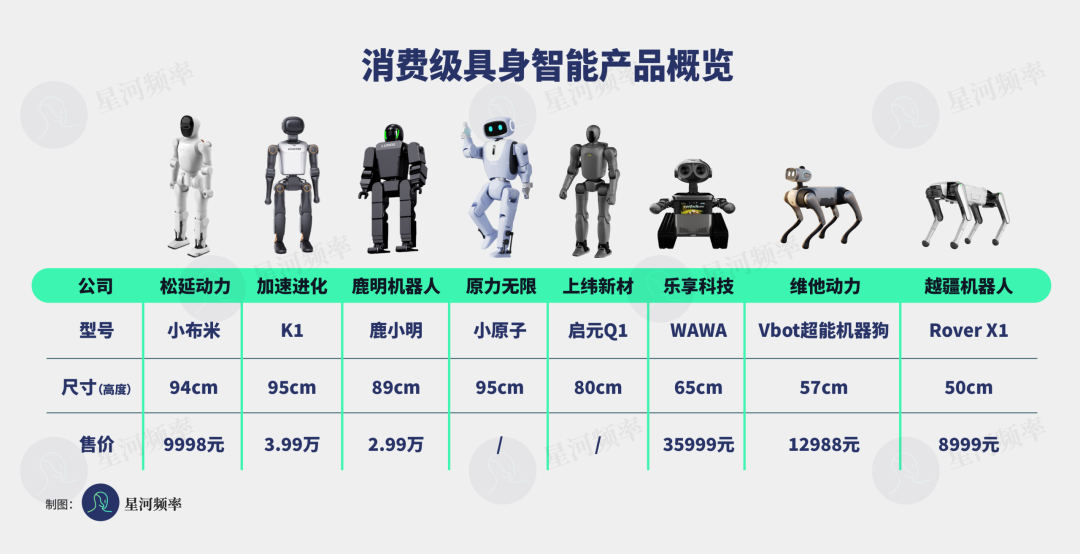
Quadruped robot dogs represent another popular category in the consumer-grade embodied AI space, characterized by all-terrain adaptability and strong practicality, with forms mimicking real dogs.
Leveraging their quadruped structure, these robots adapt to various complex terrains indoors and outdoors, focusing on core scenarios like outdoor exploration, home security, and load-bearing transportation. Their target audience includes outdoor enthusiasts, young groups, and middle-class families.
Popular products include Vitar Power's Vbot super robot dog and Dobot's Rover X1 robot dog.
Both products have secured strong order volumes post-launch, with the former accumulating 6,540 pre-orders during its pre-sale period , generating nearly 100 million yuan in sales—a record for Ten thousand yuan level embodied AI products in terms of both unit sales and revenue. The latter, priced at 7,499 yuan, exceeded 5,000 pre-orders on its first day.
Compared to small bipedal humanoid robots, quadruped robot dogs exhibit lower uncanny valley effects while boasting stronger all-terrain adaptability and broader scenario applicability through relatively mature advanced motion control algorithms.
Additionally, their functionality can surpass that of bipedal robots via external attachments. For example, Vitar Power's products can connect motion cameras and baskets through multifunctional backplates, enabling photography and cargo-carrying functions.
IP-derived robots represent the most distinctive category in the consumer-grade embodied AI space. Their core selling point lies not in extreme athletic performance or general intelligence but in achieving emotional resonance through IP empowerment.
Combining popular IP forms, these products target children and young trendsetters. Due to IP copyright issues, only Lexiang Technology's tracked robot WAWA currently holds relevant licenses.
WAWA adopts the WALL-E image from the film *WALL-E*, with a 1:1 replica design. Currently unreleased, WAWA has a pre-sale price of 35,999 yuan and has already secured 1,000 intention orders.
IP-derived robots feature designs distinct from traditional robot forms, offering higher recognition and appeal through popular IPs.
In terms of functionality, they focus more on entertainment and companionship, emphasizing core features like voice interaction, motion mimicry, and toy interaction, with a strong emphasis on fun and interactivity.
Reviewing these three product categories reveals that most prioritize gentle designs and strong interactivity, attracting users through strong emotional connections and unique content. However, this also leads to certain homogenization trends in functionality and design approaches. 
Defining a High-Quality Consumer-Grade Embodied AI Product
While consumer-grade embodied AI products hold vast potential, this is not a low-threshold, high-return track .
To stand out in fierce market competition and achieve large-scale sales, stable profitability, and long-term development, three core elements are essential: intelligent 'brains,' balanced movement capabilities, and emotionally resonant human-machine interaction.
While these elements may resemble those of full-sized humanoid robots, the essence remains embodied AI products.
'Consumer-grade' refers to market segmentation, not performance reduction. Balancing toy-like and tool-like attributes is crucial for long-term market competitiveness.
First, intelligence represents the soul of robots and cannot be compromised. 'Consumer-grade' does not mean 'low-intelligence.' True product differentiation lies in the 'brain,' not the 'body.'
Vitar Power provides an excellent example in this regard. Their robot dog 'Big Head BoBo' eliminates the need for remote controls, allowing ordinary consumers without engineering backgrounds to use embodied AI products effortlessly.
Through proprietary motion control and intelligent decision-making algorithms, it achieves stable autonomous following and obstacle avoidance in complex home environments.
Additionally, 'Big Head BoBo' incorporates Digibot's S100P chip, delivering 128TOPS of computing power—20 times that of competitors in the same price range.
Force Unlimited's Little Atom focuses on multimodal interaction and contextual understanding, not only comprehending and executing commands but also possessing continuous learning capabilities.
This relies on its dedicated embodied brain—integrating a fully self-developed Hyper-VLA end-to-end multimodal model with a causal world model, while accessing Alibaba Cloud's QianWen large model to achieve 275 TOPS of edge computing power.
Of course, maintaining intelligence does not mean blindly stacking components but rather making precise investments to ensure usability, practicality, and user-friendliness.
Second, movement capabilities must align with core application scenarios without pursuing unnecessary complexity.
If the primary scenario involves child companionship, features like collision resistance, low noise, and soft touch become more critical. For home security patrols, long battery life, quiet movement, and 24/7 operational stability take precedence.
Considering core scenarios for consumer-grade embodied AI products—family companionship, outdoor exploration, and children's play—their comprehensive movement capabilities should focus on fluidity, terrain adaptability, and motion precision.
Moreover, as children represent a key user group, robot safety is paramount.
Movements must be gentle to prevent injuries, while features like fall prevention and collision avoidance ensure robot durability and child safety during play.
Third, a natural selling point of consumer-grade products lies in their ability to serve as emotional agents. Emphasizing emotional human-machine interaction enhances user stickiness.
Emotional human-machine interaction manifests in three dimensions:
Humanized interaction methods: employing simple, natural, and intuitive interaction approaches.
Emotionally resonant interaction content: aligning robot voice, motions, and expressions with users' emotional needs.
Personalized interaction experiences: autonomously adjusting interaction methods and content based on user habits and interests.
For example, Shangwei New Materials' Qiyuan Q1 integrates with the Qiyuan Lingxin platform, supporting natural language dialogue, Q&A, English teaching, and motion demonstration. Users can also program motions, voices, and behavioral logic through the Lingchuang platform.
Both Vitar Power's 'Big Head BoBo' and Force Unlimited's Little Atom display emotionally linkage expressions through screens. These soft design elements often prove crucial for fostering user dependency and emotional bonds.
After ensuring all functional designs are in place, all participants must deliver satisfactory answers regarding cost control and value-for-money propositions.
The rising popularity of consumer-grade embodied AI products not only opens a highly practical pathway for the entire embodied AI field but also acts as a bridge connecting cutting-edge technology with mass markets before the ultimate form of AGI matures.
Every interaction accumulates scenario data, every feedback drives technological iteration, and every purchase votes for the industry's future.
While these robots may not perform highly practical tasks, they are achieving technological penetration for human-machine symbiosis in a gentler, more sustainable manner.
-
![]()
Li Bin Claims, 'Denying the Pure EV Trend is Like Ostrichism.' What's Li Xiang's Take?
-
Lenovo: Liu Jun Turns Left, Yang Yuanqing Turns Right
-
Lenovo: Liu Jun Goes Left, Yang Yuanqing Goes Right
-
![]()
MiniMax Shares Unlock: Cornerstone Shareholders Show Long-Term Optimism, Yet Stock Plummets Nearly 30% in Two Days; Zhipu Also Sees Nearly 20% Drop Today
-
![]()
Single-Day Plunge of 40%: The 'First AGI Stock' Faces More Than Just Share Price Concerns
-
![]()
Ricoh and Fuji Hike Prices on Legacy Edge; Insta360 Poised to Disrupt Mirrorless Camera Market
-
![]()
Ricoh and Fujifilm Raise Prices in Tandem, Relying on Established Reputations; Insta360 Poised to Disrupt Mirrorless Camera Market
-
![]()
Strategic Shift in Photoelectric Sensing: Maxvision Secures Controlling Stake in CAS Optotech