4.5 Billion Red Packet Battle: Who Can Create the Next Super Gateway?
 02/13 2026
 456
456
Spring Festival red packets are an annual tradition, but this year is especially lively. This time, the battleground is not e-commerce or live video streaming but AI.
Volcano Engine, a subsidiary of ByteDance, announced its role as the exclusive AI cloud partner for the 2026 Spring Festival Gala, with Doubao deeply integrated into the event's interactions. Tencent announced that Yuanbao would launch Spring Festival activities, allowing users to share 1 billion yuan in cash red packets via the Yuanbao app. Baidu joined the fray with 500 million yuan in cash red packets, while Alibaba's Qianwen app announced a 3 billion yuan "Spring Festival Treat Plan."
Simultaneously, Qianwen exclusively sponsored the Spring Festival Galas of Dragon TV, Zhejiang TV, Jiangsu TV, and Henan TV, serving as an "AI performer" to deliver gala programs through AI-generated videos, AI image recognition, and AI Q&A. The Baidu app also became the chief AI partner for the 2026 Beijing Radio and Television Spring Festival Gala.
This is a battle for traffic and exposure centered around AI during a national entertainment event, as well as a crucial positioning battle for the next generation of traffic gateways.
I. The Shift from Red Packet Battle to AI: An Inevitable War at a Turning Point
The current AI red packet battle initiated by internet giants is an inevitable choice at a critical juncture in the industry.
Understanding why this battle erupted at this moment reveals the next direction of AI application competition.
The market has reached a key turning point. After several years of development, early adopters willing to try AI technologies have largely been covered.
In 2025, the total monthly active users of major AI applications saw a significant slowdown in growth. Data shows that by December 2025, the user base for generative AI reached 602 million, with a penetration rate of 42.8%.
This indicates that the industry has moved beyond the "novelty" stage and entered a new era of mass adoption. Therefore, while pursuing user scale, it is also essential to ensure that users who have tried AI applications continue to use them frequently.
Meanwhile, the market rankings have undergone dramatic changes. For example, Doubao's user base surged to become the leader, while some early frontrunners slipped in the rankings.
This reshuffling of the landscape has created opportunities for other resource-rich and well-funded companies. They hope to leverage the Spring Festival, a time of massive national participation and traffic, to invest heavily in promotion and attempt to rapidly overtake competitors and reshape the market hierarchy.
Technological maturity is the foundation for increasing user frequency and depth of usage.
Today's AI has preliminary (initially) moved beyond the "toy" stage of simple conversations, showing progress in logical reasoning, image processing, and other capabilities, becoming a genuinely helpful "tool."
However, to prove its true "usefulness," AI must be tested in real, complex scenarios.
The Spring Festival red packet activities serve as a testing ground: they instantly attract a vast number of users, allowing AI systems to be tested for stability under immense pressure. User demands vary widely, from writing blessings to checking routes, comprehensively testing AI's practical capabilities. The massive amounts of real interaction data generated can, in turn, help AI learn and optimize.
Beyond market and technological factors, changes in competitive logic are a deeper driving force.
Current competition has transcended comparing who has more features or more accurate answers, entering a stage of vying for "definitional power." Major companies aim to convey the most critical value of their AI to users.
They choose to concentrate their promotional efforts during the Spring Festival, when national attention is at its peak, to leave the deepest impression on users and Seize the entrance to the mind (seize the entry point into users' minds).
Additionally, an "fear of missing out" (FOMO) anxiety within the industry acts as a catalyst, intensifying competition.
In an era of rapid technological change, no major company dares to miss a critical battle that could decide the future landscape.
This stems from the "collective memory" of major firms. None wish to repeat Nokia's fate during the feature phone era or miss out like Baidu did during the early stages of the mobile internet wave.
Thus, the urgency of "falling behind forever if not fully participating" has led to escalating investments, ultimately evolving into a comprehensive war that no one can afford to lose.
II. Behind Different Red Packet Strategies
In this round of Spring Festival AI red packet battles, companies have adopted vastly different strategies, not merely acquiring users through cash giveaways but also making critical bets on AI's future role.
Tencent and Baidu chose direct cash distributions but with different gameplay; Alibaba and ByteDance took alternative approaches, one focusing on consumption rights and the other betting on top-tier traffic exposure.
Tencent Yuanbao allocated 1 billion yuan in real cash. Users can earn red packets by completing tasks on Yuanbao, with the highest-weighted task being sharing to earn red packets, capped at 30 shares initially and reduced to 6 in the second round, though still the highest-weighted.
The combination of social advantages and "direct withdrawal to WeChat balance" creates a low barrier to claiming money. This design theoretically leverages users' trust in WeChat Pay to achieve near-zero-cost user conversion.
After Yuanbao began distributing money, its downloads surged, reaching the top of the Apple App Store's free chart. However, sustained download growth depends on whether sharing links remain unblocked by WeChat. We will analyze this further later.
Baidu's total of 500 million yuan lags behind Yuanbao but lasts longer. The activity entrance is not within the Wenxin app but rather the Baidu app.
In terms of gameplay, Wenxin also rewards users with red packets for completing tasks, which can then be withdrawn via Alipay or WeChat.
One type of task encourages users to try AI features, such as asking questions using Wenxin's photo function or creating videos with AI, effectively using red packets as "tuition" to guide users through hands-on experiences and remember what the AI can do. Another type of task serves Baidu's ecosystem, such as driving traffic to Du Xiaoman, YY, Baidu Maps, and Tieba.
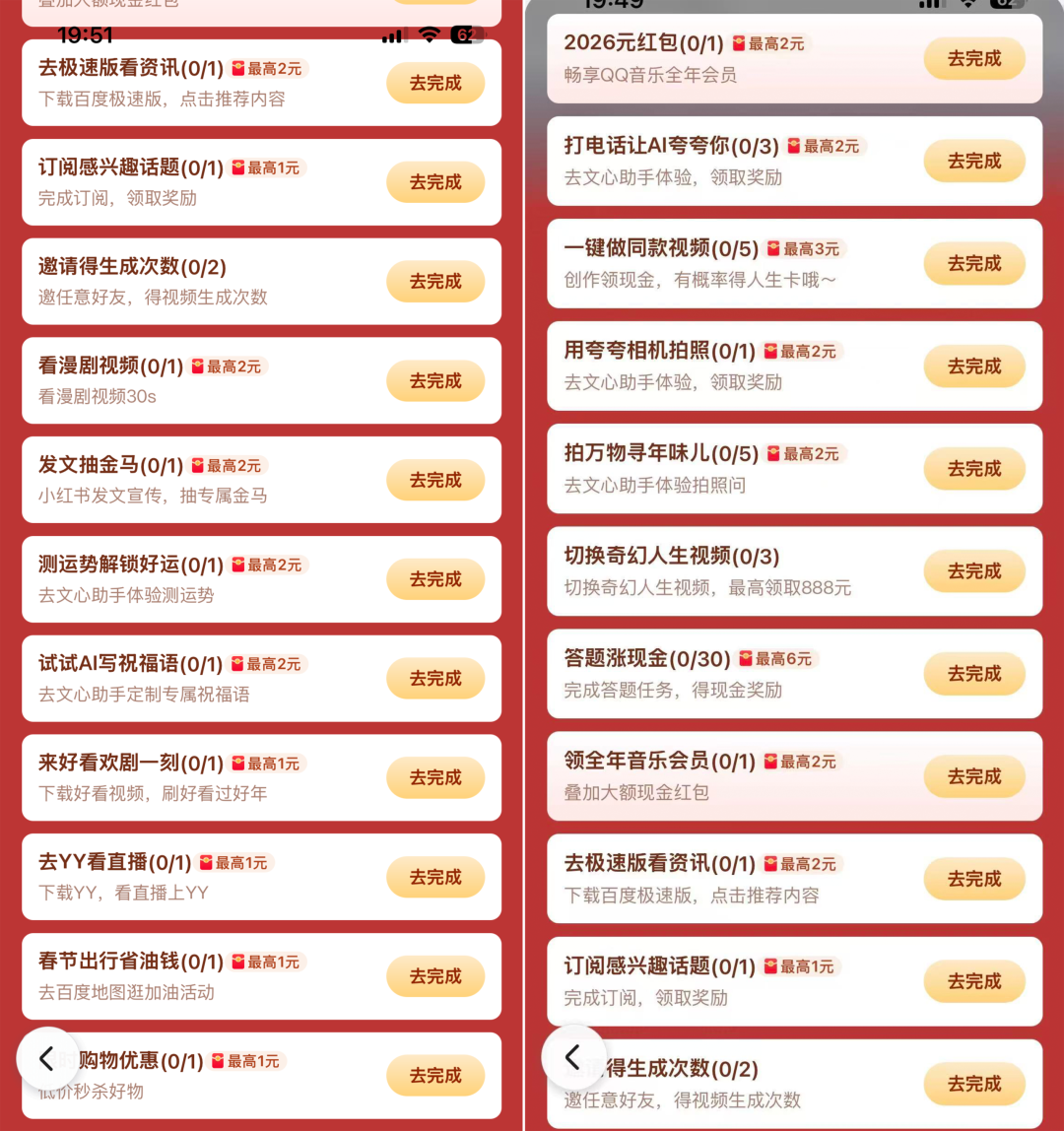
(Baidu App's Spring Festival Red Packet Tasks)
Alibaba's approach differs significantly from Yuanbao and Baidu.
Qianwen does not directly give cash but instead offers discounts or free orders when users consume through Alibaba-affiliated apps like Taobao, Ele.me, and Fliggy. It hopes to attract users to plan their lives and complete purchases through Qianwen, tying AI to spending habits.
ByteDance's Volcano Engine secured the role of exclusive AI partner for the 2026 CCTV Spring Festival Gala, deeply participating in program creation, interactions, and distribution. However, whether Doubao will distribute red packets or the amount remains unknown during the Spring Festival.
From an experience and gameplay perspective, Qianwen offers new experiences for existing, widespread needs; Baidu aims for both empowering old businesses and creating new demands through new experiences, which is one reason for using the Baidu app as the main battlefield for Spring Festival red packets; Yuanbao focuses more on creating new demands through new experiences.
Why such divergent strategies? Ultimately, it stems from their different core businesses, leading to different "toolboxes" when venturing into the new AI landscape.
Tencent employs "social binding." Red packets require WeChat sharing to earn more, and its newly launched "AI Group Chat" feature, Yuanbao Pai, aims to integrate AI into users' WeChat groups, acting as a "group member" that helps summarize chats and participate in check-ins.
Baidu seeks "search upgrades." The red packet activity places AI features next to the search bar, hoping users will seamlessly adopt AI as they would normally search.
Alibaba emphasizes "consumption closed loop (consumption closed loop)." Qianwen is fully integrated with the entire shopping and lifestyle services network, aiming to prove that AI is not just for chatting but a smart lifestyle assistant capable of driving transactions and optimizing decisions.
Doubao, temporarily leading, has already deeply integrated as a foundational service within ByteDance's matrix, including Douyin and Toutiao. During the Spring Festival, it did not follow competitors in large-scale cash red packet promotions, merely adding icing to the cake while showcasing Volcano Engine's capabilities.
This red packet battle is not just about download volumes and activity during the Spring Festival but about what you will use each company's AI for in the future—as a social toy, a search tool, a consumption manager, or a technological foundation?
Red packets are just the starting point. After the festive excitement fades, which company's AI can truly make you use it effortlessly and become indispensable will determine the real winner.
III. How Will the Red Packet Battle Unfold?
The current Spring Festival AI battle has encountered numerous issues before officially beginning. For example, WeChat blocked Yuanbao's links, prompting Yuanbao to switch to password-based red packets, possibly also reducing share-to-earn red packet counts due to this. Later, Baidu Wenxin Assistant's red packet sharing links were also blocked.
For new products, services, or processes to be accepted by users/customers, merely offering a 10% or 30% improvement in experience or cost reduction compared to the previous generation is often insufficient. Typically, an order-of-magnitude improvement, or what Silicon Valley calls "10x better," is needed to create irresistible appeal.
As mentioned earlier, compared to AI-generated images or New Year greeting videos, Yuanbao Pai and AI group chats represent newer implementation scenarios. Both OpenAI and Wenxin have explored AI group chats.
Newer implementation scenarios mean navigating uncharted territory, requiring boundless imagination. Tencent's product development approach is highly classical: cautious, experience-focused, with each feature requiring at least an 80% score before launch. This is an advantage but comes with a clear cost—slowness.
Yuanbao Pai aims to create a new social scenario, but ordinary users may struggle to intuitively understand why to introduce an AI into group chats or listen to music and watch videos together in Yuanbao Pai, especially when not directly within WeChat.
Using Yuanbao Pai requires user exploration and more importantly, finding phenomenal use cases. For example, in fan communities, AI could automatically organize celebrity news, generate secondary creative content, and facilitate topic interactions, becoming an indefatigable "super administrator."
Recently, the trend of using video calls to get fashion advice from Doubao, despite its often "hilarious" suggestions, has added entertainment value and helped users remember this usage scenario.
Technologically, Yuanbao still relies on Deepseek's models, and Hunyuan's model capabilities need improvement. Looking ahead, high-concurrency, high-consumption real-time AI interaction scenarios pose significant computational challenges.
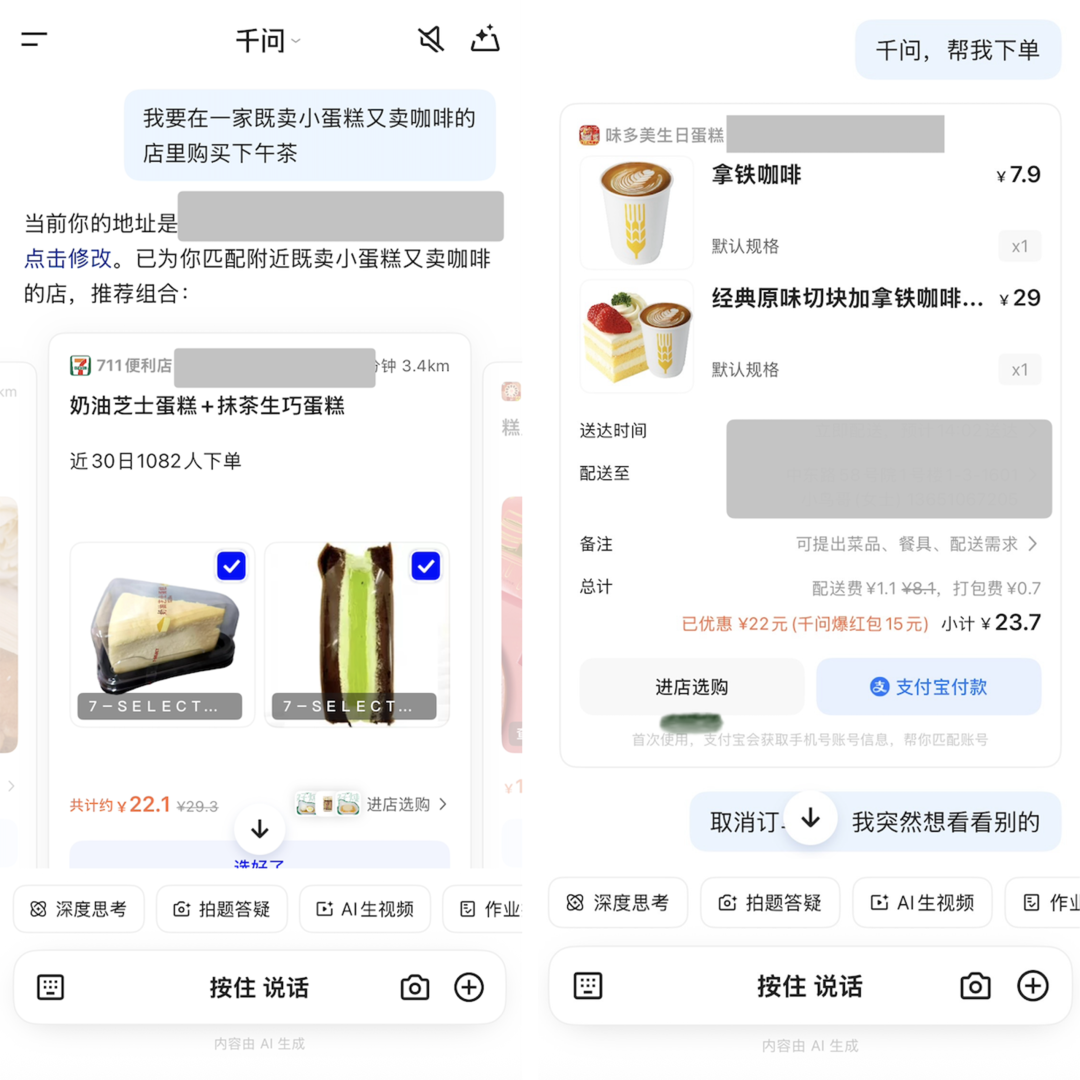
For Qianwen to deliver a smooth "consumption closed loop (consumption closed loop)" experience, it must overcome three hurdles: technology, internal company coordination, and user habits.
Technologically, Qianwen must accurately translate vague natural language instructions into complex cross-platform transactions and enable "non-jump" payments, posing significant engineering challenges.
Ecologically, while it has integrated with Taobao, Fliggy, and other ecosystem apps, coordinating the interests and performance metrics of various business lines remains a test of organizational synergy.
On the user side, it must change users' habit of opening standalone apps and establish a new habit of relying on AI for tasks. Additionally, for users accustomed to price comparisons and prioritizing cost, it may be less convenient than directly comparing prices across different standalone apps.
Regarding Baidu, Goldman Sachs believes it risks being marginalized in the competition for the next-generation AI gateway. Goldman Sachs predicts that the ultimate AI gateway will still concentrate among the three major internet platforms: Tencent, Alibaba, and ByteDance.
After the emergence of chatbots, an industry consensus is that search scenarios will be the first to be disrupted. Based on this judgment, Alibaba attempted to transform the search experience through the Quark browser but ultimately launched Qianwen due to Quark's entrenched user perception as a tool for cloud storage, photo search, and web browsing.
Baidu's actions this Spring Festival represent a different choice from Alibaba, hoping to leverage its massive monthly active users to naturally convert search users into AI users. This approach is more stable but may confine Baidu to the role of a "search enhancement tool" rather than an independent, imaginative new entity.
Doubao, with its "content + tool" generalization capabilities covering the broadest audience, coupled with potential top-tier exposure through cooperation with the Spring Festival Gala, is likely to maintain its leading advantage.
The current challenges faced by all companies point to the same core issue: relying solely on Spring Festival red packet traffic cannot make AI truly take root. After the marketing hype fades, whether users can find high-frequency, stable usage scenarios in AI applications and whether products can secure an irreplaceable niche in users' daily lives will be the key factors influencing the long-term landscape.
IV. Conclusion
This Spring Festival red packet battle, on the surface, is about companies vying for users to adopt their AI. In reality, it is an exploration of future lifestyles involving AI, questioning whether "AI + social" can create new relational bonds, whether "AI + consumption" can build smarter commercial closed loop (commercial closed loops), and whether "AI + information" can reshape knowledge acquisition.
The red packet craze will eventually fade, but the fundamental questions raised by this competition will persist: what role do we truly need artificial intelligence to play?
The Spring Festival AI red packet battle may not provide answers, but it will likely push the most promising options to the forefront for all to see.
-
![]()
Li Bin Claims, 'Denying the Pure EV Trend is Like Ostrichism.' What's Li Xiang's Take?
-
Lenovo: Liu Jun Turns Left, Yang Yuanqing Turns Right
-
Lenovo: Liu Jun Goes Left, Yang Yuanqing Goes Right
-
![]()
MiniMax Shares Unlock: Cornerstone Shareholders Show Long-Term Optimism, Yet Stock Plummets Nearly 30% in Two Days; Zhipu Also Sees Nearly 20% Drop Today
-
![]()
Single-Day Plunge of 40%: The 'First AGI Stock' Faces More Than Just Share Price Concerns
-
![]()
Ricoh and Fuji Hike Prices on Legacy Edge; Insta360 Poised to Disrupt Mirrorless Camera Market
-
![]()
Ricoh and Fujifilm Raise Prices in Tandem, Relying on Established Reputations; Insta360 Poised to Disrupt Mirrorless Camera Market
-
![]()
Strategic Shift in Photoelectric Sensing: Maxvision Secures Controlling Stake in CAS Optotech