Rational Analysis of Seedance 2.0: Far Less 'Formidable' Than Hype Suggests
 02/13 2026
 555
555
Over the past two days, Seedance 2.0 has become the center of attention, fueled by Weibo trending topics adorned with words like 'terrifying,' 'explosive,' and 'game-ending,' alongside a wave of admiration from bloggers and influencers.
From the Snow King's robot battles to everyday scenes of men and women, and even videos of cats and dogs dunking on 'LeBron James and Kobe Bryant,' creative content is flooding various platforms. Short drama mimicry clips are so lifelike that they are discussed alongside genuine short drama clips. This dissemination path demonstrates that Seedance 2.0 has transcended mere technical discussions and entered the realm of popular culture. 
Screenshot of a video generated by Seedance 2.0
Of course, an undeniable boost came from top influencer Film and Television Hurricane Tim's evaluation in his demo video.
Tim used multiple exclamations of 'terrifying' to describe Seedance 2.0's generation effects. This endorsement from a professional and influential figure proved highly effective in spreading the word, significantly propelling Seedance 2.0 into the mainstream.
Subsequently, Feng Ji, the producer of 'Black Myth: Wukong,' published a lengthy article expressing his thoughts on Seedance 2.0, using phrases like 'the childhood era of AIGC is over' to endorse the slogan 'Kill the game!' 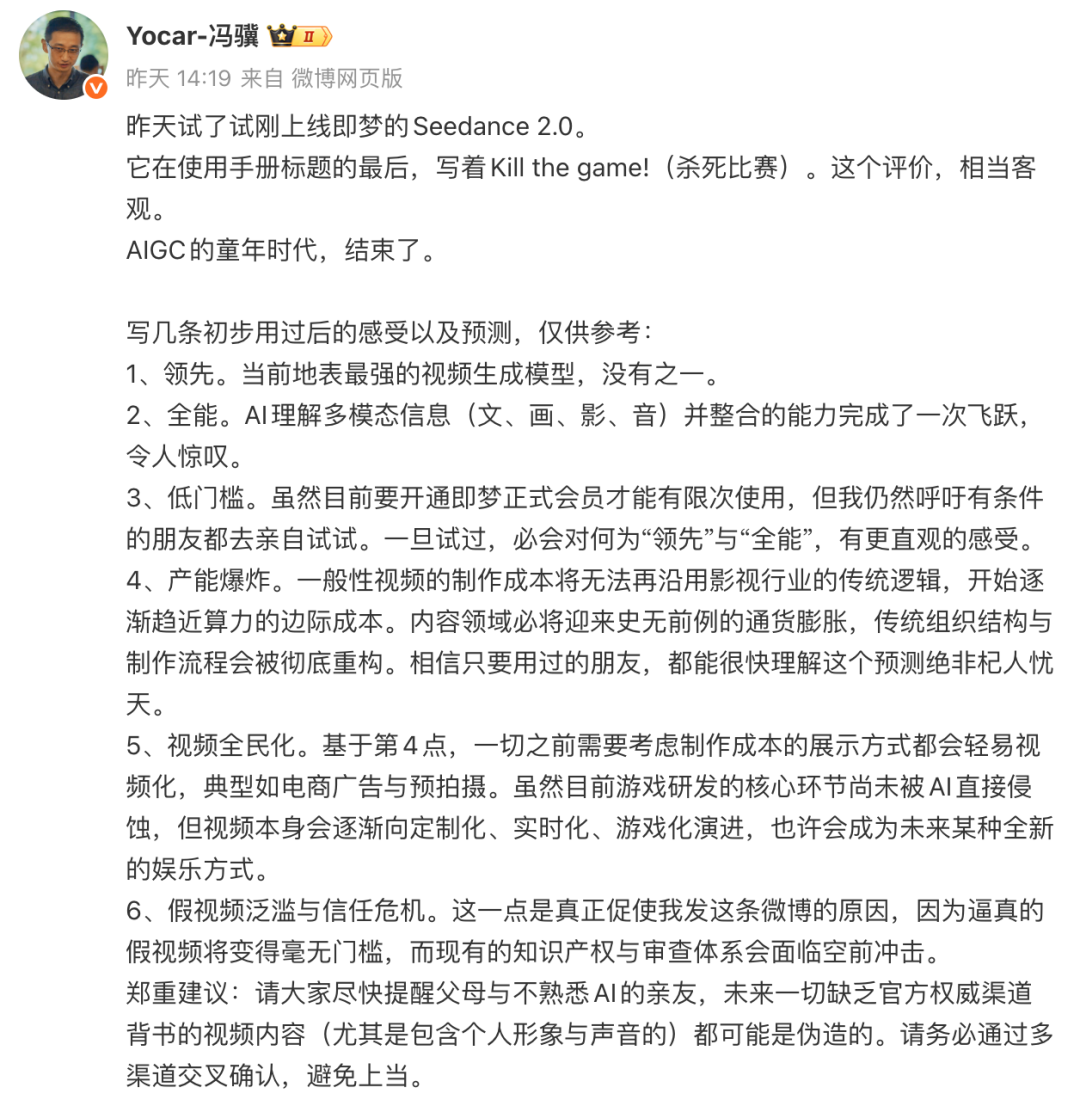
Weibo Screenshot
Judging by the results, this breakthrough has undoubtedly been a success.
Seedance 2.0 has become one of the few video generation tools widely discussed by ordinary users since Sora, with generative video entering the public eye in such a direct manner for the first time. Even domestically, tools like 'Kling,' its 'old rival,' have already achieved impressively realistic effects.
Meanwhile, whenever generative AI reaches a new level of hype, influencers seem to guide the public to 'be shocked' once again, as if previous experiences didn't exist—a curious phenomenon in the AI discourse. 
Image source: Internet
Shifting focus from trending topics and emotional reactions to the broader context of technological evolution and industry cycles, this sense of 'shock' itself needs to be recalibrated. 
What Seedance 2.0 truly addresses is 'certainty,' not 'imagination'
According to consensus in English-language reviews, Seedance 2.0 is most frequently praised for 'more easily reproducing a desired result' rather than for single-generation visual impressiveness.
The introduction of multimodal references makes it exceptionally practical in commercial and production scenarios—users can specify style, characters, actions, and even pacing, rather than relying on trial-and-error with prompts.
The significance of this capability lies in making generated results resemble a manageable production line, ensuring stable output and reusability. 
Screenshot of a video generated by Seedance 2.0
This forms a subtle contrast with Kuaishou's latest Kling 3.0, which leans toward 'cinematic output': Kling emphasizes camera movement and visual completion, while Seedance prioritizes predictability and reusability of results.
Equally important is the native audio integration.
While the English-language community remains divided on whether generated audio quality is commercially viable, Seedance's decision to include audio in the same generation loop reflects a clear engineering-oriented approach, focusing on reducing complexity from separate audio pipelines.
From this perspective, Seedance 2.0 seems tailored for TVC ads, social media shorts, branded content, and templated storytelling. It primarily reduces uncertainty in production costs, with relatively limited impact on the imaginative space of content creation. 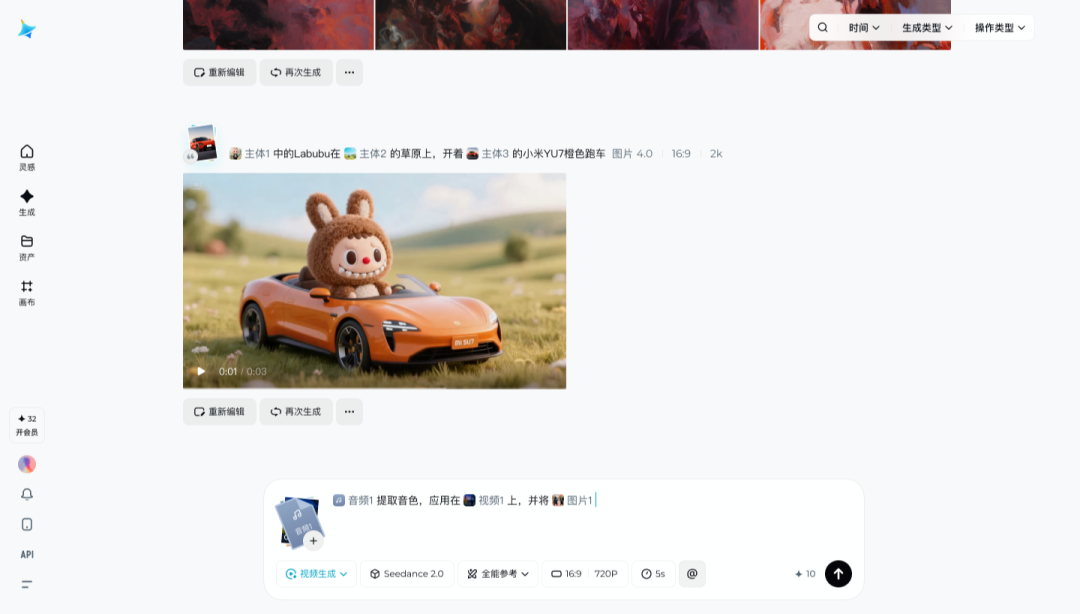
Seedance 2.0's biggest highlight is its 'referencing capability'
This is why it's often evaluated as 'practical' and 'production-friendly' in English creator communities, but rarely described as 'mind-blowing.'
Of course, shifting perspective to the Chinese context, Seedance 2.0's influence takes on another dimension.
It's one of the few AI video generation tools, besides Sora, to truly trend on Weibo, indicating it has broken beyond tech or creator circles into rare mainstream dissemination. From a dissemination standpoint, this breakthrough is undoubtedly successful, meaning generative video is now perceived and discussed by a broader public. 
When Seedance 2.0 is Deified, It Reveals Industry Anxiety
The current enthusiastic praise for Seedance 2.0 is closely tied to the urgent desire for a 'definitive answer' in video, the 'crown jewel of content.'
With Sora's delayed full release, Gemini's Genie 3 shifting toward world models, and Veo emphasizing platform-based delivery, the market desperately hopes for an AI video generation model that's both powerful and immediately usable, capable of fundamentally transforming production logic.
Current video generation sits at a highly engineered yet deeply uncertain stage. What increasingly differentiates experiences isn't whether models are 'smarter,' but whether they remain stable and controllable after large-scale release, and whether they can withstand cost and efficiency tests in real-world usage. 
Screenshot of a video generated by Seedance 2.0
However, Seedance 2.0's current demonstrated progress largely builds on beta testing and early adopter environments, which alone cannot justify overly high industry expectations.
In the relatively short history of generative AI, such phases aren't unfamiliar: beta stages often amplify model capabilities, while true turning points emerge after full release, paid tiers, and resource allocation.
By then, generation speed, cost per use, failure rates, and sustainable experience will redefine a product's actual value. Seedance 2.0 will likely prove no exception.
Thus, extrapolating current performance as a complete replacement for production systems remains premature.
Whether described as 'production-ready' in English circles or met with cries of 'indistinguishable from reality' in Chinese discourse, evaluations rely more on technical potential than long-term performance. 
Screenshot of a video generated by Seedance 2.0
For AIGC products, true mettle is never tested in demo windows.
Moreover, in becoming 'more usable,' Seedance 2.0 gradually encounters unavoidable boundary issues. Tim's demo video showcased the model's high fidelity in replicating facial features, voices, and overall demeanor when real human footage serves as a high-weight reference. Technically, this capability signifies efficiency; in reality, it quickly slides into discussions about portrait rights, licensing boundaries, and deepfakes.
ByteDance's urgent tightening of real-person reference material capabilities on the afternoon of February 9 resembles a risk governance signal: when generative video shifts from 'resembling content' to 'resembling people,' model usability ceases to be merely an engineering issue and begins facing ethical and societal constraints. 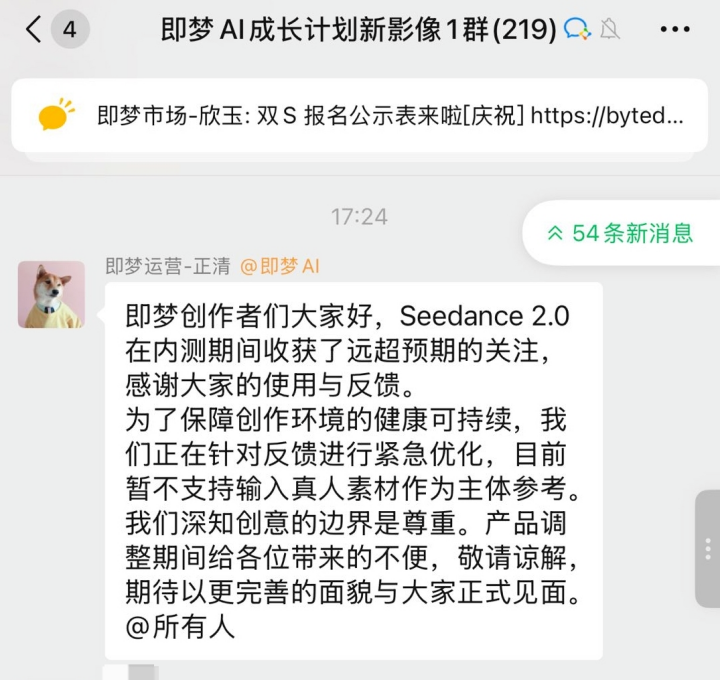
Image source: Internet
To some extent, this precisely indicates Seedance 2.0's proximity to real production environments, explaining why such issues arise so early.
Meanwhile, social media reports about 'beta access' being revoked are circulating.
Thus, maintaining a restrained judgment on Seedance 2.0 stems more from respect for generative video's long-term trajectory.
When a model hasn't undergone the wear and tear of massive users, real payments, and complex scenarios, mythologizing it based solely on early adopter impressions isn't beneficial.
In this sense, the anxiety Seedance 2.0 sparks in China doesn't derive entirely from what it has achieved, but more from what it 'might achieve.' Such possibilities will only fully emerge through the interplay of time, scale, and commercial realities.
Reprint Whitelisting · Business Cooperation · Author Recruitment
-
![]()
Li Bin Claims, 'Denying the Pure EV Trend is Like Ostrichism.' What's Li Xiang's Take?
-
Lenovo: Liu Jun Turns Left, Yang Yuanqing Turns Right
-
Lenovo: Liu Jun Goes Left, Yang Yuanqing Goes Right
-
![]()
MiniMax Shares Unlock: Cornerstone Shareholders Show Long-Term Optimism, Yet Stock Plummets Nearly 30% in Two Days; Zhipu Also Sees Nearly 20% Drop Today
-
![]()
Single-Day Plunge of 40%: The 'First AGI Stock' Faces More Than Just Share Price Concerns
-
![]()
Ricoh and Fuji Hike Prices on Legacy Edge; Insta360 Poised to Disrupt Mirrorless Camera Market
-
![]()
Ricoh and Fujifilm Raise Prices in Tandem, Relying on Established Reputations; Insta360 Poised to Disrupt Mirrorless Camera Market
-
![]()
Strategic Shift in Photoelectric Sensing: Maxvision Secures Controlling Stake in CAS Optotech