Sci-Tech Innovation | API Calls Skyrocket 20-Fold: JieYue and Kimi Vie for the Title of AI ‘Pioneer in the Booming Field’
 04/01 2026
 505
505
Preface:
Amidst the global surge in [AI technology development, likened to a 'lobster farming' craze for its rapid growth], two Chinese companies have stood out prominently.
JieYue Xingchen's Step 3.5 Flash model has witnessed its daily API calls on OpenClaw soar over 20 times compared to 30 days ago, securing the top spot globally in terms of total token calls over the past month.
Yuezhian'anmian's Kimi K2.5 model is hot on its heels, consistently ranking among the top three, with its overseas API platform experiencing a 10-20 fold surge in daily average visits, achieving a commercial milestone by surpassing its 2025 total revenue in just 20 days.
Explosive Growth in API Calls, Both Reaping Benefits from the [Booming Field]
Kimi's precise market positioning and rapid execution allowed it to capitalize on the initial wave of opportunities.
In January 2026, Yuezhian'anmian launched and open-sourced the K2.5 model, deeply optimized for Agent scenarios, supporting up to 100 sub-Agents operating in parallel and over 1500 consecutive tool calls, perfectly catering to the needs of long-chain task execution.
This seemingly minor technological advancement at the time set the stage for Kimi to later seize the traffic dividends from OpenClaw.
Within a month of OpenClaw's popularity surge, Yuezhian'anmian secured two rounds of financing totaling over $1.2 billion, with its valuation skyrocketing from $4.3 billion to $12 billion, peaking at $18 billion.
In just three months, its valuation quadrupled, setting the record for the fastest rise of a domestic large model company from inception to becoming a [decacorn, a startup valued at over $10 billion].
JieYue Xingchen's momentum began with its comprehensive open-sourcing in early March 2026.
By then, OpenClaw's popularity had extended from the developer community to the entire industry. Kimi had already captured a significant market share with its first-mover advantage, while JieYue Xingchen countered with an industry-rare [full-suite open-source] strategy.
In early March, JieYue Xingchen officially open-sourced the Step 3.5 Flash model, specifically tailored for Agents. Not only did it release the model itself, but it also simultaneously provided two core weights: the pre-training weights (base) and mid-training weights (midtrain).
The former is akin to offering developers a [blank canvas model space], enabling them to conduct full-parameter fine-tuning and build exclusive models from scratch to meet their specific needs.
The latter resembles a [fully equipped model space], already enhanced with core Agent capabilities such as reasoning, coding, and tool calls, allowing developers to build on existing strengths and significantly shorten the AI agent development cycle.
After open-sourcing, Step 3.5 Flash quickly climbed to the top of the monthly OpenClaw model call rankings, consistently ranking first globally for multiple days, earning the reputation of the [most developer-friendly AI brain] in the open-source community.
Kimi's top-down strategy prioritized securing official entry points, rapidly capturing C-end traffic, and establishing user recognition through its first-mover advantage.
JieYue's bottom-up approach first captured the developer base through open-sourcing, then expanded to ordinary users with products, building long-term barriers through ecosystem development.
These two vastly different paths ultimately converged on the OpenClaw battlefield, making the race for the [pioneer in the booming field] even more thrilling.
Secondary Market Frenzy Opens IPO Window
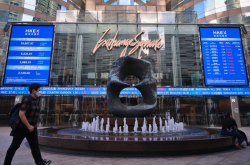
In the first quarter of 2026, the Hong Kong Stock Exchange IPO market witnessed its strongest start in recent years, raising approximately $11.6 billion, a year-on-year increase of over 385%.
Tech companies re-entered the listing queue, with large model companies becoming the most sought-after targets for capital.
The market performance of Zhipu and MiniMax after their listings further fueled capital enthusiasm, with both companies' market values rapidly surpassing HK$300 billion post-IPO, far exceeding previous market expectations.
This also sparked valuation speculation for unlisted targets in the primary market.
The global developer ecosystem dividends brought by the AI boom suddenly brought income inflection points for large model companies that had previously struggled to achieve commercialization.
Just three months ago, Yang Zhilin clearly stated in an internal letter that the company was not in a rush to go public in the short term.
At that time, his confidence stemmed from the company's over RMB 10 billion in cash reserves and sustained financing capabilities in the primary market.
However, in just three months, dual changes in the market and industry quietly altered the company's listing pace.
The latest market news indicates that Yuezhian'anmian is evaluating the possibility of a Hong Kong Stock Exchange IPO and has engaged in discussions with CICC and Goldman Sachs regarding listing cooperation.
At the end of last year, Zhang Yutong, former managing partner of GSR Ventures, was appointed as the president of Yuezhian'anmian, responsible for overall strategy and commercialization, including financing-related matters.
Founder Yang Zhilin has also frequently stepped into the spotlight recently, first attending NVIDIA's GTC conference as the only invited founder of an independent Chinese large model company, systematically disclosing the technical roadmap behind K2.5.
He also made multiple appearances at the Zhongguancun Forum, continuously strengthening the company's technological narrative and brand presence.
Unlike Yuezhian'anmian's [timing-based] approach, JieYue Xingchen's IPO signals are much clearer, with its progress taking the lead.
Information disclosed by Caijing shows that JieYue Xingchen plans to complete its Hong Kong Stock Exchange listing application by June 30, 2026, with a target valuation of approximately $10 billion, aiming to complete the listing within the year.
In January this year, JieYue Xingchen completed a Series B+ financing round of over RMB 5 billion, setting a new record for the largest single financing in China's large model sector over the past year.
The investor list includes not only old shareholders like Tencent and Qiming but also multiple state-owned and industrial capital firms such as Shanghai State-Owned Assets, China Life Equity, and Pudong Venture Capital, solidifying the capital foundation for its IPO journey.
The joining of Yin Qi directly enabled JieYue Xingchen to form a complete closed loop of [model R&D + industrial implementation], which is also its core confidence for pursuing an IPO.
At the terminal implementation level, JieYue's models have been integrated into the systems of mainstream smartphone manufacturers like OPPO, Honor, and ZTE, with cumulative deployments exceeding 42 million devices.
In automotive scenarios, its AgentOS has been adopted by the Geely system, with an expected vehicle deployment volume exceeding 1 million units in 2026.
At this year's CES, its joint demonstration with Geely of the Galaxy M9 intelligent cockpit interaction system achieved a first-sound response time of under 0.7 seconds, with the model already selling over 50,000 units.
This industrial implementation capability has translated into a stable revenue base.
Market disclosure data shows that JieYue Xingchen's 2025 revenue was approximately RMB 500 million, roughly on par with the full-year revenue of listed company MiniMax at RMB 546 million, with a 2026 revenue target of RMB 1 billion to 1.2 billion.
More importantly, its revenue structure is clear, with core segments such as terminal licensing, in-vehicle systems, and enterprise services providing long-term, deterministic income, offering sufficient performance security to the secondary market.
In the industry cycle of Agent explosion, whether it can win a broader developer user base and API calls on the foundational model route, rather than relying solely on B-end channel implementations, will directly impact its post-IPO valuation and growth potential.
The Clash of Two Paths and the Industry's Deep-Seated Variables
Yuezhian'anmian tells a high-growth narrative of [technological breakthrough + global ecosystem].
Its core bargaining chip is the exponential growth in API calls amidst the AI boom and sustained breakthroughs in the overseas developer market, aligning with the valuation logic of global leading model manufacturers and presenting the long-term growth potential of general-purpose large models to the market.
JieYue Xingchen, on the other hand, tells a high-certainty narrative of [industrial binding + closed-loop implementation].
Its core bargaining chip lies in its deeply bound implementation scenarios with terminals and automakers, a stable and predictable revenue curve, presenting the market with a proven commercialization closed loop.
Another core variable in this race is the gap between the primary market's valuation exuberance and the secondary market's expectation fulfillment.
Currently, Yuezhian'anmian's valuation of $18 billion and JieYue Xingchen's $10 billion both exceed the pre-IPO valuations of Zhipu and MiniMax.
However, the post-listing market value surge of Zhipu and MiniMax largely stemmed from the scarcity premium of large model targets on the Hong Kong Stock Exchange. When the third and fourth large model companies list, this scarcity premium will quickly dilute.
The secondary market will ultimately return to performance itself, with both companies needing sustained growth to support their current valuation expectations.
Changes in regulatory sentiment have also introduced uncertainty to this race.
Recently, the Hong Kong Stock Exchange has continuously tightened regulations on red-chip structure listings, with the CSRC increasingly focusing on the reasonableness and necessity of companies establishing red-chip structures. Some companies have already chosen to dismantle their red-chip structures and switch to H-share listings.
Yuezhian'anmian adopts a Cayman-Hong Kong-domestic red-chip structure, and these regulatory changes may introduce additional variables to its IPO process.
Conclusion
The so-called [pioneer in the booming field] can be understood as who first proves that AI can generate revenue at scale.
Kimi has seen commercial explosions but with high volatility, while JieYue has stable revenue but less steep growth.
The true key variable is whether token revenue possesses [sustainability].
Alphabet Rankings: 'Kimi and JieYue Vie for the [Pioneer in the Booming Field]', Sohu Technology: 'Yuezhian'anmian and JieYue Xingchen Race Towards Hong Kong Stock Exchange IPO, Market Value Expectations Exceed $38 Billion, Is Yang Zhilin Anxious?', Shanghai Securities News: 'Is China's Third Large Model Company Coming?', Caijing AI: 'JieYue Xingchen Plans to List on the Hong Kong Stock Exchange This Year, with 2025 Revenue of Approximately RMB 500 Million'
-
![]()
Model Giant Jieyue Xingchen Steps into Smartphone Arena: A Strategic Alliance with Huaqin Technology
-
![]()
Big Model Firm Dives into Phone Market: StepFun and Wingtech Forge a ‘Dynamic Duo’
-
![]()
Zhongrun Optics Makes a Bold Move with 1 Billion Yuan Investment: Is a Turning Point on the Horizon for the Precision Optics Industry?
-
![]()
Deploy CLBO Crystals and YIG Single Crystals! Erythritol Leader Invests 30 Million in Youwei Optoelectronics
-
CXMT’s July 16 Subscription: Leading Domestic Memory Manufacturer—What’s the Earning Potential per Lot?
-
![]()
Rhythm Discrepancy and Premium Value Erosion: Foreign Luxury Brands Must Re-evaluate Their China Strategy
-
![]()
Half-Year, 1 Billion Yuan Financing, 7 Billion Yuan Valuation: A New Dark Horse Emerges in the Embodied AI Sector
-
![]()
Strong Rebound for Tech Stocks in Hong Kong Stock Market: Is It Time to Bottom-Fish?