Tesla Officially Announces FSD's Entry into China: A Belated Breakthrough and an Unfinished Journey
 05/21 2026
 770
770
Original content by the editorial team of Keji Sishao © Youliao Business
Author | Xuan Niao
On May 21, 2026, Tesla's official account on X announced the launch of the supervised version of FSD in 10 countries/regions, with "China" prominently listed. This marks the first time Tesla has officially confirmed FSD's availability in the Chinese market through official channels, signifying a milestone in this multi-year effort to enter China.
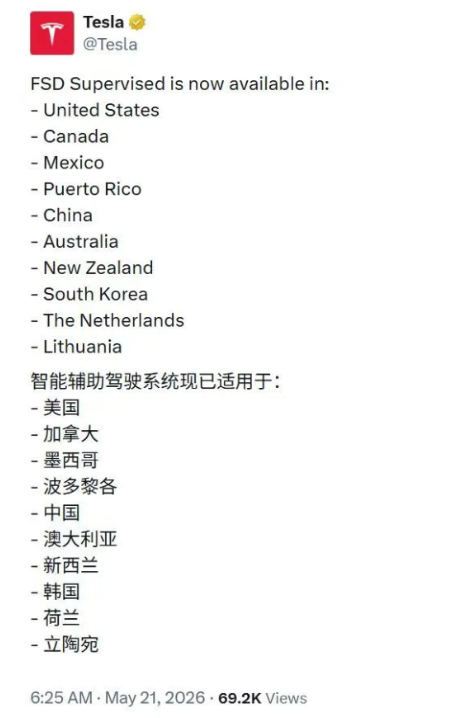
Tesla's official X account releases a list of regions where FSD Supervised is available, with China included
According to Tesla's official tweet, FSD Supervised is now available in 10 countries/regions, including the United States, Canada, Mexico, Puerto Rico, China, Australia, New Zealand, South Korea, the Netherlands, and Lithuania. Tesla claims it is the "only robotic car you can buy," with FSD Supervised capable of taking users anywhere in these regions.
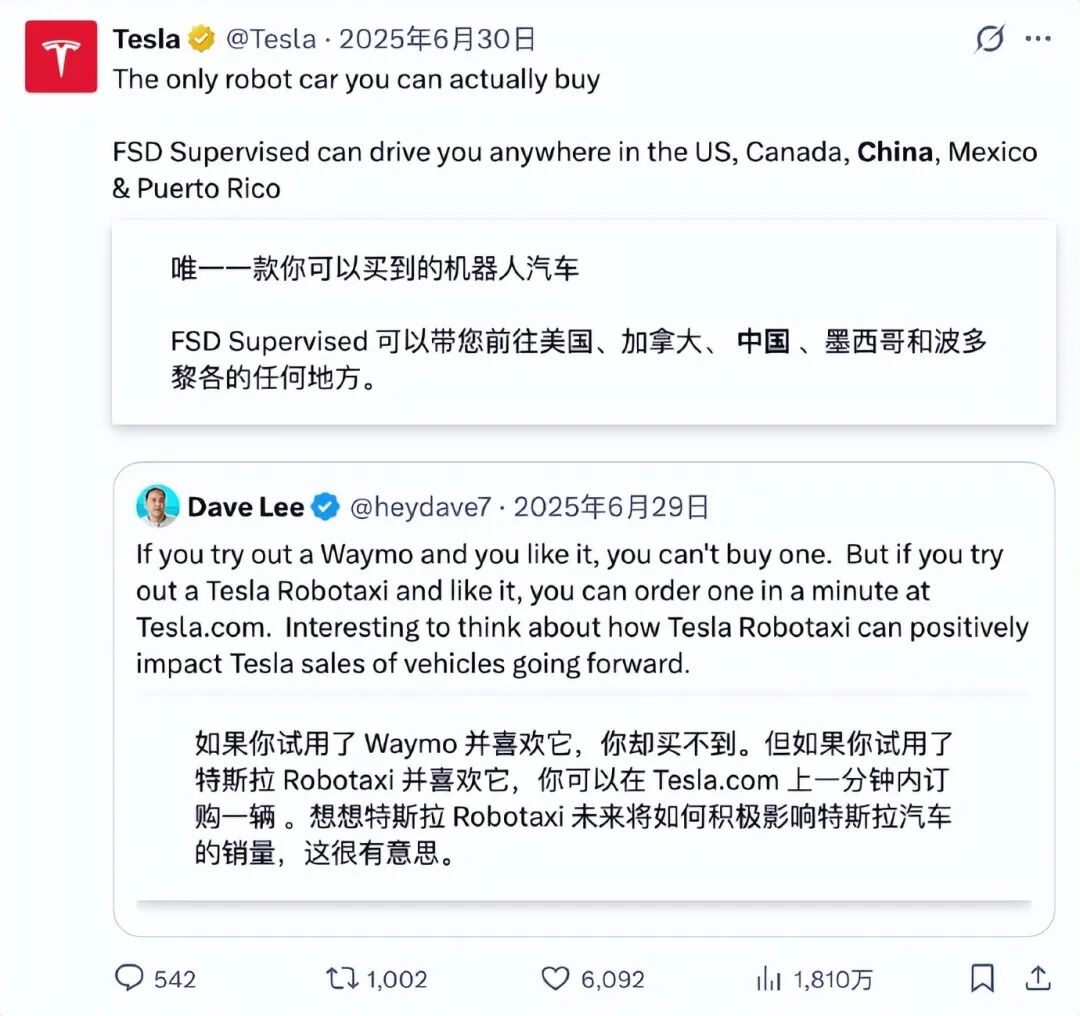
Tesla officially claims FSD is the "only purchasable robotic car," with Dave Lee comparing Waymo and Tesla's Robotaxi business models
Meanwhile, Tesla China recently posted around 90 job openings related to intelligent driving testing in nine key cities (Beijing, Shanghai, Guangzhou, Shenzhen, Suzhou, Wuhan, Chengdu, Tianjin, and Chongqing), sparking further industry speculation about FSD's rollout in China. When contacted by media posing as consumers, Tesla's official customer service replied, "The RMB 64,000 intelligent assisted driving function is not compatible with all vehicles; some are only compatible with the RMB 32,000 enhanced assisted driving function. The company is actively pursuing regulatory approvals in accordance with national regulations and will roll out the feature to domestic customers as soon as approvals are obtained."
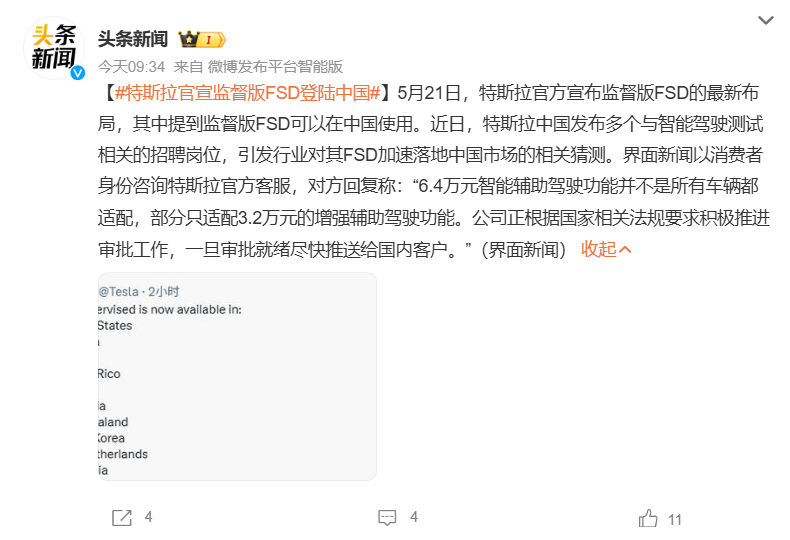
Headline News reports Tesla's official announcement of FSD's launch in China, with customer service responding to questions about the RMB 64,000 feature's compatibility
During the Q1 2026 earnings call, Tesla CFO Vaibhav Taneja made a clear statement regarding FSD's progress in China. He said Tesla has received some approvals in China but is still working on "broader approvals" in collaboration with Chinese regulators, hoping to secure them by Q3.
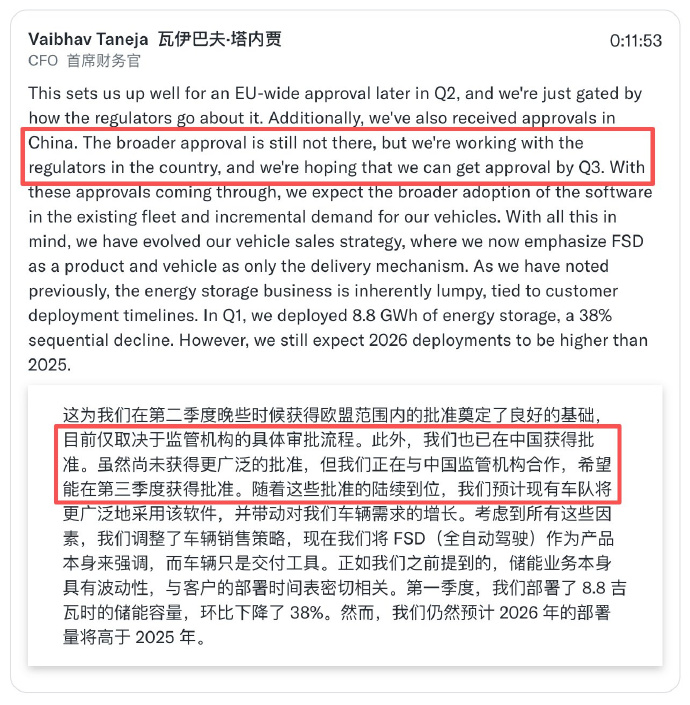
Tesla CFO Taneja states that some approvals have been obtained in China, with hopes for broader approvals in Q3
Notably, Taneja also revealed a significant strategic shift—Tesla has adjusted its vehicle sales strategy, "now emphasizing FSD as the product itself, with the vehicle merely serving as the delivery tool." This means Tesla is transitioning from a "car-selling company" to a "software-selling company," with FSD no longer being an optional feature but the core product.
However, reviewing the previously expected timeline, Tesla has repeatedly "missed deadlines" on approvals: At the 2025 shareholders' meeting, Musk predicted FSD would likely receive Chinese approval by February-March 2026; at the January 2026 Davos Forum, Musk said approval could come as early as February; but on January 23, Tesla China urgently clarified that "there has been no new progress in advance (tui jin, meaning 'advancement')." While the May 21 announcement marks significant progress, it still falls short of "full approval."
Why the Delay?
The fundamental reason Tesla's FSD entry into China has faced years of setbacks lies in two insurmountable barriers—the U.S. export controls on chips to China and the rigid constraints of China's data security regulations. These two barriers intersect, creating an almost unsolvable "computing power-data" dilemma.
Training autonomous driving large models requires massive computational power. Tesla has a computing cluster of about 100 ExaFLOPS in the U.S., roughly 2-3 times the combined computing power of China's major autonomous driving companies. However, in October 2022, the U.S. Department of Commerce's Bureau of Industry and Security imposed export controls on advanced integrated circuits, restricting the export of high-performance AI chips like NVIDIA's H100 to China. This means Tesla cannot deploy computing equipment with restricted chips in China.
Core Conflict: Tesla's 100E FLOPS of computing power in the U.S. cannot be used for training in the Chinese market due to data localization requirements; meanwhile, U.S. chip export controls prevent Tesla from replicating equivalent computing infrastructure in China. Computing power and data are physically isolated on opposite sides of the Pacific.
Faced with this dilemma, Tesla's potential solutions include: building its own computing center in China (but limited by chip supply, its computing power would be far inferior to that in the U.S.), switching to domestic chips (such as Huawei's Ascend series, but requiring a complete overhaul of the algorithm layer, potentially significantly reducing training efficiency), or leasing computing power through partnerships with Chinese companies. It is known that Tesla has built a computing center in China, but its specific computing power has not been disclosed. 36 krypton reports that the Chinese team mainly "uses off-the-shelf materials for localized tuning" rather than training with data collected from Chinese vehicle owners, suggesting its computing power in China may be quite limited.
If chip blockades represent the issue of "computing power not entering China," then China's data security regulations address the problem of "data not leaving China." Together, they create a dual dilemma for Tesla's FSD entry into China.
The "Provisions on the Administration of Automobile Data Security (Trial)" implemented on October 1, 2021, explicitly require that important data collected by automobiles must be stored within China; if it needs to be provided overseas, it must pass a data exit security assessment organized by the national cyberspace administration. Additionally, the "Data Security Law" and "Personal Information Protection Law" form a more complete regulatory framework, covering the entire lifecycle of data collection, storage, use, processing, transmission, provision, and disclosure.
Regulatory Constraints: Driving data from Chinese vehicle owners, road information collected by cameras, and environmental data recorded by vehicle sensors—all essential "fuel" for training FSD models—must remain within mainland China and cannot be transmitted across borders to Tesla's U.S. computing center for training.
To meet compliance requirements, Tesla has taken a series of measures: establishing a data center in Shanghai for localized data storage; obtaining a Class B surveying and mapping qualification issued by the Ministry of Natural Resources; and collaborating with Baidu to customize a high-precision mapping engine. In April 2024, Tesla's Shanghai factory models passed data compliance inspections by the China Association of Automobile Manufacturers and the China National Computer Network Emergency Response Technical Team Coordination Center, becoming the only qualifying foreign-funded enterprise.
It is important to clarify that Tesla's collaboration with Baidu is often misinterpreted as a "joint effort to enhance intelligent driving." In fact, both The Paper and Sina Finance have explicitly stated that this partnership is limited to map navigation and does not involve FSD performance improvements. This represents Tesla's compliant path to obtaining surveying and mapping qualifications under Chinese regulations, not a deep technical collaboration.
Limited Rollout, Hardware Compatibility, and the RMB 64,000 Controversy
Despite Tesla's official announcement of FSD's availability in China, the actual rollout is extremely limited. Weibo blogger "Not Zheng Xiaokang" pointed out that FSD actually entered China as early as March 2025 and was officially announced in June last year, but at that time, it was only permitted to be rolled out to about 5,000 vehicles.
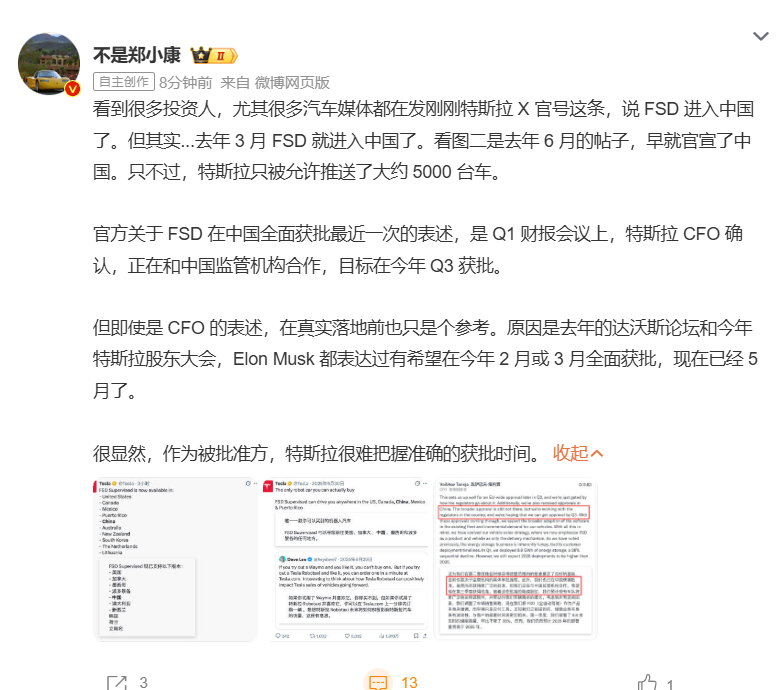
Weibo blogger "Not Zheng Xiaokang" notes that FSD entered China as early as March last year but was only rolled out to about 5,000 vehicles
Weibo blogger "Qiqi Super Intelligent" further argued that if the new V14 version is still only rolled out to these few thousand vehicles, it is largely meaningless. Even with a full rollout, the number of domestic users purchasing FSD would be extremely small. The truly noteworthy news would be when Tesla introduces a subscription model in China—without it, FSD will remain merely a "mascot" in China.
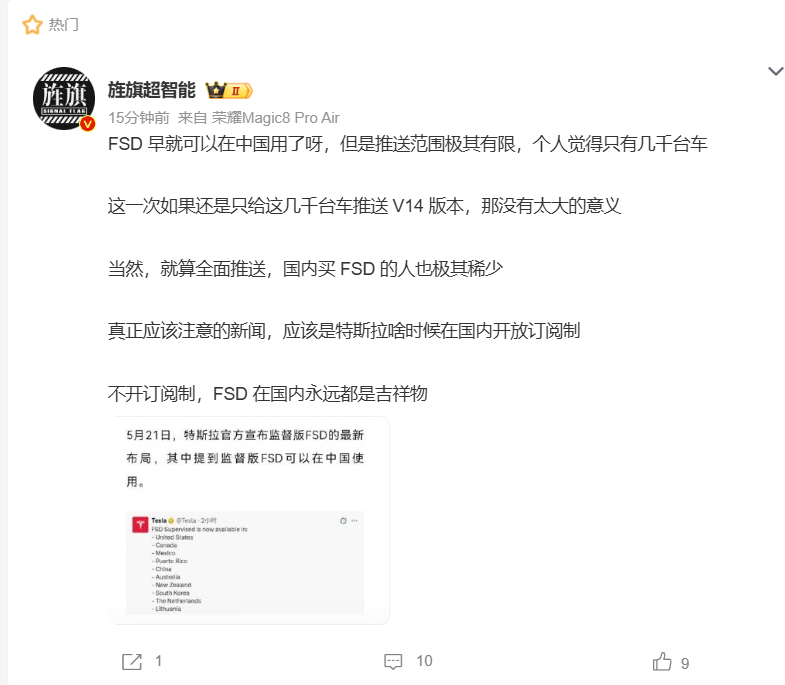
Weibo blogger "Qiqi Super Intelligent" believes a subscription model is key to FSD's success in China
Another practical issue FSD faces in China is hardware compatibility. Tesla's intelligent driving hardware has evolved from HW2.5 to HW3.0 and now to HW4.0 (also known as AI4). HW3.0 offers 144 TOPS of computing power, while HW4.0 boosts this to 720 TOPS, upgrades cameras from 1.2 megapixels to 5 megapixels, and increases detection range from 250 meters to 424 meters. Currently, all Tesla models sold in China are equipped with HW4.0 hardware.
However, a large number of older vehicles equipped with HW3.0 cannot run the new on-device models, posing the biggest obstacle to FSD's widespread adoption. Some commentators have pointed out that the largest barrier to FSD is the insufficient penetration rate of AI4 hardware.

Netizens point out that the biggest obstacle to FSD is the insufficient penetration rate of AI4 hardware, with many HW3.0 vehicles unable to run new models
Tesla's FSD is priced at RMB 64,000 as an optional feature in China, but not all vehicles are compatible with this function—some are only compatible with the RMB 32,000 enhanced assisted driving feature. What frustrates vehicle owners even more is that some who paid RMB 64,000 for vehicles without the corresponding hardware have been unable to use FSD for years, and Tesla refuses to issue refunds.

Netizens question Tesla's practice of charging RMB 64,000 from owners without the hardware and refusing refunds, arguing that domestic automakers would face widespread criticism for such behavior
One frustrated vehicle owner stated, "Tesla charged RMB 64,000 from owners without the hardware version but refuses to issue refunds after all these years. If any domestic automaker did this, they'd be heavily criticized online. Only Tesla seems to get away with it." This comment reflects consumer dissatisfaction with Tesla's "double standards"—the same business practice would draw severe criticism if done by a domestic brand, yet Tesla seems to receive more leniency.
Other netizens have questioned the claim that "only a few thousand vehicles" have received the rollout, pointing out that Tesla sold at least 1 million vehicles in China from 2022-2023, with tens of thousands of buyers purchasing the self-driving feature. If FSD has only been rolled out to a few thousand vehicles, the remaining tens of thousands of buyers would be left feeling like "fools."

Netizens question the claim that "only a few thousand vehicles" have received the rollout, pointing out that tens of thousands of self-driving feature buyers have been ignored
A Spectrum of Voices: From Anticipation to Skepticism
News of Tesla's FSD entry into China has sparked widespread discussion on social media, with netizens' attitudes showing clear polarization.
Some netizens are optimistic about FSD's entry into China. Tech media figure "Keji Xinyi" expressed concern about when Musk would bring FSD to China, arguing that "otherwise, Tesla's intelligent driving in China would fall too far behind." Others believe that "Tesla's intelligent driving is so powerful that it outperforms domestic assisted driving," showing confidence in FSD's technical capabilities.
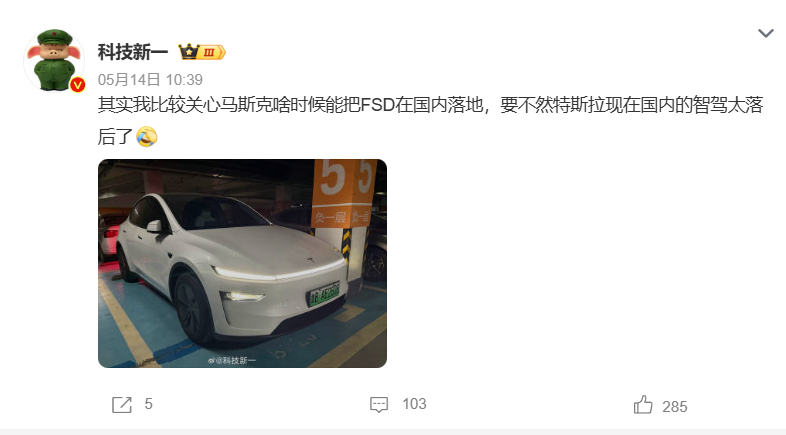
Tech media figure "Keji Xinyi" believes Tesla's domestic intelligent driving is lagging and looks forward to FSD's rollout

Some netizens believe Tesla's intelligent driving "outperforms domestic assisted driving," contrasting with the "lagging" view
Other netizens are skeptical about FSD's entry into China. Previous road tests of FSD have been widely criticized for violations such as occupying bus lanes and ignoring traffic lights, with some netizens joking that "12 points wouldn't be enough to deduct." The issue of RMB 64,000 refunds for older vehicle owners also continues to draw dissatisfaction. Some analysts point out that FSD's entry into China is more likely to drive technological competition and business model iteration in the short term rather than disrupt the market—domestic intelligent driving systems' adaptability to complex scenarios poses a key barrier.
Domestic automaker executives have adopted a more composed stance. Li Xiang of Li Auto stated, "Tesla has always been a good example for us to learn from in the intelligent electric vehicle space," welcoming comparisons with Li Auto's AD Max. He Xiaopeng of XPeng Motors "warmly welcomed" FSD's entry, emphasizing that XPeng and Tesla were among the first to mass-produce end-to-end large-model intelligent driving systems.
From the table above, it can be seen that although Tesla FSD boasts the most extensive accumulation of autonomous driving data and the most mature pure vision end-to-end technology roadmap globally, it faces 'inherent weaknesses' in the Chinese market: its computing power is blocked overseas by chip restrictions, and its data is constrained domestically by regulations. The accumulation of localized training data lags far behind competitors like Huawei and XPENG, which have deep roots in the Chinese market. In the industry tier ranking for 2026, FSD is only listed as second-tier, creating a stark contrast with many people's intuitive perceptions.
After the Breakthrough, the Journey Has Just Begun
Tesla FSD's entry into China, on the surface, appears to be a victory in technology deployment, but in essence, it resembles a survival battle to break through heavy encirclement. When we look beyond the official announcements and examine the underlying logic, we find that this 'entry into China' is far more complex than imagined.
First, chip restrictions and data compliance pose structural dilemmas. This is not a problem that can be resolved through commercial negotiations or technical optimization. U.S. chip export controls are a product of geopolitics, while China's data security regulations represent a sovereign bottom line (bottom line)—neither is likely to 'greenlight' Tesla. Tesla's computing power in China will never match that of its U.S. operations, meaning FSD's model training and iteration speed in the Chinese market will be long-term constrained. Even if domestic chip alternatives are adopted, the costs of algorithm reconstruction and efficiency losses cannot be ignored.
Second, 'officially available' does not equal 'truly usable.' In terms of rollout scope, it currently covers only a few thousand vehicles, far from the millions sold by Tesla in China to date. From a hardware compatibility perspective, many HW3.0 owners cannot use the latest FSD version even after paying RMB 64,000. Commercially, the one-time buyout price of RMB 64,000 lacks competitiveness in the Chinese market—domestic competitors mostly include basic intelligent driving functions with vehicle purchases, while advanced features often adopt monthly subscription models. Tesla has already abolished one-time buyouts globally in favor of monthly subscriptions1, but subscription pricing and availability in China remain undetermined.
Third, the true significance of FSD's entry into China lies in the 'catfish effect.' As implied by statements from executives at Li Auto and XPENG, domestic automakers are not afraid of FSD's competition—they welcome it. The reason is that FSD's entry will accelerate Chinese consumers' awareness and acceptance of intelligent driving, drive the industry's business model shift from 'selling hardware' to 'selling software + subscriptions,' and compel domestic automakers to continuously invest in end-to-end large models, data loops, and computing infrastructure. The ultimate beneficiaries of this competition will be Chinese consumers.
Fourth, Tesla faces a deeper strategic paradox. CFO Taneja stated, 'The vehicle is just a delivery tool; FSD is the product,' but in the Chinese market, FSD's delivery is precisely constrained by the iteration speed of vehicle hardware and the pace of regulatory approvals. When your core product cannot be fully delivered to most paying users, the narrative of 'software-defined vehicles' suffers fundamental cracks. Owners who pay RMB 64,000 for features they cannot use are the most direct victims of this paradox.
Tesla FSD's entry into China is not the finish line—not even the end of the starting point. It is merely a milestone on a long journey ahead, which includes approvals for full-scale rollout, implementation of subscription models, catching up on localized training, and direct competition with China's first-tier intelligent driving players like Huawei, XPENG, and Li Auto. After this breakthrough, the true journey has just begun.
Disclaimer: This article is written based on publicly available information or details provided by interviewees. However, Keji Sishao and the author do not guarantee the completeness or accuracy of the information or associated references mentioned or displayed in this article, nor do they represent the positions of any institutions or individuals. In case of infringement, please contact us for removal. Under no circumstances shall the information or opinions expressed in this article constitute investment advice to any person.
-
![]()
The Allure of 'Acquisition Spree': Li Shufu's Left Turn, Xu Jiayin's Right
-
![]()
Strategic Transformation Yields Results: Phoenix Optics Reports 10.9% YoY Rise in Core Net Profit for H1 2026
-
![]()
Three Key Growth Trajectories Synergize! Crystal-Optech Reports 3.478 Billion Yuan in Revenue for H1 2026
-
![]()
Semi-Annual Report Sparks XPENG Motors Buzz
-
![]()
1.6 Billion Big Order Secured! SeeYA Technology's Revenue Soars by 287.87% in the First Half of the Year
-
![]()
Baidu's Profits Plunge by 68%: Unraveling the Mystery Behind the Numbers
-
![]()
Baidu’s Profits Tumble by 68%! Where Has All the Money Gone?
-
![]()
Hynix’s Taobao Store Shuts Down Abruptly: What Should Customers Do About Warranty Services for Memory Modules?