The Real Threat to Didi Lies in the AI Super Entrances of Qianwens
 04/10 2026
 444
444
In late March this year, Didi Chuxing and Alibaba's Qianwen successively launched AI ride-hailing functions. Judging from the data disclosed by both sides during the Qingming Festival holiday, this new feature has initially shown growth potential.
During the Qingming Festival holiday, the number of AI ride-hailing orders placed through Qianwen surged by over 1,500% week-on-week, while Didi's AI ride-hailing demand rose by 86% compared to regular days. However, the growth bases of the two differ significantly. Qianwen, starting almost from scratch, is not yet in the same league as Didi, which handles nearly 40 million daily orders.
Nevertheless, this still represents a head-on collision between two business models. As a leader in the ride-hailing industry, Didi has built a moat through years of industry deep cultivation (industry deep cultivation can be translated as "deep industry expertise" or "in-depth industry engagement" depending on context; here, "deep industry expertise" is used for clarity) and strong fulfillment capabilities, which constitute its core competitiveness. Qianwen, as a challenger armed with a super ecosystem, attempts to redefine service entrances with AI and disrupt the existing ride-hailing market landscape. Its greatest advantage lies in the vast imagination space across scenarios.
The AI super entrance represented by Qianwen poses a real and fundamental strategic threat to Didi. This threat is not reflected in immediate market share grabbing but rather in the deeper risk of "entrance substitution." In the long run, it may directly shake the core barriers upon which Didi relies.
The Growth Confidence of Qianwen
Before entering the AI ride-hailing market, Qianwen demonstrated its growth potential during the Spring Festival.
According to the "Spring Festival Hospitality" Summary Report released by the Qianwen app, during the Spring Festival holiday, Qianwen helped users place nearly 200 million orders with "one-sentence ordering." On average, one in every 10 people nationwide completed a consumption order through Qianwen. During the event, users across the country shouted "Qianwen, help me" 5 billion times, propelling Qianwen to become a national-level AI assistant.
More noteworthy than the scale of orders is the user growth structure brought by Qianwen. Data from Taobao Flash Sales shows that nearly half of the orders driven by Qianwen came from county-level regions. Meanwhile, 1.56 million people aged over 60 experienced food delivery services for the first time through Qianwen, and over 4 million elderly users tried AI shopping for the first time using "one-sentence ordering." This fully demonstrates the enormous growth potential of AI interactions, as demands previously suppressed by barriers such as " Too lazy to open it APP (too lazy to open the app)" and " don't know how to operate APP (unable to operate the app)" are being continuously released.
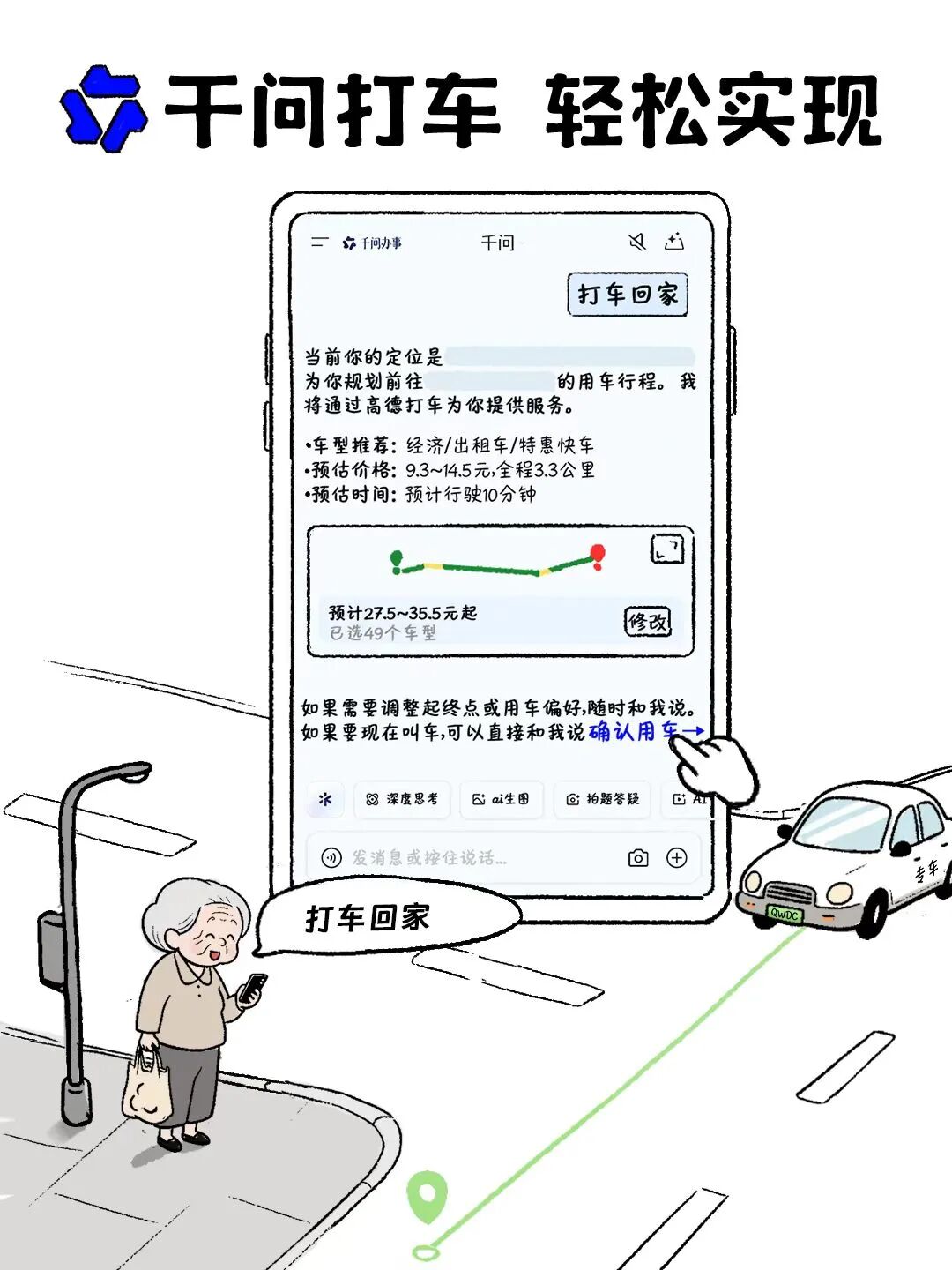
The ability to tap into new growth within the existing market is one of the most coveted models for current internet giants. This growth, driven by an interaction revolution, does not rely on macroeconomic growth or demographic dividends but is purely released from "demand expression efficiency."
From a customer base perspective, Didi's core strengths are concentrated among high-frequency, high-value, and strongly business-oriented user groups. The order growth brought by county-level markets and elderly users is relatively limited, primarily reflecting long-term penetration of user mindset and consumption habits.
The most threatening signal released by Qianwen's Spring Festival data is its first powerful proof that AI entrances can truly become the first touchpoint for user consumption decisions. As more people become accustomed to using AI for shopping and ordering food, they will not only remember that "Qianwen can get things done" but also form a foundational cognition that "a single sentence to AI can solve problems."
Once this habit takes shape, it will be natural for users to accept "a single sentence to AI to hail a car," directly challenging Didi's position as the independent entrance to the core ride-hailing platform.
Fortunately, Didi responded swiftly, launching its AI ride-hailing function about a week earlier than Qianwen, attempting to proactively convert AI's innovations in interaction and experience into its own moat advantage.
Extension of Services
In the ride-hailing scenario, "transporting users from point A to point B" is the fundamental demand. This fundamental demand is influenced by vehicle fulfillment rates and safety guarantees. In the past, competition in the ride-hailing industry primarily focused on meeting this fundamental demand, with transportation capacity supply and order fulfillment certainty being core factors supporting Didi's dominance in the ride-hailing field.
At this level, Qianwen has a proven track record in traffic entrances, particularly in stimulating user interest and cultivating user habits. However, it still relies on third-party execution for transportation capacity and fulfillment. Qianwen's execution end is connected to the aggregated platform Gaode, which primarily features transportation capacity from numerous small and medium-sized taxi companies and third-party ride-hailing platforms. Gaode has not yet established service advantages sufficient to shake Didi users' loyalty.
With years of development in the ride-hailing industry, the demand for "getting a car" has long shifted to "getting a good car." Here, "good car" does not refer to the physical configuration of the vehicle in the traditional sense but rather encompasses numerous personalized demands beyond users' fundamental need to travel from point A to point B. For example, users may be prone to carsickness, prefer fresh air, like soft seats, be traveling with pregnant passengers, or have a lot of luggage requiring a larger trunk.
In the past, to meet personalized demands, users not only needed to add notes but also had to screen the evaluations and tags of drivers after the app assigned an order. Younger groups may be more adaptable to this operational rhythm, but it is less user-friendly for the elderly due to the numerous steps involved.
However, through AI interactions, users can convey their preferences to AI in one or two sentences, significantly streamlining the operational process and straightening the user's ride-hailing efficiency.
To accurately meet user demands, AI must have a sufficient data foundation. In the current competition for AI ride-hailing, Didi and Qianwen have different data accumulations. Didi's advantage stems from its real operational data accumulated over the past decade, which forms the basis for AI's precise matching. Qianwen, on the other hand, relies more on the reasoning capabilities of its large model, with its data advantage lying in cross-scenario universality.
Of course, transportation capacity is also a factor that cannot be ignored. If users fully express their vehicle requirements for accepting orders, but AI cannot find suitable vehicles in a short time, it will also fall into the Embarrassing situation (embarrassing situation) of "no cars available for assignment."
In other words, in terms of expertise in travel services, Qianwen, which relies on aggregated platforms for fulfillment, currently lacks the strength to shake Didi's foundations. However, when it comes to composite scenario demands, Qianwen has significant advantages. For example, if a user's demand is to travel to a destination by car and inquire about highly rated restaurants near the destination or has accommodation needs to book a hotel upon arrival, Qianwen's cross-scenario advantages backed by Alibaba's ecosystem will come into play.
The Encroachment of Super Entrances
Another point worth noting is that although the core logic of users using Didi and Qianwen still differs fundamentally: Didi is a strong-intention, dedicated tool that users actively open when they have clear travel needs; Qianwen, on the other hand, is scenario-embedded and triggered incidentally, completing ride-hailing casually during life services and AI interactions.
However, relying on its super entrance with over 300 million monthly active users, Qianwen folds travel demands into diverse scenarios without requiring users to switch apps. In the long run, this will continuously erode the value of Didi as an independent travel entrance. For Didi, orders may still be growing, but user mindset, scenario entrances, and decision-making chains are being gradually replaced by AI super assistants, risking the platform's degradation from a "travel entrance" to a "transportation capacity pipeline."
In fact, Didi faces not only competition for traffic entrances from Alibaba's Qianwen. According to media reports, Tencent has recently revealed plans to connect various mini-programs within its WeChat ecosystem through AI agents, allowing users to complete multiple services, including ride-hailing, shopping, and local life, through natural language conversations in one stop. Once this layout is implemented, it will further strengthen WeChat's position as a super life entrance. With 1.4 billion monthly active users, WeChat will also continuously divert the independent entrance value of vertical travel platforms like Didi.
At the same time, super apps like Douyin and Meituan have already formed a diversion trend. Meituan integrates ride-hailing into its food delivery and in-store scenarios, relying on its local life closed loop. Douyin, on the other hand, intercepts travel demands incidentally in entertainment scenarios through content seeding and life service entrances. More fatally, these platforms are all accelerating their AI transformation: Meituan launched the AI assistant "Xiaomei," and Douyin's Doubao created a "one-sentence service," essentially reconstructing "users actively seeking apps" into "scenarios Self service (scenarios Self service can be translated as "services inherently embedded in scenarios").
For Didi, this is no longer a battle for orders but a battle for survival paradigms: when the four super entrances of Alibaba's Qianwen, WeChat, Douyin, and Meituan completely fold travel into their respective life scenarios, the "necessity" of Didi as an independent travel tool is being continuously eroded. In the long run, Didi may gradually degenerate from the "preferred entrance" for users to hail cars into a backend transportation capacity pipeline under the major super AI ecosystems.
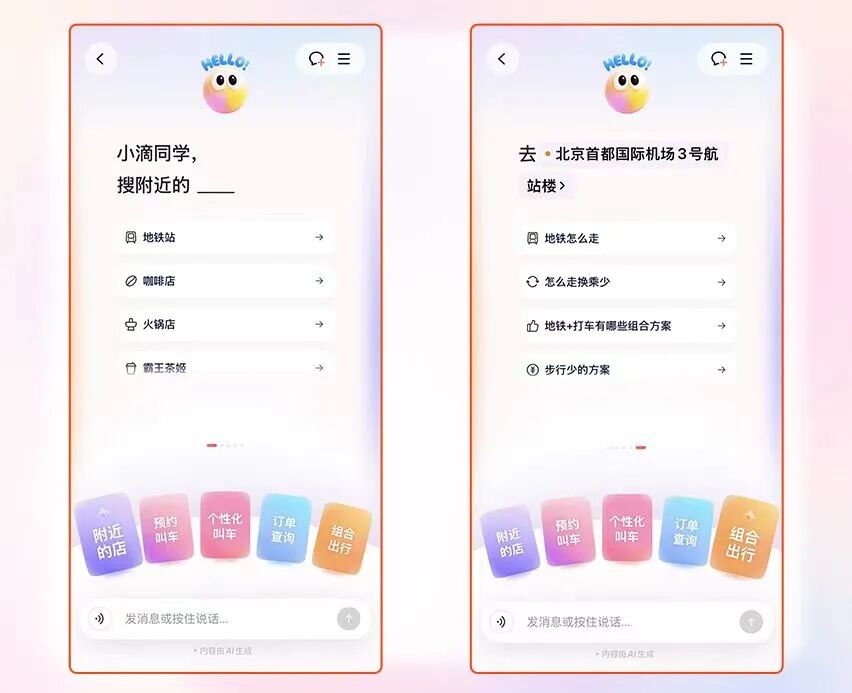
The emergence of AI ride-hailing functions means that users no longer need to actively open the Didi app for pure travel needs but can casually complete ride-hailing in the AI scenarios of various super platforms. This shift in user behavior from application-oriented to scenario-oriented essentially weakens the independent presence of vertical travel tools. In the long run, user dependency on the Didi app will continue to decline, directly shaking its core value as an independent application.
This is also the reason for the "AI war" during the 2026 Spring Festival. In the internet era, the emergence of various needs such as food delivery, hotel booking, ride-hailing, and community browsing has prompted the birth of various vertical apps. Consumers have preferred apps they tend to open in their hearts. However, when AI super entrances can help users save operations, the necessity of opening a specific app for a particular task is greatly reduced.
The squeeze on traffic will also further affect Didi's available transportation capacity. Saturation of ride-hailing capacity is no longer a novelty. In 2025, multiple regions across the country issued industry risk warnings repeatedly, reminding enterprises and individuals to enter the industry cautiously and rationally.
According to the "Urban Travel Employment Resilience: Ride-hailing Driver Employment Landscape and Professional Performance" report released by the China New Employment Form Research Center, as of October 2024, 7.483 million driver's licenses and 3.206 million transport certificates have been issued nationwide. The market is severely oversupplied, directly leading to a sharp decline in driver order acceptance and over 50% idle/empty driving rates in multiple regions.
The "2025 Annual Ride-hailing Industry Capacity Enterprise and Driver Survey Report" jointly released by the China Urban Public Transport Association and 58.com shows that the proportion of drivers planning to continue working in the ride-hailing industry has dropped from 30% last year to 23%; 38% of drivers plan to switch careers, with nearly 80% citing "low income and high costs" as the primary reason.
For drivers, the core criterion for choosing a platform is who can bring more orders. The aforementioned report mentions that aggregated platforms, leveraging their traffic and model advantages, continue to expand, with their order share increasing from 22% in July 2022 to 31% in January 2026.
Aggregated platforms are inherently strong in traffic. Qianwen's entry has brought more stable traffic to Gaode and will provide drivers with a more attractive option. Against the backdrop of saturated transportation capacity, drivers' motivation to switch platforms if they cannot receive orders also exposes Didi to the risk of driver attrition.
Therefore, Qianwen's threat to Didi is structural. It does not compete head-on with Didi in its strongest area of fulfillment capabilities but strengthens its traffic entrance through AI. When the entire ride-hailing market becomes a traffic game centered on AI competition, Didi may face dual pressures from both users and drivers: super apps compete for user entrances, while aggregated platforms compete for transportation capacity resources.
Of course, the competitive landscape is not yet fully set. Didi is still actively reducing commissions to retain drivers and building AI service barriers. Aggregated platforms also face their own challenges, with their low-price strategies and lack of strong control over transportation capacity raising concerns from regulators.
Conclusion
The power balance in the industry is never constant. If the Alibaba ecosystem behind Qianwen can further standardize Gaode's transportation capacity system and improve end-fulfillment quality, Qianwen's structural threat to Didi will continue to grow.
However, this is still far from a head-on confrontation between the two sides. The next critical turning point lies in whether Qianwen can deeply penetrate its AI capabilities into the underlying transportation capacity management link in the short term. Qianwen's threat to Didi has never been about how many orders it can seize in the present but rather about its super entrance attribute, which may leave Didi with no business to seize in the future.
(Image sources: Official WeChat accounts of Qianwen and Didi)",
-
![]()
The Allure of 'Acquisition Spree': Li Shufu's Left Turn, Xu Jiayin's Right
-
![]()
Strategic Transformation Yields Results: Phoenix Optics Reports 10.9% YoY Rise in Core Net Profit for H1 2026
-
![]()
Three Key Growth Trajectories Synergize! Crystal-Optech Reports 3.478 Billion Yuan in Revenue for H1 2026
-
![]()
Semi-Annual Report Sparks XPENG Motors Buzz
-
![]()
1.6 Billion Big Order Secured! SeeYA Technology's Revenue Soars by 287.87% in the First Half of the Year
-
![]()
Baidu's Profits Plunge by 68%: Unraveling the Mystery Behind the Numbers
-
![]()
Baidu’s Profits Tumble by 68%! Where Has All the Money Gone?
-
![]()
Hynix’s Taobao Store Shuts Down Abruptly: What Should Customers Do About Warranty Services for Memory Modules?