Trending Search Surges: Tesla’s FSD Finally Makes Its China Debut!
 05/22 2026
 655
655
Elon Musk’s China Visit Proves Fruitful
Author|Wang Lei
Editor|Qin Zhangyong
As anticipated, Musk’s joint visit to China with Trump was far from futile.
Early this morning, Tesla officially announced on the social media platform X that the supervised version of FSD (FSD Supervised) is now ready for activation and use.
The available regions encompass the United States, Canada, Mexico, Puerto Rico, Australia, New Zealand, South Korea, along with select European countries such as the Netherlands and Lithuania.
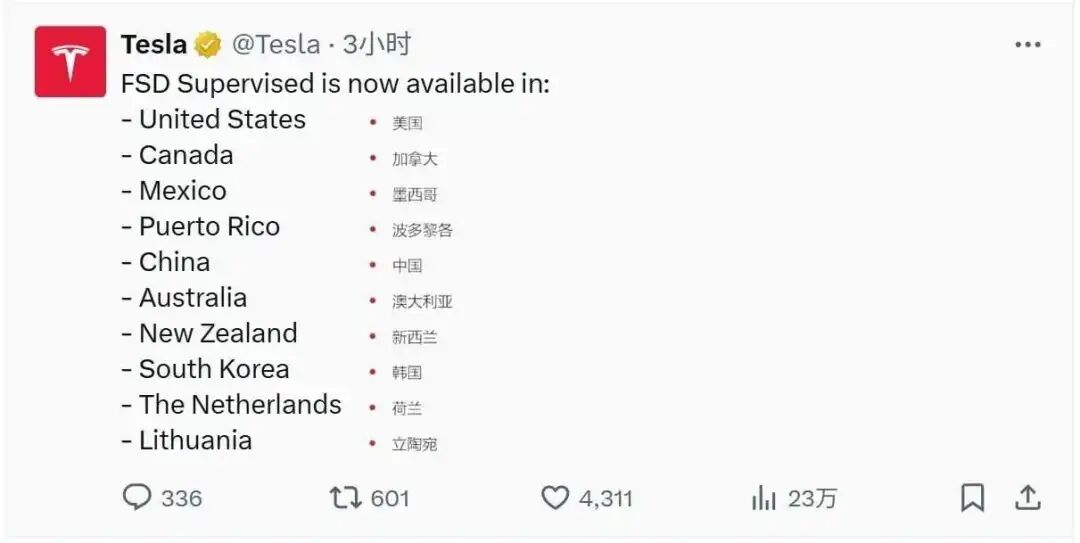
Notably, ‘China’ has been officially mentioned for the first time, linking FSD with the Chinese market.
This signifies that FSD is finally poised to enter China.
However, Tesla has yet to announce a specific rollout timeline, and it remains uncertain when users will truly be able to experience this functionality, pending further approvals. Nevertheless, the news triggered a collective surge in A-share intelligent driving concept stocks during today’s morning trading, with many stocks hitting their upper limits.
Even before its official launch, Tesla’s FSD is already making waves, acting like a ‘catfish’ in the market.
01 Urgent Recruitment for Intelligent Driving Test Roles
While the official availability has been announced, there is clearly a regulatory approval process that must be completed before domestic car owners can truly utilize this system.
It’s worth noting that this is not the first time Tesla has made such an announcement. As early as last June, Tesla sent out a message claiming it was the ‘only robotic car you can buy,’ with FSD Supervised capable of taking users anywhere in countries such as the United States, Canada, and China.
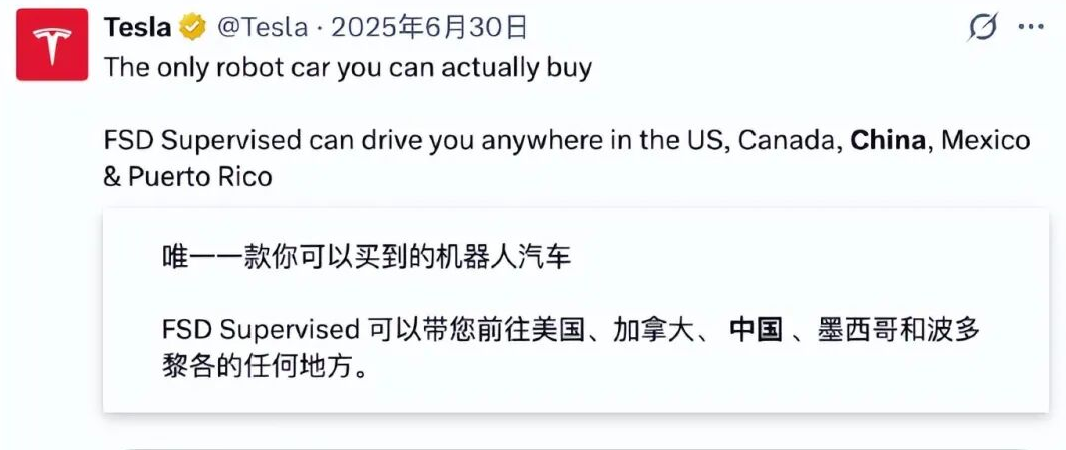
Shortly thereafter, in November, Musk revealed at a shareholder meeting that FSD had only received partial approval in China and predicted full approval around February or March 2026.
However, the reality is that FSD has not yet landed in China to this day. But recent information from the past two months suggests that the situation is moving in a positive direction.
A few days before Tesla’s official announcement, on May 18th, Tesla’s recruitment website posted approximately 90 core R&D positions, with a significant number of job listings related to intelligent driving testing drawing the most attention.
These include roles such as intelligent driving test vehicle technicians, test engineers, and site test specialists, with work locations spanning Beijing, Shanghai, Guangzhou, Shenzhen, Suzhou, Wuhan, Chengdu, Tianjin, and Chongqing, many marked with ‘urgent hiring’ signs.
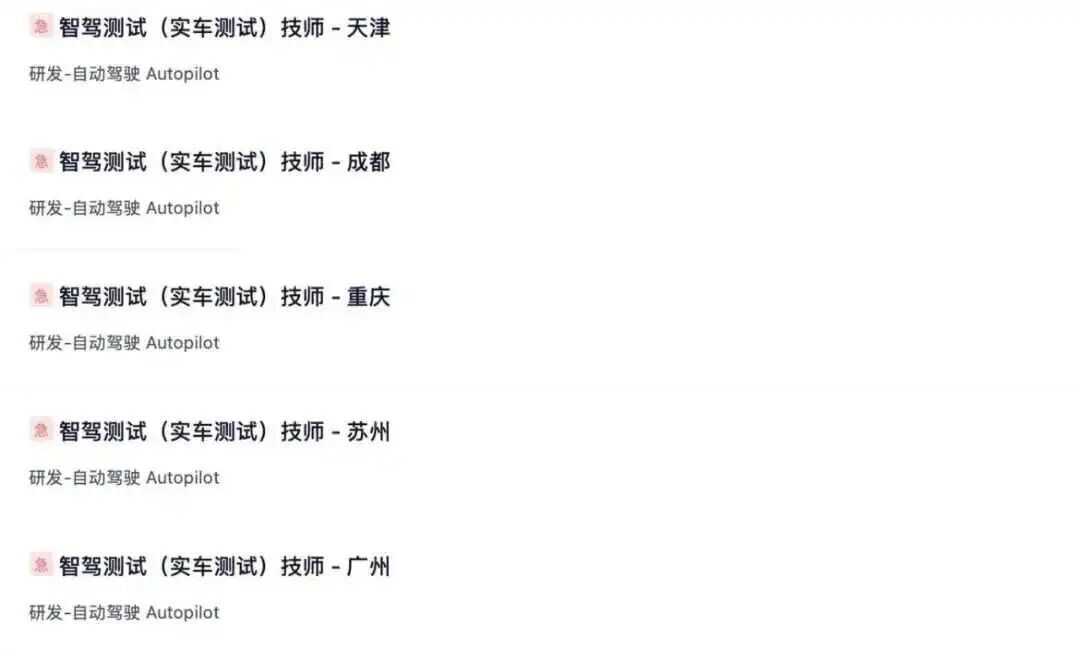
Most of these positions fall under the Autopilot R&D department, with job descriptions involving identifying functional improvements and performance degradations in various software iterations. This requires flexible travel domestically and internationally to conduct field tests on vehicles on public roads, test tracks, and verification sites. They also explicitly mention the need to track changes in Chinese certification and regulatory requirements.
In terms of job requirements, applicants must hold a valid driver’s license with over 3 years of driving experience, an annual mileage exceeding 10,000 kilometers, and no major accidents or violation records in the past year. Command-line operation experience or a racing background is preferred.
This large-scale recruitment of localized talent with stringent driving experience requirements strongly indicates that Tesla is making intensive preparations for FSD’s local road testing and eventual launch in China.
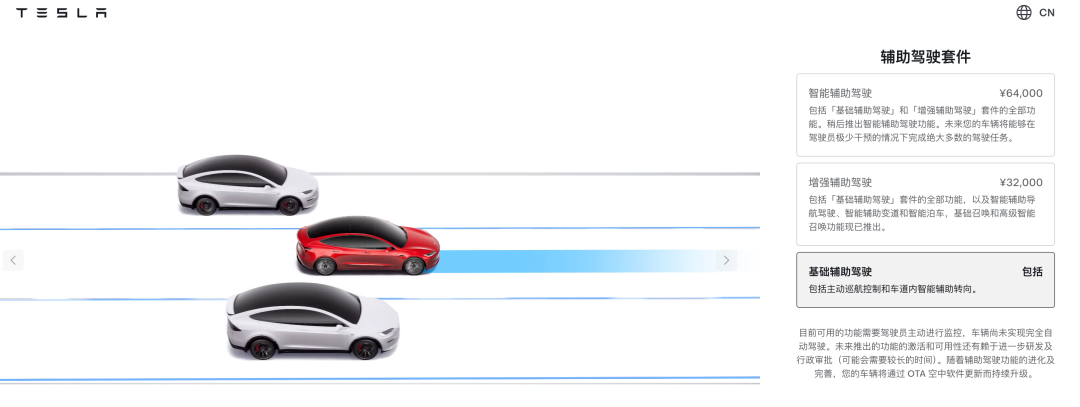
At the same time, responses from official customer service also indirectly confirm that FSD is accelerating its entry into China. They stated that the company is actively advancing approval work in accordance with national regulatory requirements and will roll out to domestic customers as soon as approvals are obtained.
They also emphasized that the current ‘FSD Intelligent Driving Assistance Function’ priced at 64,000 yuan is not compatible with all vehicles, with some models only supporting the 32,000 yuan Enhanced Autopilot (EAP) function.
Additionally, in early May, Tesla updated the owner’s manuals for some domestic Tesla models to version 2026.14, officially adding a complete functional introduction to the FSD V14 version, suggesting that its technical groundwork is gradually being laid.
02 The Long-Awaited ‘Catfish’
Judging from Tesla’s consecutive moves over the past month, it seems that FSD’s launch in China is imminent. Now, the key questions we are most concerned about are:
What capabilities does the latest supervised version of FSD currently possess? Will it suffer from localization issues in China, similar to the FSD rollout in February last year, which was suspended after just one week?
Currently, the latest version Tesla is rolling out in the United States is FSD V14.3.3, released on May 17th, initially covering Model S, Model 3, Model X, Model Y, and Cybertruck models equipped with AI4 hardware.
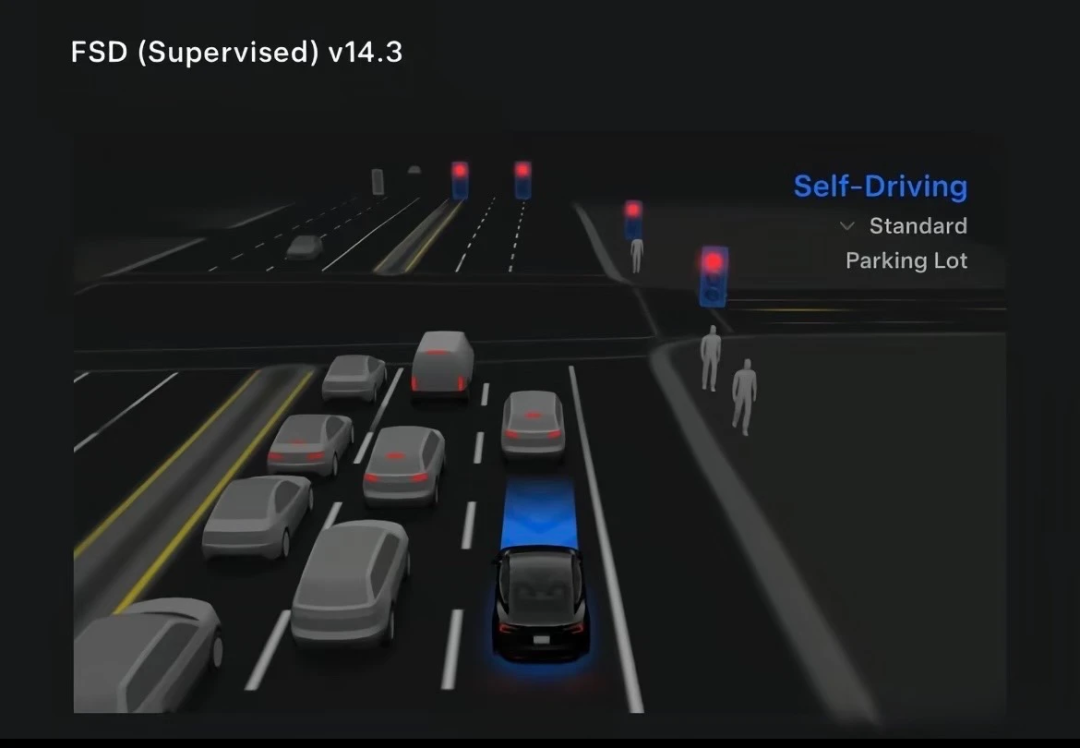
Musk previously described the V14.3 series as solving the ‘last major piece of the puzzle’ for autonomous driving, and the version likely to launch in China will probably be this one.
Starting from V12, Tesla has entrusted perception and path planning to neural networks, meaning the system’s judgments about its surroundings and where to go are no longer dependent on manually written rules.
AI neural networks directly handle the entire process of intelligent driving. From receiving images from onboard cameras to final steering wheel and pedal commands, the system no longer relies on any manually written rules—this is the global one-stage end-to-end architecture we often hear about.
Under this architecture, there is no need to separately define modules like perception, planning, and control; the entire process is completed by a single neural network. To achieve this, Tesla has increased the neural network’s parameter count to about 10 times that of previous versions. A larger model can remember more diverse road condition patterns, such as irregular intersections, compound traffic lights, complex construction zone layouts, and non-standardized traffic signs.
In terms of vision and decision-making, the upgraded neural network visual encoder has stronger 3D geometric understanding and traffic sign recognition capabilities in low-visibility and rare scenarios, with enhanced responses to special objects like emergency vehicles, school buses, and right-of-way violators. It also improves handling of small animals and traffic light judgments at complex intersections.
Driving behavior has been refined, with greater handling of long-tail scenarios, reduced unnecessary lane offsets and slight tailgating, more decisive parking spot selection, and a new predicted parking spot function marked with a ‘P’ icon on the map. It also better handles temporary system downgrades, reducing unnecessary interventions.
V14.3 also introduces explicit spatiotemporal memory capabilities to the FSD model for the first time, with a duration of about 3 to 5 seconds. Previously, FSD’s decision-making was more focused on reacting based on the current frame.
This means the model can remember the acceleration and deceleration dynamics of the vehicle ahead in the short term, as well as the speed limit number on that road sign just missed, or the pedestrian’s movement speed changes on the side of the intersection. This information participates in subsequent trajectory planning and speed adjustments, making driving actions more coherent. Based on this, the vehicle no longer reacts frame by frame but has a continuous temporal perception.
The latest version also includes some optimizations for Smart Summon, now increasing the maximum speed to 8 mph (about 13 km/h), up from 6 mph (about 10 km/h) previously, with Musk calling it ‘a great version.’
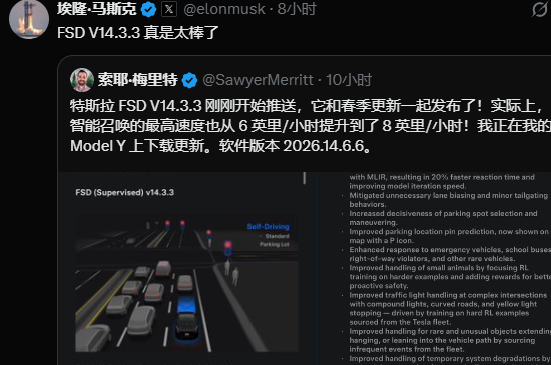
Despite Musk’s enthusiasm, the hardware generation gap poses a significant real-world challenge. Musk has publicly admitted that the HW3.0 hardware’s memory bandwidth is only one-eighth that of HW4, unable to support the full version of FSD, achieving only 10% to 20% of its capabilities.
This means that older Tesla models produced between 2019 and 2023, even if FSD is approved, may not be able to use the full version. Officials have explicitly mentioned that FSD V14.3 will currently only be rolled out to Tesla models equipped with HW4.0 hardware, while models with HW3.0 or lower can only receive the so-called ‘V14 Lite’ streamlined version of FSD.
This implies that even if approved, very few models in China will truly be able to use the pure, full version of FSD.
In terms of localization scenario adaptation, for China’s complex road environments and non-standard traffic scenarios, it remains to be seen whether FSD can perform as smoothly as in North America when facing uniquely Chinese complex scenarios like unprotected left turns, mixed non-motorized vehicle traffic, and reversible lanes. This still requires large-scale local data training and real-world testing verification.
Meanwhile, domestic advanced driving assistance levels are also rapidly improving. Domestic intelligent driving solutions, represented by Huawei ADS 4.0 and XPeng’s second-generation VLA, have already matured in urban high-level driving assistance, with high-level intelligent driving capabilities becoming standard in mainstream models around the 200,000 yuan range, even beginning to layout for the L4 era.
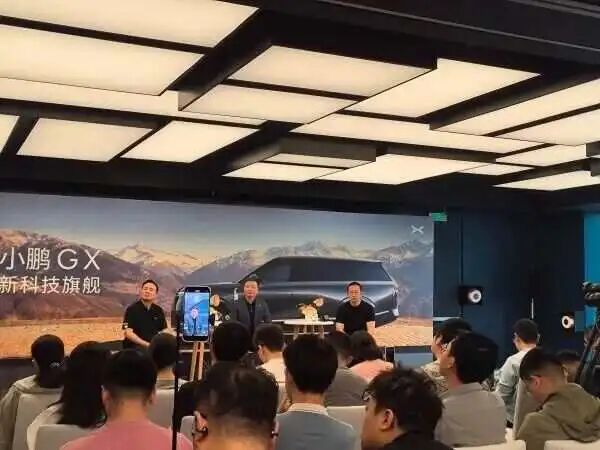
Moreover, this morning, Liu Xianming, head of XPeng’s General Intelligence Center, responded to the news of Tesla’s supervised FSD launching in the Chinese market during a group interview after the XPeng GX launch. He said he very much welcomes Tesla FSD’s entry into the Chinese market and hopes to have a direct comparison with Tesla.
In April of this year, the Dutch vehicle authority RDW granted Tesla FSD Supervised certification in the Netherlands, becoming the first European country to officially approve this driving assistance technology.
However, RDW also explicitly pointed out that FSD Supervised is a Level 2 driving assistance system that can take over many driving tasks but is not an autonomous driving system.
When Level 2 FSD officially lands in China, will it still be a ‘catfish’?
If you’ve read this far, you’ve carefully gone through the entire article. Feel free to share your thoughts in the comments section.
-
![]()
Doubao Work Unveiled! Domestic AI Leaders Fully Commit to the 'Work' Sector
-
![]()
Who’s Sounding the Alarm on ‘Rushed Vehicles’?
-
![]()
Over 5.3 Billion Yuan in Losses Over Three and a Half Years! Can Yonyou Reverse Its Fortunes Through Streamlining and AI Transformation?
-
![]()
Baidu AI Adopts Free Model: A Strategic Maneuver in Traffic and Monetization
-
![]()
Silicon-Based OLED Pioneer Unveils Financial Results: H1 Shipments Outpace Entire 2025 Volume
-
![]()
AI's First "Lost Summer"
-
![]()
Zeiss Makes Another €2.2 Million Bet: Will Eye Tracking Be the Next Big Thing in the Smart Glasses Industry?
-
![]()
RUNTO Ranking | Global Top TV ODM Factories' Shipment Figures for July 2026