Will WeChat Start Charging Fees?
 06/11 2026
 618
618
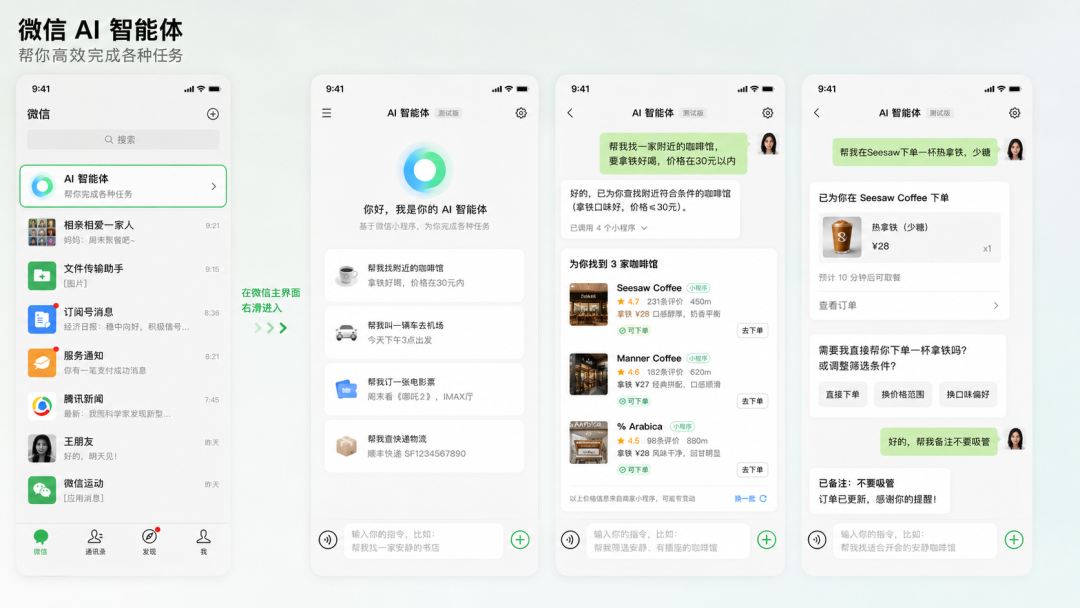
On June 8th, WeChat officially unveiled its "Guidelines for Developers to Integrate into the WeChat AI Ecosystem," confirming that the platform is conducting internal tests to enable the invocation of Mini Programs within its ecosystem via AI.
In simpler terms, the long-awaited WeChat Agent may soon become a reality.
According to the guidelines, Mini Programs integrating with WeChat AI can operate in either automatic or development mode.
The automatic mode is fully managed by the platform, which analyzes the source code of your Mini Program to understand and determine how the AI should operate the page. No additional operations are required beyond enabling the corresponding settings in the background.
In contrast, the development mode requires developers to decide which AI capabilities to expose to WeChat and ensure proper integration of these functionalities.
As anticipated, Tencent, the industry leader, simply needs to signal its intentions, and a multitude of followers will rally. JD.com, Meituan, Ctrip, Didi, and others have all officially announced their immediate participation in the internal testing.
The Financial Times previously reported that the early demo version involved swiping right on the WeChat page to access the agent conversation interface.
While the specific mechanism has not yet been disclosed, some simple analyses and speculations can be made.
Pony Ma, Tencent's CEO, has previously criticized peers sharply on two occasions.
He believes that Doubao's mobile approach, which relies on 'black market plugin methods,' is unsafe and irresponsible. While he commends Qianwen's integration of Alibaba's internal ecosystem, he notes that users may not prefer an all-in-one solution, and the service quality of internal ecosystems may not match that of external competitors.
At a subsequent shareholder meeting, he further stated, 'Agent partners hope to have traffic and entry points, but they also don't want to be simply utilized.'
Therefore, the WeChat Agent will undoubtedly be more open and strive not to disrupt the existing long-term business models of its partners.
During several past Tencent earnings calls, management repeatedly highlighted the relative scarcity of computing power supply, with limited resources being prioritized for internal core product needs.
However, WeChat is a national app with a billion users. Opening up even the most basic agent capabilities to such a vast user base will result in massive computing power consumption.
Tencent has already been slower than ByteDance and Alibaba in purchasing GPUs, and supporting the WeChat Agent will place significant pressure on its resources.
When Qianwen was implementing AI-driven services, it frequently encountered issues due to high participation levels, prompting users to try again later.
Moreover, since Qianwen's integration was internal, it significantly conserved computing power by primarily mapping user natural language instructions to specific API calls.
The WeChat ecosystem is much richer than Alibaba's, with millions of Mini Programs that could be transformative if utilized effectively.
However, effective utilization is a high bar, especially considering computing power constraints.
For example, in automatic mode, the platform will analyze Mini Program pages to enable direct operation by WeChat AI. This resembles direct App operation, but WeChat conducts it within its own system with developer authorization.
Thus, WeChat does not need to employ screen recognition, similar to operating web pages through Claude plugins, which indeed significantly reduces computing power consumption compared to Doubao's mobile approach.
Nevertheless, it remains significantly higher than general conversation scenarios. Enabling large models to reliably operate browsers requires continuously feeding environmental states into the context and making multi-round decisions.
It's even possible that WeChat may introduce a subscription plan similar to Doubao's to offset computing power costs.
A popular question was once posed on Zhihu: Would you continue to use WeChat if it charged a 500-yuan annual fee?
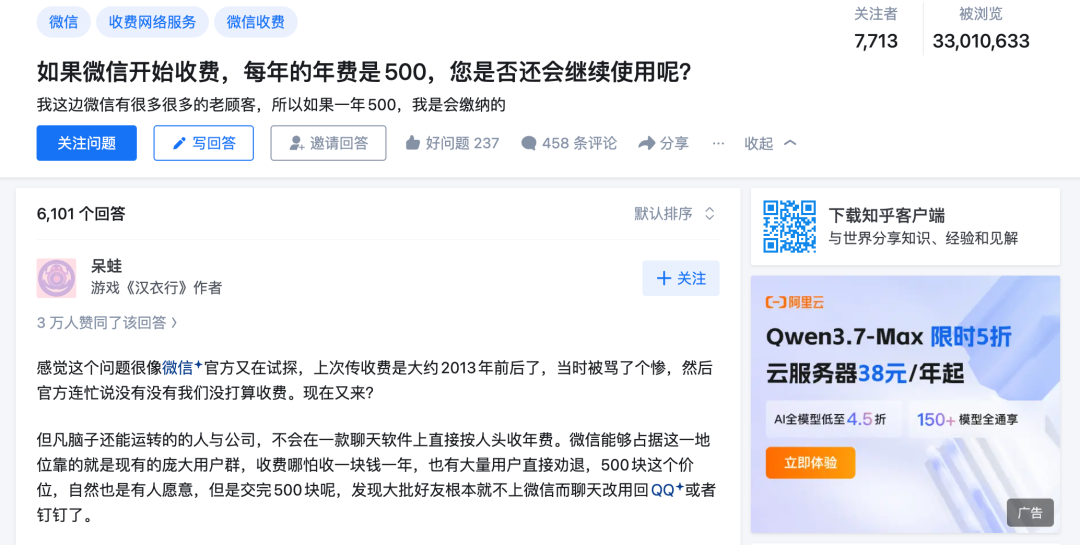
Now, this question seems conservative, as domestic AI product subscriptions have already reached the 5,000-yuan tier. If WeChat's Agent starts charging, it's entirely plausible given its ecosystem's completeness.
Combining Pony Ma's statements and the objective constraints of computing power, the WeChat Agent will initially operate in a semi-closed loop state.
This means deliberately limiting proactivity during AI conversations and redirecting to corresponding Mini Programs midway.
For instance, if you want to purchase something through the WeChat Agent, and it's available on both JD.com and Meituan, WeChat may present product information from both in the conversation.
You have the right to choose, but you must redirect to JD.com's or Meituan's Mini Program to complete the transaction, driving traffic to their platforms.
The enthusiasm of partners like JD.com and Meituan in joining is not just to show respect to the leader but also because they view the WeChat Agent as a pure channel increment.
For WeChat, this semi-closed loop model offers two advantages.
As mentioned earlier, WeChat has millions of Mini Programs, which serve as the execution space for the Agent. Directly granting the Agent the highest execution permissions could lead to stability issues, which contradicts Pony Ma's cautious approach.
Another advantage is that offloading some processes to Mini Programs can conserve computing power costs. Since the redirected processes essentially replace AI with manual operations.
The emergence of the WeChat Agent reminds many of the opportunity presented by Mini Programs back in the day.
In fact, the scale of Mini Programs may exceed many people's perceptions.
The monthly active users (MAUs) of JD.com's main App are around 600 million, but the MAU of JD.com's shopping Mini Program reaches 420 million. Meituan's App has 510 million MAUs, while the combined MAUs of Meituan's Mini Program and Meituan Takeaway Mini Program (before deduplication) exceed 300 million.
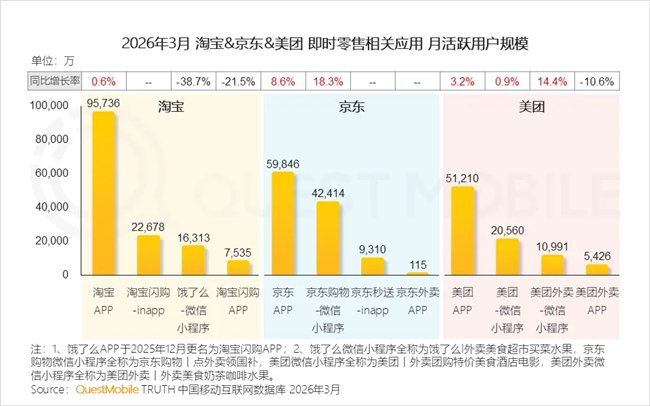
Mini Programs are a wonderful innovation, allowing users to download fewer Apps and enabling platforms to reach more users through WeChat.
Moreover, this channel growth is achieved without sacrificing any platform autonomy. The pages users see when opening Apps and Mini Programs are controlled by the platforms themselves, not affecting their ability to earn transaction commissions or marketing budgets, thus solidifying their business model foundations.
This historical experience with Mini Programs is a key driving force for these platforms to continue investing in the WeChat Agent.
This historical experience is indeed applicable now, as the WeChat Agent maintains a framework of cooperation and mutual benefit rather than striving to pipeline others.
WeChat's restraint in this regard, following the Doubao mobile incident, provides the psychological reassurance that everyone desperately needs.
However, it must be said that the current mechanism arrangement harbors a hidden core contradiction.
The narrative of agents inherently implies the pipelining of existing internet products, and the ability to pipeline products is the most compelling reason and greatest attraction for using agents.
Efforts to resist pipelining contradict users' core needs, effectively choosing partners over users. It also violates the first principles of AI, which dictate that all spaces that can be occupied by silicon-based intelligence will be.
Unsatisfied and irreducible demands will eventually find their outlet.
Remember, Human-in-the-Loop (HITL) is a pragmatic compromise, not our aspiration.
Ideally, only products that provide process enjoyment to humans will avoid pipelining, while all other products should be pipelined.
This contradiction is not yet apparent because silicon-based intelligence is not yet sophisticated enough, meaning the ability to pipeline other products has not been fully established.
Today, both Qianwen and Doubao support closed-loop shopping transactions within Apps, but they currently lack significant appeal.
However, unless large model capabilities converge marginally, we will eventually have a superintelligence as a personal assistant.
If WeChat is unwilling to meet user demands, then Doubao, Qianwen, or some open-source agent like Lobster Hermès will gladly occupy that position.
-
![]()
Registered Capital Slashed to 372 Million Yuan! Yutong Optical Finalizes Industrial and Commercial Change Registration
-
![]()
Zhuque-3 Successfully Lands, and 'Time Traveler' Secures Another ¥100 Million in Funding: China's Commercial Space Industry Experiences a 'Dynamic August'
-
![]()
Autohome Faces a Shrinking Window of Opportunity
-
![]()
Even a Titan Like Musk Has Faced Setbacks in Fulfilling Promises
-
![]()
AI Office: The End of the Racing Era, Context Becomes the Key to Success
-
![]()
Domestic Vehicle Chassis Revolution ②: The Steering Wheel Remains, But Mechanical Connections in the Steering System Are Decreasing
-
![]()
Exploring MiniMax Design: Can Video Editing Be as Simple as Speaking?
-
![]()
Why Can SenseTime Achieve Profitability While CloudWalk Still Faces Challenges, Despite Both Adopting Large Models?