Global Tech Sector Sees Collective Panic: Is the AI Hype Finally Deflating?
 06/18 2026
 578
578
This marks the 1342nd exclusive article from 'New Energy Frontier.' Click above to follow and 'star' our account for more insights. The views expressed in this article are solely those of 'New Energy Frontier' and do not constitute investment advice. The author does not manage investment groups, offer paid stock tips, or handle client portfolios.
--------
Last week's steep drop in U.S. tech stocks sent ripples through China's A-share tech sector, prompting a wave of commentary suggesting 'the AI bubble is set to pop' and 'the tech sector's heyday is over.' This has left many, particularly tech investors, feeling uneasy. How should we rationally interpret this wave of market corrections?
Firstly, let me clarify that I am not a perpetual bull for the tech sector, nor for any specific industry or theme.
As regular readers know, 'New Energy Frontier' primarily focuses on the new energy industry but also keeps a watchful eye on the tech landscape. While we have been optimistic about AI, especially its hardware segment, we explicitly cautioned against 'tech mania' in an article published in early May.
In my view, the ultimate goal of investing is to generate profits, not to adhere to dogmatic beliefs. Labels like 'bull' or 'bear' are relative; opinions can vary significantly based on stock price levels.
With that context established, let's delve into how to interpret this wave of tech sector corrections.
01 The Tech Plunge Unveiled: Macro Factors as the Primary Culprit
It's crucial to recognize that the global AI supply chain is now highly interconnected, leading to synchronized movements across related sectors. This is a cause, not an effect, and understanding this dynamic is essential.
Now, let's dissect last week's tech sector corrections.
As the subtitle suggests, macroeconomic factors bear the primary responsibility for last week's market downturn. The release of robust U.S. non-farm payroll data directly led the market to reassess expectations regarding 'Fed rate hikes/delayed rate cuts.'
From a macroeconomic standpoint, growth assets like tech stocks, whose valuation models (DCF) are highly sensitive to liquidity and risk-free rates, are particularly vulnerable. Stronger-than-expected non-farm data -> rising inflation concerns -> increased likelihood of rate hikes -> surging Treasury yields -> compression of tech stock valuations. This is a standard and classic macro trading narrative.
Of course, it's also true that the AI hardware segment is currently crowded, with significant profit-taking occurring. Some funds, wary of macro uncertainties, are taking profits or even shorting the market. However, this is fundamentally different from an 'AI bubble' bursting.
As for whether the Fed will actually raise rates, the key factor to monitor is geopolitics, particularly developments between the U.S. and Iran. Personally, I believe the Strait of Hormuz cannot remain closed indefinitely, and the global crude oil supply chain has its limits. Therefore, the likelihood of substantive Fed rate hikes is actually low. However, given the complexity of macro dynamics, we won't delve deeper into this topic today.
02 Respecting Fundamentals: Is There Truly an AI Bubble?
The market is increasingly discussing an 'AI bubble,' and to some extent, bearish sentiment towards AI has become the norm, especially in secondary markets. So, is there really an AI bubble? Opinions vary, but my stance is firm: the AI industry itself is not in a bubble.
While current large models have not yet fully established a perfect commercial closed loop in the B2C space, and many are still burning cash, the technology's long-term evolution path is clear. Especially as AI enters its next phase—the era of Physical AI (embodied intelligence, humanoid robots, smart manufacturing)—AI will directly interact with the physical world, significantly boosting societal productivity. At that point, alleged commercial closed loop issues will resolve themselves.
However, just because the industry is not in a bubble doesn't mean the 'AI sector' in capital markets is bubble-free.
Over the past two to three years, too many marginal companies and purely conceptual software stocks have been overhyped. These pure concept plays, lacking performance support, undoubtedly contain significant bubbles and will inevitably undergo a brutal valuation correction.
Nevertheless, for true beneficiaries of AI's growth with proven performance—such as core computing power leaders—and for those poised to benefit from the 'Physical AI' wave while still at low valuations, I believe there's little cause for concern. These hardly qualify as bubbles.
The logic is straightforward: if AI's technological potential is far from exhausted and continuous evolution is needed, demand for computing power, advanced packaging, electricity, and liquid cooling will persist. As long as performance continues to deliver, even if expectations are currently high, subsequent rapid growth can digest valuations. After adjustments, new highs are just a matter of time.
At worst, as the absolute mainstay supporting global capital markets over the past two years, the AI sector is so massive that even if it were to peak and collapse, major funds could not exit all at once. Technically, at least a 'double top' formation would likely occur. For rational investors, there would be ample time to exit calmly; there's no need to panic now.
03 Objectively Viewing Low-Valuation Non-Tech Assets
A-share market trends have been highly polarized over the past two years, heavily concentrated in the tech sector, especially AI hardware and semiconductor supply chains. Most other industries have either seen only phased performance or have been in a prolonged downtrend. As a result, many investors in non-tech assets (now dubbed 'old economy assets') are suffering and deeply resentful towards the tech sector—understandably so, as many other sectors have effectively served as blood bags for tech.
Now, with the tech sector adjusting from highs, many traditional asset investors, feeling vindicated, are even more convinced of an AI bubble.
However, if we view capital markets more objectively, we realize there's no such thing as 'new,' 'mid,' or 'old economy' assets—only cycles.
Sectors like consumer goods, photovoltaics, new energy vehicles, pharmaceuticals, medical devices, and healthcare services, which have performed poorly recently (with innovative drugs being a brief exception last year), were all darlings just a few years ago. Back then, valuations of many consumer and healthcare companies were no different from today's tech stocks.
The capital markets have also been prone to exaggeration. During the new energy boom, phrases like 'lithium rules the world' were common, and even analysts at securities firms extrapolated performance projections to distant future years (amusingly, while bold in time projection, they were cautious in performance estimates, predicting figures that could be achieved within a couple of years).
In terms of trading congestion, it's much the same across the board—all sectors have experienced or are experiencing crowding. In short, no one should look down on others; it's all about being in the right window of opportunity (trend).
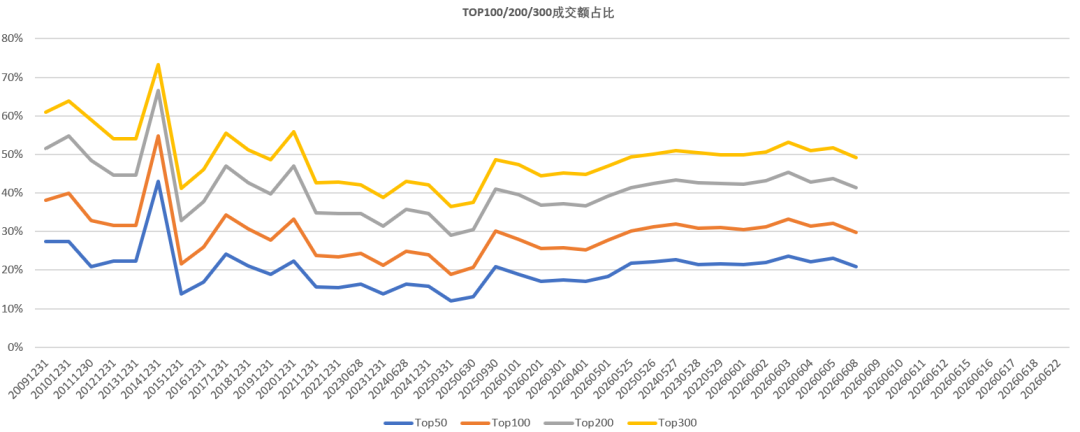
Moreover, we must guard against biased views that dismiss tech companies as lacking performance or being purely speculative, while viewing consumer, healthcare, and new energy sectors through rose-tinted glasses.
In reality, if we set aside biases and examine tech and many traditional industries based on financial reports, the results may surprise many. Tech sector performance has been quite strong over the past two years, outperforming many traditional sectors, especially consumer goods. Given the lofty expectations placed on consumer goods a few years ago, even after several years of declines, valuations in many consumer (and some medical) sectors remain unattractive.
While capital markets can occasionally behave irrationally, they are generally highly effective over the long term. Many attribute the tech rally to mere speculation, but based on performance, the market's choice of tech over the past two years has been entirely reasonable.
Indeed, without signs of a macroeconomic reversal, industries under pressure are unlikely to see broad reversals; at best, individual companies with strong performance may experience periodic valuation corrections.
Conversely, even if the tech sector faces short-term adjustment pressures, it will likely involve internal rotations—shifting from extremely crowded, overly optimistic hardware computing segments to relatively undervalued new branches poised to outbreak (explode) in the Physical AI era.
Regarding the AI bubble, while commercial closed loops are not yet fully established, certain niches, particularly coding, have proven viable. Future applications like robotics, autonomous driving, and edge AI have also shown initial viability, pending only technical iterations.
Thus, when it comes to investing, set aside biases and labels. Don't dismiss assets as 'new,' 'mid,' or 'old economy' or assume some lack performance and are purely speculative. Instead, conduct objective, specific research on industries and companies. Examine the performance of the industry your invested company operates in, its position within that industry, and its own performance.
Always remember that everything operates in cycles, and strive to select assets in their upward cycle.
-
![]()
Registered Capital Slashed to 372 Million Yuan! Yutong Optical Finalizes Industrial and Commercial Change Registration
-
![]()
Zhuque-3 Successfully Lands, and 'Time Traveler' Secures Another ¥100 Million in Funding: China's Commercial Space Industry Experiences a 'Dynamic August'
-
![]()
Autohome Faces a Shrinking Window of Opportunity
-
![]()
Even a Titan Like Musk Has Faced Setbacks in Fulfilling Promises
-
![]()
AI Office: The End of the Racing Era, Context Becomes the Key to Success
-
![]()
Domestic Vehicle Chassis Revolution ②: The Steering Wheel Remains, But Mechanical Connections in the Steering System Are Decreasing
-
![]()
Exploring MiniMax Design: Can Video Editing Be as Simple as Speaking?
-
![]()
Why Can SenseTime Achieve Profitability While CloudWalk Still Faces Challenges, Despite Both Adopting Large Models?