AI Fails to Predict 'Cape Verde' Upset
 06/18 2026
 560
560
Author|Zhu Fenglin
Editor|Liu Jingfeng
Cape Verde, a West African island nation with a population of under 600,000, comprises ten volcanic islands. The players on its national team are scattered across lower-tier leagues in various European countries, hastily returning for each matchday. They train under limited conditions, with team practice time squeezed to the maximum.
Yet, this very team made history by reaching the World Cup finals for the first time. On the 16th, they faced Spain, a World Cup champion boasting top-tier stars and a sophisticated tactical system, in the group stage.
The gap in strength was immense, and few believed Cape Verde could make a difference.
However, when the final whistle blew, everyone was stunned—Cape Verde's 40-year-old goalkeeper, Vozinha, made seven remarkable saves to keep the score at 0:0. The formidable Spanish team failed to score a single goal in 90 minutes.
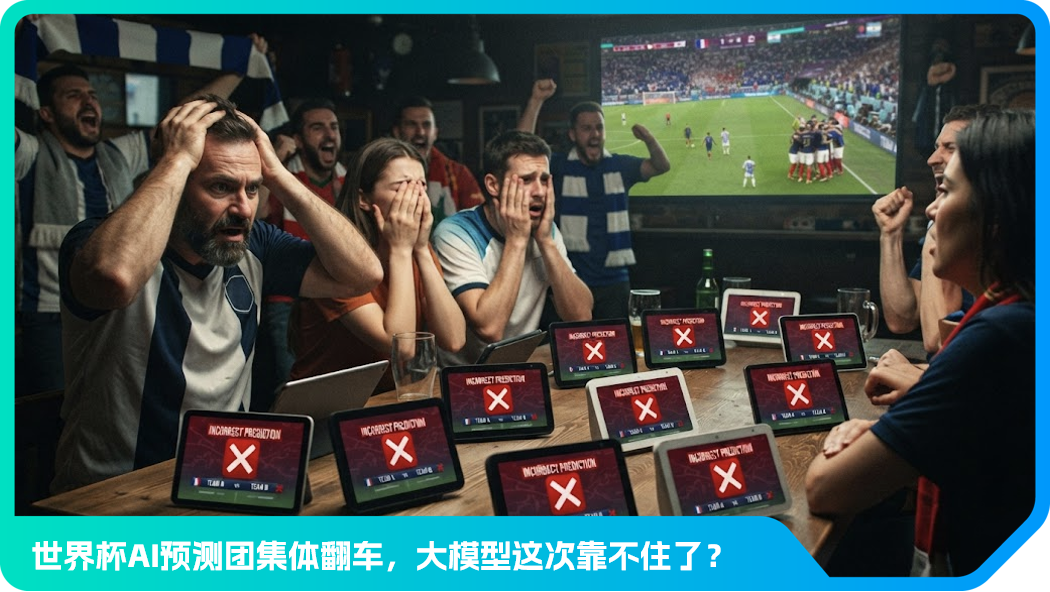
On paper, Spain's victory seemed assured, a sentiment echoed in the "World Cup Prediction Human-Machine Battle" launched by Lenovo Group and Migu Video. Before the match, 12 mainstream domestic AI models, including DeepSeek, Kimi, ERNIE Bot, Tongyi Qianwen, and China Mobile Jiutian, predicted the outcome—11 backed Spain, 1 sided with Cape Verde. The final draw meant all AI predictions were incorrect.
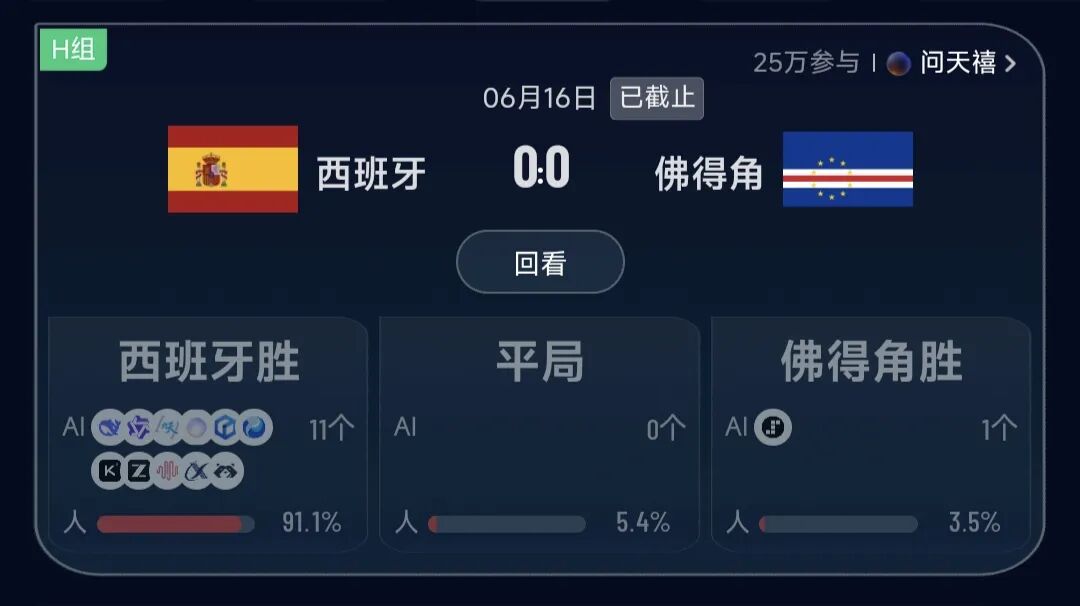
Spain vs. Cape Verde, AI Prediction Results
Similar scenarios played out in the Brazil vs. Morocco match on the 14th and Portugal vs. Congo on the 18th. In the former, all 12 AI models predicted a Brazilian win, but Morocco held Brazil to a 1:1 draw. In the latter, the AI predictions mirrored those of Spain vs. Cape Verde, with 11 models favoring Portugal (featuring Cristiano Ronaldo) and 1 choosing Congo, ending in another 1:1 draw.
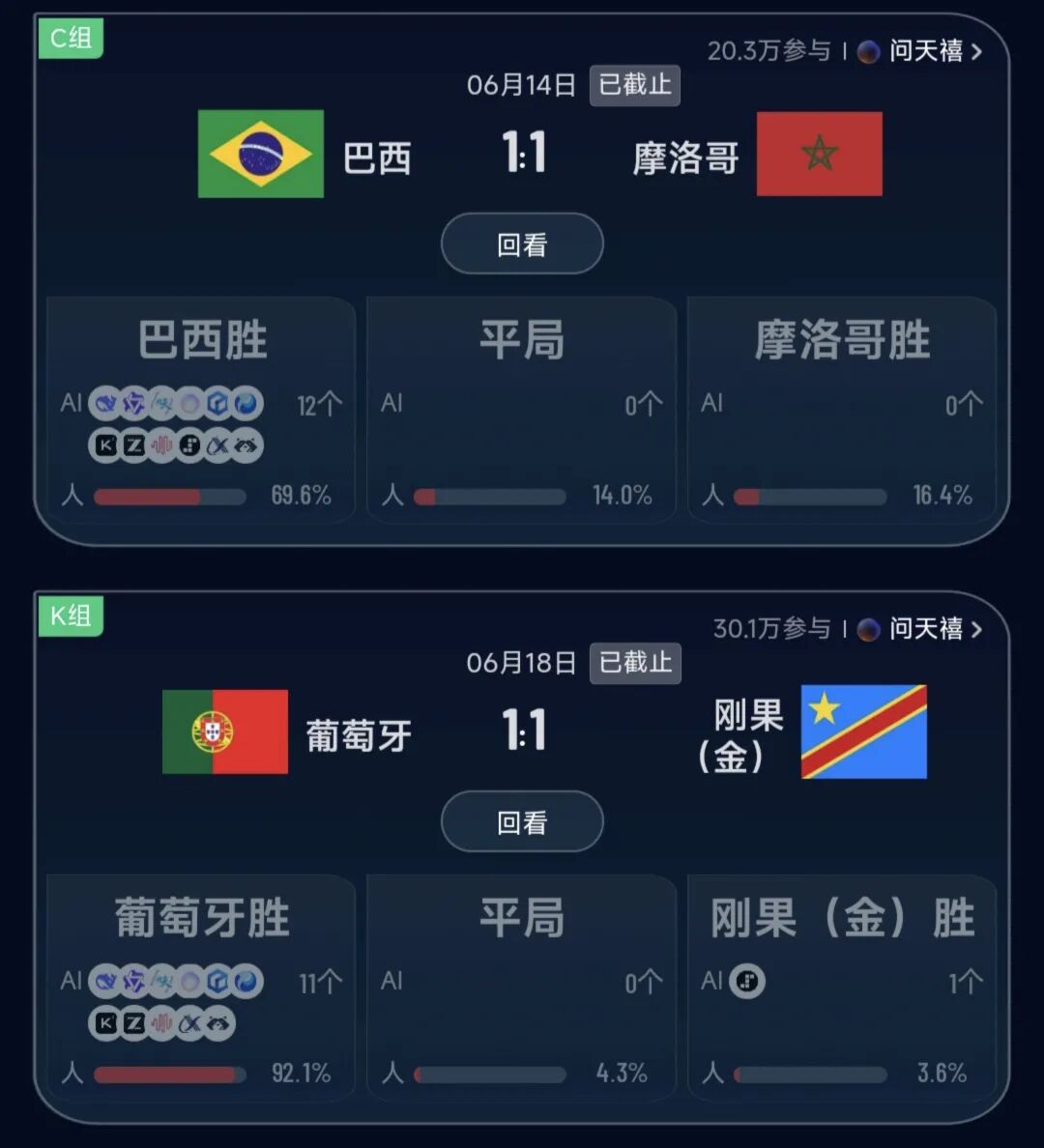
Brazil vs. Morocco, Portugal vs. Congo, AI Prediction Results
In five days, three upsets, and three consecutive AI misfires.
Five days earlier, large model predictions for the World Cup had dominated tech media headlines. Yet reality seemed to mock AI.

A Risk-Free Traffic Bonanza
Even before the World Cup began, the off-field "World Cup Prediction Human-Machine Battle" had already commenced. Led by Lenovo's self-developed Tianxi AI Super Intelligent Agent as the main organizer, 12 mainstream domestic large models formed the "AI Prediction League," predicting all 104 matches of this World Cup one by one. Once the predictions were released, public curiosity was piqued. People were eager to see how accurate AI predictions would be and to compete against AI themselves.

However, most participating models merely went through the motions. After all, in a purely entertainment scenario like World Cup predictions, AI's margin for error was nearly 100%. A correct guess could showcase technical prowess, while an incorrect one highlighted football's unpredictable nature. No one would blame AI for a wrong prediction. For any AI company, this was a zero-risk, high-visibility opportunity. Simply submitting score data could tie the product name to the World Cup in major media reports. Prediction accuracy was secondary; no one truly cared.
Yet, Qianwen and Kimi seemed unwilling to just go through the motions; they aimed to fully capitalize on the traffic. While participating in Lenovo's event, they each launched interactive features for ordinary users on their platforms, elevating the human-machine battle from professional predictions to widespread public participation.
Backed by Alibaba, Qianwen clearly had more experience in internet marketing, directly launching a World Cup prediction zone, "USA-Canada-Mexico," on its homepage. It offered tangible rewards: 100 cash red envelopes worth 10,000 yuan each, 1,000 Qianwen AI glasses, and an integral mechanism (point system) for donating football fields to schools in impoverished areas.

Qianwen's USA-Canada-Mexico World Cup Prediction Prize Pool
According to Qianwen's rules, users earned 100 points for each correct prediction. When the total points accumulated by all users reached 50 million, Qianwen would donate a football field. By the morning of June 18th, just seven days into the tournament, netizens had unlocked three fields through predictions, meaning users had correctly predicted 1.5 million matches.
While the cash prizes, physical rewards, and incremental public welfare donations represented significant investments, for Alibaba, the brand exposure and increased user engagement far outweighed these costs. This World Cup prediction essentially followed the same business logic as previous "Qianwen Treats" campaigns—using attractive incentives to drive massive user participation and data contribution, rapidly boosting product visibility and user base in a short time.
Similarly, Kimi introduced a new feature to predict the World Cup champion and compete for trillion-token rewards. Users could choose one team as their main support, with no changes allowed afterward. Each time the team won a match, users received a lottery opportunity, with a maximum of 10 billion tokens per person. This betting mechanism deeply tied users' "gains" to team performance, greatly stimulating sustained attention and repeated logins.
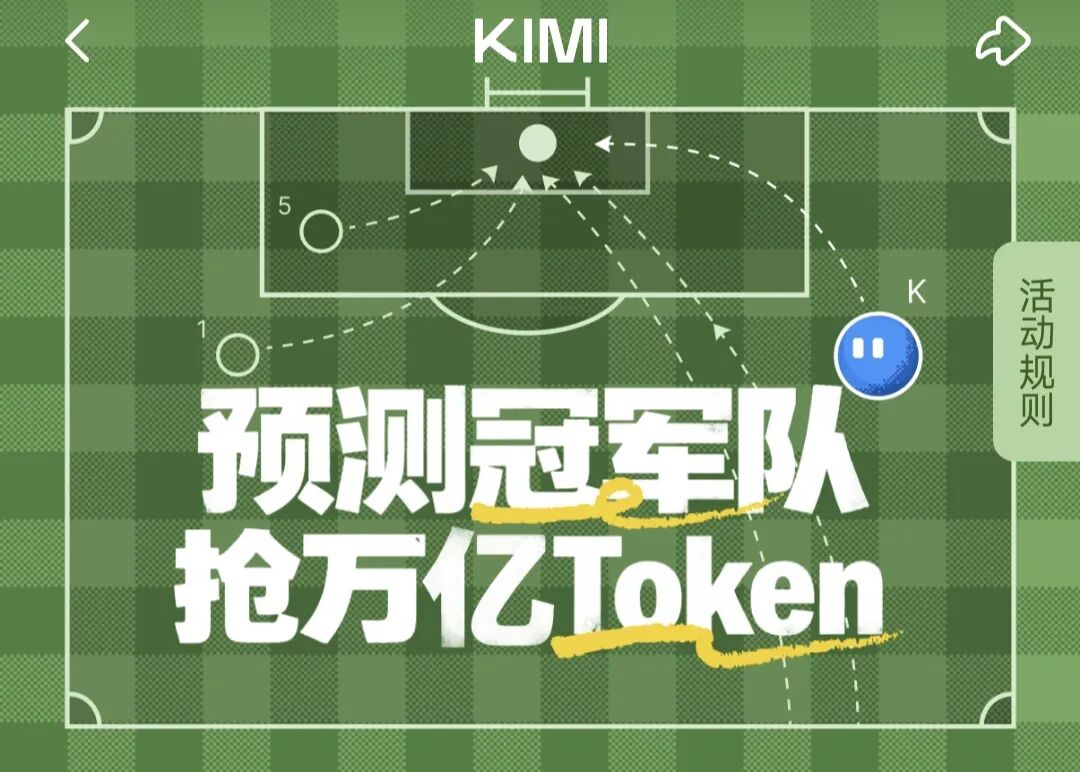
Additionally, Kimi boldly announced it would deploy 300 sub-Agents to form an "Agent Cluster" for round-by-round predictions and reviews of all matches. These 300 Agents had clear divisions of labor, analyzing team strength, offensive and defensive data, tactical styles, player injuries, match environments, odds fluctuations, and public sentiment psychology. A central scheduler aggregated and output the results. This seemingly precise and professional technical architecture showcased Kimi's strong technical image to the outside world.
However, neither the direct output of general large models nor the precise deductions of Kimi's Agent Cluster escaped collective failures in upset matches.
The reason is not complex. When human fans predict matches, they can visualize scenes—such as a player's recent lackluster running or a team's defensive weakness emerging under a tight schedule. These specific, time- and space-sensitive judgments stem from long-term viewing accumulation and intuition.
But AI has no football field; it's merely a text-processing tool. Sometimes, predicting a strong team's victory isn't because it constructs a real football field in the background for inference but because, in the vast text it has learned, it identifies high-frequency co-occurrences of the strong team and victory, leading it to judge the team should win based on textual statistical patterns.
AI doesn't understand football; it only understands text patterns and data analysis. Using text patterns to infer competitive sports results is inherently a mismatch.
This mismatch was glaringly exposed in Spain's match against Cape Verde. Before the game, Qianwen unequivocally predicted a Spanish win, stating the only suspense was the margin of victory. Yet, when the final whistle blew, Cape Verde held Spain to a 0:0 draw.
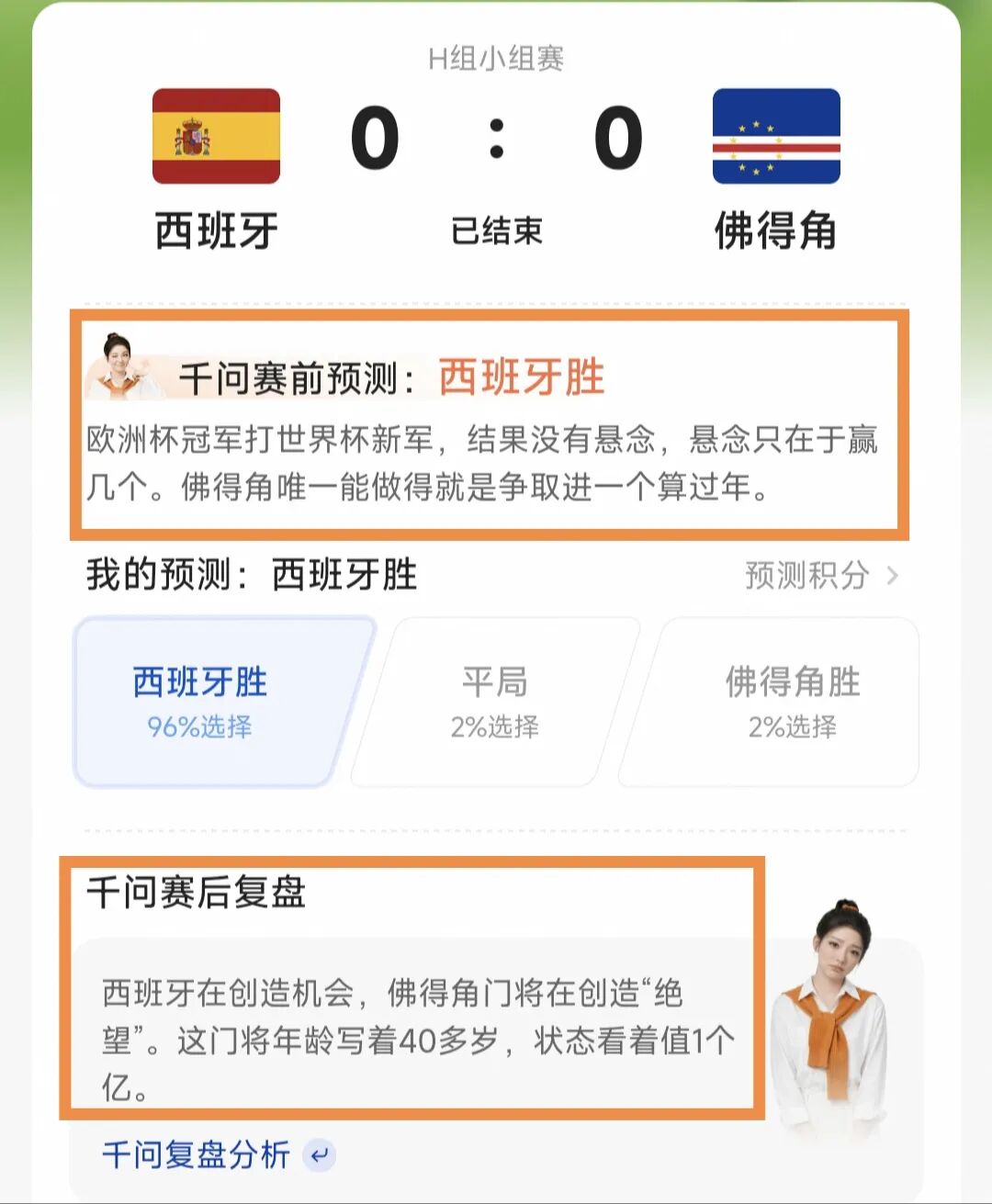
Perhaps these AI companies truly cared less about prediction accuracy and more about the massive traffic generated by this quadrennial top-tier event—using controllable costs to achieve nationwide brand exposure and maximize product visibility in the public eye.
Ultimately, the real battleground of this "human-machine battle" was never on the football field or in algorithmic precision but on users' phone screens and social media feeds. The AI that occupies more users' attention and time during this month is the biggest winner.

AI Can't Calculate Human Limits
Since the Chinese national team didn't qualify for the World Cup, predicting matches has become a form of nationwide entertainment in China. Without a home team to support, people can focus more purely on the matches themselves. However, whether seasoned fans or casual viewers on their phone screens, most people's pre-match judgments align with AI's, often favoring strong teams.
The difference between humans and AI lies in the fact that human judgments stem from years of viewing experience and emotional investment. A fan's prediction often includes irrational elements unexplainable by data, such as long-standing bias for a team, deep hope for a veteran player's satisfactory ending, or anticipation of a clash between top stars.
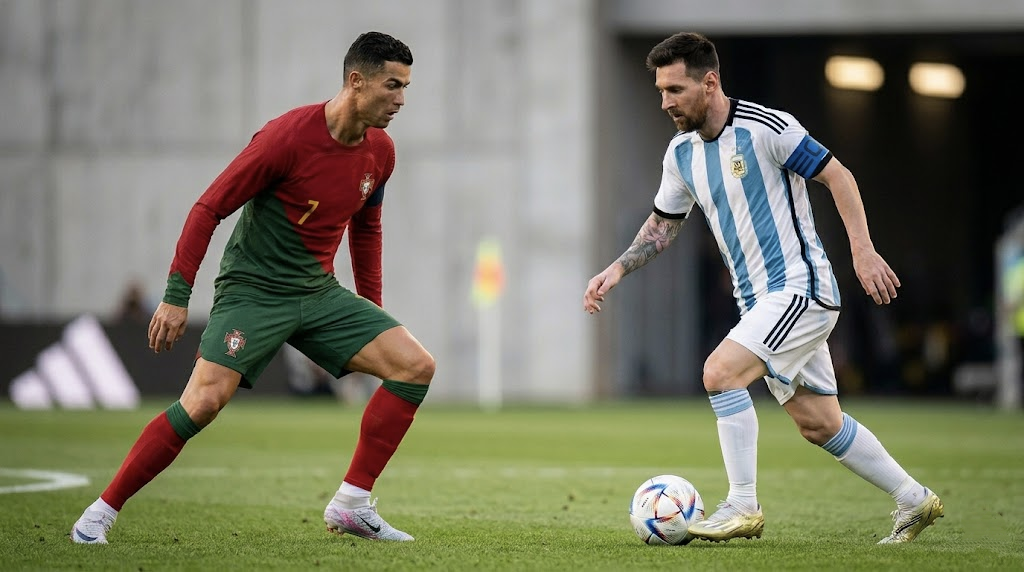
The recent buzz about whether Messi and Ronaldo would face off at the World Cup for the first time exemplifies this mindset. Now nearly 39, Messi, and 41-year-old Ronaldo, are likely in their final World Cup appearances. The hoped-for encounter transcends mere victory or defeat. These subjective factors, though irrational, are a natural part of human decision-making. The charm of competitive sports, to some extent, stems from this irrationality.
AI's decision-making logic is entirely based on data and algorithms. It lacks emotions, stances, or concern for which team's story is more compelling. It follows a probability logic designed to minimize errors. When asked for specific score predictions, its calculation model seeks the safest standard answer in vast historical data.
Facing mismatched matches, AI rarely bets on the underdog, as strong teams winning is the mathematically safest choice. AI has no home team, no identity, and no concept of "upsets." It treats predictions as statistical problems, seeking the highest-scoring objective number in historical data and filling it in.
AI only bows to cold probability; humans do not. People's passion for sports often stems from moments that defy conventions and overturn probabilities, essentially a desire to witness humans pushing physical and mental limits.
On the football field, players run over ten kilometers in 90 minutes under high heat, endure massive impacts during tackles, and maintain clear minds despite near-exhaustion. When a far weaker team perseveres to the end, when a veteran chases back with depleted energy, when a group of underdogs compensate for individual weaknesses through teamwork, these moments thrill because they showcase the boundaries of human physical and mental capabilities—boundaries constantly widened by "breaking the impossible." This unique trait of competitive sports remains AI's unreachable blank space.
AI can calculate the probability of a strong team winning but not the energy an underdog unleashes in desperation. Each upset, superficially an AI probability failure, is humanity's answer to challenging the impossible.
-
![]()
Registered Capital Slashed to 372 Million Yuan! Yutong Optical Finalizes Industrial and Commercial Change Registration
-
![]()
Zhuque-3 Successfully Lands, and 'Time Traveler' Secures Another ¥100 Million in Funding: China's Commercial Space Industry Experiences a 'Dynamic August'
-
![]()
Autohome Faces a Shrinking Window of Opportunity
-
![]()
Even a Titan Like Musk Has Faced Setbacks in Fulfilling Promises
-
![]()
AI Office: The End of the Racing Era, Context Becomes the Key to Success
-
![]()
Domestic Vehicle Chassis Revolution ②: The Steering Wheel Remains, But Mechanical Connections in the Steering System Are Decreasing
-
![]()
Exploring MiniMax Design: Can Video Editing Be as Simple as Speaking?
-
![]()
Why Can SenseTime Achieve Profitability While CloudWalk Still Faces Challenges, Despite Both Adopting Large Models?