Musk Declares SpaceX Will Surpass the Combined Value of Everything on Earth! Is He Just Making Bold Claims? Online Debates Rage On…
 07/13 2026
 355
355
Recently, a social media user raised questions about SpaceX's latest computing power agreement with AI company Anthropic, as well as the allocation of funds. They expressed a desire to know whether history would view the $7.5-40 billion Anthropic/SpaceX AI deal as the most significant waste of resources in the AI era. 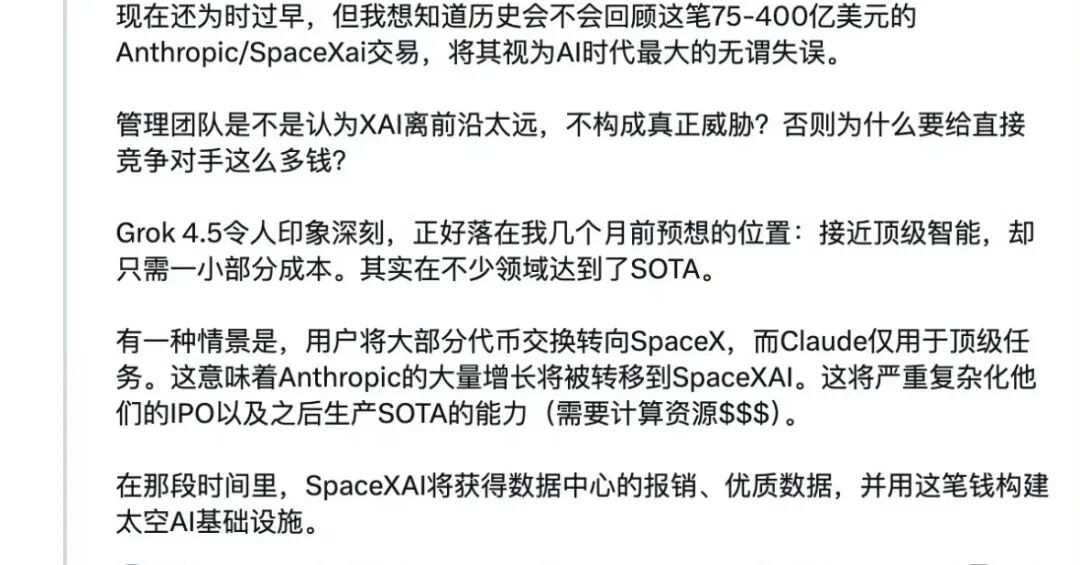 "Does the management team believe that XAI is too far behind the cutting edge to pose a genuine threat? Otherwise, why would they allocate so much money to a direct competitor?" In response to this query, Musk stated, "If we accomplish our goals, SpaceX's value will surpass the combined worth of everything else on Earth."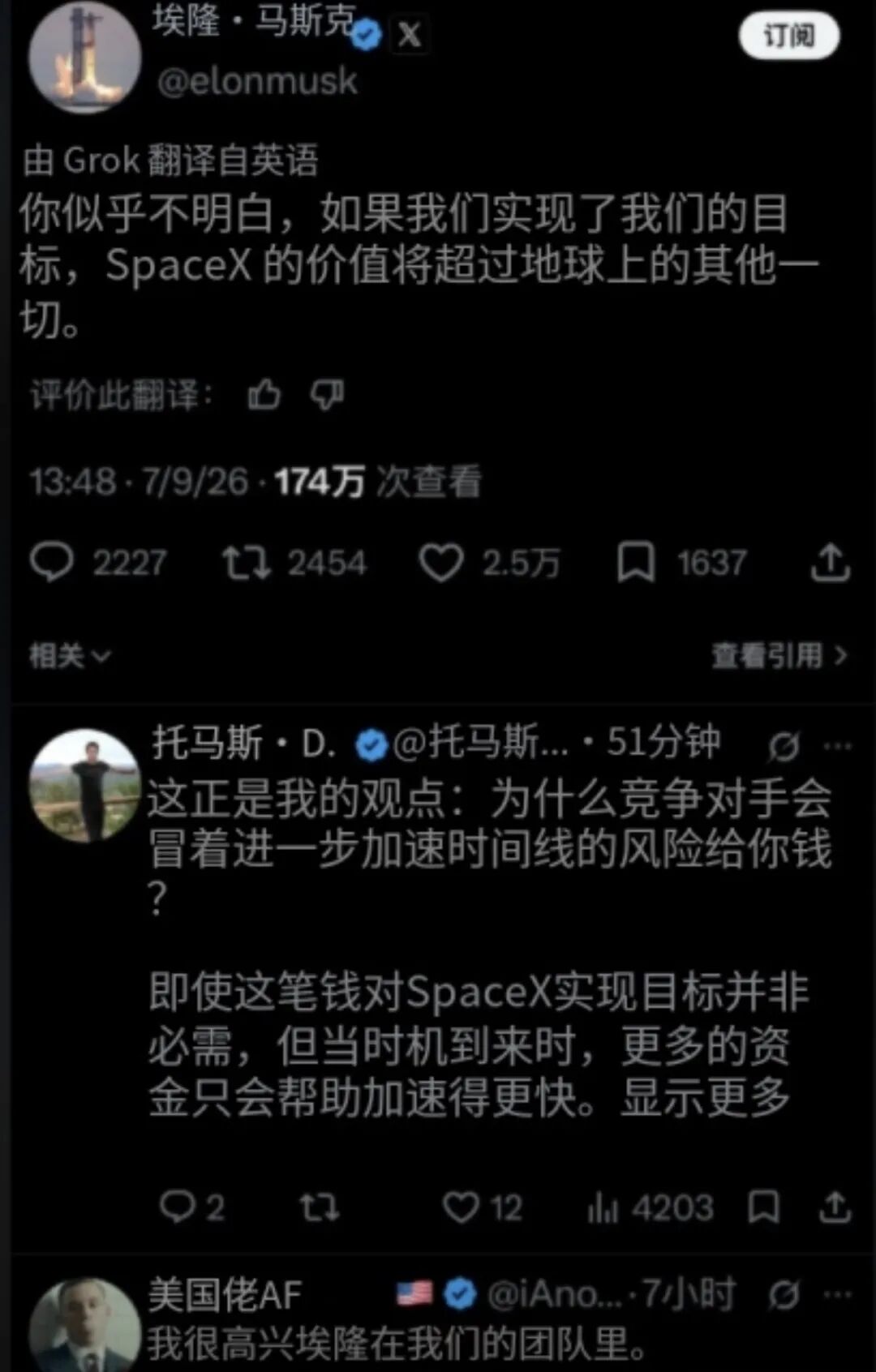
Musk's remarks immediately ignited a heated debate among netizens, with opinions sharply divided. Some accused him of being boastful, while others rallied behind his vision. For instance, one netizen commented: "He always likes to use large-scale spatiotemporal data to support his project narratives. Theoretically, it's somewhat plausible, and practically, he does make some progress. Coupled with a grand vision, the market value skyrockets." 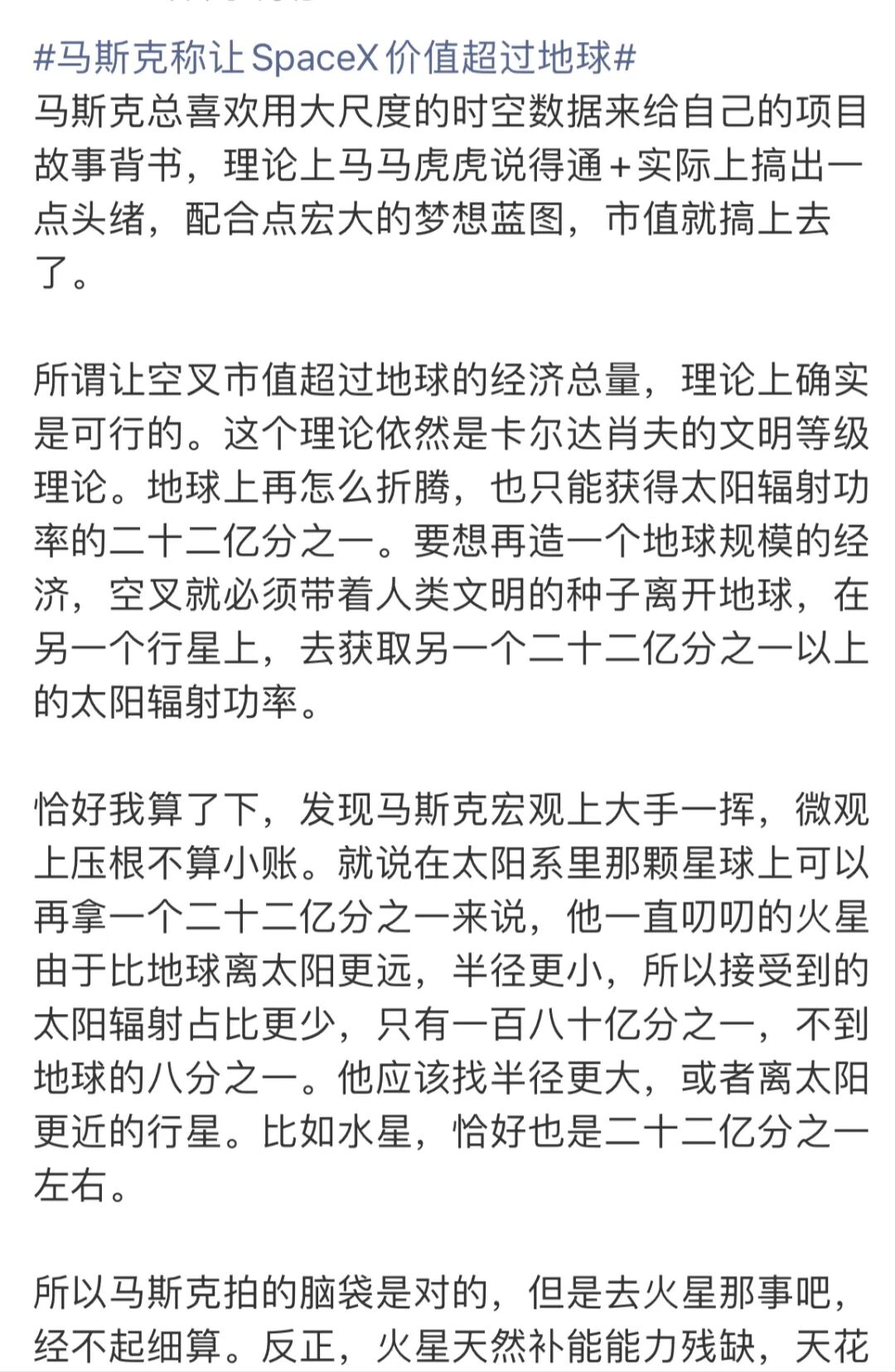
"What's going on with Master Musk? Is he painting another pie in the sky?" "Again, with the pie-in-the-sky promises." "As long as there are believers, that's all that matters." 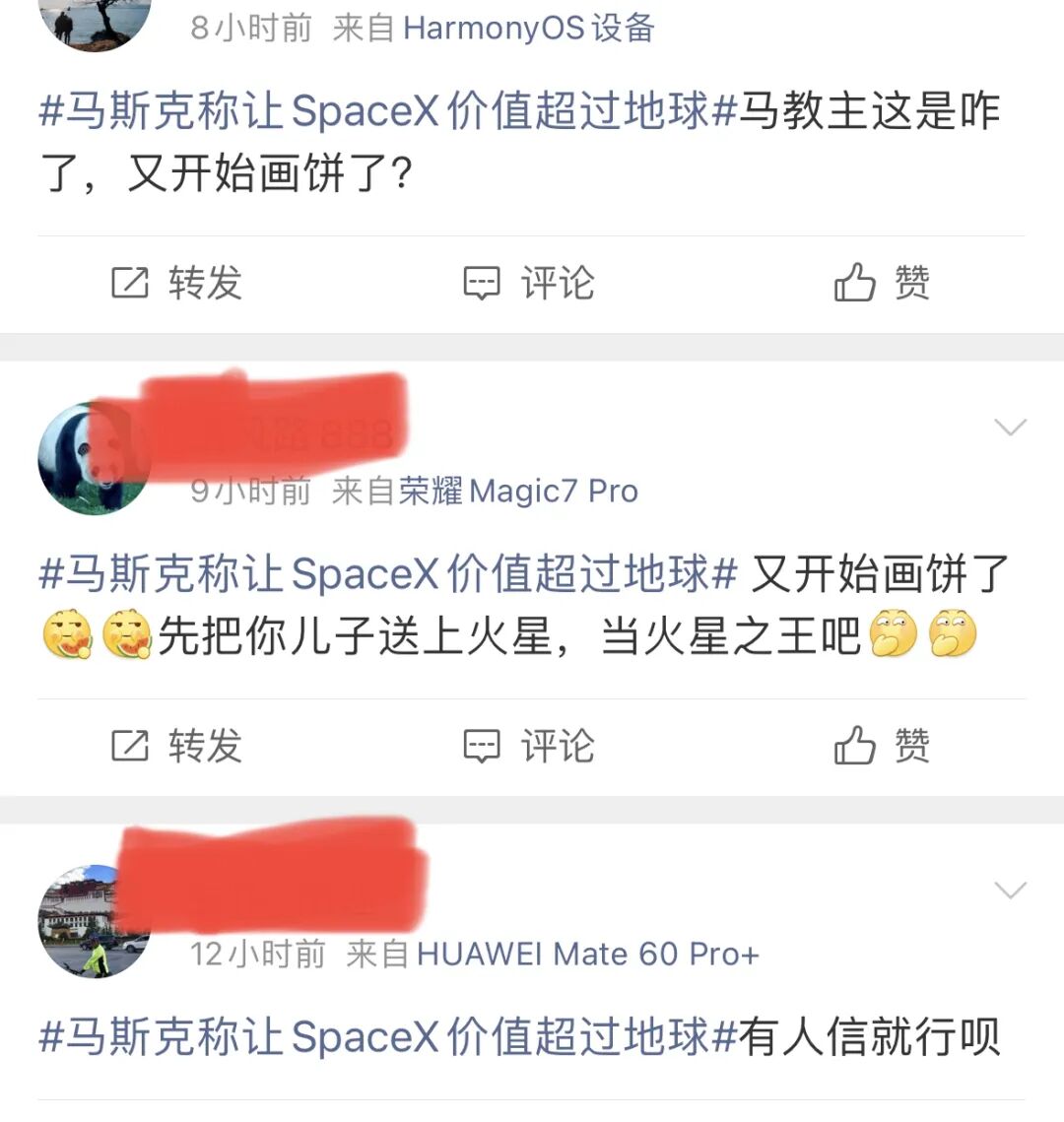
"Musk claims SpaceX will be worth more than the entire planet. Earth's GDP is in the hundreds of trillions, while SpaceX is currently valued at just over $200 billion, 500 times less. But this guy is really skilled at painting grand visions. Tesla also said it would surpass Toyota, and it did. I'll just treat it as a sci-fi movie; what if it actually comes true?" 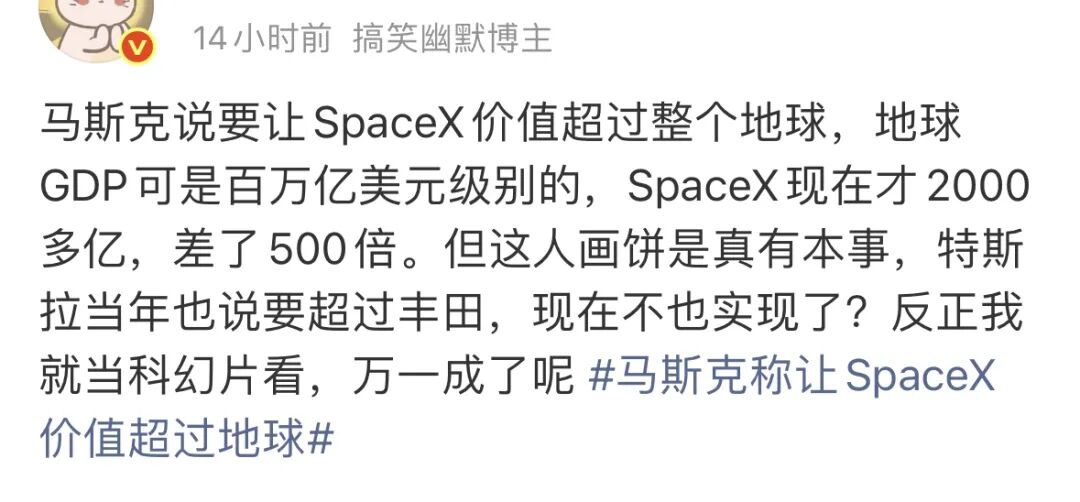
However, a substantial number of netizens also pointed out that Musk's underlying logic is rooted in the boundless potential of "space-based solar power." Currently, Earth's civilization utilizes less than one-millionth of the sun's total energy, while humans could potentially harness energy in space equivalent to 100,000 times the current global energy consumption. Once space-based solar power is fully developed, SpaceX's value could indeed surpass the global GDP of approximately $100 trillion.
Some also argue that this theory aligns with the Kardashev civilization scale, which suggests that for human civilization to advance, it must venture into space to tap into stellar energy, thereby breaking free from the limitations of Earth's finite resources. In fact, Musk's remarks are not without foundation; they are closely tied to his ambitious space strategy and capital maneuvers.
On one hand, to address the surging demand for AI computing power, SpaceX has proposed the "Starbrain" plan, which involves deploying millions of satellites to transfer computing power into space, thereby avoiding the consumption of Earth's energy, water, and land resources. On the other hand, Musk has revealed plans to achieve manned moon landings within the next two to three years, establish a self-sufficient city on the lunar surface capable of accommodating tens of thousands within a decade, and land thousands of people on Mars within 10 to 12 years. 
Despite these grand visions, SpaceX's financial fundamentals and ultra-high valuation have sparked significant market disagreement. Financially, SpaceX has accumulated losses of $41.3 billion since its inception in 2002, with losses of approximately $5 billion in 2025 and $4.2 billion in the first quarter of 2026. Moreover, SpaceX's price-to-sales ratio exceeds 112 times, far surpassing those of Tesla and Nvidia.
Institutions like Morningstar consider its valuation inflated, suggesting that a reasonable market value might be less than half of the current one.
Legendary investor Jeremy Grantham even warned with 90% confidence that SpaceX's stock price will plummet in the future. Notably, amidst Musk's remarks, China successfully achieved controlled recovery of a launch vehicle's first stage for the first time and accomplished the world's first network-based recovery of a launch vehicle. This technological breakthrough directly caused SpaceX's stock price to drop by 4.51% at midday on July 10, indicating that the global space race is exerting substantial market pressure on the company.
END
-
![]()
What Does MaaS Ultimately Bring to Chinese Cloud Providers? | In-Depth Industry Analysis
-
![]()
China’s Auto Resale Value Report Unveiled: AITO M9 Electric and Hybrid Variants Dominate Rankings
-
![]()
Dialogue with Huang Yangming: On the Eve of the Physical AI Boom, the Value of Data Infrastructure Begins to Materialize
-
![]()
The Experience is a Bit Unusual! Logitech G Cloud Review: Great Feel, but Not Ideal for Cloud Gaming
-
![]()
From 30% Yearly Growth to a Slump: Supcon’s Struggle in Industrial AI Transformation
-
![]()
How Alibaba Can Shake Off the 'Valuation Discount' Label Amid a Long-Awaited Rebound
-
![]()
The Arrival of AIDC: Can Traditional IDCs Still Profit by 'Selling Racks'? | Xinliu AIDC Column
-
![]()
China’s Computing Reaches New Heights: From LingSheng to Shuguang 8000