Kejinming's IPO: Diminished Fundraising, Slashed Working Capital Project, Sluggish Growth of Core Products, and a Cooling North American Market
 08/10 2026
 351
351
Recently, Shenzhen Kejinming Electronics Co., Ltd. (hereinafter referred to as Kejinming) secured approval for its IPO on the Beijing Stock Exchange. However, concerns linger regarding its performance growth prospects.
Securities Star observed that all three of the company's primary products are encountering growth hurdles to varying degrees. The growth rate of smart cloud photo frames, Kejinming's top revenue generator, has slowed. The OBM business of smart micro-projector products has significantly contracted and remains unprofitable. Smart portable media player products have experienced a continuous revenue decline due to the impact of streaming media. Furthermore, the North American market, which accounts for over half of the company's revenue, has witnessed a downturn.
Following two rounds of inquiries from the exchange, Kejinming has seen its fundraising amount reduced and the working capital supplement project eliminated. The company's planned expansion of 2LCD smart micro-projector products has yet to reach economies of scale, with revenue falling short of 10 million yuan. There is considerable uncertainty regarding whether the new production capacity can be fully utilized.
01. Contraction of OBM Smart Micro-Projector Business
As a global provider of smart visual terminal products, Kejinming currently focuses on three main product categories: smart micro-projectors (i.e., projectors), smart cloud photo frames, and smart portable media players. It has adopted a strategic development model driven by both "ODM + OBM."
According to the prospectus, the company's performance has demonstrated growth in recent years, with revenue increasing from 614 million yuan in 2023 to 984 million yuan in 2025. Net profit attributable to the parent company rose from 45.1057 million yuan to 64.5508 million yuan during the same period. In the first half of 2026, the company anticipates revenue of approximately 380 million yuan to 400 million yuan, representing a year-on-year growth rate ranging from -1.63% to 3.54%. Net profit attributable to the parent company is expected to be between 15 million yuan and 17 million yuan, with a year-on-year growth rate of 11.91% to 26.83%.
In terms of business segments, smart micro-projector products were once Kejinming's primary revenue source. However, due to the cyclical peak in global demand for projectors, overall industry shipments have declined, resulting in weaker sales and slower revenue growth for the company's products.
RUNTO data indicates that global projector shipments decreased by 4.8% year-on-year in 2025. During the same period, Kejinming's smart micro-projector sales reached 968,100 units, a 2.53% year-on-year decline. Revenue from the smart micro-projector business was 366 million yuan, a 10.5% year-on-year increase, significantly slower than the 31.9% growth rate in 2024.
Securities Star noted that Kejinming's OBM business for smart micro-projectors has underperformed, experiencing significant contraction and drawing attention from the exchange. The response to the review inquiry letter revealed that the company's OBM smart micro-projector sales dropped from 72,200 units in 2023 to 9,700 units in 2025. Revenue fell from 56.3815 million yuan to 5.4263 million yuan, with operating profit turning into a loss since 2024. In the first quarter of 2026, the company's OBM smart micro-projector revenue and sales continued to decline, and it has yet to achieve profitability.
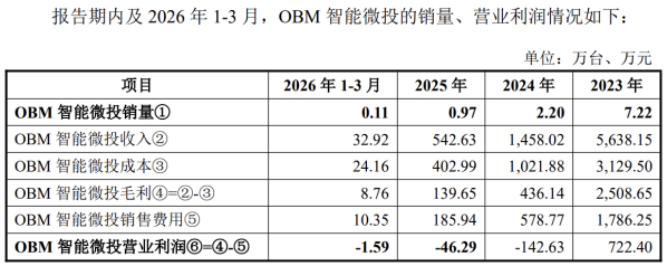
It should be noted that the current smart micro-projector market is highly concentrated and fiercely competitive, jointly dominated by international traditional giants such as Epson and Sony, as well as domestic emerging brands like XGIMI and JmGO. The window of opportunity for new consumer brands to enter has closed, and the cost of entry is high. Based on practical considerations, Kejinming has systematically reduced its investment in OBM smart micro-projectors since 2023 and gradually shifted its focus to the ODM business.
Affected by adjustments in sales strategy and the growing proportion of ODM smart micro-projector revenue, the gross profit margin of the company's smart micro-projector products has fluctuated significantly. From 2023 to 2025, the gross profit margin of these products was 28.79%, 13.9%, and 15.28%, respectively. It nearly halved in 2024 and, although it improved in 2025, it has not yet returned to previous levels.
02. Slowing Growth of Smart Cloud Photo Frames
Currently, smart cloud photo frames have supplanted smart micro-projectors as Kejinming's primary revenue source. However, the growth dividends of this segment are gradually diminishing. QY Research data shows that the revenue growth rate of the global smart digital photo frame market (excluding traditional digital photo frames) slowed from 30.85% in 2022 to 18.61% in 2025.
Against the backdrop of slowing industry growth, Kejinming's revenue growth rate for smart cloud photo frames slowed from 210.03% in 2024 to 31.46% in 2025, with revenue reaching 422 million yuan during the period.
The company's smart portable media player business has performed poorly, with sales and revenue declining for several consecutive years. Driven by the trend of networked distribution of playback content, the development of digital streaming media has significantly impacted the market demand for smart portable media players. Sales of these products dropped from 363,800 units in 2023 to 241,000 units in 2025, a cumulative decline of 33.76%. Revenue fell from 162 million yuan to 105 million yuan, a total decline of 35.19%.
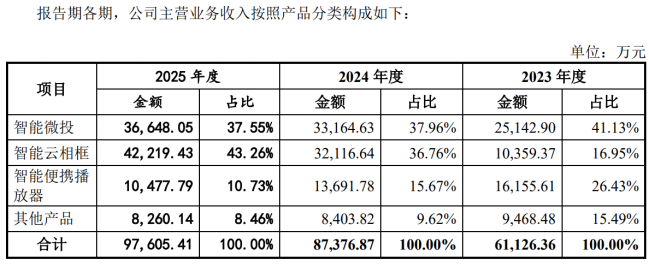
In terms of product consumption, the consumer markets for Kejinming's three major products are primarily concentrated in overseas regions such as North America, Europe, and Japan. Consequently, the company's revenue is heavily concentrated overseas, with overseas markets contributing more than 70% of its revenue over the long term.
Securities Star noted that the revenue growth rate from overseas markets has also slowed. In 2025, the company's revenue from overseas markets was 728 million yuan, accounting for 75% of total revenue, with the growth rate slowing from 40.27% in 2024 to 4.11%.
The company's revenue is highly dependent on the North American market, which contributes more than half of its income. In 2025, revenue from this market was 526 million yuan, a 1.5% year-on-year decline. During the same period, revenue from the Japanese market was 33.3394 million yuan, a 31% year-on-year decrease.
Notably, as revenue has grown, Kejinming's accounts receivable have also increased. As of the end of 2025, the book value of the company's accounts receivable was 189 million yuan, a 115.32% year-on-year increase, far exceeding the revenue growth rate of 11.82% during the same period, and accounting for 36% of current assets at the end of the year. The growth in accounts receivable has affected the company's cash flow. In 2025, the net cash flow generated from operating activities was 32.577 million yuan, a 51.19% year-on-year decline.
03. Uncertainty Surrounding Capacity Digestion
Kejinming originally planned to raise 300 million yuan, with 170 million yuan allocated to the Smart Projector Series Product Upgrade and Industrialization Technical Transformation Project (hereinafter referred to as Project One), 79.5 million yuan to the R&D Center Construction Project (hereinafter referred to as Project Two), and the remaining 50 million yuan for working capital supplement.
However, during two consecutive rounds of inquiries by the Beijing Stock Exchange, the fundraising projects became a focus of regulatory concern. In response to the second round of inquiry letters, the company reduced the funds raised in this offering, canceling the original "working capital supplement" project and lowering the fundraising amount from 300 million yuan to 240 million yuan. Before the listing meeting, Kejinming further reduced the fundraising amount to 200 million yuan. Among them, the planned investment amounts for Project One and Project Two were reduced to 150 million yuan and 50 million yuan, respectively.
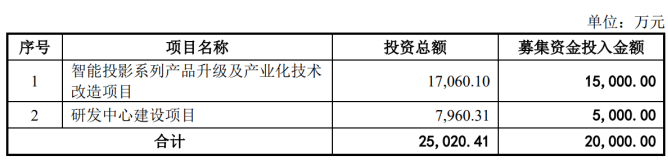
According to the prospectus, Project One plans to add 1.2 million units of smart micro-projector production capacity per year, including 700,000 units of single-LCD smart micro-projectors and 500,000 units of 2LCD smart micro-projectors. Notably, 2LCD smart micro-projectors are a new product for the company, with a relatively small current revenue scale. In 2025 and January-April 2026, the company sold a total of 3,609 2LCD smart micro-projectors, with sales amounting to only 5.4828 million yuan.
Kejinming also noted in the prospectus that the company's new generation of 2LCD smart micro-projector products is still in the stage of joint development with customers and has not yet achieved commercialization. There is uncertainty regarding the subsequent development, customer verification, market promotion, and large-scale production of the products. Given that the 2LCD products have not yet achieved economies of scale, there is significant doubt as to whether the company's new production capacity can be fully utilized.
In terms of equity structure, Kejinming is a typical family business, with the company's actual controllers, Zhu Wenming and Chen Ximei, holding a combined 91.27% stake. Their son, Zhu Xianxiong, currently serves as a director and general manager of the company. According to his resume, Zhu Xianxiong holds a junior college degree and has served as the company's sales manager and board secretary. Notably, despite having no R&D-related professional background, Zhu Xianxiong is listed first among the company's core technical personnel, raising questions about the strength of Kejinming's technological innovation attributes. (This article was first published by Securities Star, Author | Li Ruohan)
- End -
-
![]()
The Ruthless B-Side of AliExpress's Global Expansion
-
![]()
BYD's Mass Production of Photovoltaic Sunroofs: A New Opportunity for PV?
-
New Business Models in the Era of AI Agents: A2A
-
![]()
Kejinming's IPO: Diminished Fundraising, Slashed Working Capital Project, Sluggish Growth of Core Products, and a Cooling North American Market
-
![]()
Tencent Secures a Crucial Victory in AI Office Arena, While Baidu Continues to Struggle
-
![]()
DeepSeek Raises Prices, Alibaba Takes a Cut: Will Major Clients Stay or Leave?
-
![]()
After Persistent Declines, Is This Joint Venture Automaker Considering an Exit? Here’s the Official Word
-
![]()
DeepSeek Raises Prices, Alibaba Takes a Cut: Will Big Clients Pay Up or Walk Away?