DeepSeek Raises Prices, Alibaba Takes a Cut: Will Big Clients Pay Up or Walk Away?
 08/10 2026
 430
430

Alibaba Follows the Dark Side of the Moon: Large Models Weigh the Scales
Author | Xin Jian
Editor | Xiaobai
Illustrations | AI-Generated
Produced by | Qiangdiao Next On August 6, DeepSeek added a note to its official API documentation: It plans to raise API service pricing across the board in the near future, with a “significant expected increase,” and will announce specific plans separately.
A day later, Reuters, citing two sources familiar with the matter, reported that Alibaba plans to introduce new commercial licensing terms for its next-generation flagship model, Qwen3.8-Max: Model weights will remain open, but large commercial users may need to share a portion of their revenue with Alibaba. The revenue-sharing ratio is still under discussion, and Alibaba has not yet officially released the licensing text.
The “price hike” logic differs between the two. DeepSeek is raising the unit price for model calls, while Alibaba is attempting to alter revenue distribution after opening model weights. However, both moves reveal that Chinese large models are crossing the same threshold in commercialization: Low prices and open access got models into more products; now, fees and price adjustments target those already making big money off the models.
Over the past two years, model companies competed to sell Tokens more cheaply. Next, as cloud providers, inference platforms, and app companies start earning money from these models, the question becomes: How much can model companies take back?
───
01
Low Prices Aren’t Over, but the Targets Have Changed ■
DeepSeek’s currently announced prices for V4-Flash are 1 yuan per million Tokens for cache-miss inputs and 2 yuan for outputs. V4-Pro costs 3 yuan and 6 yuan, respectively. The new prices have not yet been announced, but the company has clearly stated that the overall increase will be substantial. 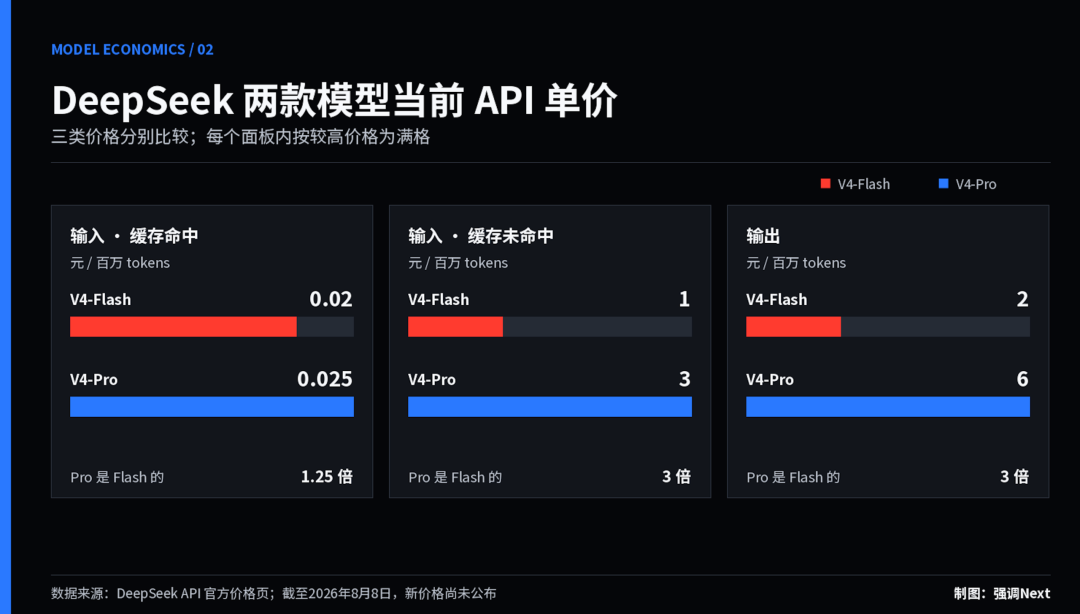
A “significant increase” might suggest an end to price wars, but it depends on the starting point.
Research firm Artificial Analysis previously calculated that the average cost for V4-Flash to complete a standard test is approximately $0.03, compared to $0.86 for Kimi K3, $1.86 for OpenAI GPT-5.6 Sol, and $3.15 for Anthropic Claude Fable 5. Even with a substantial price hike, DeepSeek may not lose its low-cost advantage. 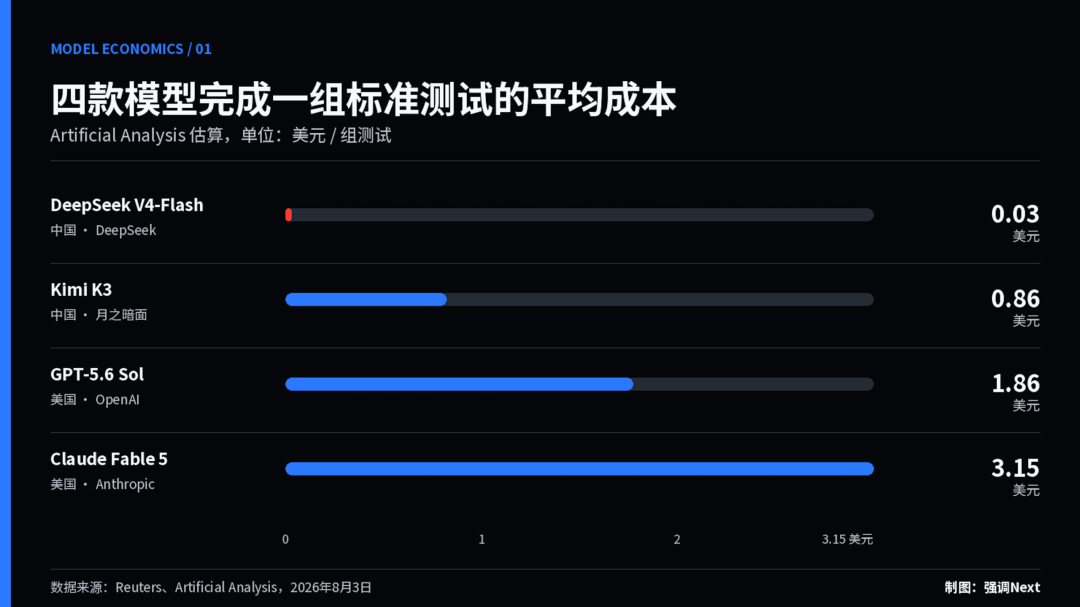
Thus, DeepSeek seems to be repairing unit revenue from extremely low prices rather than abandoning cost-effectiveness. The company has not explained whether the price hike stems from demand, computing power, new model costs, or a proactive move to improve commercialization.
Alibaba’s approach goes further. Previously, Alibaba could charge for Qwen calls deployed on Alibaba Cloud, but once customers downloaded open weights to their own data centers, Alibaba typically received no ongoing revenue. The new license reported by Reuters aims to close this commercialization gap: Weights can still be downloaded, deployed, and modified, but if customers package the model into a service and generate significant revenue, renegotiation is required.
This means the charging logic shifts from “how many Tokens were used” to “how much money was made using the model.” The former sells computing power and calls, while the latter contends for the model’s value share in the industrial chain.
───
02
Alibaba Follows the Dark Side of the Moon ■
Kimi K3 from the Dark Side of the Moon has already provided a more complete example.
Kimi K3’s public license stipulates that if the licensee operates a Model-as-a-Service (MaaS)—offering model inference or fine-tuning capabilities as a service to third parties—and its total revenue with affiliates exceeds $20 million over 12 consecutive months, a separate agreement with the Dark Side of the Moon is required before commercial use.
The license does not specify a fixed revenue-sharing ratio. Reuters, citing anonymous sources, reported that the Dark Side of the Moon demands up to 30% revenue sharing in actual negotiations. The license also sets boundaries: Simply embedding the model into end-user products with specific functions is not automatically considered MaaS. Pure internal use, calls through official products or certified inference partners, are exempt. Commercial products with over 100 million monthly active users or monthly revenue exceeding $20 million must also prominently display “Kimi K3” on their interfaces. 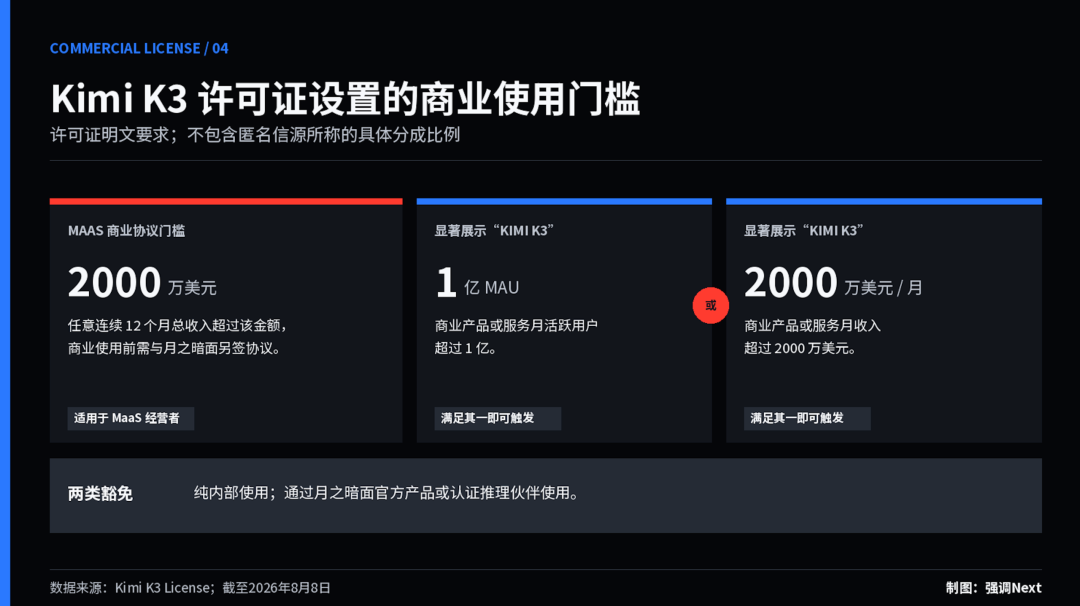
The focus of this design is not to charge all developers but to preserve the long-tail ecosystem while intercepting the commercial channels most likely to bypass official APIs: third-party inference platforms and model service providers.
If Alibaba adopts a similar plan, the change will be deeper than a simple API price hike. The current Qwen3 main force model uses an Apache 2.0 license, allowing royalty-free use, modification, and distribution. If Qwen3.8-Max switches to a custom license with commercial thresholds, Alibaba can still gain from the spread and developer base enabled by open weights but would no longer promise permanent free use for large-scale commercial applications.
Open weights thus shift from a product philosophy to a tiered pricing tool: Individuals and small-to-medium teams contribute to the ecosystem, while large clients contribute revenue; self-deployment expands coverage, while commercial licensing recovers value after scale is achieved.
Strictly speaking, “open weights” does not equal “open source and permanently free.” Weights being downloadable only determines whether the model can be deployed locally. Whether it can be used commercially without conditions, whether MaaS can be provided, and at what scale fees are required are still determined by the license.
───
03
Alibaba Seeks to Regain Channel Bargaining Power ■
Alibaba is now in a position to attempt this step because Qwen is no longer just a model project reliant on subsidies to acquire customers.
Qwen3.8-Max, unveiled on August 3, boasts 2.4 trillion parameters and uses a Mixture of Experts architecture, activating approximately 95 billion parameters per request. It subsequently became the highest-ranked Chinese text model on Arena.AI and ranked second globally in visual benchmarks.
In tests more focused on enterprise workflows, the results were similarly strong. Artificial Analysis’ Agentic Index, which evaluates tool invocation, task planning, and multi-step execution capabilities, ranked Qwen3.8-Max in the global top tier with a score of 58 as of August 9. 
Leaderboards do not directly determine enterprise procurement but strengthen Alibaba’s bargaining position when negotiating commercial terms with large clients.
A more direct signal comes from the cloud business. In the quarter ending March 2026, Alibaba Cloud Intelligence Group’s revenue grew 38% year-over-year to 41.63 billion yuan. AI-related products accounted for 30% of external customer revenue. Alibaba also stated that its AI investment over the next three years would exceed the previously announced 380 billion yuan plan, with management prioritizing market share expansion over short-term profit margins. 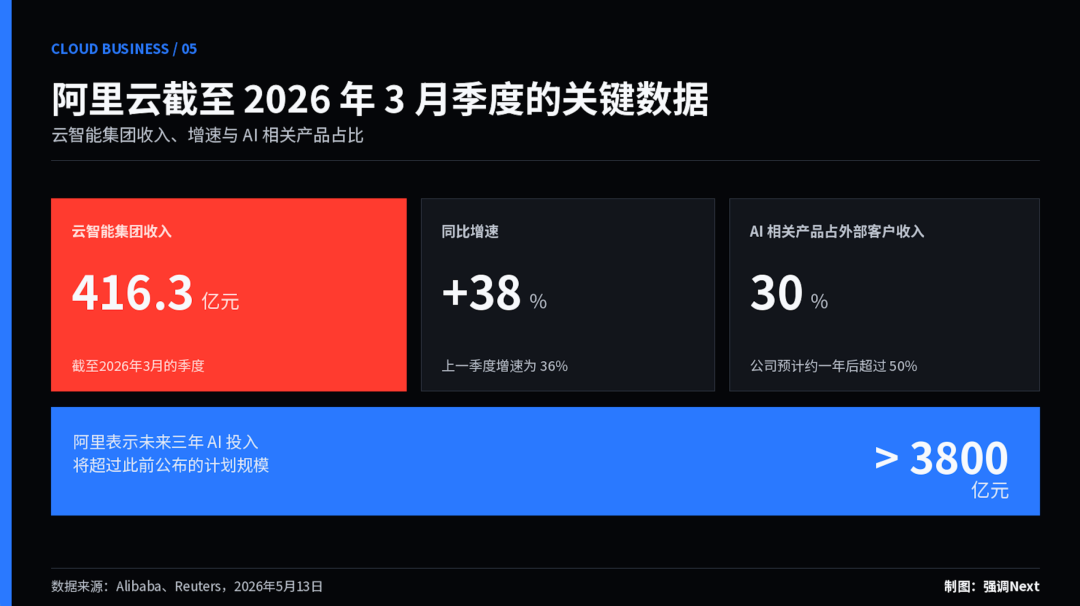
Thus, Alibaba clearly cannot settle for just trading influence for open weights. The next competition is not just about download counts but about who controls access points, enterprise clients, and settlement relationships.
Third-party inference platforms are the most sensitive layer. They download weights, optimize inference on their own clusters, and sell them to clients via APIs. The model capabilities come from Alibaba, but the computing power and customer relationships are controlled by the platforms. Under traditional permissive licenses, the larger the platforms grow, the more potential cloud revenue Alibaba loses.
Revenue sharing attempts to reclaim this overflow value for the model company: earning from Qwen calls on competing clouds and potentially directing some clients to official clouds and certified partners. The license is not just a legal text but also a channel policy.
However, Alibaba’s bargaining power is not unlimited.
If commercial terms become too onerous, large clients can continue using older Apache-licensed models or switch to alternatives like DeepSeek, which remains fully free under Apache 2.0, or Zhipu GLM-5.2, which uses MIT with no revenue thresholds, or Meta’s Llama, which only sets a 700 million monthly active user threshold without taking a cut.
Alibaba must weigh these considerations when setting its fee rates. Qwen’s leading capability margin, migration costs, and tooling ecosystem will ultimately determine how much Alibaba can collect.
───
04
Revenue Sharing Is Harder to Enforce Than Price Hikes ■
The logic of API price hikes is straightforward: Model companies announce unit prices, and clients settle based on Tokens used. Revenue sharing, however, requires first determining how much revenue the model actually generates.
For pure MaaS platforms, this question is relatively clear. But in code tools, customer service systems, and enterprise software, the model is only part of the product. Should revenue be shared based on the entire product’s income or just the model-related portion? How should fine-tuning, distillation, and multi-model routing be attributed? Each interpretation could become a contract negotiation point.
The sharing ratio also affects whether interests align. Too low a ratio fails to cover model investments; too high a ratio leads app companies to believe the model provider is taking value that belongs to the product, channel, and customer service. If Reuters’ claim of Kimi K3’s 30% maximum sharing ratio becomes a reference point, disputes will center on how much value the model truly contributes to a commercial service.
As of August 8, the public only knows that Alibaba is discussing commercial thresholds similar to Kimi K3, with specifics on applicable targets, revenue thresholds, sharing bases, ratios, audit methods, and exemption scopes still unclear. Any change to these terms will alter the actual impact.
Thus, it cannot yet be said that Chinese large models have bid farewell to price wars. But at least the wars are stratifying: Basic calls remain low-threshold, while top-tier capabilities start raising prices; weights stay open, but large-scale resale requires renegotiation.
DeepSeek’s next official price list will reveal the cost floor for low-priced models. Qwen3.8-Max’s final license will answer a more crucial question: After growing an open ecosystem, can model companies reclaim some of the value taken by channels without driving away developers?
These two documents matter more than slogans about “open source vs. closed source” in marking the true inflection point for Chinese large model commercialization. Cover image: Quentin Massys, The Moneylender and His Wife Note: Data in this article comes from public sources and does not constitute investment advice.
- END -
-
![]()
The Ruthless B-Side of AliExpress's Global Expansion
-
![]()
BYD's Mass Production of Photovoltaic Sunroofs: A New Opportunity for PV?
-
New Business Models in the Era of AI Agents: A2A
-
![]()
Kejinming's IPO: Diminished Fundraising, Slashed Working Capital Project, Sluggish Growth of Core Products, and a Cooling North American Market
-
![]()
Tencent Secures a Crucial Victory in AI Office Arena, While Baidu Continues to Struggle
-
![]()
DeepSeek Raises Prices, Alibaba Takes a Cut: Will Major Clients Stay or Leave?
-
![]()
After Persistent Declines, Is This Joint Venture Automaker Considering an Exit? Here’s the Official Word
-
![]()
DeepSeek Raises Prices, Alibaba Takes a Cut: Will Big Clients Pay Up or Walk Away?