BYD's Mass Production of Photovoltaic Sunroofs: A New Opportunity for PV?
 08/10 2026
 417
417
BYD's Mass Production of Photovoltaic Sunroofs: A New Opportunity for PV?
In an open-air parking lot in Tongzhou, a Han DM-i was left under the sun for three days. When the owner returned, an additional line of text appeared on the central control screen: the rooftop PV had generated a cumulative total of 4.62 kWh.
4.62 kWh may not seem like much at a power station. But it came from a sunroof glass panel—one that looked no different from an ordinary sunroof.
Starting in March 2026, BYD will offer the option to equip four models—Han DM-i, Han EV, Tang DM-i, and Tang EV—with “photovoltaic smart sunroofs” for 8,000 yuan, available for direct order at 4S dealerships. By the end of the year, this option will also be extended to high-volume models in the 100,000–200,000 yuan range, such as the Qin, Song, and Dolphin.
When news broke, the automotive community was abuzz: some argued that at 8,000 yuan, it would take 12 years to recoup the cost, calling it a “fool’s tax”; others praised the cool interior temperatures in summer, deeming it worthwhile.
What owners debate is “value for money.” But what PV professionals see is another question—
Why HJT, of all technologies?
1. What This Glass Panel Does
The specifications are brief but noteworthy:
- Ultra-thin PV module (millimeter-level thickness), sandwiched between two high-transparency glass panels, directly replacing the original sunroof with no visible difference in appearance.
- Utilizes HJT cells with a photoelectric conversion efficiency of 23.18%, placing it in the global first tier for onboard PV mass production.
- System rated power of 720W, nearly five times that of traditional onboard solar panels, which typically hover around 150W.
- After parking and shutting off the engine, a second layer of the sunroof automatically slides back approximately 400 mm, increasing the light-receiving area from 1.1 m² to 1.8 m², a more than 60% expansion. At speeds exceeding 10 km/h, it retracts automatically within 20 seconds, increasing wind resistance by only 0.01.
- Official claim: 8 hours of sun exposure generates 2–5 kWh, corresponding to an increased driving range of 20–50 km.
- Bonus effect: After 8 hours of sun exposure, interior temperatures are more than 8°C lower than with ordinary glass (as per media testing).
In PV industry terms: This is a 0.72 kW module installed on a 1.8 m² “roof,” passing all automotive-grade tests before being fitted to vehicles.
This is a different breed from the modules used in power stations.
2. The Roof: The Most Demanding “Power Station” for Modules
Disclaimer: BYD has not officially disclosed its selection rationale. The following analysis is based on industry insights into physical characteristics.
How harsh are the conditions on a car roof?
- Temperature: Under direct sunlight, roof surface temperatures can reach 70–90°C. While modules at power stations may get “hot to the touch” in summer, on a car roof, it’s a daily “grill.” PV module output power declines as temperature rises—this is a physical law.
- Thickness: Sunroof glass cannot be thick. Modules must be millimeter-thin while remaining transparent and safe.
- Operating Conditions: Daily vibrations, thermal expansion and contraction, flying debris, and compliance with collision safety regulations.
Against these three conditions, HJT’s advantages become clear:
- Temperature Coefficient: HJT’s temperature coefficient is approximately -0.24%/°C, compared to -0.30%/°C for TOPCon and -0.35%/°C for PERC. For every 1°C increase, HJT’s output declines about 0.06 percentage points less than TOPCon. During high-temperature periods on the roof, this 0.06 difference accumulates into tangible energy gains. While seemingly minor, in daily high-temperature conditions on the roof, every fraction counts.
- Low-Temperature Process: HJT’s maximum process temperature is below 200°C, making it inherently suitable for thin silicon wafers—warping and stress are easier to control with thinner wafers. TOPCon, with its multiple high-temperature steps (diffusion, annealing at 800–900°C), struggles with thermal stress management as wafers get thinner. For millimeter-thin ultra-thin modules, HJT’s process route holds a natural advantage.
- Symmetrical Structure: HJT’s symmetrical design ensures uniform thermal stress distribution, offering better resistance to vibrations and thermal shocks than single-sided structures. It passes automotive-grade vibration tests with greater confidence.
However, it’s important to clarify a counterintuitive point: since the roof receives light from only one side, HJT’s renowned bifaciality advantage is irrelevant here.
This is not a victory for “bifaciality” but for “temperature coefficient + ultra-thin process”—two dimensions often overlooked in power station scenarios. In power stations, the focus is on efficiency, cost, and bifaciality; on car roofs, the focus is on heat resistance, thinness, and durability.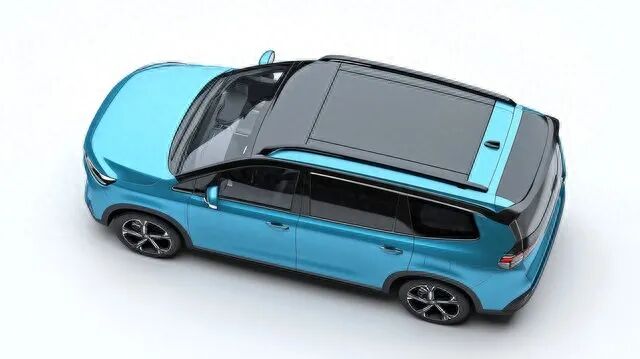
There’s also an industrial logic angle: BYD operates its own HJT module production line (the HALO series, available on its official website). Producing HJT in-house means controlling the supply chain and costs—another key consideration in BYD’s choice. Why not opt for lighter thin-film technology? Quantitative production maturity—BYD prioritizes reliability and supply chain stability.
3. The Weight of “Automotive-Grade”
We’re accustomed to modules in power stations, but rooftop modules face an entirely different set of standards.
- Power Station Modules: Installed and largely stationary for 25 years, enduring dozens of thermal cycles annually. A single damaged cell doesn’t affect the entire system.
- Automotive-Grade Modules: Must withstand repeated thermal shocks from -40°C to 90°C, continuous vibrations, flying debris, UV exposure, and collision safety tests—shattered glass must not cause injuries.
At millimeter-level thickness with double-glass encapsulation, they must generate power while remaining transparent and indistinguishable from ordinary sunroofs. This transcends conventional PV module design, entering the crossroads of automotive glass and PV technology.
This is where Fuyao Glass comes in: automotive glass stress control, bending processes, and safety standards are unfamiliar territory for PV module manufacturers. PV firms understand cells; Fuyao understands glass. Together, they create a functional photovoltaic sunroof.
This explains why onboard solar has languished for over a decade (Toyota fitted the Prius with a solar roof in 2009) without mass production—not due to inferior cells, but because the “automotive-grade” barrier is too high. Few companies can bridge the PV and automotive industries.
4. The Shift PV Professionals Should Notice
The most intriguing aspect of BYD’s move isn’t the energy generated but the signal it sends to the PV industry:
Module evaluation criteria are shifting from “levelized cost of electricity” to “scenario adaptation.”
At power stations, HJT cannot compete with TOPCon on price—this is a fact. But on car roofs, the most efficient technology isn’t necessarily the winner; the most suitable technology is. HJT’s temperature coefficient, ultra-thin capabilities, and low-temperature processes—mere “bonuses” in power stations—become “prerequisites” on car roofs.
Power stations find HJT expensive; car roofs clamor for it.
The scale of onboard PV is limited—each vehicle offers just 1–2 m², a fraction of a power station’s capacity. But its significance lies in proving that PV modules can enter consumer-grade scenarios and compete in industries with stringent safety and reliability demands, such as automotive. This sets a precedent for HJT, BIPV, and all “non-typical” PV applications.
Notably, the end-of-year rollout to 100,000–200,000 yuan models matters more: once these high-volume vehicles adopt onboard PV, it will no longer be a novelty for flagship models. Amid PV overcapacity and price wars, this represents a small but real incremental outlet.
5. The 8,000-Yuan Calculation Doesn’t Add Up
The most widely circulated payback calculation: 8,000 yuan ÷ 0.5 yuan/kWh = 16,000 kWh. At an average daily generation of 3.5 kWh, payback would take 12.5 years.
The flaw: 3.5 kWh is an idealized summer value. Assuming ~650 kWh annually, the daily average is ~1.8 kWh.
Recalculating uniformly:
- At residential electricity rates (0.5 yuan/kWh): 650 kWh × 0.5 yuan = 325 yuan/year → 24.6-year payback.
- At charging station rates (1.5 yuan/kWh): 650 kWh × 1.5 yuan = 975 yuan/year → 8.2-year payback.
Thus, the “12.5-year payback” claim is inaccurate. The reality: photovoltaic sunroofs aren’t financial investments but experience upgrades—cooling, anti-drain, camping power. These values can’t be quantified in electricity prices.
But this is precisely what PV professionals should understand:
The 8,000-yuan question shows that PV’s value is shifting from “selling electricity” to “selling experience.”
In the power station era, PV had one sales pitch: price per kilowatt-hour. In the rooftop era, it’s: a glass panel that happens to generate power.
Summary
BYD didn’t choose the most efficient technology but the one best suited for car roofs.
PV’s next battleground isn’t in power stations but in scenarios.
The 8,000-yuan debate will rage on among owners. But PV professionals should remember: when car roofs start clamoring for HJT, modules are no longer just electricity generators.
They’re becoming part of the product.
Interactive Poll: Do you think onboard PV is a differentiated path for HJT?
Share your thoughts in the comments.
#HJT #BYD #OnboardPV #PhotovoltaicSunroof #PVNotes
-
![]()
The Ruthless B-Side of AliExpress's Global Expansion
-
![]()
BYD's Mass Production of Photovoltaic Sunroofs: A New Opportunity for PV?
-
New Business Models in the Era of AI Agents: A2A
-
![]()
Kejinming's IPO: Diminished Fundraising, Slashed Working Capital Project, Sluggish Growth of Core Products, and a Cooling North American Market
-
![]()
Tencent Secures a Crucial Victory in AI Office Arena, While Baidu Continues to Struggle
-
![]()
DeepSeek Raises Prices, Alibaba Takes a Cut: Will Major Clients Stay or Leave?
-
![]()
After Persistent Declines, Is This Joint Venture Automaker Considering an Exit? Here’s the Official Word
-
![]()
DeepSeek Raises Prices, Alibaba Takes a Cut: Will Big Clients Pay Up or Walk Away?