Chinese Enterprises Going Global 3.0: From World Factory to AI Infrastructure Builder
 08/24 2026
 343
343
By Shan Hetao
In just two short months, the global AI landscape has undergone a significant 'turnaround'.
On one hand, Chinese large-scale AI models are gaining traction among U.S. companies.
According to CNBC data, Chinese open-source models, exemplified by DeepSeek, account for 46% of the token usage by U.S. companies on the OpenRouter platform.
On the other hand, Chinese companies are also securing major AI infrastructure contracts from the Brazilian government.
As per the latest Reuters report, the Brazilian government has unveiled an AI investment plan worth approximately 2.3 billion reais (around $444 million), with roughly 1.3 billion reais allocated for a supercomputing infrastructure project in Rio de Janeiro.
The Chinese companies entrusted with this project are Huawei and iFLYTEK, who will collaborate with Brazil to develop general and industry-specific large language models.
At this pivotal moment when global AI is 'seeking value through implementation', it is fascinating to observe, on one hand, Chinese open-source models progressively narrowing the performance gap with leading U.S. closed-source models, and on the other hand, Chinese companies emerging as a new option for overseas nations in constructing AI infrastructure.
From the cost-effectiveness advantage of APIs to global application acceleration, and now to participating in the foundational AI construction of other countries, the key trend reflected is that today's Chinese companies going global are harnessing systemic AI capabilities to delve deeper.
Chinese companies going global is, of course, not a novel concept.
From the 1.0 era of OEM and trade exports, leveraging commodities and demographic dividends, to the 2.0 era of industrial exports, where electric vehicles, lithium batteries, and photovoltaic 'new three' industries profit from industrial chain spillovers.
Now, in the 3.0 era of AI exports, Chinese companies are beginning to sell AI capabilities.
Goldman Sachs recently highlighted in its latest research report that Chinese exports are no longer confined to commodities but encompass an AI-driven, technology-led industrial capability, spanning from power infrastructure for AI data centers to robots and physical AI.
The collaboration between Huawei and iFLYTEK in Brazil's national AI project, as well as the widespread and in-depth utilization of Chinese open-source models by overseas developers and companies, underscore this point.
This signifies that current Chinese AI exports are not merely about individual models excelling but represent the holistic export of genuine Chinese AI capabilities.
You will notice that the path of Chinese AI exports is also unique. It has never been about erecting barriers with cutting-edge technologies but about transforming AI into a publicly accessible capability.
As early as this year's World Artificial Intelligence Conference (WAIC), China was actively promoting the realization of this vision.
On the opening day of WAIC, the World Artificial Intelligence Cooperation Organization (WAICO) was announced in Shanghai, with 29 founding signatory countries spanning Asia, Africa, the Americas, and Europe. The establishment of this 'AI circle of friends' is not to erect barriers but to foster the beneficial, safe, and equitable development of artificial intelligence, preventing a new global development gap caused by technological disparities.
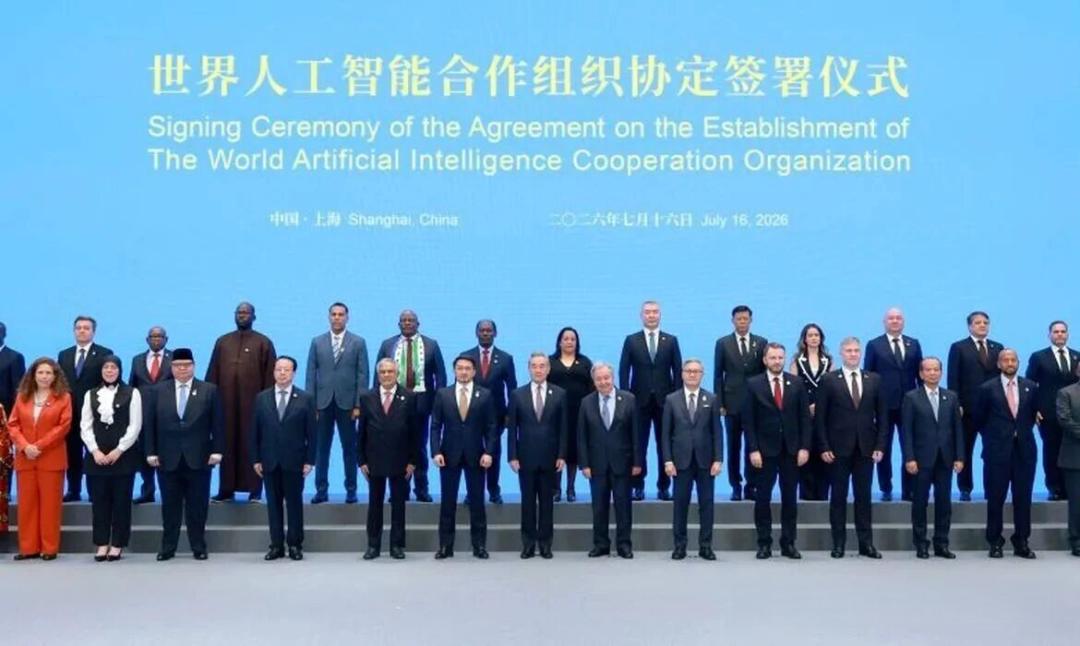
The Brazilian project is also among the fastest-implemented national-level projects since the establishment of WAICO. The Brazilian government stated that the project aims to bolster the country's AI computing capabilities and data sovereignty, reducing reliance on a single country, enterprise, or technology route.
From being a 'world factory' exporting commodities globally to deeply engaging in the world's AI infrastructure construction as an 'AI factory', it is evident that Chinese AI exports are undergoing two major transformations.
The first transformation is in roles.
From the past 'selling cheap tokens' in the global gold rush to establishing AI factories locally and participating in standard-setting. Previously, Chinese AI exports focused on API call volumes, with customers departing after use, easily replaceable by cheaper models.
However, building AI infrastructure is different. According to a report by Brazil's Folha de S.Paulo, the project involving Huawei and iFLYTEK will develop large language models akin to ChatGPT and Claude, with an emphasis on enhancing support for Portuguese and encompassing Spanish applications.
Their collaboration extends beyond computing power and model layers. Huawei and iFLYTEK will provide cooperation in technology transfer, research and development, and talent cultivation, implying that Chinese AI has the potential to become a benchmark for the local AI industry.
The second transformation is in the division of labor.
From being 'AI contractors' engaged in resource integration and earning modest profits overseas to a clearer and more defined division of labor in the AI industry.
For instance, in the Brazilian project, Huawei is responsible for computing power, providing the underlying computing infrastructure, while iFLYTEK is tasked with security, constructing middle-layer model architecture and standardized token products, with industry applications and services for the Portuguese-speaking world emerging at the top layer.
It is worth mentioning that 'Jensen Huang and his counterparts' also feature in Brazil's AI planning.
According to Brazilian media reports, the Brazilian government also plans to construct another AI supercomputer in Rio Grande do Norte state in the northeast. The equipment will be procured through public bidding, with U.S.-based NVIDIA anticipated to be the primary supplier.
This implies that on the fertile ground of AI infrastructure in Brazil, Chinese AI will sit alongside overseas giants and compete on equal footing.
'Jensen Huang and his counterparts' excel at constructing 'AI factories' with a closed ecosystem using a top-down approach. His proposed five-layer cake of 'energy, chips, infrastructure, models, and applications' exemplifies this, involving substantial investments in AI infrastructure by overseas cloud providers and model companies to establish this closed-loop model ecosystem.
Objectively speaking, Chinese AI lacks such financial depth but has instead forged a pragmatic ecosystem with limited resources. Chinese AI companies like Huawei and iFLYTEK have long prepared 'three aces'.
The first ace is full-stack autonomy.
Both Huawei and iFLYTEK have constructed a full-stack autonomous and controllable technology system. They also commenced early to jointly build an autonomous and controllable ecosystem, launching China's first Spark large model based on domestically produced computing power, firmly grasping the technical definition rights from AI underlying computing power, core algorithms, data training to upper-layer applications.
Liu Qingfeng, Chairman of iFLYTEK, stated as early as 2025: 'If we cannot accelerate the resolution of issues such as the weak industrial ecosystem and adaptation difficulties of domestically produced autonomous and controllable artificial intelligence, it would be tantamount to 'building a high-rise on someone else's foundation'.
Chinese AI with full-stack autonomy boasts two major advantages when going global.
On one hand, it is secure. The full-process independent research and development of Chinese AI, from model training to inference applications, can ensure security and controllability in AI infrastructure construction, with localized source technology research and development preventing the underlying layer from being controlled by others.
On the other hand, it is cost-effective. The integrated adaptation of Huawei's computing power and iFLYTEK's models and applications, from the underlying computing power to applications, further amplifies the cost advantages of Chinese AI, making AI 'accessible and affordable' for more overseas users.
The second ace is deep scenario integration.
As early as 1999, Huawei established its first overseas representative office in Latin America in Brazil. Over the past three decades, Huawei's investments and constructions in Brazil have spanned energy, ICT infrastructure, talent cultivation, and other fields. Huawei, rooted in underlying rigid demand scenarios, has become one of the most significant 'Chinese forces' in Brazil's digital transformation wave.
Like Huawei, iFLYTEK is also a typical 'deep scenario integration practitioner' compared to other AI companies betting on traffic entry points.
In this collaboration, iFLYTEK will focus on enhancing the model's support for Portuguese while encompassing Spanish applications, inherently linked to its years of accumulation in multilingual and multimodal core underlying technologies.
As early as September 2025, iFLYTEK trained a Spark multilingual large model foundation covering ten languages specifically for the ASEAN region based on fully domestic computing power.
The Xunfei Spark X2 large model released before the Spring Festival can support mutual translation of over 130 languages, with translation effects for key languages in Latin America and the ASEAN region ranking at the forefront of the industry. The dedicated Spark voice simultaneous interpretation large model has a first-character response time for Chinese and English as low as 2 seconds, reaching the level of human high-end simultaneous interpretation.
Not only does the model excel in multilingual capabilities, but iFLYTEK also continues to deeply integrate AI capabilities into 'high-compliance, high-threshold' scenarios on the industrial side, such as education, healthcare, politics and law, automotive, central state-owned enterprises, etc., maintaining the top position in the industry in terms of bid amount and quantity for an extended period.
According to statistics from the industry media 'Intelligent Hyperparameters', in the second quarter of this year, iFLYTEK once again achieved the top position in terms of the number of bid projects and bid amount, securing numerous projects in finance, telecommunications, healthcare, government affairs, and other industries.
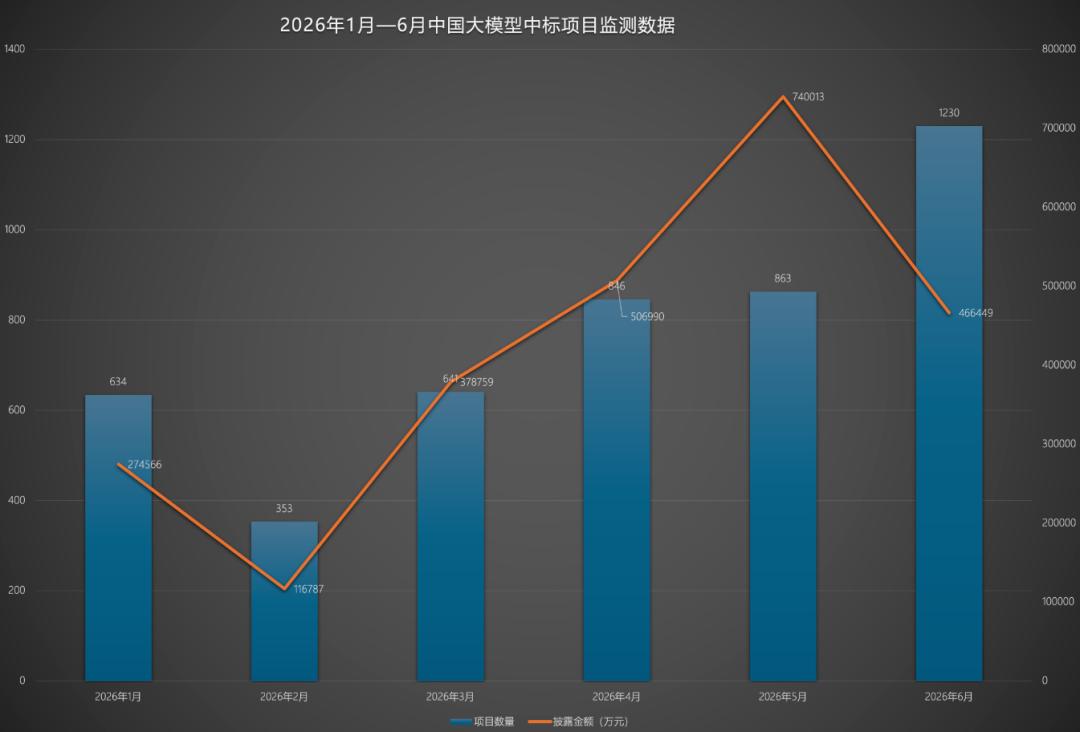
Scenarios such as healthcare and education are precisely the rigid demand scenarios where AI needs to take root in developing countries like Brazil. Chinese AI also better comprehends the needs of such scenarios, and the scenario experience accumulated domestically can be swiftly transferred overseas.
There is also an easily overlooked ace, which is Chinese efficiency.
Compared to developed countries, developing countries lack AI resource advantages and are more inclined to achieve optimal results with limited resources.
This is precisely the domain where Chinese AI excels.
Huawei's semiconductor innovation 'Tao's Law', forced out by circumstances, and the Xunfei Spark large model achieving industry-leading results with less computing power.
Chinese AI has accumulated robust engineering and delivery capabilities under computing power constraints and limited budgets, which can further enhance AI infrastructure construction in countries like Brazil and shorten the AI development gap with efficiency advantages.
What Chinese AI gains is far more than just a Brazilian government order but new imagination for going global.
Firstly, by setting an AI infrastructure precedent in Brazil, Chinese AI can accumulate systematic experience in AI exports.
As mentioned earlier, the collaboration between the two sides is not merely about computing power and models but also involves in-depth local talent cultivation and scenario penetration.
In this process, every project delivery, every scenario penetration, and every local engineer trained by Chinese AI companies, including iFLYTEK, represent a deeper level of localization in going global. In the future, Chinese AI can expand the depth and breadth of going global with stronger localization capabilities, more flexible business strategies, and faster product iteration speeds.
In fact, Chinese AI exports have also accelerated. iFLYTEK's latest semi-annual report shows that its overseas revenue has increased by 160% year-on-year, forming a new curve for the company's revenue growth.
Secondly, from exporting commodities to producing intelligence, providing the world with a 'Chinese AI choice'.
Liu Qingfeng has repeatedly emphasized that the world needs a 'second choice' for artificial intelligence from China more than ever before.
Over the past few decades, relying on the advantage of being the world's factory, China has exported inclusive commodities to the world. In this round, by exporting AI infrastructure, China is exporting more inclusive AI, transforming AI into a new type of productivity that is visible and tangible.
True technological globalization has never been about the transplantation of standards but about the symbiosis of values. This future practice rooted in Brazil is not only a new starting point for Chinese companies going global but also provides a reference path for Chinese AI exports.
When intelligence is no longer defined by a few entities, diverse technological choices can unleash greater productivity. Chinese AI is injecting its new development ideas into the global intelligent transformation.
-
![]()
Alibaba's AI Offensive: Over Half of Investment Allocated, Time to Reap Returns
-
![]()
Alibaba’s AI Push: Over Half of Investments Made, Time to Harvest Returns
-
![]()
Chinese Enterprises Going Global 3.0: From World Factory to AI Infrastructure Builder
-
![]()
Honor RobotPhone Review: Half Movie Camera, Half Robot
-
![]()
AI-Driven Cheating Surges in Universities! Online Exams Reduced to Mere Formalities, Degree Credibility on the Line
-
Insta360’s Decade in Panoramic Imaging: Making Cameras ‘Invisible’ and Returning Creation to the Masses
-
![]()
Foreign Media Claims Apple is Concentrating Resources on AI Development: Vision Pro and Siri Teams Lay Off 200 People
-
Big News! Huaneng and Huawei Hold Talks in Shenzhen with Ren Zhengfei in Attendance; Huawei Emerging as the 'Second Brain' of China's Energy System