The 'Dichotomy' in Alibaba's AI Ledger
 08/25 2026
 365
365
By Dou Wenxue
Edited by Ziye
Alibaba, a company fully immersed in the AI sector, recently unveiled an AI financial report marked by striking contrasts.
On August 20, Alibaba released its financial results for the first quarter of FY2027 (equivalent to the second quarter of 2026). The company reported revenue of RMB 268.953 billion, up 9% year-on-year. However, adjusted EBITA (Earnings Before Interest, Taxes, and Amortization) was RMB 27.329 billion, down 30% year-on-year, and net profit was RMB 10.444 billion, a 75% decrease from the previous year. Overall, Alibaba maintained slight revenue growth from the preceding quarter but continued to grapple with profit pressures. The company attributed the profit contraction to significant investments in technology (including AI infrastructure capital expenditures), goodwill impairment, and fluctuations in the fair value of equity investments.
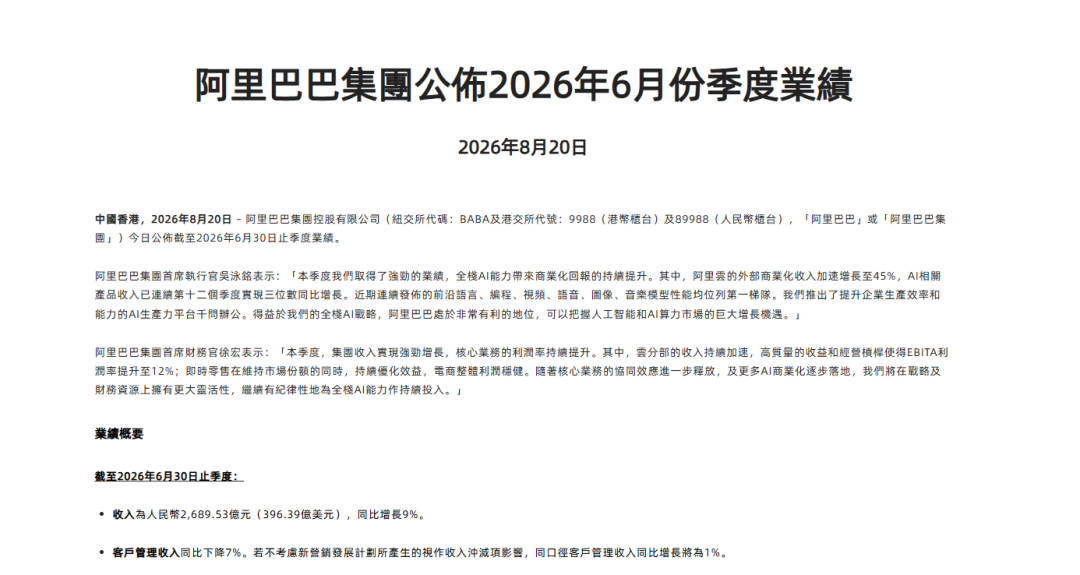
Alibaba's FY2027 Q1 financial report press release, sourced from Alibaba Group's official website.
In this fiscal quarter, Alibaba revamped its disclosure segments, transitioning from the previous "1+6+N" framework to four key divisions: Alibaba E-Commerce Group, AI Cloud and Computing Services, AI Labs and Applications, and "All Other."
Among these, AI-related businesses were distinctly categorized into supply and application segments. AI Cloud and Computing Services encompass Alibaba Cloud and the T-Head semiconductor business, while AI Labs and Applications include AI model R&D, the Qianwen Consumer Business Unit, and the Qianwen Office Business Unit.
The performance of these two segments presented a stark dichotomy, becoming a focal point of industry discussion.
AI Cloud and Computing Services witnessed significant growth in both revenue and profit, with further enhancement of operating leverage in the cloud business. In contrast, AI Labs and Applications generated less than RMB 4 billion in revenue but incurred an adjusted EBITA loss of RMB 13.861 billion, emerging as the primary drag on the group's profits.
Alibaba has consistently demonstrated a strong commitment to investing in its strategic initiatives, whether in the fierce competition of instant retail or the broader trend of "All in AI."
Over the past period, Alibaba has made substantial investments in both AI cloud services and AI applications. However, the commercial returns from these two distinct AI businesses have diverged significantly, particularly for AI applications, which have yet to demonstrate clear signs of commercial viability.
Nevertheless, Alibaba remains resolute in its commitment to further investment.
Today, Alibaba announced a new share placement, offering 710 million new shares at HK$112.70 each, raising a total of HK$80 billion. The placement targets investors outside the United States, with proceeds earmarked for enhancing full-stack AI capabilities and expanding cloud infrastructure.
Following the announcement, Alibaba's stock price fell more than 8%, reflecting the capital market's nuanced stance toward Alibaba's AI future.
For an extended period, Alibaba's cloud division has been the group's most stable growth segment, and this trend persisted in the second quarter of this year.
This quarter, the Cloud Intelligence Group, combined with T-Head (previously part of "Other Businesses"), formed the AI Cloud and Computing Services segment, achieving revenue of RMB 48.437 billion, up 45% year-on-year.
Compared to the previous quarter, when Alibaba's Cloud Intelligence Group revenue grew by 38% year-on-year, this quarter exhibited clear acceleration. External commercial revenue growth increased from 40% to over 45% year-on-year, maintaining overall performance consistent with the previous quarter.
Specifically, the increased adoption of AI-related products remained the primary driver of Alibaba's AI cloud business growth. AI-related products generated RMB 12.376 billion in revenue this quarter, accounting for nearly 26% of the segment's total revenue and growing by over 150% year-on-year, marking the twelfth consecutive quarter of triple-digit growth.

Correspondingly, Alibaba Cloud and T-Head semiconductors have gained significant traction among customers.
According to Omdia's "China AI Cloud Market Share 2025" report, Alibaba Cloud holds a 38.1% share of China's AI cloud market, ranking first.
T-Head's Zhenwu chips, delivered via Alibaba Cloud services, have been widely commercialized across more than 650 external customers in over 20 industries, including autonomous driving, internet services, and financial services.
Beyond revenue growth, Alibaba has indeed achieved profitability in this business.
This quarter, the segment's adjusted EBITA increased to RMB 5.628 billion from RMB 2.419 billion year-on-year, up 133%; the EBITA margin improved to about 12% from around 7% year-on-year.
These revenue and profit gains are tied to explosive industry demand.
Since 2026, the surge in AI Agent applications has driven exponential growth in Token usage. Major vendors have shifted from the price wars of 2025, with Tencent Cloud, Baidu Intelligent Cloud, and Alibaba Cloud announcing price hikes in March this year.
Among them, Alibaba Cloud raised prices for AI computing power and storage products by up to 34%. Computing cards like T-Head's Zhenwu 810E saw increases of 5% to 34%, while file storage product CPFS (Smart Computing Edition) rose by 30%.
The price hikes by cloud service providers have not only secured Alibaba Cloud's gross margin advantage in the near term but also reflect robust market demand for cloud computing power. In the second quarter of 2026, global enterprise spending on cloud infrastructure services reached US$143 billion, up 43% year-on-year, the highest in eight years.

Driven by market demand, Alibaba's past investments in AI infrastructure are now yielding returns.
In February 2025, Alibaba announced a three-year, RMB 380 billion AI computing power investment plan. By the end of this quarter, approximately RMB 190 billion had been invested, more than halfway through the plan.
However, management stated during the earnings call that, given current AI product gross margins, related capital expenditures are expected to recoup costs within three years. Furthermore, with continuously improving AI product gross margins and increasing usage of self-developed chips, the payback period could shorten to 2.5 years or even two years.
While returns on the supply side are promising, Alibaba, which focuses on both supply and demand, faces commercialization pressures on the application side.
In contrast to the growth in cloud and semiconductor businesses, Alibaba incurred substantial losses in AI labs and applications.
In the second quarter of this year, Alibaba consolidated its AI model labs, Qianwen 2C Business Unit (Qianwen App), and Qianwen Office—previously part of "Other Businesses"—into the "AI Labs and Applications" segment. This restructuring revealed the true profit and loss situation of Alibaba's AI applications for the first time.
This quarter, the segment generated only RMB 3.338 billion in revenue, up 16% year-on-year, but incurred an adjusted EBITA loss of RMB 13.861 billion, compared to a loss of RMB 3.224 billion year-on-year—a 330% increase. The loss was 4.2 times the revenue.
Alibaba attributed the losses to "increased investment in AI capabilities and rising inference costs associated with the Qianwen App."
The inference and deployment of AI large models incur costs, a reality faced by many large model providers.
Notably, the Qianwen App, which was specifically mentioned, has seen massive investment but minimal returns over the past six months.
Since December last year, Alibaba has placed high hopes on this core consumer-facing application, establishing the Qianwen Consumer Business Group, led by Group Vice President Wu Jia.
Internally, Alibaba expected the Qianwen App to replace Kuake as its primary AI-to-Consumer super app. Shortly before the Chinese New Year, the Qianwen App announced full integration with Alibaba's ecosystem businesses, including Taobao, Alipay, Fliggy, and Amap.

Sourced from the Qianwen AI platform official website.
To further acquire users, the Qianwen App launched a RMB 3 billion Chinese New Year promotion plan, offering free orders, cash red envelopes, and other incentives across dining, entertainment, and shopping scenarios, attempting to cultivate user habits of ordering takeout via the Qianwen App through financial incentives.
Aggressive user acquisition is a common tactic for Alibaba in expanding its consumer market and often achieves the desired results.
On the first day of the free order promotion, Qianwen's DAU surged from 7.06 million to 58.48 million, up 727.7%; it peaked at 73.52 million the next day. QuestMobile data showed that over 30 million users participated in the first two days of the event.
Subsequently, several user acquisition campaigns by the Qianwen App yielded short-term success. For example, during the college entrance exam season, it launched a free AI college application advisory service. By July 8, over 40 million users had consulted Qianwen about college applications, with 23 million free AI advisory reports issued.
However, the Qianwen App, eager to acquire users through marketing, failed to retain them effectively. Traffic often surges quickly but dissipates just as fast.
During the Chinese New Year, the Qianwen App experienced prolonged outages, and many users reported being unable to find desired restaurant links. Many users never reopened the app after the promotion ended.
According to a Morgan Stanley report on the Chinese New Year AI app market in March 2026, during the AI red envelope battle, the Qianwen App's average daily usage time was 6.3 minutes before the event but dropped to a low of 3 minutes after the peak, a 51% decline, as user behavior shifted primarily to coupon redemption and ordering. The Qianwen App's DAU peaked at 73.5 million but nearly halved when subsidies ended.
Massive investment failed to retain users, making the Qianwen App's past efforts seem uneconomical.
DataEye Research estimates that the marketing campaigns for Yuanbao, Doubao, and Qianwen during the Chinese New Year cost over RMB 10 billion in total. Yuanbao spent RMB 1 billion, Doubao RMB 1.5-2 billion, and Qianwen the most at RMB 6 billion, translating to a customer acquisition cost of about RMB 144 per daily active user.
Another newly restructured product, Qianwen Office, has not yet moved beyond the investment phase.
Qianwen Office acted swiftly, integrating three intelligent agents—QoderWork, Wukong, and MuleRun—within a short period. It launched a beta test in late July and a public test in early August.

Sourced from the Qianwen AI platform official website.
Organizational restructuring requires substantial investment, and Qianwen Office is still in public testing, with limited user scale and insufficient paid conversions. For Qianwen Office to gain an edge, Alibaba must invest more in R&D, computing power, and organizational resources.
Thus, Qianwen Office is unlikely to achieve break-even in the short term.
The consistently loss-making Qianwen App and Qianwen Office must now find ways to generate revenue.
Despite seeing signs of cost recovery in cloud services, Alibaba struggles to sustain continuous investment in the AI industry.
In the second quarter of this year, Alibaba's operating cash flow was RMB 22.945 billion, up 11% year-on-year, while free cash flow deteriorated from a net outflow of RMB 18.815 billion year-on-year to a net outflow of RMB 44.67 billion.
The contrast between these two metrics stems from Alibaba's accelerated expansion of AI infrastructure, with dual capital drain from growing internal AI application demand and external customer computing power supply expansion.
The company's capital expenditures surged to RMB 67.678 billion this quarter, up 75% from RMB 38.676 billion year-on-year, far exceeding market expectations of RMB 36 billion.
The financial report attributed the increase to AI infrastructure investments. With surging Agent usage, the company needed to procure large-scale CPUs in addition to GPUs, compounded by storage price hikes and delivery cyclicality.
Sourced from Alibaba Group's official website.
The newly disclosed share placement reflects Alibaba's need to ramp up investment while urgently recouping funds.
The volatility in Alibaba's stock price today reflects market concerns: first, equity value dilution in the short term, as Alibaba's large-scale equity financing amid recovery efforts dilutes existing shareholders' returns; deeper concerns arise from Alibaba's shift from a light-asset platform operation to heavy Capex investments, altering market expectations of its stable cash flow logic.
Beyond "floating profit and increasing positions" in AI infrastructure to capitalize on strong market demand, Alibaba is also exploring ways to monetize AI applications.
Notably, the Qianwen App has shifted from its previous positioning as a consumer super app to attempting commercial returns through AI office tools.
In August this year, the Qianwen App officially launched paid membership tiers for its office assistant: Premium, Elite, and Flagship, priced at RMB 19, RMB 49, and RMB 128 per month for continuous subscription, or RMB 200, RMB 568, and RMB 1,499 per year.
Additionally, leveraging Alibaba's e-commerce strengths, the Qianwen App is expanding merchant intelligent agents. On June 3, it announced full openness to third-party Agents and Skills, allowing all businesses to operate their brand agents on Qianwen.
Recently, Alibaba Qianwen also announced its integration as an AI capability into Apple Intelligence, bringing intelligent experiences to Chinese users of iOS, iPadOS, macOS, and visionOS—another commercialization attempt by the Qianwen App.
In comparison to the Qianwen App, Qianwen Office is strategically positioned to cater more closely to both individual consumers and businesses, acting as Alibaba's flagship product for monetizing office-related services.
Lianxian Insight has discovered that Qianwen Office currently enjoys a high level of strategic importance within Alibaba, with internal resources—such as computing power—being channeled towards its development.
Citing insiders at Alibaba, other media outlets have reported that Qianwen Office is earmarked as the "sole pivotal SaaS product" being championed by Alibaba Cloud and DingTalk. Talent and computational resources from underlying businesses are set to be fully integrated into Qianwen Office. Furthermore, Alibaba Cloud is expressly forbidden from luring away team members associated with DingTalk, with product teams reporting to DingTalk and sales and operations being overseen by Alibaba Cloud.

Image sourced from Alibaba Group's official website
Against this backdrop, the Qianwen App is under pressure to demonstrate its profitability at the earliest opportunity. For Wu Jia, who leads the Qianwen App, the paramount challenge lies in identifying a scalable commercial pathway while preserving the app's autonomy.
Looking ahead, the market's scrutiny of Alibaba has transitioned from the scale of its investments to its ability to generate profits. Given the present circumstances, Alibaba's AI storyline has entered its second act, necessitating more tangible results to reassure the market.
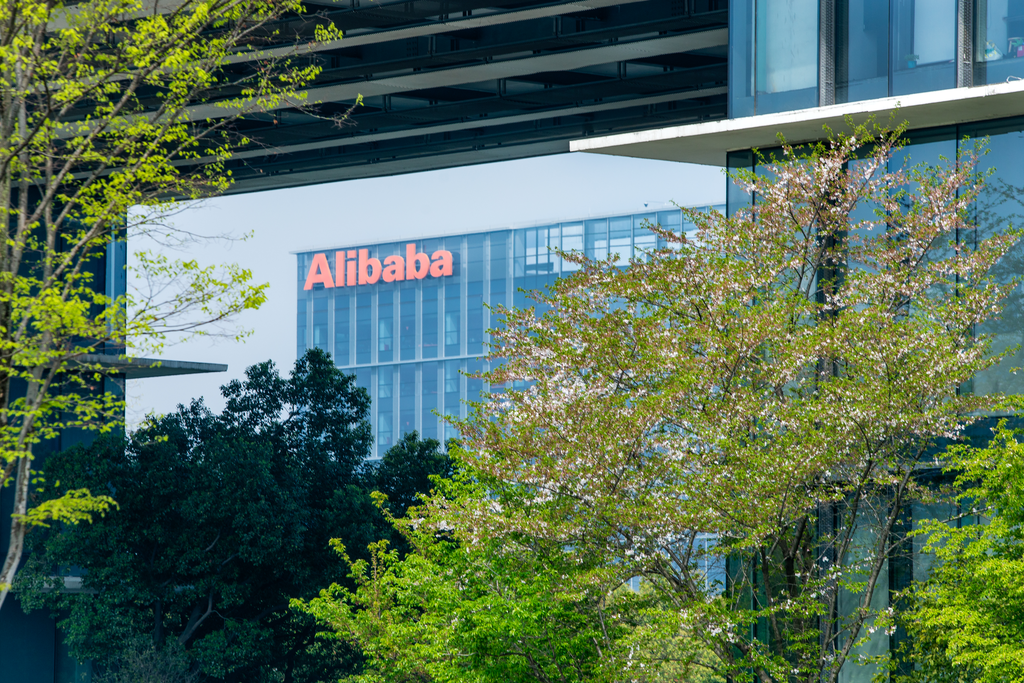
(The header image featured in this article is sourced from Alibaba Group's official website.)
-
![]()
Tough Times Are Here: The Auto Industry Is Mired in Immense Pain
-
![]()
Honda Finds Itself 'With No Alternative' but to Battle On for Another Ten Years
-
![]()
Is the 'Chili Fish Head' Car, Once a Hit Among Noble Ladies, on Its Way Out?
-
![]()
DJI Osmo 360 II Review: Impeccable Hardware, Yet Software Still Lags Behind
-
![]()
The 'Dichotomy' in Alibaba's AI Ledger
-
Reinventing the 'Old Guard' with AI: A $12 Billion Venture in Just a Year
-
![]()
Alibaba's Q2 Profit Plummets by 32.6 Billion Yuan, with 67.7 Billion Yuan Earmarked for Capital Expenditures
-
![]()
DJI Osmo 360 II In-Depth Review: How Does It Achieve Significant Image Quality Enhancements Without Sensor Changes or Excessive Spec Stacking?