Baidu's Profits Plunge by 68%: Unraveling the Mystery Behind the Numbers
 08/25 2026
 542
542

Baidu has successfully positioned AI as its primary revenue driver, yet the capital markets remain unimpressed.
Recently, Baidu unveiled its Q2 2026 financial results, drawing significant market attention.
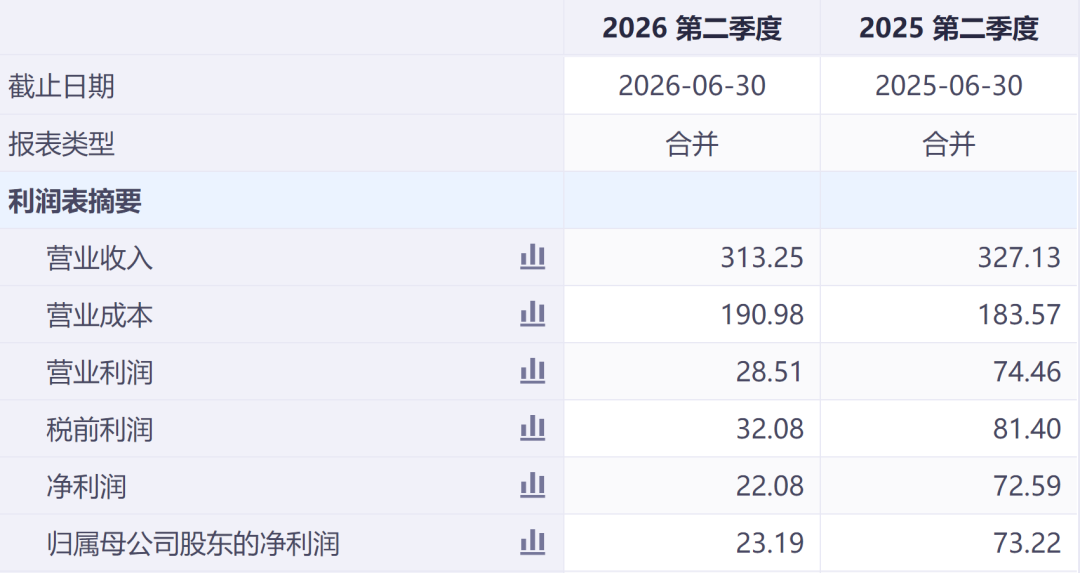
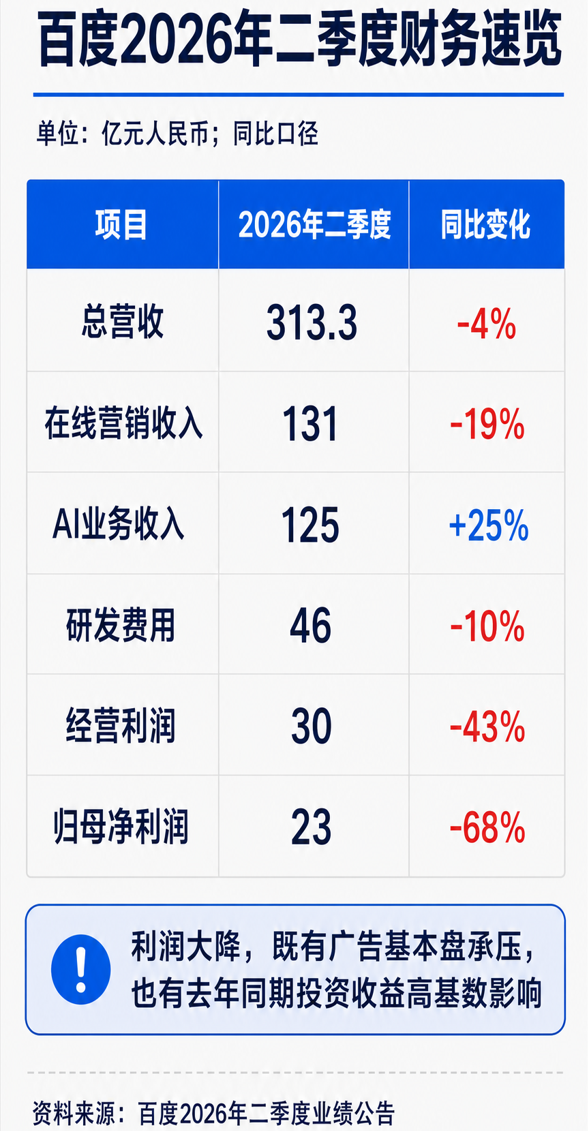
The second quarter saw total revenue of RMB 31.33 billion, a 4% year-on-year decrease. Net profit attributable to the parent company's shareholders was RMB 2.319 billion, a stark 68% drop compared to the same period in 2025. Online marketing revenue stood at RMB 13.1 billion, down 19% year-on-year. Following the release of the financial report, Baidu's U.S. stocks plummeted by approximately 7% during the trading session.
While profit decline is glaring, it's not the sole concern.
Baidu's AI revenue within its general business soared to RMB 12.5 billion, a 25% year-on-year increase, accounting for roughly 50% and marking its second consecutive quarter in the lead. From a revenue perspective, Baidu has transcended its identity as a mere search advertising company. However, from a profitability standpoint, the new business engine has yet to fully compensate for the decline of the old one.
An online claim suggests that Li Yanhong hailed this financial report as Baidu's AI transformation's "rite of passage."
After thorough verification, it appears that "rite of passage" is more of a media-coined term summarizing the report, rather than a direct quote from the financial report announcement or earnings call.
Li Yanhong actually emphasized that the sustained growth of the AI business validates Baidu's shift from an internet-centric to an "AI-first" company. He also proposed elevating the Wenxin large model to the top tier.

Why do media outlets favor the term "rite of passage"? Because AI revenue comprising half of Baidu's general business for two consecutive quarters signifies that this business can no longer rely on "future potential" for leniency.
Once revenue surpasses the halfway mark, the market's evaluation criteria shift. Previously, model parameters, product launches, and technical narratives were considered. Now, customer retention, gross margins, cash flow, and external revenue are scrutinized.
A true rite of passage isn't marked by revenue hitting exactly 50%, but when the new business starts shouldering its own profit and cash flow responsibilities. By this measure, Baidu has reached adulthood but hasn't fully earned its diploma. Li Yanhong, seasoned by numerous challenges, remains calm and composed about the current business landscape.
At past product launches, he maintained his composure even when unexpectedly doused with water.


A RMB 5 Billion Profit Decline: Not Solely Attributable to AI Spending
Baidu's Q2 net profit attributable to the parent company plummeted from approximately RMB 7.3 billion in the same period last year to RMB 2.3 billion, a decrease of about RMB 5 billion. Blaming this entire decline on R&D investment would be simplistic.
The first layer of pressure stems from the old business. Online marketing revenue decreased by 19% year-on-year, a reduction of about RMB 3.1 billion. Search advertising remains Baidu's high-margin, cash-generating business. Its contraction not only impacts revenue but also alters the gross margin of the entire business portfolio.
Since the Wei Zexi incident in 2016, Baidu has established certain norms in search advertising promotion, yet controversies persist regarding ensuring the authority and professionalism of product searches.

AI search provides users with more direct answers but reduces traditional webpage clicks and ad display positions. Baidu is leveraging new products to transform the old ones while also altering its revenue collection methods.
The second layer of pressure arises from the revenue structure. AI cloud infrastructure revenue was RMB 7.3 billion, a 50% year-on-year increase, with GPU cloud revenue skyrocketing by 283%, the brightest spot in the financial report.
However, cloud infrastructure is inherently more capital-intensive than mature advertising, requiring servers, chips, data centers, and continuous depreciation. AI application revenue was RMB 2.5 billion, up only 3%. This indicates that Baidu's strongest AI growth currently comes from selling computing power and enterprise infrastructure, while high-margin, scalable monetization of consumer applications has yet to explode simultaneously.
The third layer of pressure comes from the retreat of non-operating income. Baidu's other net income for the quarter was only RMB 184 million, compared to RMB 4.9 billion in the same period last year, mainly due to a decrease in fair value gains from long-term investments and foreign exchange losses. This year-on-year change alone was close to RMB 4.7 billion. Additionally, income tax expenses for the quarter were about RMB 1 billion, higher than about RMB 880 million in the same period last year.
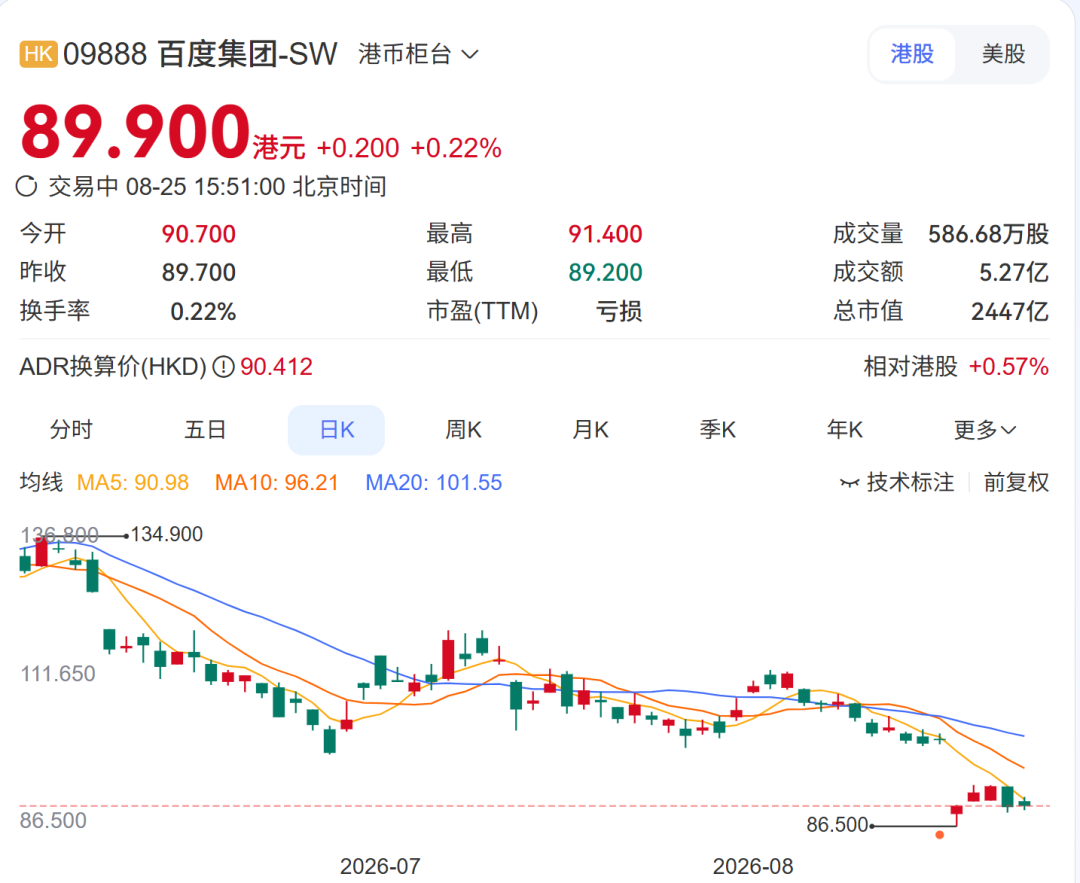
Thus, the true structure of this profit decline is: the shrinking of the advertising cash cow, the AI business still in a heavy investment phase, and a higher investment gain in the same period last year raising the base. The combination of these three forces resulted in a 68% decline. The capital markets had already anticipated this, as evidenced by their earlier actions.
Baidu's R&D Commitment: Not Reduced, but Financially Constrained
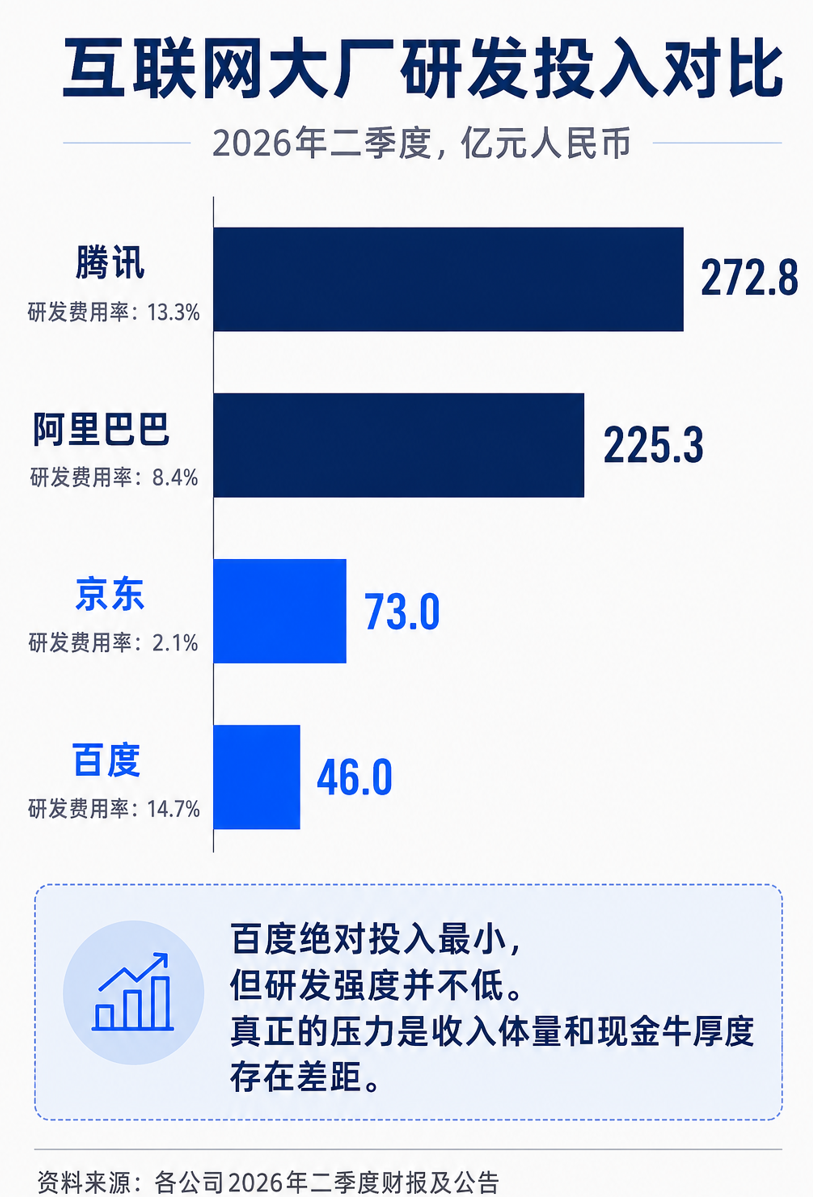
Baidu's Q2 R&D expenses were RMB 4.6 billion, a 10% year-on-year decrease, accounting for about 14.7% of revenue. This proportion is substantial, even higher than Alibaba's approximately 8.4%, Tencent's about 13.3%, and JD.com's about 2.1%. However, the absolute amount gap is significant.
Tencent's R&D expenditure for the quarter was RMB 27.28 billion, Alibaba's was about RMB 22.53 billion, and JD.com's was RMB 7.3 billion. Baidu's was only RMB 4.6 billion. Baidu's R&D intensity is high, but its R&D depth is limited by its revenue scale. It faces a daunting challenge: waging a full-stack war of foundational models, AI applications, and computing infrastructure against opponents with thicker cash flows from gaming, e-commerce, payments, and advertising.
More notably, R&D expenses are only part of the AI bill. Baidu's Q2 capital expenditures were about RMB 11.39 billion, accounting for about 36% of quarterly revenue.
R&D expenses affect current profits, while capital expenditures are gradually reflected through cash flow and future depreciation. Focusing solely on the RMB 4.6 billion in R&D expenses underestimates the true cost of Baidu's AI transformation.
Baidu's strategy is clear. It utilizes Kunlun Core at the bottom to reduce computing power dependence, Wenxin and intelligent cloud services in the middle to serve enterprises, and search, Wenku, Netdisk, digital humans, and Apollo Go at the top to find application entry points.
This full-stack layout is technically sophisticated, and the collaborative logic holds, but the battle lines are too long.
Currently, the output shows significant differentiation. GPU cloud growth is rapid, proving that enterprises are willing to pay for computing power. The penetration rate of AI functions in Wenku and Netdisk increased by 27.4% year-on-year, indicating that the transformation of old products is effective. Apollo Go continues to globalize, bringing long-term imagination space.
On the other hand, AI application revenue grew by only 3%, Wenxin still needs to catch up to the top tier, and AI-native marketing must address the conflict between user experience and commercialization.
What Baidu lacks now is not AI stories or product launches but several high-quality results that can significantly alter the profit statement. After attending so many Baidu product launches, the author still first recalls Li Yanhong being doused with water, with no product leaving a lasting impression.
Cloud revenue growth is important, but if it relies heavily on capital-intensive investments, faster revenue growth may also increase cash pressure. AI applications having users is important, but if payment rates and average transaction values remain low, popularity will be hard to convert into profits.

Kunlun Core IPO: A Strategic Move
Baidu's most closely watched capital move currently is the spin-off and listing of Kunlun Core. The company confidentially submitted its listing application to the Hong Kong Stock Exchange in January 2026 and initiated Sci-Tech Innovation Board listing counseling in May.
Baidu announced that after the spin-off, Kunlun Core is expected to remain a Baidu affiliate, with specific issuance size and equity dilution yet to be determined.
Kunlun Core's advantages are clear. It grew out of Baidu's internal real business scenarios, not just a lab chip. Baidu Cloud can provide both training and inference needs while helping the chip with software adaptation, cluster verification, and commercialization. The rising demand for domestic computing power also provides it with an opportunity to expand external clients.
However, its fundamental challenges are equally clear.
The first is customer concentration. Kunlun Core has long served Baidu deeply, and while external sales are expanding, whether it can form an independent, diversified, and sustainable customer structure is key to market valuation.
The second is the supply chain and manufacturing process. AI chips are not just about design but also advanced manufacturing, packaging, interconnectivity, software ecosystems, and stable delivery.
The third is capital intensity. Chips iterate quickly, requiring long-term investment in R&D and production capacity. Going public can replenish funds but also means the market will more rigorously question revenue, gross margins, and loss reduction paths.
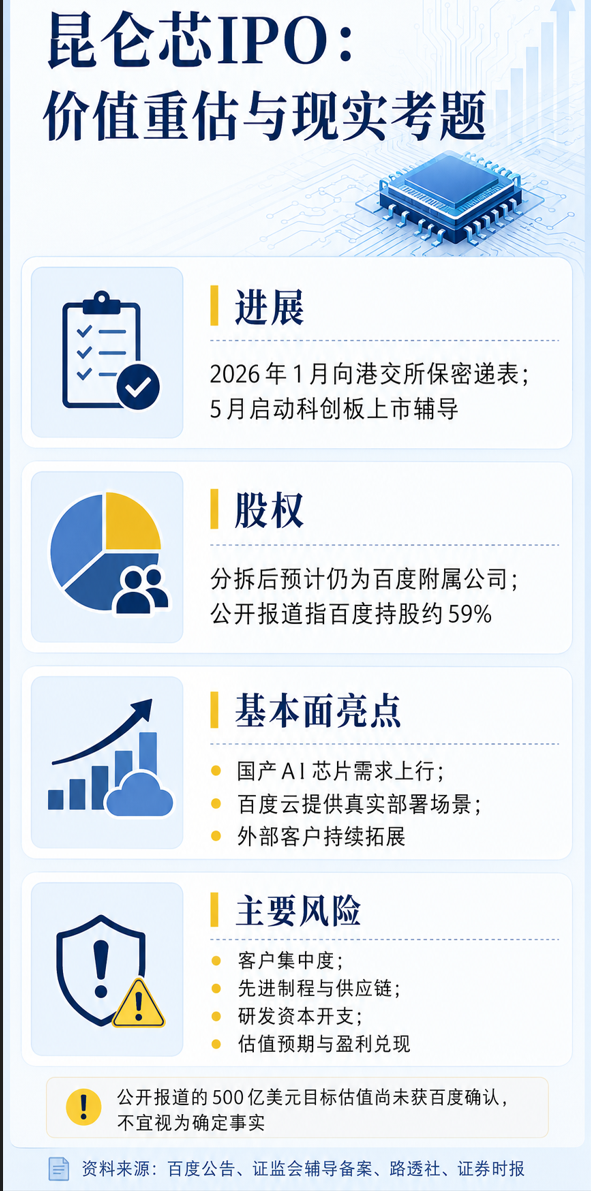
Public reports have mentioned a target valuation of USD 50 billion, but Baidu has not confirmed this, and Reuters has stated it cannot independently verify it. This figure can be understood as market expectation, not a confirmed fact.
A more prudent reference is that Kunlun Core's latest funding round valued it at about RMB 21 billion. Whether this valuation can significantly jump ultimately depends on external revenue, product competitiveness, and profit visibility.
The spin-off and listing have three layers of significance for Baidu. First, it allows the capital markets to price the chip assets separately, alleviating the issue of Baidu's overall valuation being dragged down by traditional advertising business. Second, it establishes independent financing channels for Kunlun Core, reducing the parent company's sole burden of capital expenditures. Third, it attracts talent and clients through independent governance.
However, a spin-off is not a panacea. It can place assets into a new valuation framework but cannot replace fundamentals.
Sending loss-making or heavy-investment businesses to go public merely shifts pressure from one financial statement to another. Technology, orders, and profits still ultimately determine value.
Baidu's Toughest Challenge: Balancing Dual Transformations
This financial report should not be simply dismissed as "Baidu falling behind" nor celebrated as "AI transformation already successful."
Baidu is undertaking two very difficult transformations simultaneously. One is transforming search from link distribution to answers and intelligent agents; the other is shifting the company's revenue from advertising to cloud, applications, chips, and autonomous driving.
The former actively weakens the old business model, while the latter requires massive investment. The rapid decline of old profits and the slow growth of new profits mark the most painful stage of transformation.
What deserves recognition is that Baidu's AI revenue has reached RMB 12.5 billion, and the growth of GPU cloud and AI cloud infrastructure is not just conceptual but represents real money. It also possesses a complete chain from chips, models, cloud, to applications, still rare among domestic internet companies.
What requires caution is that completeness does not equate to strength, being first does not equate to leadership, and revenue exceeding half does not equate to a closed profit loop.
Baidu must narrow its battle lines and concentrate resources on the segments most likely to generate scalable profits. For investors, four future figures matter more than product launches: whether the decline in online marketing narrows, whether AI applications can reaccelerate, whether AI cloud gross margins improve, and whether capital expenditures can convert into free cash flow.
Just as Li Yanhong maintained his composure and calm demeanor when he was unexpectedly doused with water on stage, he is equally capable of navigating through any tempests and challenges, transforming them into opportunities and instilling the market with greater confidence in growth prospects. This is precisely what the market yearns for most.

Baidu has demonstrated that AI can indeed generate revenue. The next crucial step is to prove that this revenue can effectively offset the costs associated with computing power, depreciation, research and development, and customer acquisition, ultimately resulting in a profit.
Only by achieving this milestone can Baidu's AI transformation be truly deemed mature.
The signs are just starting to emerge; with time, they will become more evident.
-
![]()
The Allure of 'Acquisition Spree': Li Shufu's Left Turn, Xu Jiayin's Right
-
![]()
Strategic Transformation Yields Results: Phoenix Optics Reports 10.9% YoY Rise in Core Net Profit for H1 2026
-
![]()
Three Key Growth Trajectories Synergize! Crystal-Optech Reports 3.478 Billion Yuan in Revenue for H1 2026
-
![]()
Semi-Annual Report Sparks XPENG Motors Buzz
-
![]()
1.6 Billion Big Order Secured! SeeYA Technology's Revenue Soars by 287.87% in the First Half of the Year
-
![]()
Baidu's Profits Plunge by 68%: Unraveling the Mystery Behind the Numbers
-
![]()
Baidu’s Profits Tumble by 68%! Where Has All the Money Gone?
-
![]()
Hynix’s Taobao Store Shuts Down Abruptly: What Should Customers Do About Warranty Services for Memory Modules?