Semi-Annual Report Sparks XPENG Motors Buzz
 08/25 2026
 416
416
XPENG Motors has once again captured public attention, this time with its financial report.
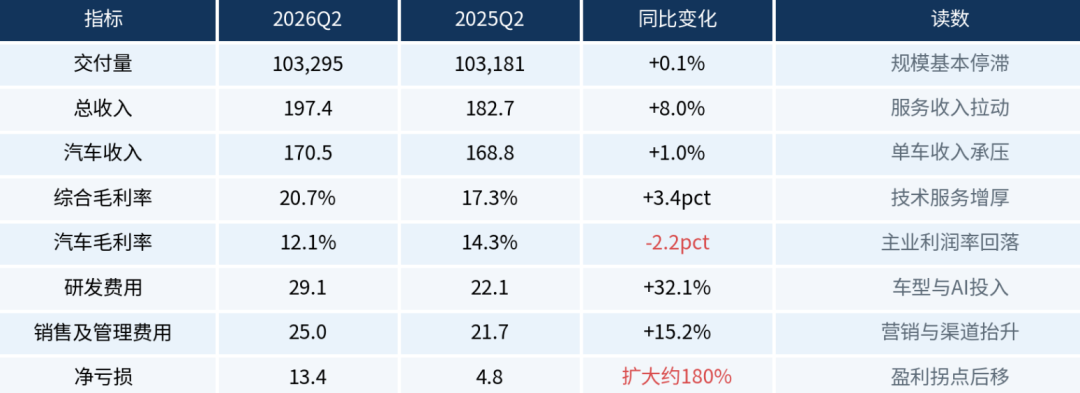
On August 24, XPENG unveiled its Q2 2026 financial results. The company's total revenue soared to RMB 19.74 billion, marking an 8% year-over-year (YoY) increase and a substantial 51.5% quarter-over-quarter (QoQ) rise. The overall gross margin climbed to 20.7%, setting a new historical high. At first glance, these figures hardly suggest a company experiencing a "plummeting" performance.
However, the market's focus shifted to another set of numbers: a net loss of RMB 1.34 billion, compared to a loss of RMB 480 million in the same period last year, representing an approximate 180% YoY surge in losses. Even under non-GAAP accounting standards, the net loss reached RMB 1.24 billion.
Meanwhile, XPENG provided a Q3 revenue forecast ranging from RMB 21.7 billion to RMB 23.4 billion, falling short of the market's average expectation of RMB 26.61 billion, according to LSEG statistics. Following the release of the financial report, XPENG's U.S.-listed shares dipped by 3.1% in pre-market trading, adding to a year-to-date decline of approximately 40%.
Thus, the real "plummet" this time around is not in revenue or sales volume but in market confidence regarding a near-term inflection point for profitability.
A financial report that appears promising on the surface has nonetheless left the market disappointed.
XPENG delivered 103,295 vehicles in Q2, reflecting a mere 0.1% YoY increase. With virtually no growth in sales volume yet an 8% revenue hike, it becomes evident that the company is not solely relying on price cuts to drive growth. Service and other revenues surged to RMB 2.7 billion, up 93.9% YoY, emerging as a significant growth driver.
However, a closer look at the revenue breakdown reveals underlying issues.
Automotive sales revenue amounted to RMB 17.05 billion, up just 1% YoY. A rough calculation of automotive revenue divided by delivery volume suggests that revenue per vehicle was approximately RMB 165,000, showing no significant increase from about RMB 164,000 in the same period last year. More critically, the automotive gross margin declined from 14.3% in the same period last year to 12.1%.
The company attributed this primarily to product transitions.
Why, then, did the overall gross margin rise to 20.7%? The answer lies in service revenue. The gross margin for services and other businesses in Q2 was a staggering 75.1%, encompassing revenue recognized from providing technology R&D services to an automaker, as well as sales of parts and accessories.
While high-margin technology revenue boosted the overall gross margin, it did not alter the fact that the profitability of the vehicle business declined YoY.
This is the most concerning aspect of this quarter's financial report. The overall gross margin may look robust, but it cannot be simply equated with the core vehicle manufacturing business having reached a comfortable zone.
Ultimately, automotive companies must address a fundamental question: How much profit is generated from selling each vehicle?

Why are losses larger despite higher gross profits?
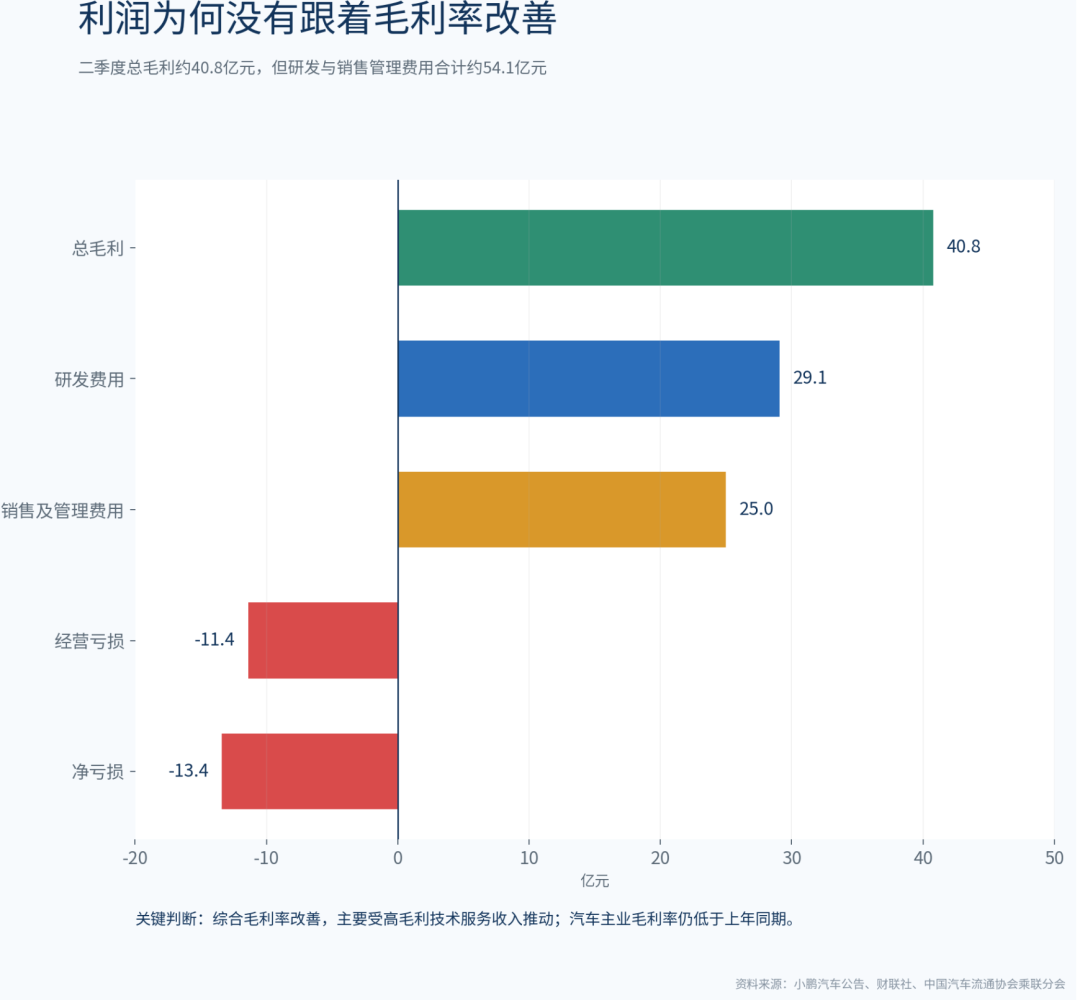
XPENG's gross profit in Q2 was approximately RMB 4.08 billion, up about RMB 910 million YoY. However, R&D expenses were RMB 2.91 billion, up 32.1% YoY, while sales and administrative expenses were RMB 2.5 billion, up 15.2% YoY. Together, these two expenses totaled RMB 5.41 billion, exceeding the entire quarter's gross profit.
The increase in R&D expenses is not surprising. XPENG is simultaneously advancing new vehicle models, AI technology, Turing chips, Robotaxi, and robotics, broadening its technological focus and naturally increasing investments.
The issue is not the amount spent on R&D but whether the speed of revenue realization can keep pace with the expansion of investments. Long-term projects can shape valuations, but short-term cash flows will not automatically improve just because of grand narratives.
Changes in sales and administrative expenses are also noteworthy. These expenses increased by 32.5% QoQ, primarily due to higher commissions for franchise stores, marketing, and advertising costs, according to the company.
As of the end of Q2, XPENG had 740 stores covering 257 cities. Channel expansion can enhance reach, but if per-store sales volume and brand premium do not rise concurrently, broader channels can lead to expenses increasing before revenues do.
Cash levels also showed signs of depletion. As of the end of June, the company's cash position was RMB 40.48 billion, a decrease of RMB 1.61 billion from the end of March.
This scale is still sufficient to support R&D and new product cycles, posing no imminent liquidity crisis. However, inventory rose from RMB 10.38 billion at the end of 2025 to RMB 13.73 billion, an increase of about 32%, while short-term borrowings increased from RMB 4.28 billion to RMB 10.07 billion.
New vehicle transitions, stockpiling, and production ramp-ups can drive up inventory, and the increase in borrowings may also include operational arrangements, but the simultaneous changes indicate that expansion is not cost-free.
XPENG's core dilemma now is not "whether it can survive" but "whether scale, technology, and profits can converge at the same time."
China's new energy vehicle (NEV) market in 2026 presents a contradictory picture.
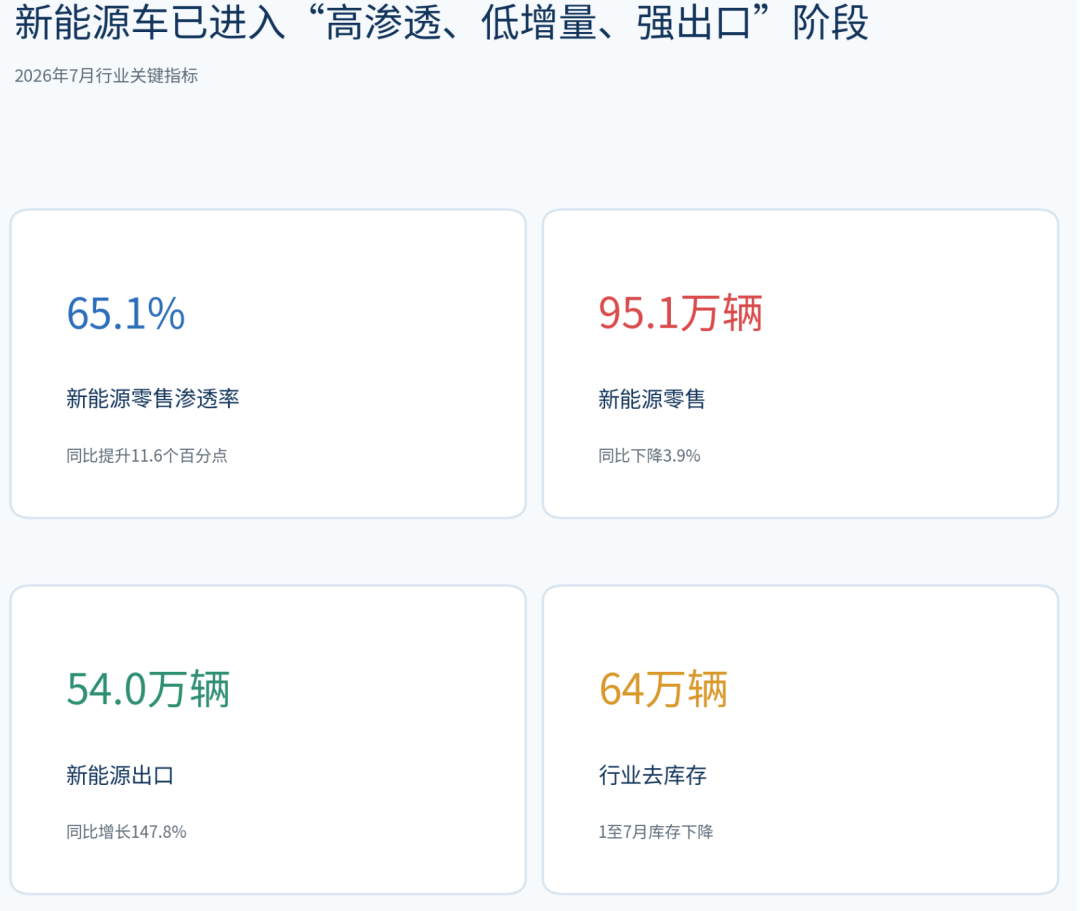
Data from the China Passenger Car Association shows that in July, retail sales of new energy passenger vehicles reached 951,000 units, down 3.9% YoY, with cumulative retail sales from January to July at 5.668 million units, down 12.5% YoY. However, the NEV retail penetration rate in July reached 65.1%. The market still demands NEVs, but the focus has shifted from rapid adoption to competing for existing market share.
Meanwhile, exports have become the brightest growth area. In July, new energy passenger vehicle exports reached 540,000 units, up 147.8% YoY, with cumulative exports from January to July at 2.771 million units, up 128.5% YoY. Whoever can replicate the supply chain and intelligent capabilities developed domestically overseas has the opportunity to bypass the most crowded domestic price bands.
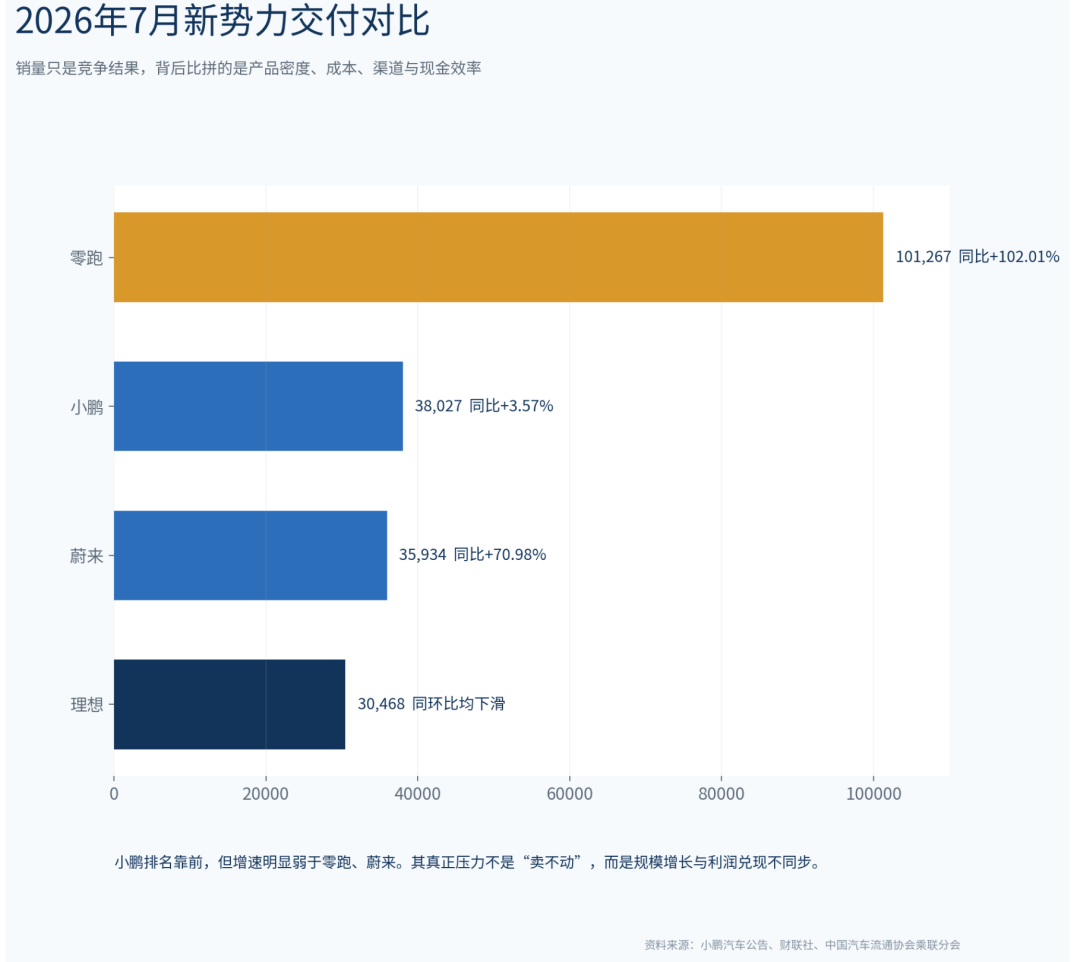
The competitive landscape is also evolving. BYD sold 419,000 vehicles in July, establishing scale advantages through a full price range, supply chain, and overseas markets. Leapmotor delivered 101,267 units in the same month, becoming the top-selling new force, with notable strengths in cost control and product coverage.
NIO delivered 35,934 units, up 70.98% YoY, with multiple brands beginning to form synergies. XPENG delivered 38,027 units, still among the top new forces, but with a mere 3.57% YoY growth. Li Auto delivered 30,468 units, facing increasing competition in its original extended-range advantage.
Xiaomi represents another type of pressure. It may not overwhelm XPENG with model quantity but can capture young tech-savvy users through brand traffic, ecological synergy, and blockbuster products.
Tesla's advantages remain its global brand, manufacturing efficiency, and continuous cost reductions. Traditional automakers like Geely and BYD are simultaneously rolling out pure electric, plug-in hybrid, and extended-range models, using vast product matrices to squeeze consumer attention.
For XPENG, the MONA model helps the company tap into the mass market, while models like the P7 and GX undertake the task of brand elevation. Overseas and technical services are responsible for opening a second growth curve.
This combination is logically sound, but the challenge lies in the need for investment on every front. Price reductions suppress per-vehicle profits, brand elevation requires marketing, overseas expansion needs channels and localization, and AI demands long-term R&D. Companies are most vulnerable to resource dilution precisely when "all directions seem correct."
In Q3, XPENG expects to deliver 115,000 to 121,000 vehicles, representing a YoY change of approximately a 0.87% decline to a 4.3% increase. This indicates that new products will drive QoQ improvements, but YoY growth remains weak.
What the market truly wants to see is no longer a model securing tens of thousands of orders within minutes of launch but whether orders can steadily convert into deliveries, deliveries into gross profits, and gross profits into cash.
What XPENG needs is stronger delivery execution
Objectively speaking, XPENG has not lost momentum. Q2 revenue surged QoQ, the overall gross margin exceeded 20%, July deliveries remained at the forefront of the second-tier new forces, and RMB 40.48 billion in cash provides room for trial and error.
Rapid growth in technical service revenue also proves that its self-developed capabilities are beginning to hold external monetization value.
However, market patience is wearing thin. In the past, investors were willing to pay a premium for leadership in intelligent driving; now, all automakers talk about AI, chips, and large models, making technological labels increasingly similar, while profit delivery has become scarce. R&D investments can explain losses but cannot indefinitely replace returns.
The author believes that XPENG must accomplish at least three things in the next stage.
First, reverse the decline in automotive gross margins. While improvements in overall gross margins are welcome, vehicles remain the core business. After product transitions end, cost reductions and model mix must be reflected in automotive gross margins.
Second, transform channel expansion into efficiency gains. Having 740 stores is not the finish line; per-store sales volume, customer acquisition costs, and repurchase reputation are. If marketing expenses only generate short-term buzz, they will ultimately become a heavy burden on the profit statement.
Third, establish a clearer commercialization timeline for AI investments. Robotaxi, chips, and robots may all hold long-term value, but capital markets need to see milestones, customers, revenue, and gross profits—not just technology launches.
This financial report does not prove XPENG's failure but reminds everyone: In the second half of the NEV race, the rarest capability is no longer building vehicles or narrating concepts but transforming technology into products, products into profits, and profits into cash for sustainable investment in next-generation technologies.
XPENG has crossed the survival threshold; the next hurdle is operational quality.
Only by overcoming it can it truly evolve from a new force skilled at innovation into an automotive company capable of sustained returns.
What are your thoughts on XPENG Motors' semi-annual report? We welcome your civil and rational insights in the comments section.
Disclaimer: This article is solely for financial hotspot analysis, citing publicly available data, company announcements, and Huitongshun IFinD. The views expressed are for reference only and do not constitute any investment or consumption advice.
#FinancialHotspots #InDepthAnalysis #BusinessFinance #InvestmentBankingCircle #ListedCompanies #PrimaryMarket #IPO #XPENGMotors Thanks for your patience in reading. Feel free to give a "like" if you found this helpful.
-
![]()
The Allure of 'Acquisition Spree': Li Shufu's Left Turn, Xu Jiayin's Right
-
![]()
Strategic Transformation Yields Results: Phoenix Optics Reports 10.9% YoY Rise in Core Net Profit for H1 2026
-
![]()
Three Key Growth Trajectories Synergize! Crystal-Optech Reports 3.478 Billion Yuan in Revenue for H1 2026
-
![]()
Semi-Annual Report Sparks XPENG Motors Buzz
-
![]()
1.6 Billion Big Order Secured! SeeYA Technology's Revenue Soars by 287.87% in the First Half of the Year
-
![]()
Baidu's Profits Plunge by 68%: Unraveling the Mystery Behind the Numbers
-
![]()
Baidu’s Profits Tumble by 68%! Where Has All the Money Gone?
-
![]()
Hynix’s Taobao Store Shuts Down Abruptly: What Should Customers Do About Warranty Services for Memory Modules?