The Driving Force Behind the iPhone 17 Price Reduction: Is Apple’s Golden Era Waning?
 05/21 2026
 786
786
Author|Haotian
The 618 shopping festival is yet to commence, but Apple has already set the stage for a ‘price war’.
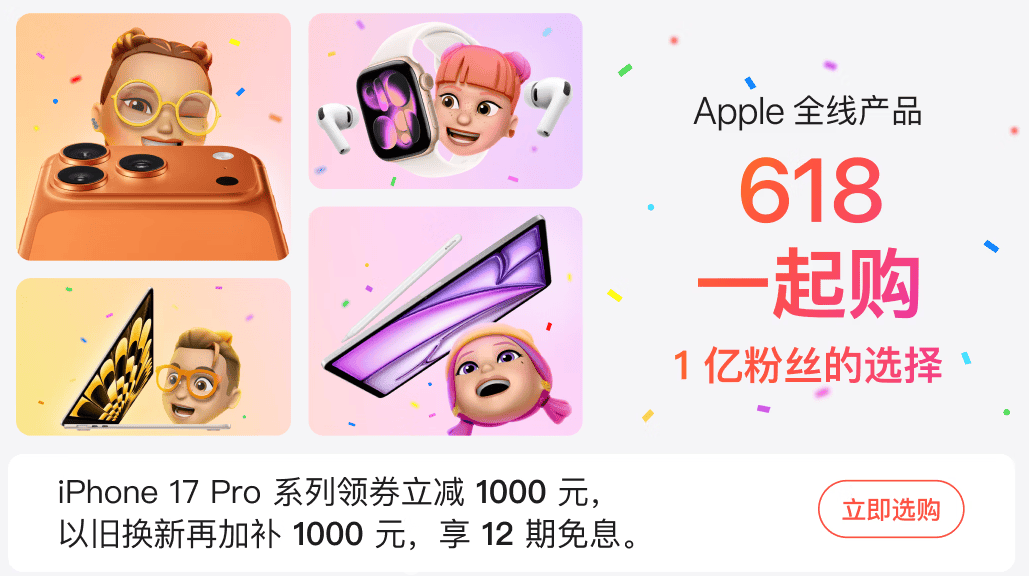
Image Source: JD.com
On May 15, 2026, the iPhone 17 series experienced significant price reductions across the board. The base model iPhone 17 saw a price drop of RMB 200, and with national subsidies and trade-in offers, it started at RMB 4,499. The iPhone 17 Pro was discounted by RMB 1,000, with an additional RMB 1,000 off for trade-ins, starting at RMB 6,999. This promotion will last until June 21, covering the entire 618 shopping festival period.
The substantial discounts instantly made the iPhone 17 series the focal point of consumer attention. According to Jiemian News, within three days of the price reduction, searches for ‘iPhone’ on Taobao and Tmall surged sevenfold compared to usual levels. On Xiaohongshu, numerous users shared their experiences of purchasing the iPhone 17 series at discounted prices.
Although Apple has frequently resorted to price reductions to boost sales in recent years, this move is particularly noteworthy given the increasingly challenging market conditions. Since 2025, memory prices have soared, exerting significant cost pressures on smartphone manufacturers.
Despite the sharp rise in upstream component costs, Apple, unlike most Android flagship models, chose not to raise prices but instead offered discounts to consumers. This indicates a gradual relaxation of its ‘pricing power’.
01
iPhone 17 Price Cut Compels Domestic Flagships to Follow Suit
If one had to pick a keyword for the smartphone industry in the first half of 2026, ‘price hikes’ might be more fitting than the vague ‘AI’.
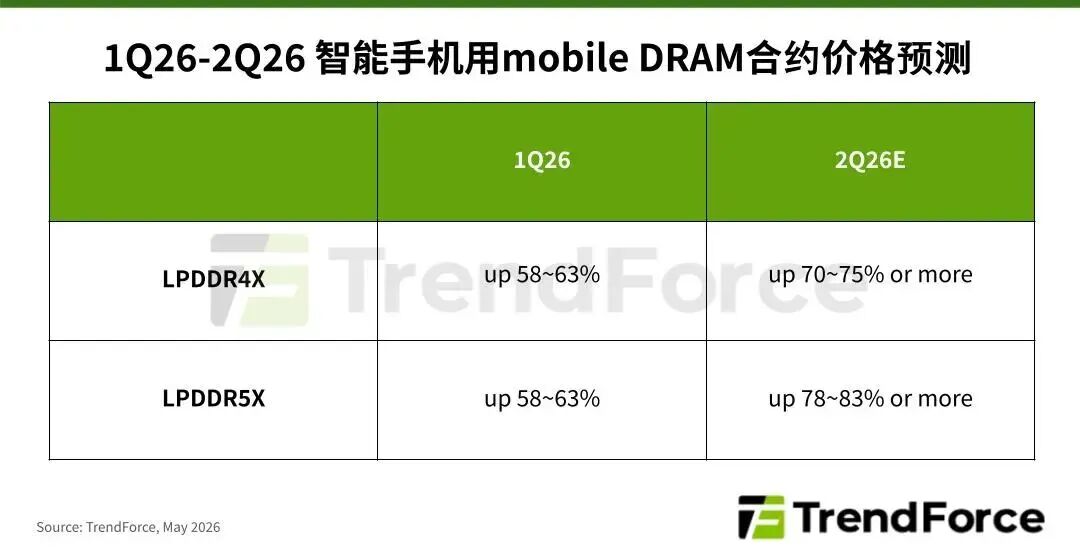
Image Source: TrendForce
Data from TrendForce reveals that in Q2 2026, smartphone DRAM contract prices continued to rise sharply, with LPDDR4X increasing by 70%-75% and LPDDR5X by 78%-83% quarter-over-quarter, surpassing the increases seen in Q1.
Against this backdrop, smartphone manufacturers such as OPPO, Vivo, and Honor not only launched new flagship models at higher prices but also raised prices for existing products. Counterpoint Research noted in a research report that after March 2026, new Chinese smartphone models would see price increases of 15%-25% compared to same-tier models in 2025.
During a livestream in mid-May 2026, Xiaomi President Lu Weibing lamented that the pricing of any smartphone today is influenced by the significant rise in memory costs. ‘In the second half of this year, especially by the end of the year, some domestic flagship bar phones might exceed RMB 10,000 in price,’ he said.
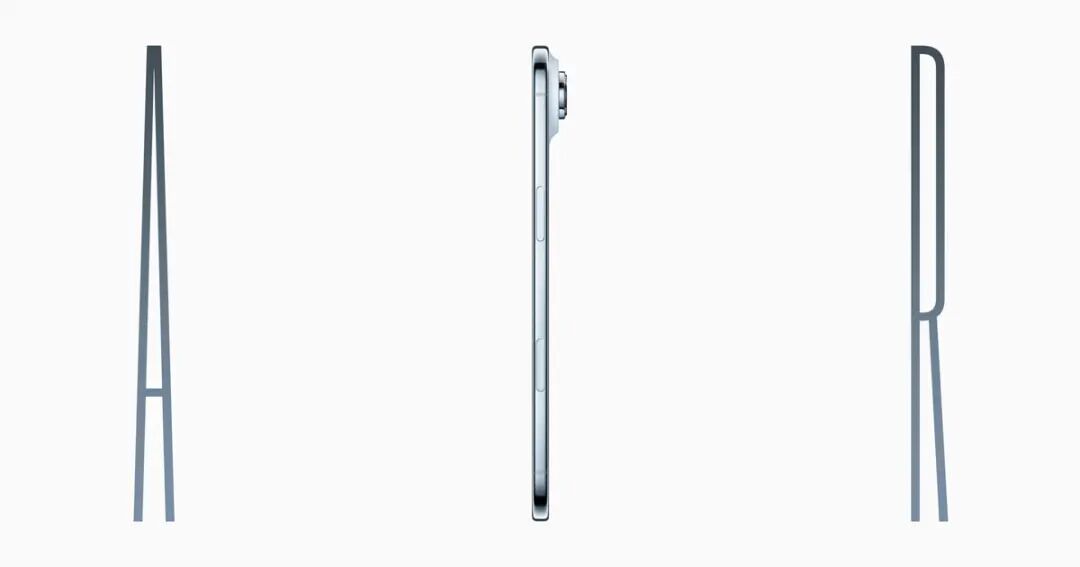
Image Source: Apple
However, unusually amidst rising memory prices, Apple, positioned as a premium brand, did not increase prices but instead frequently reduced them. In early 2026, the iPhone Air, just three months after its launch, saw a price drop of RMB 2,000, starting at RMB 5,499 with national subsidies. On the eve of the 618 shopping festival, the iPhone 17 series underwent across-the-board price reductions.
Shijiao Farsight believes that due to its profit margins far exceeding the industry average, Apple views this memory price hike as a historic opportunity to further expand its market influence.
At AWE 2026, Liu Yang, head of the ZhuiMi AURORA smartphone division, revealed, ‘Currently, about 80% of the global smartphone market's profits are captured by Apple.’ With high shipment volumes, Apple can leverage its strong bargaining power to secure memory supplies while relying on its broad profit margins to absorb upstream cost increases internally.
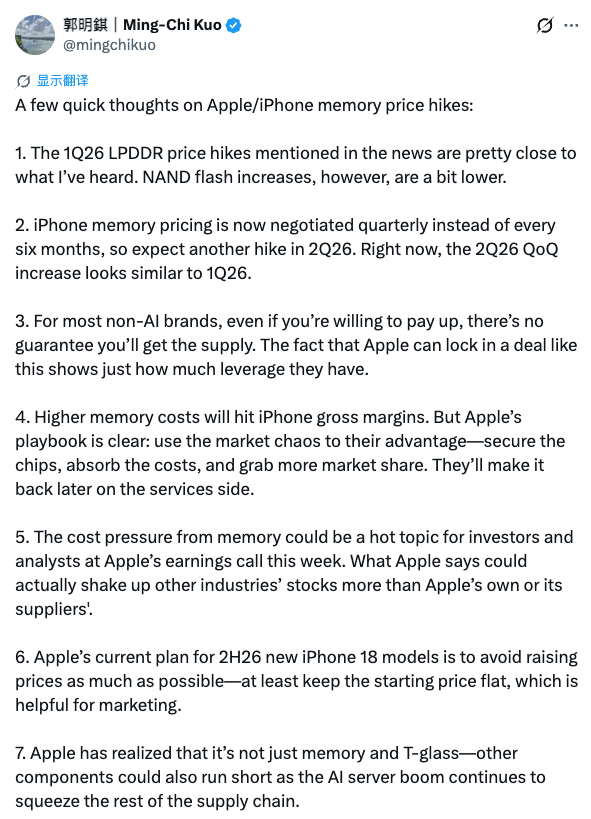
Image Source: Guo Minghao
Ming-Chi Kuo, an analyst at TF International Securities, disclosed that in Q2 2026, iPhone memory cost increases would approach Q1 levels, but Apple's strategy is clear: use its strong bargaining power to ensure chip supply, bear cost pressures to capture market share, and later compensate for losses through service businesses.
In the face of Apple’s proactive ‘price concessions,’ domestic smartphone manufacturers, despite facing significant cost pressures, had to follow suit with price reductions to avoid losing consumers. After the iPhone 17 series price cut, the Huawei Mate X7, Mate X6, and Xiaomi 15 Ultra saw price reductions of RMB 1,000, RMB 3,000, and RMB 1,500, respectively.
02
From Specs to Price: Apple's Dominance Weakens
The iPhone 17 series' price reduction ahead of the 618 shopping festival, which triggered responses from multiple smartphone manufacturers, demonstrates that Apple still wields considerable influence in the smartphone industry.
However, focusing on the evolution of the iPhone reveals a noticeable weakening of Apple's dominance in the industry.
Once, with its exceptional product strength and closed-loop ecosystem experience, Apple established a well-structured product lineup. Each September, Apple's new iPhones did not blindly compete with Android flagships on underlying specs but instead used stringent spec differentiation to segment product lines. Meanwhile, the previous year's iPhones would see price reductions, becoming mid-to-high-end products.
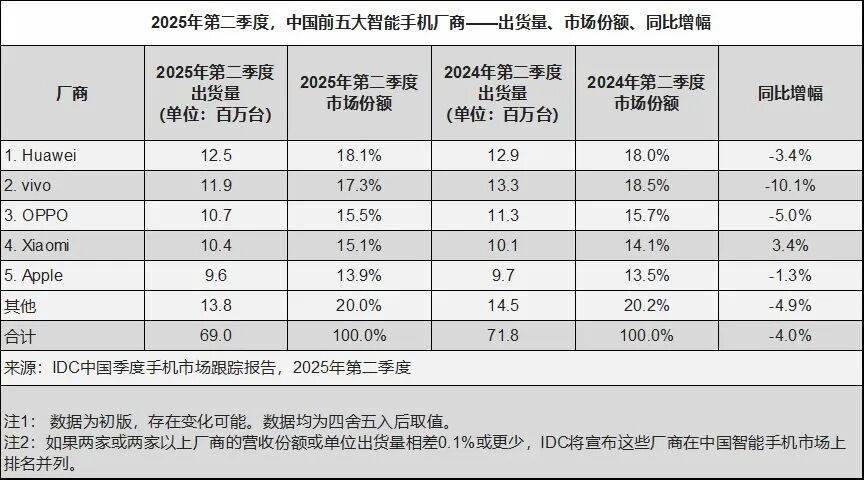
Image Source: IDC
However, due to a lack of innovation, iPhone shipments have been declining in recent years. IDC statistics show that from 2023 to 2024, iPhone shipments in the Chinese smartphone market fell by 2.2% and 5.4% year-over-year, ranking first and third, respectively. In Q2 2025, iPhone shipments were only 9.6 million units, down 1.3% year-over-year, ranking fifth.
To enhance market competitiveness, the iPhone 17 series abandoned incremental updates and began strengthening underlying specs. For example, the iPhone Air, at just 5.6mm thick, is touted as the ‘thinnest iPhone yet,’ while the standard iPhone 17 features an LTPO screen supporting 1-120Hz ProMotion variable refresh rates.
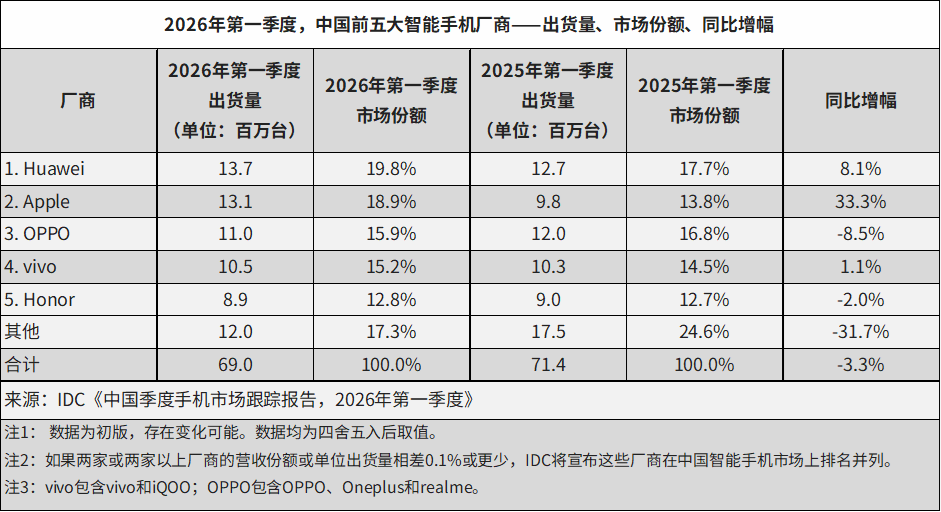
Image Source: IDC
By significantly addressing underlying spec shortcomings, iPhone shipments returned to growth. IDC data shows that from Q4 2025 to Q1 2026, Apple shipped 16 million and 13.1 million units in the Chinese market, up 21.5% and 33.3% year-over-year, ranking first and second, respectively.
However, with only one annual update, since February 2026, as domestic flagships one after another launched new models, the iPhone once again faced growth challenges.
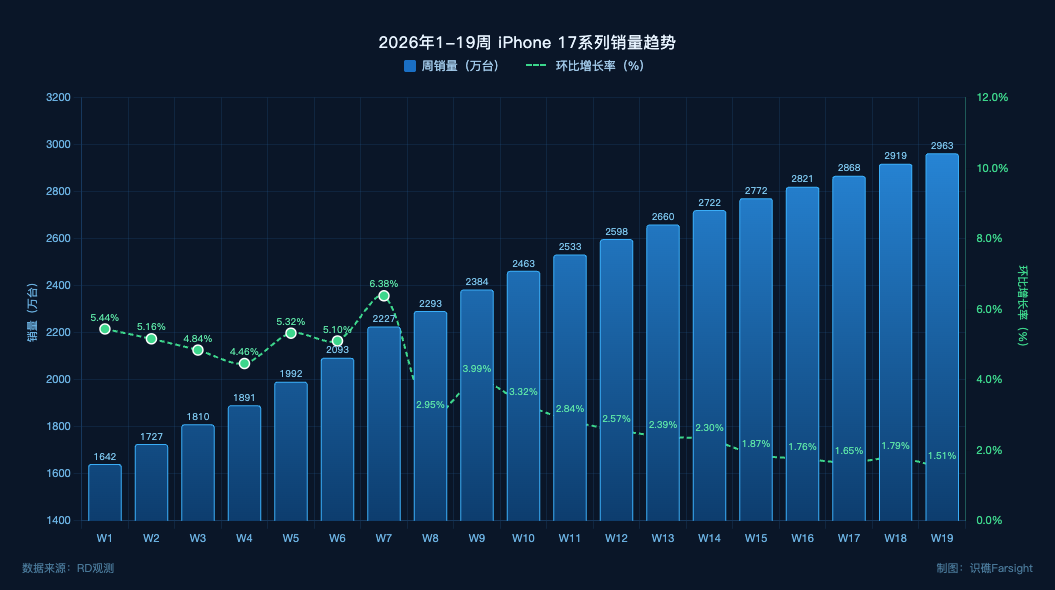
Shijiao Farsight, analyzing sales data for the iPhone 17 series from Weeks 1-19 of 2026 disclosed by digital blogger ‘RD Observation,’ found that while sales steadily increased, the week-over-week growth rate declined after Week 8, with Week 19's growth rate at just 1.51%, far below the initial 5% increase.
In response, Apple chose to proactively reduce prices ahead of the 618 shopping festival, hoping to attract more consumers to purchase the iPhone 17 series.
However, as Duan Yongping, founder of BBK and investor, said, ‘Price reductions are a sign of no competitive moat.’ Today, proactively competing on underlying specs and price, while temporarily boosting the iPhone's market influence, is unlikely to permanently alleviate Apple's internal anxieties.
For a premium brand rarely involved in cutthroat competition, price reductions are not merely promotional tactics but signals of weakening market dominance. Over time, Apple's profit margins will not only be squeezed but its premium brand positioning may also waver.
03
Rise of Domestic Flagships: Apple's Advantages No Longer Prominent
As the company that pioneered the smartphone era, Apple's strong pricing power largely stemmed from its ability to provide consumers with differentiated user experiences.
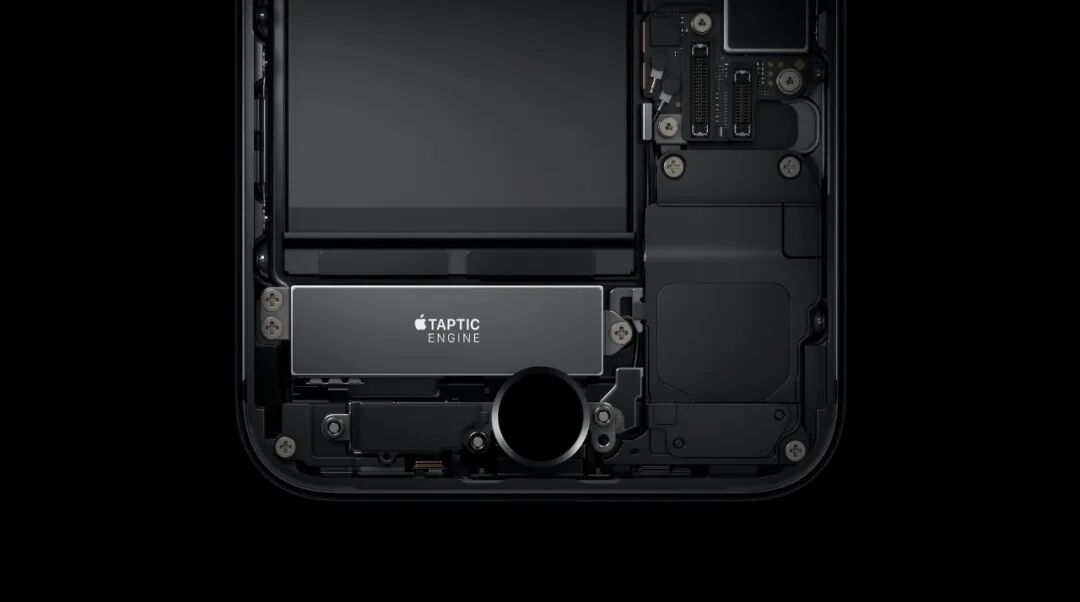
Image Source: Apple
For example, the iPhone 5s, introduced in 2013, integrated Touch ID into the Home button, offering a natural and fast recognition experience. Most Android phones at the time had fingerprint sensors on the back, providing a disjointed experience. The iPhone 6s, released in 2015, featured the Taptic Engine, simulating the mechanical feel of physical buttons, while most Android phones used rotor motors, providing a coarse vibration.
However, in recent years, as domestic smartphone manufacturers have intensified their internal improvements, the iPhone's comparative advantages have become less pronounced, with configurations like imaging, fast charging, and battery life now significantly lagging.
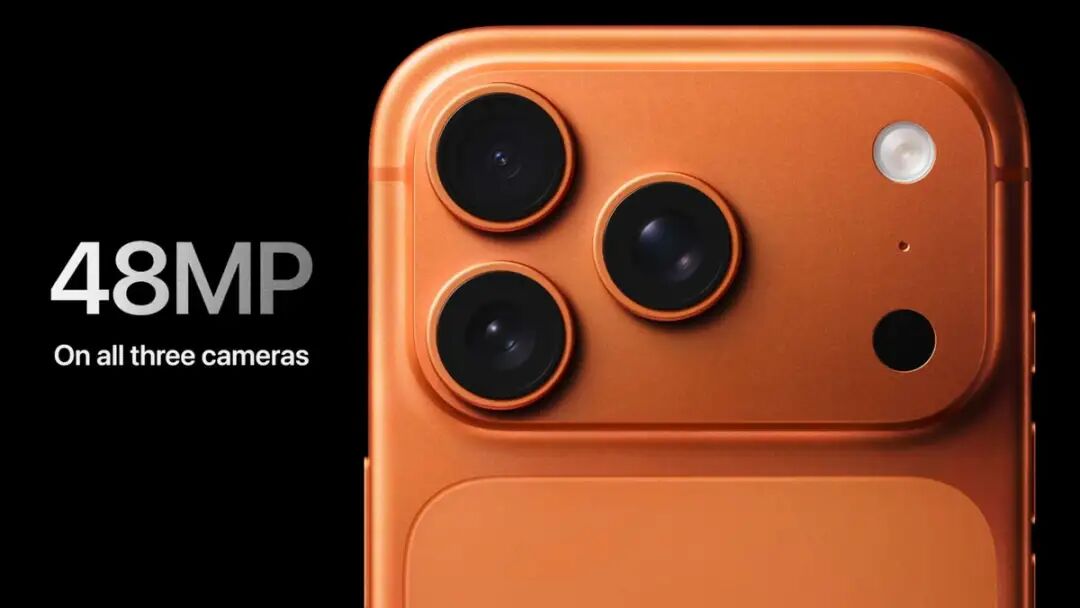
Image Source: Apple
Take the iPhone 17 Pro Max, positioned as an imaging flagship, which only features a 48MP periscope telephoto lens supporting 4x optical zoom. At long distances, images easily become distorted. In contrast, recently released domestic imaging flagships mostly support 10x optical zoom and can even use teleconverters for ultra-long-distance clear imaging.
Not only do current product configurations have shortcomings, but Apple also appears to lack momentum in deploying new form factors and cutting-edge technologies.
Apple is expected to launch its first foldable iPhone in autumn 2026, featuring a horizontal inward fold design with a 7.8-inch inner screen and a 5.5-inch outer screen, replacing Face ID with side-mounted Touch ID.
However, due to the engineering challenges of foldable phones, Apple has encountered significant obstacles in developing the foldable iPhone.
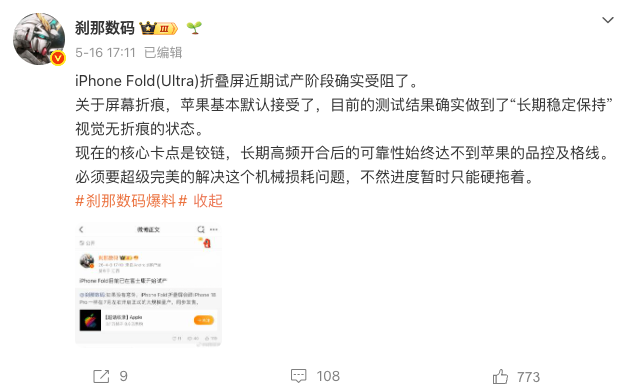
Image Source: Shana Digital
In early 2026, digital blogger ‘Dingjiao Digital,’ citing sources close to Apple, reported that Apple had purchased and disassembled the OPPO Find N5 for research, creating numerous prototypes internally but finding it difficult to surpass OPPO in screen crease smoothness. In mid-May, ‘Shana Digital’ revealed that Apple had compromised on screen creases but encountered hinge issues, with long-term, high-frequency opening and closing reliability failing to meet Apple's quality control standards.
Furthermore, as AI technology matures, agents have become a major trend in the tech industry, with many domestic smartphone manufacturers actively ‘cultivating shrimp.’ In contrast, Apple has yet to deploy agents and has not even integrated its Siri voice assistant with large models, lacking support for natural language conversations.
As smartphones enter the agent era of ‘getting things done,’ the iPhone, stuck in the ‘old era,’ is highly susceptible to disruption.
Ultimately, as Li Nan, former vice president of Meizu Technology, said, ‘The iPhone 17 series' current success is mainly due to its surprise attack. But if the Android camp responds actively, even if the 17 loses, the 18 or 19 will eventually be defeated.’
The iPhone 17 series' ‘spec upgrades and price reductions,’ while providing Apple with breathing room, also expose internal cracks.
As competitors continue to invest in cutting-edge technologies, the iPhone's competitive moat is gradually drying up. To retain consumers, Apple has no choice but to lower its stance and compete with domestic smartphone manufacturers on the same level.
The significance of the iPhone 17 price reduction lies not just in the savings of a few thousand yuan but also in signaling Apple's proactive compromise to the market. As the flagship smartphone industry enters an era of inventory competition, without sustained technological advantages, Apple will find it difficult to rely solely on brand premium to remain detached from industry cycles in the long run.
Interactive Topic
What do you think of the iPhone 17 series? Is the current price attractive?
This article is original content from Shijiao Farsight and is prohibited from reproduction without authorization.
-
![]()
"Tech Ferrari" Xiangjie RX: Yu Chengdong’s Glowing Review Sparks Wild Netizen Speculation: Is It the YU7?
-
![]()
Chery's 'Audi Suit Gangster' Makes Waves with Unbeatable Pricing. Netizens React: 'Is This the Aorui A6L?'
-
![]()
AITO Takes a Bold Leap, Forms Joint Venture with BMW and Mercedes-Benz
-
![]()
How Does the Cloud Data Engine Transform Physical Labor into Technical Work for Autonomous Driving Annotators?
-
![]()
Historic Strongest Mercedes-Benz GLE L Faces Intense Competition from Domestic 9 Series
-
![]()
Jeff Dean's First Entrepreneurial Venture After Leaving Google: Why Launch an AI Company 'Not Aiming to Make Money' at This Juncture?
-
![]()
Caught in the Traffic 'Web'
-
![]()
Alibaba's AI Offensive: Over Half of Investment Allocated, Time to Reap Returns