Domestic Automotive-Grade Chips: Navigating the Challenges of Advanced Integration
 04/28 2026
 550
550
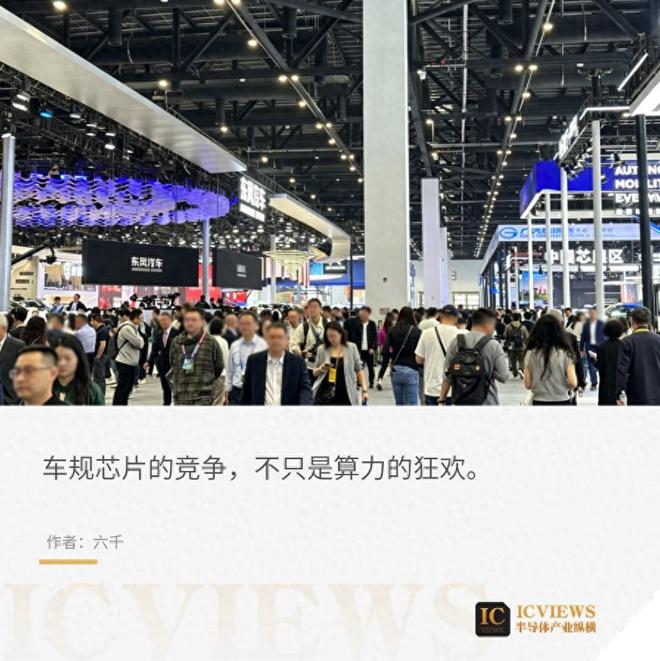
First off, a pro tip for those heading to the 2026 Beijing International Automotive Exhibition: slip on some comfy shoes. You'll be covering a lot of ground in that massive 380,000-square-meter exhibition hall.
At this record-breaking Beijing Auto Show, not only are domestic automakers flexing their muscles with a variety of debut models, but domestic automotive-grade chips are also making waves, stepping into a new era with mass-produced offerings.
Just a couple of years back, the domestic automotive-grade chip scene might have been all about 'price wars.' Now, the competition has shifted gears, focusing on 'performance,' 'ecosystem,' and 'innovation.'
No longer just playing in the crowded field of automotive MCUs, domestic automotive chips are now venturing into the big leagues of intelligent driving and smart cockpits. The deep waters they're wading into aren't just about lab benchmarks; it's about long-term reliability in real-world driving and the confidence to deliver at scale.
01
The Accelerated Integration of Automotive-Grade Chips
From single-function chips to the seamless integration of cockpit and driving systems, integration marks the first major step for domestic automotive chips into these challenging waters.
At the 2026 Beijing International Automotive Exhibition, Semidrive Technology unveiled its 5nm automotive-grade AI cockpit-driving integration chip, the 'Dragon Eagle II,' set for adaptation in the first quarter of 2027. Boasting an AI computing power of 200 TOPS, a built-in multi-core CPU of 360KDMIPS, a GPU reaching 2800GFLOPS, and bandwidth up to 518GB/s, it supports LPDDR6/5X/5. This chip can handle all AI cockpit and cockpit-driving integration scenarios, eliminating data bottlenecks in multi-screen interaction and AI computing.
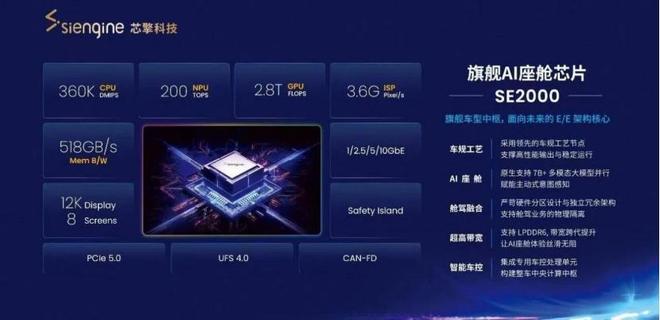
Dr. Wang Kai, founder of Semidrive Technology, emphasized that the 'Dragon Eagle II' can simultaneously run three complex tasks: AI, smart cockpit, and intelligent driving. This integration not only cuts costs but also accelerates the intelligent evolution of mid-to-low-end models.
Chipway has also rolled out its AI cockpit chip X10, offering a 4x improvement in large model computing efficiency. With 80 TOPS of dense computing power and 154GB/s of DDR bandwidth, it supports large models with up to 9B parameters on the device side. The X10, built on a 4nm automotive-grade process, significantly boosts CPU and GPU performance, reaching 250KDMIPS and 3000GFLOPS, respectively. Paired with a VPU and DPU supporting 8K resolution, it also supports 12 cameras and 8 displays, replacing the traditional cockpit domain controller + external AI Box setup with a single chip, saving 25% of DDR storage capacity.
Horizon Robotics, just before the Beijing Auto Show's opening, launched its cockpit-driving integration chip, 'Starry Sky.' Based on a 5nm automotive-grade process, the BPU computing power of the Starry Sky 6P chip reaches 650 TOPS, with a memory bandwidth of 273 GB/s. It reduces space occupancy by 50%, shortens the research and development delivery cycle from 18 months to 8 months, and cuts cockpit-driving integrated software and hardware delivery time by 56%.
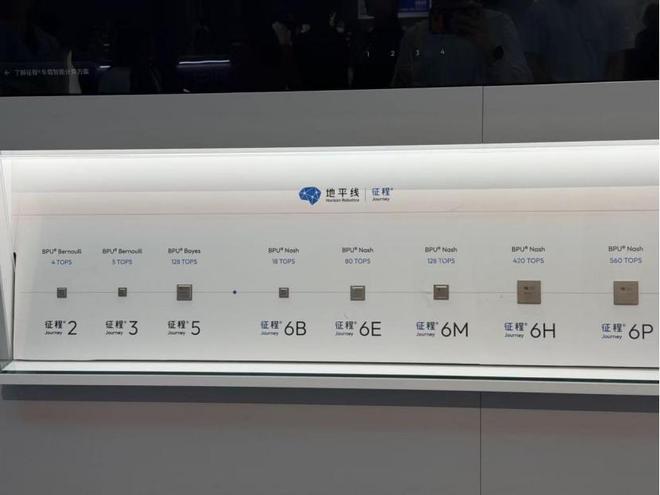
The technological routes for cockpit-driving integration are highly aligned, and the primary value they bring is significant cost reduction for the entire vehicle. Semidrive's Dragon Eagle II can slash the BOM cost per vehicle by 2000-3000 yuan; Chipway's X10 AI cockpit solution can reduce the overall system BOM cost by 1500-3000 yuan. Horizon Robotics claims that the Starry Sky cockpit-driving integration chip can cut the comprehensive cost per vehicle by 1500 to 4000 yuan. Integration is becoming a buzzword in automotive chips, echoing NIO CEO William Li's recent call for 'chip normalization.'
02
Simultaneous Acceleration of Mass Production and Cost Reduction
Higher integration brings intuitive cost advantages, and technological and cost breakthroughs must ultimately be realized through large-scale mass production. This is a crucial step for domestic automotive-grade chips to 'hit the road.'
Semidrive Technology's 'Dragon Eagle I' smart cockpit chip has already achieved cumulative shipments of 1.5 million units, covering dozens of mainstream models such as FAW Hongqi, Geely Lynk & Co, Changan Qiyuan, and some models from Volkswagen Germany.
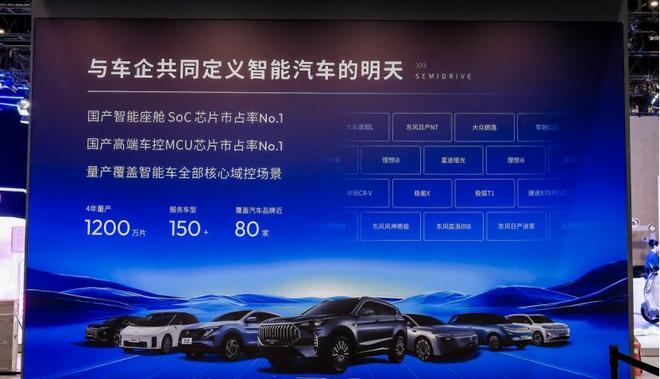
Chipway, with products spanning cockpits, gateways, and MCUs, has shipped 12 million units, serving over 150 vehicle models and nearly 80 brands.
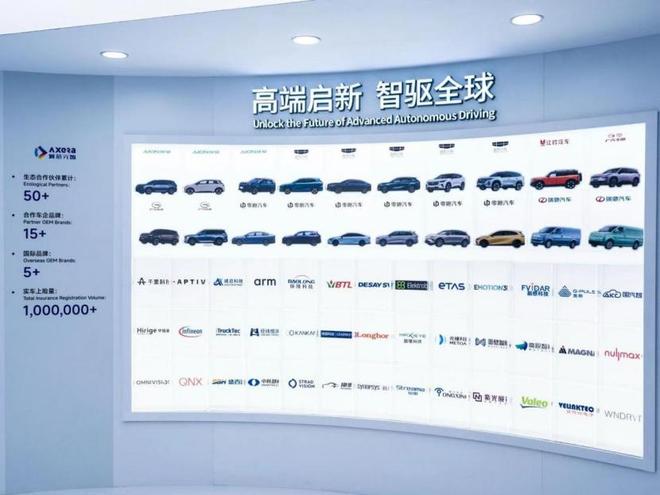
Axera Intelligence's smart automotive SoCs have reached 1 million units in actual vehicle insurance volume, collaborating with over 15 automaker brands such as GAC Aion, Geely Automobile, and Jiangling Motors, as well as over 5 international brands.
Horizon Robotics' Starry Sky 6 announced cooperation intentions with over a dozen automaker brands and several Tier 1 suppliers upon its release, including BAIC Group, BYD Group, and Changan Group.
Behind these impressive shipment figures lies an unchanging iron law in the automotive-grade chip industry: only with ultimate cost-effectiveness and large-scale implementation can a firm foothold in the market be truly established.
Against the backdrop of an increasingly divided market for smart vehicles, automotive chips must not only find the right track but also ensure scale. Domestic smart automotive chip companies have charted a clear course: focusing on intelligent driving integration chips for L2 and L2+ level autonomous driving; continuously exploring non-integrated high-end intelligent driving chips; and paying attention to products such as embodied intelligence to expand product application scenarios.
As domestic automotive chips enter the 5nm/4nm era, technologies such as Chiplet and advanced packaging will also become crucial for automotive-grade chip companies to reduce costs.
Cost reduction is not just about cheaper chips but also about the successful transformation of the entire vehicle's electrical and electronic architecture (EE) from distributed to centralized. Shipment volume and cost-effectiveness are just the starting points. To gain a firm foothold in the global automotive chip arena, domestic automotive-grade chips need to precisely focus on core capabilities and build long-term competitiveness.
03
Domestic Automotive-Grade Chips: Three Areas of Focus
Industry leaders like NVIDIA and Qualcomm already boast extremely deep ecosystems in terms of hardware and software provided on automotive platforms. NVIDIA offers Thor chips on the vehicle side and AI models and development platforms in the cloud. Such strong integration capabilities have built a solid barrier for these market leaders.
Therefore, the rise of domestic automotive-grade chips may follow the feasible paths of batteries from CATL and BYD: leveraging local scale for cost advantages and then catching up through technological breakthroughs.
Shifting from 'technological breakthroughs' to 'mass production verification,' the industry's focus has turned to the real verification of the number of design wins and the scale of vehicle installations. Automotive-grade chip companies must simultaneously focus on computing power, adaptability, and ecosystems.
Computing power is the foundation of automotive-grade chips. A highly integrated chip can enable the integration of cockpits, driving, parking, and AI models into vehicles. Horizon Robotics stated that automobiles are a new terminal for AI interaction, thus posing higher requirements for the computing power of intelligent driving integration chips. Smart cockpit chips require computing power to sense user status, analyze user needs, and handle parallel tasks. With the popularization of urban NOA and highway NOA, intelligent driving chips require safe and sufficient computing power support. For today's automotive-grade chip market, having sufficient computing power is the ticket to enter the arena.
Adaptability determines the speed at which automotive-grade chips can be integrated into vehicles. With the accelerated iteration of smart automotive products, support for functions such as multi-screen display, voice interaction, and map navigation by smart cockpit chips has become a rigid demand. As automakers continuously update their product definitions, the ability of automotive chip companies, as upstream suppliers in the supply chain, to quickly form new solutions in collaboration with Tier 1 suppliers will become an important competitiveness factor for automotive-grade chips. The adaptability of intelligent driving chips and cockpit chips reflects not only the design capabilities of automotive-grade chip companies but also their understanding of the industry.
Ecosystem determines the profitability of automotive-grade chip companies. Deep binding with Tier 1 and other Tier 2 suppliers can accelerate the integration of automotive-grade chip products into vehicles. Axera Intelligence's financial report showed that the company's full-year revenue in 2025 was 562 million yuan, with intelligent automotive business revenue reaching 48.17 million yuan, a year-on-year increase of 618.2%. Expanding the cooperation ecosystem and accelerating profitability have become common choices for automotive-grade chip companies.
Semidrive Technology announced collaborations with partners such as WeRide, Shouchuan Microelectronics, and Zhuoyu Intelligence ahead of the 2026 Beijing Auto Show. Semidrive stated that the cooperation with Shouchuan Microelectronics helps complete a closed loop of domestic solutions from computing to transmission, thus accelerating coordination with OEMs. Chipway announced a strategic cooperation with ZBO Electronics during the Beijing Auto Show, which will accelerate the global expansion of Chipway's products. Ecosystem construction will directly boost product shipment volume, becoming an accelerator for revenue growth for automotive-grade chip companies.
04
Automotive-Grade Chip Companies: Laying Out a Second Growth Curve
As automotive chips trend towards 'normalization' and integration increases, the number of chip suppliers will ultimately be significantly reduced. This is a challenge that industry players in the deep water zone must face.
Computing power, adaptability, and ecosystems have constructed current competitive barriers. However, as the industry moves towards a red ocean, market players will face a new round of reshuffling. Seeking a second growth curve has become an inevitable choice for automotive chip companies to navigate through cycles.
Domestic automotive chip companies can be roughly divided into two types based on their product matrices: those dedicated to automotive chips and those that have crossed over from other fields. With products being mass-produced and integrated into vehicles, companies dedicated to automotive chips are now seeking a second growth curve, with embodied intelligence and industrial control sectors becoming popular choices.
The choice of embodied intelligence is because automobiles are seen as embodied intelligent products with four wheels, with the cockpit's interaction capabilities and intelligent driving's control capabilities corresponding to the brain and cerebellum of embodied intelligence, respectively. For automotive-grade chip companies, this represents a smooth migration path.
The background for choosing industrial control is that automotive-grade chips (such as those meeting AEC-Q100/Q101 certifications) have higher requirements than industrial-grade standards in terms of operating environment (temperature, vibration), stability, and failure probability. As industrial control systems (especially in high-end manufacturing and power grids) demand higher safety, automotive-grade chips become a superior 'high-reliability' alternative. From a market potential perspective, the industrial control market is several times larger than the automotive-grade chip market, making it an important area for scaled products for automotive-grade chip companies.
05
Conclusion
From technological breakthroughs to mass production verification, from breaking out locally to expanding cross-borderly, domestic automotive-grade chips have completed a triple jump from 'usable' to 'user-friendly' and then to 'large-scale integration into vehicles.'
As domestic automotive-grade chips bid farewell to 'low-price internal competition' and venture into the deep water zone of 5nm integration and mass production delivery, has China truly grasped the discourse power in the intelligence of its automobiles?
Perhaps the answer will only come when domestic automotive chips define Chinese standards on the global stage.
-
![]()
The Allure of 'Acquisition Spree': Li Shufu's Left Turn, Xu Jiayin's Right
-
![]()
Strategic Transformation Yields Results: Phoenix Optics Reports 10.9% YoY Rise in Core Net Profit for H1 2026
-
![]()
Three Key Growth Trajectories Synergize! Crystal-Optech Reports 3.478 Billion Yuan in Revenue for H1 2026
-
![]()
Semi-Annual Report Sparks XPENG Motors Buzz
-
![]()
1.6 Billion Big Order Secured! SeeYA Technology's Revenue Soars by 287.87% in the First Half of the Year
-
![]()
Baidu's Profits Plunge by 68%: Unraveling the Mystery Behind the Numbers
-
![]()
Baidu’s Profits Tumble by 68%! Where Has All the Money Gone?
-
![]()
Hynix’s Taobao Store Shuts Down Abruptly: What Should Customers Do About Warranty Services for Memory Modules?