Chinese Cars Seize Overseas Markets: The Advent of a Winner-Takes-All Era
 06/11 2026
 496
496
Lead
Introduction
Chinese cars are on the brink of fully capturing the overseas market.
This year, early indicators have revealed just how challenging the overall automotive market environment has become.
Despite a surge in new car launches, the fierce competition in the end-user market is evident. Numerous dealerships are closing down, and consumer attitudes toward car purchases are significantly influenced by external policies, casting a shadow of stagnation over the entire automotive market.
It was hoped that the accelerated market penetration of electric vehicles (EVs) would counterbalance the sales decline caused by the slump in fuel-powered vehicles. However, the consecutive declines in domestic end-user sales in April and May were starkly apparent. Amidst this scenario, what path should Chinese automakers take?
As attention shifts overseas, the answer becomes clear. The vast overseas market not only exceeds the domestic market in size but also offers significant profit potential that cannot be ignored.
Since the automotive industry's rapid shift toward electrification, Chinese automakers have consistently enhanced their technologies in the three key areas of electric vehicles. This trend has been evident for some time, but 2026 has witnessed remarkable progress like never before.
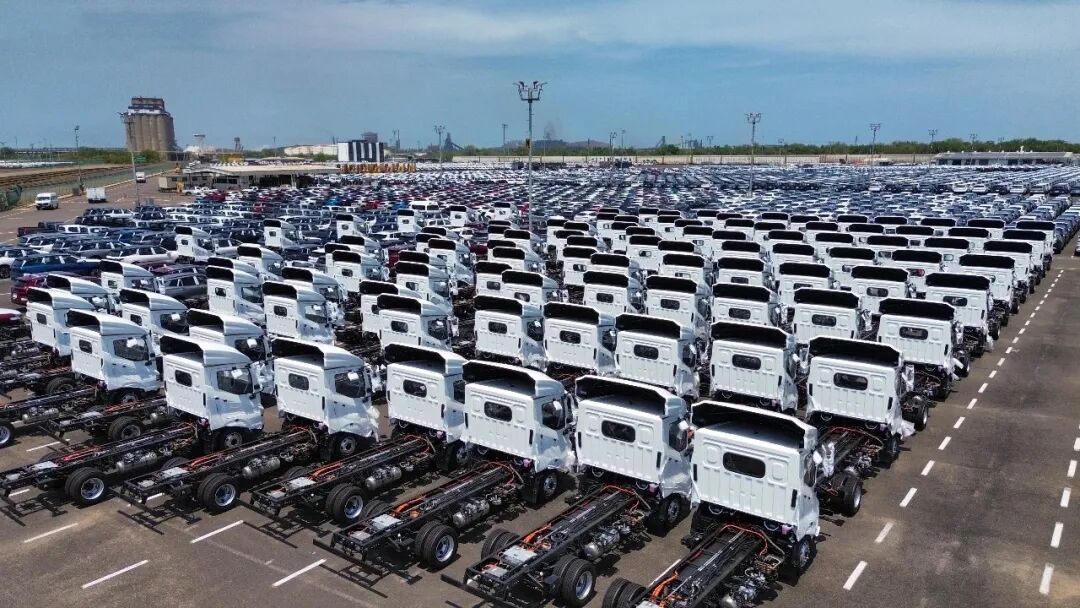
In May, China exported 930,000 vehicles (both passenger and commercial), marking a 3.1% month-on-month increase and a 68.7% year-on-year surge, maintaining a level above 900,000 units for two consecutive months. From January to May, car exports reached 4.059 million units, up 63% year-on-year.
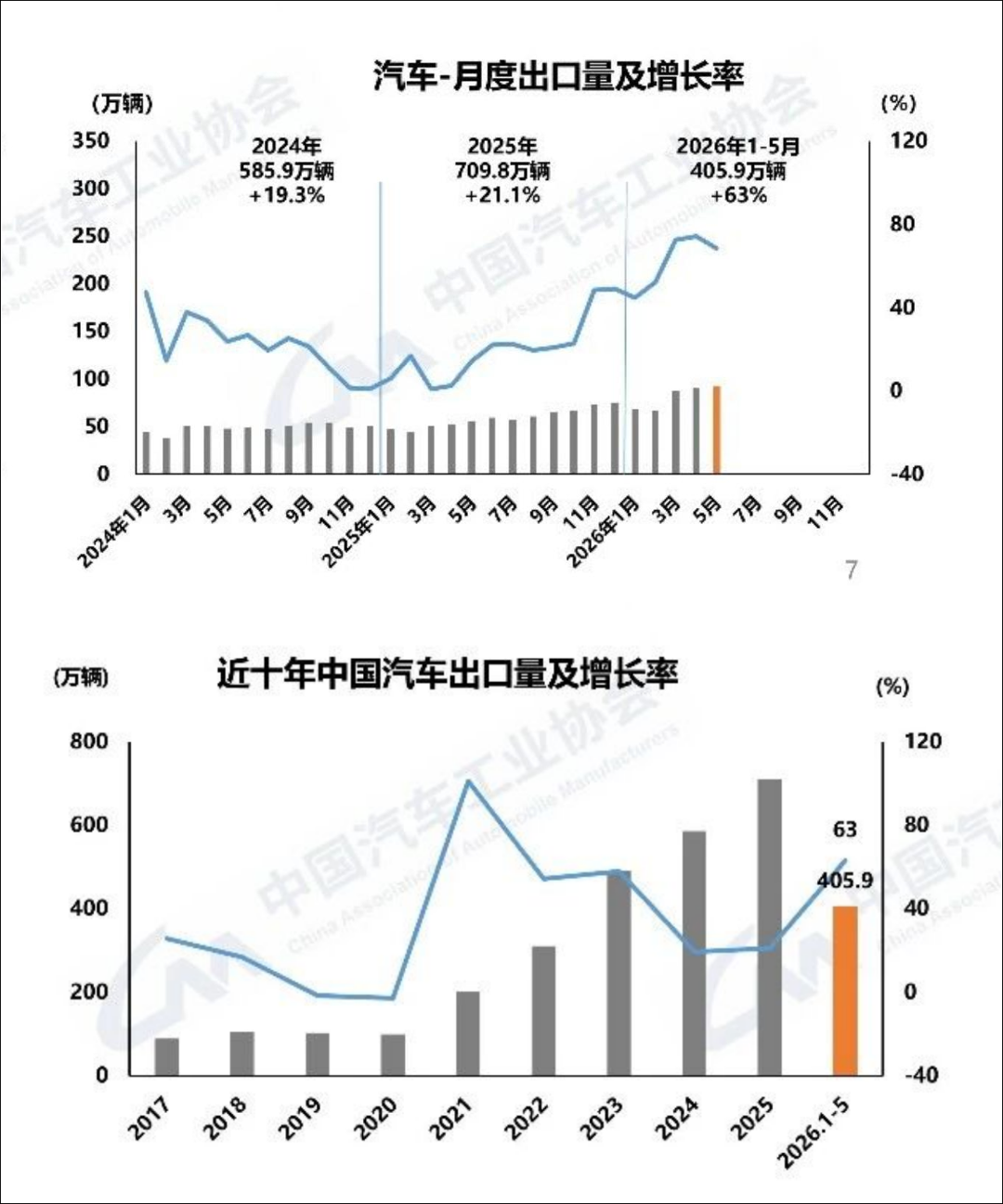
These are the latest export figures released by the China Association of Automobile Manufacturers (CAAM). From these numbers, it is evident that for Chinese automakers, car exports have transitioned from a "supplementary channel" to a primary driver of industry growth. Chinese automakers are also evolving from a "pure trade export" model to making significant strides toward "localized production + ecological expansion overseas."
Unsurprisingly, as car exports in the first half of this year approach 5 million units, an annual total of 10 million exports seems inevitable.
This era signifies the heyday of Chinese automobiles. Of course, when Chinese cars achieve such historical milestones in such a short time, it suggests that a winner-takes-all scenario is imminent. Whether domestically or internationally, after a few dominant automakers carve up the market, the existing automotive industry structure will undergo another significant transformation.
01 Chinese Cars Going Global: Unstoppable Momentum
Since the beginning of this year, amidst multiple shocks such as insufficient domestic demand, high costs, and tightening policies across the industry, it is clear that the Chinese automotive market is characterized by "domestic pressure and strong foreign trade." In other words, as domestic market growth stalls and profitability declines, the intensity of automotive expansion overseas is bound to be stronger than in previous years.
Last year, data showed that China's annual car exports reached a new high of 7.098 million units, up 21.1% year-on-year. This sustained leap from 5.859 million units in 2024 and 4.91 million units in 2023 demonstrated the industry's strong resilience early on.
With these changes, the export volume in 2026 has once again excited the entire industry. However, no one expected that amidst ongoing disruptions like the Middle East conflicts, Chinese car exports would surge so dramatically.
Of course, considering the 23.4% year-on-year decline in the domestic passenger car market in May and the 23.8% drop in domestic passenger car sales from January to May to 6.791 million units, with traditional fuel-powered vehicles selling only 497,000 units in May (down 41.8% year-on-year) and cumulative sales for the year so far falling by 1.243 million units compared to the same period last year to 3.203 million units, all signs point to the difficulties Chinese cars face domestically.
To alleviate this predicament, "exports" represent the best available solution.
Excluding commercial vehicles, passenger car exports reached 809,000 units in May, up a staggering 73% year-on-year. From January to May, exports totaled 3.528 million units, up 69.6% year-on-year. Meanwhile, new energy passenger vehicle exports reached 435,000 units in May and 1.792 million units from January to May, both more than doubling year-on-year.
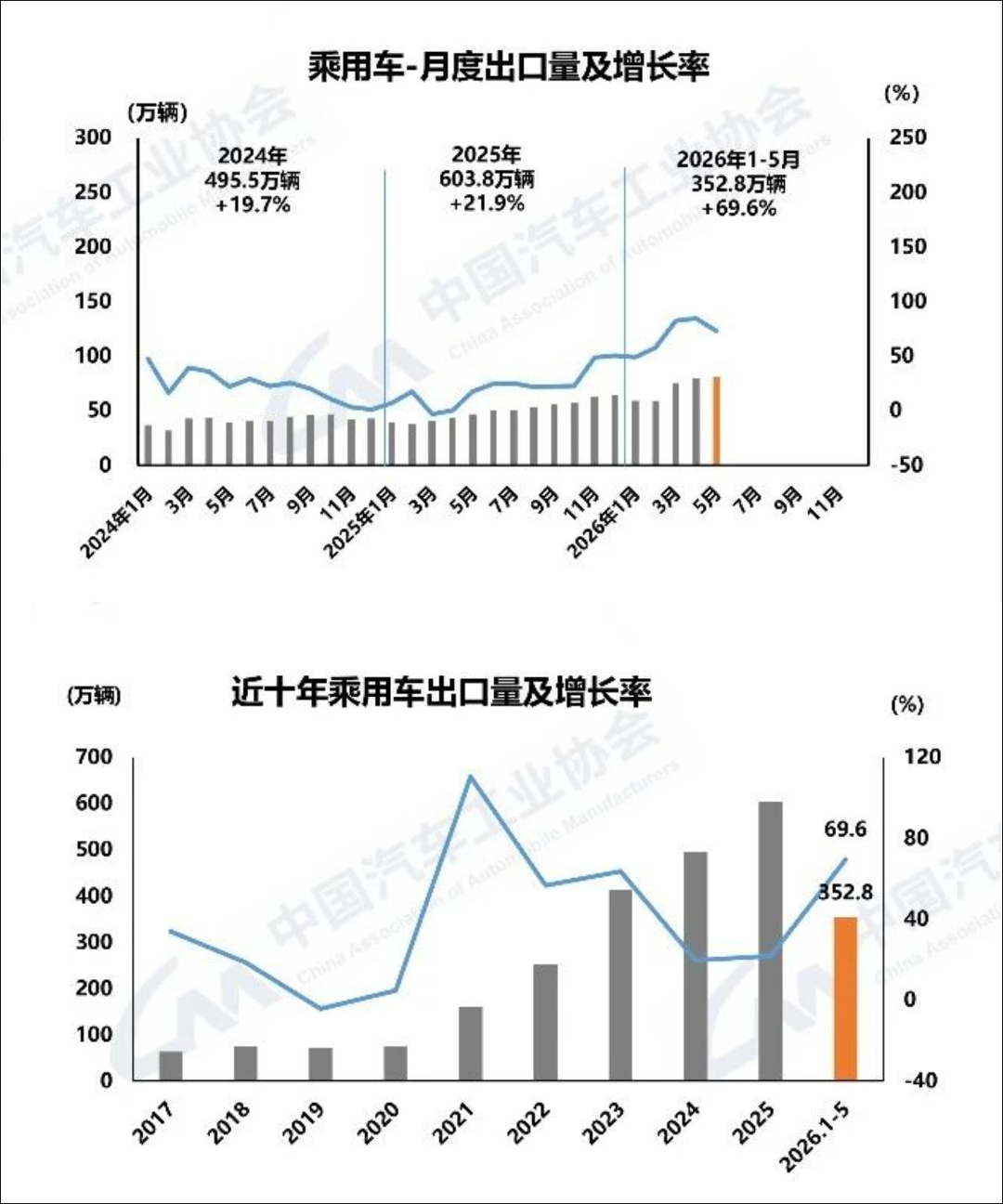
If this surge in data represents Chinese automakers capitalizing on the wave of new energy industry development to reap market rewards, then, riding this momentum, Chinese automakers collectively going overseas—whether through acquisitions, revitalization, or seeking partnerships—and completing systematic "shopping sprees" will involve transplanting the entire automotive industry ecosystem overseas, replicating to the greatest extent possible the path once taken by Japanese and Korean companies.
In this process, BYD plans to negotiate with European automakers like the Stellantis Group to take over idle or underutilized factories in Europe; Geely intends to acquire Ford's BODY 3 final assembly line at its Valencia Almussafes plant in Spain; Dongfeng is discussing with the Stellantis Group the possibility of localized production of Dongfeng's new energy vehicle models at its Renault factory in France; XPENG may leverage Volkswagen's idle capacity to manufacture vehicles...
Simply put, unlike the impression of wealth and extravagance left by rapidly expanding large corporations, everything Chinese automakers are doing for exports now is no longer scattered capital impulses but rather premeditated structural integration into global automotive production capacity.
Once these efforts form combat effectiveness in the near future, the scenario of Chinese cars dominating overseas markets is bound to take shape quickly. By then, regardless of the current chaos in the domestic market or how competition devolves into a "scorched-earth" battle, as long as overseas markets are secured, the ability to replenish resources will only increase, not weaken. The impact that leading Chinese automakers like BYD, Geely, and Chery will have on traditional automotive giants is predictable.
02 BYD Will Thoroughly Reshape the Export Landscape
Regarding the future of automotive exports, given the current international situation, we need not worry about the extent of resistance Chinese automakers will face. This is an industry trend with a set direction; all that remains is the question of timing.
In comparison, as the pace and depth of automotive expansion overseas accelerate, differentiation among Chinese companies themselves is inevitable. In other words, whoever takes the lead in this period of rapid expansion has a high probability of gaining an edge in future overseas market competition.
In May alone, BYD sold a total of 383,453 vehicles, with passenger vehicle sales reaching 376,990 units, up 20% month-on-month. Its overseas sales hit 160,644 units, soaring 80.4% year-on-year, marking the first time monthly exports surpassed 160,000 units and setting a new record, accounting for over 40% of total sales.
Similarly, Chery, which has already made significant strides overseas, has truly "hit the jackpot" in exports this year. In May, the group exported 181,871 units, up 80.5% year-on-year, setting a new record for Chinese automotive monthly exports for three consecutive months. From January to May, cumulative exports reached 752,755 units, up 69.5% year-on-year. To date, Chery Group's global cumulative automotive user base has surpassed 19.62 million, with overseas users exceeding 6.59 million.
Following closely behind BYD and Chery, other Chinese automakers like SAIC, Geely, Changan, and Great Wall Motors also show no signs of slowing down in exports, easily surpassing 50,000 units in monthly exports.
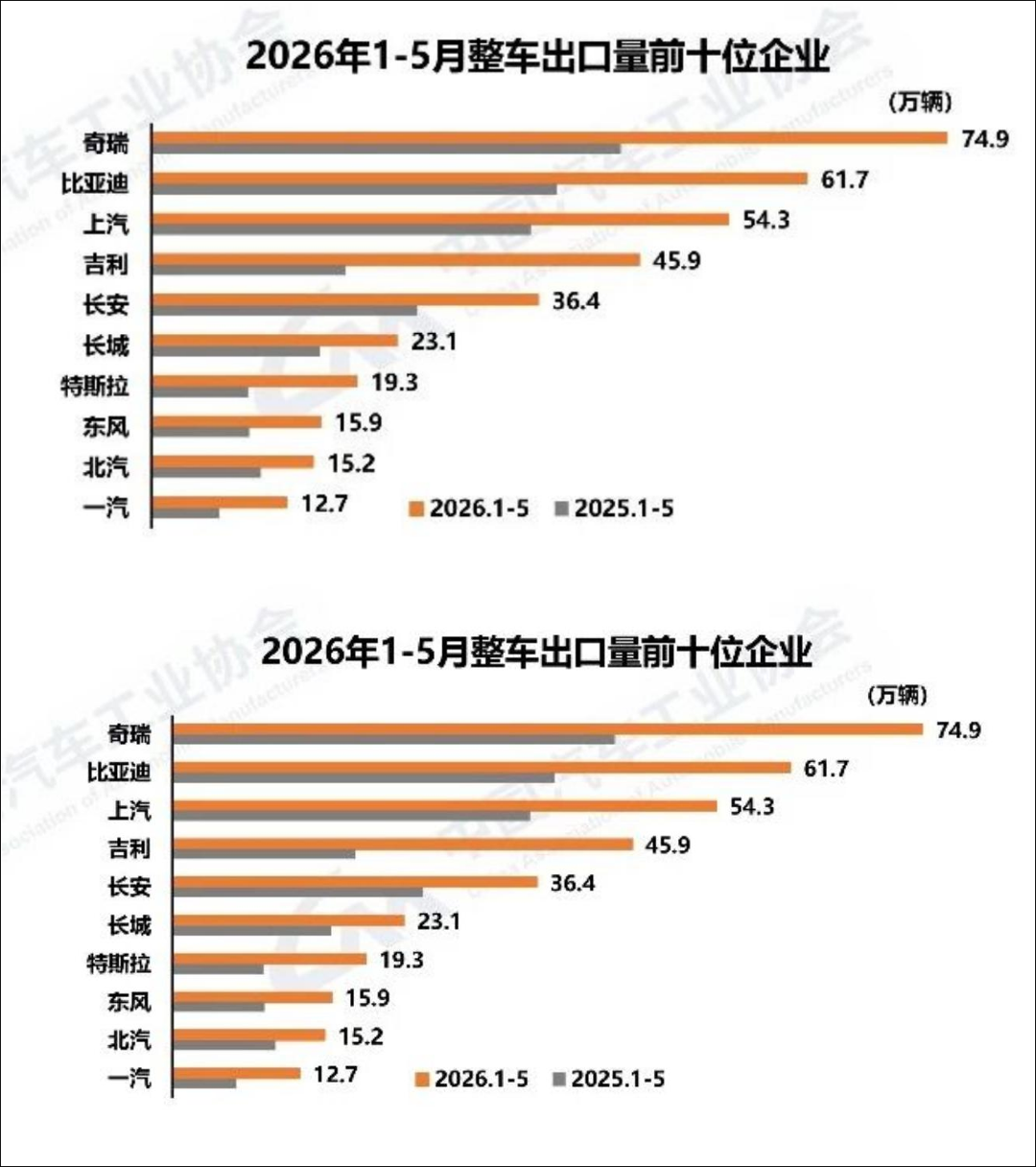
In fact, following this trend, Chinese automakers are bound to strengthen and expand their export businesses. However, in this landscape, with leading groups like BYD and Chery firmly grasping the core of overseas markets, other Chinese automakers will have to survive in the cracks, making do with scraps. It could even be said that nearly 80% of Chinese automakers will become highly passive in exports.
Moreover, one might ask, will the ranking within the leading group remain unchanged? The answer is clearly not fixed.
In May, the surge in new energy vehicle exports is undeniable. Among them, 269,000 fully electric vehicles were exported, up 3.2% month-on-month and 94.3% year-on-year. Plug-in hybrid models saw 178,000 units exported, up 4.9% month-on-month and 1.4 times year-on-year. From January to May, total fully electric vehicle exports reached 1.125 million units, up 1.1 times year-on-year, while plug-in hybrid exports reached 708,000 units, up 1.2 times year-on-year.
In other words, as new energy vehicles dominate exports, companies that previously led in traditional overseas fuel-powered vehicle markets, especially Chery, risk being overtaken by BYD if they do not promptly adjust to market demands.
It is worth noting that BYD is aiming for annual sales of 5 million units this year. Coupled with the relative weakness in the domestic retail market, accelerating new energy vehicle exports has become the focal point of BYD's business development.
Domestically, Chery has already fallen behind Geely, Changan, and even Great Wall Motors in various market segments. If a day comes when BYD fully dominates global core markets and the surge in new energy users propels competitors like SAIC forward, the current ranking in overseas markets will ultimately be upended.
Editor-in-Charge: Cao Jiadong Editor: He Zengrong
THE END
-
![]()
Doubao Work Unveiled! Domestic AI Leaders Fully Commit to the 'Work' Sector
-
![]()
Who’s Sounding the Alarm on ‘Rushed Vehicles’?
-
![]()
Over 5.3 Billion Yuan in Losses Over Three and a Half Years! Can Yonyou Reverse Its Fortunes Through Streamlining and AI Transformation?
-
![]()
Baidu AI Adopts Free Model: A Strategic Maneuver in Traffic and Monetization
-
![]()
Silicon-Based OLED Pioneer Unveils Financial Results: H1 Shipments Outpace Entire 2025 Volume
-
![]()
AI's First "Lost Summer"
-
![]()
Zeiss Makes Another €2.2 Million Bet: Will Eye Tracking Be the Next Big Thing in the Smart Glasses Industry?
-
![]()
RUNTO Ranking | Global Top TV ODM Factories' Shipment Figures for July 2026