Financial Report Circulation Techniques in the Automotive Industry
 06/18 2026
 645
645

When delving into the financial reports and business models of emerging automotive companies, one cannot help but be impressed by the intricacy of their financial strategies (here, "intricacy" is used in a positive sense). Essentially, these strategies involve leveraging corporate structure adjustments to facilitate the circulation of performance across the three primary financial statements, thereby minimizing risks and maximizing benefits.
In simpler terms, understanding these emerging automotive companies by examining just one financial statement is challenging. A more nuanced approach is required to grasp their operational logic fully.
Take NIO as an example. The company introduced the innovative BaaS (Battery as a Service) model, where customers purchase the vehicle outright and then lease the battery on a monthly basis.
If the battery swap business were entirely contained within NIO's corporate structure, the company would face significant battery depreciation and provision expenses, undermining its broader profitability objectives.
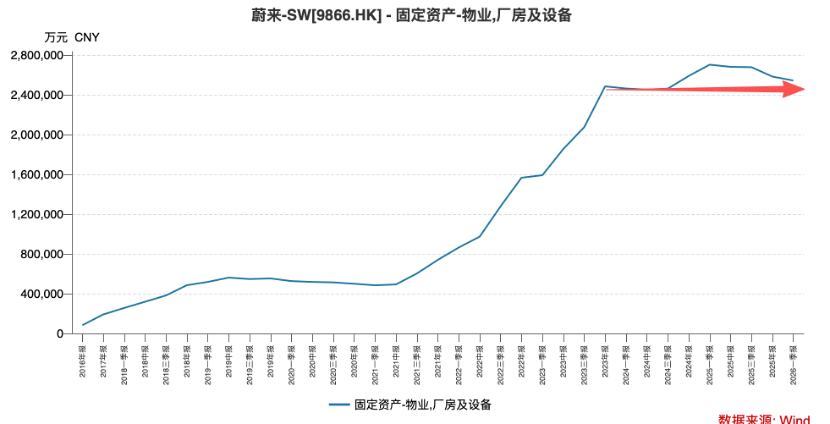
Initially, when I encountered NIO's battery swap model, I assumed that NIO was leveraging balance sheet expansion as a trade-off (a Chinese term meaning a calculated exchange) to enhance its income statement. However, in practice, NIO's fixed assets have not witnessed substantial growth in recent years.
I am truly impressed by the organizational acumen of NIO's management team. They have strategically positioned the operational entity of their battery swap business, "Weilai Energy," outside their core corporate structure, maintaining a shareholding ratio of less than 20% (with investment gains and losses accounted for using the equity method). When customers opt for the battery swap service during vehicle purchase, NIO simultaneously transfers the battery to Weilai Energy, and the customer enters into a leasing agreement with Weilai Energy.
This arrangement offers several advantages:
1) NIO is relieved of the substantial battery amortization costs, thereby enhancing its gross profit margin;
2) With NIO's shareholding in Weilai Energy below 20%, the impact of Weilai Energy's profit fluctuations on NIO is minimized.
While many have discussed these aspects, and they were even a focal point of contention when Grizzly Research shorted NIO in the past, the intricacies extend further:
Under normal circumstances, Weilai Energy is perceived as alleviating NIO's financial strain. However, NIO also provides covert support to Weilai Energy.
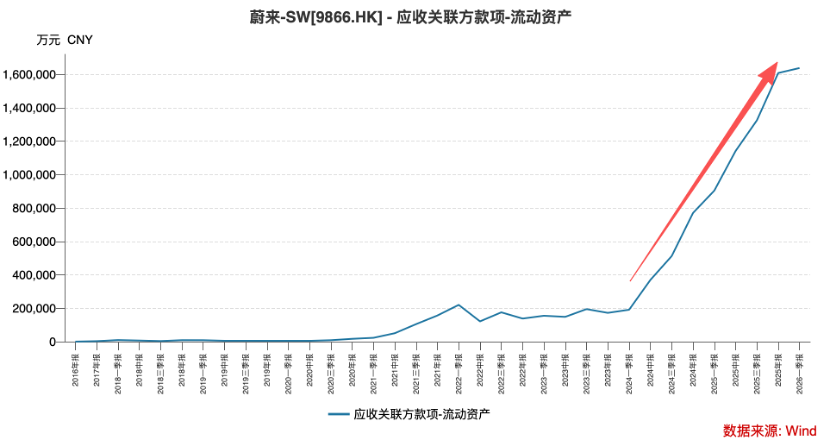
For instance, significant accounts receivable have accumulated between the two entities. If the battery transfer is viewed as a sale to Weilai Energy, NIO has effectively granted Weilai Energy generous credit terms. In essence, while NIO is easing its balance sheet and income statement pressures, it is also incurring substantial cash flow costs. Jokingly, in this sophisticated financial design, it is nearly impossible for all three financial statements to remain unaffected. This represents the inherent trade-offs in business model innovation.
For Weilai Energy, its operational rationale is clear:
1) Part of its capital expenditure for battery acquisitions relies on the favorable credit terms extended by NIO, while another portion is financed through issuing ABS (Asset-Backed Securities) based on customers' battery monthly rental contracts. This strategy significantly reduces NIO's main body's capital borrowing needs, helping to maintain NIO's balance sheet ratios and other financial indicators;
2) Its battery monthly rental pricing is designed to achieve positive ARR (Annualized Recurring Revenue), a sophisticated financial metric that ensures the sustainability of Weilai Energy's operations;
3) NIO provides customer and cash flow support to Weilai Energy, and the two entities achieve maximum synergistic benefits with minimal equity cross-holdings.
Through these financial and organizational structure designs, NIO's battery swap model minimizes its impact on the listed company's financial reports. Meanwhile, Weilai Energy, as the operational entity, enjoys a privileged position, ensuring at least the protection of its income statement. Additionally, it enhances NIO's credit rating (as the listed company's financial condition continues to improve), achieving a win-win-win scenario. I am truly impressed by this strategic approach.
Numerous other automotive companies have also introduced similar innovations, and we will share more insights in the future when opportunities arise.
The purpose of this article is simply to share some observations from financial analysis. If you disagree, please refrain from negative comments.
-
![]()
Silicon-Based OLED Pioneer Unveils Financial Results: H1 Shipments Outpace Entire 2025 Volume
-
![]()
AI's First "Lost Summer"
-
![]()
Zeiss Makes Another €2.2 Million Bet: Will Eye Tracking Be the Next Big Thing in the Smart Glasses Industry?
-
![]()
RUNTO Ranking | Global Top TV ODM Factories' Shipment Figures for July 2026
-
![]()
Dealer Service Operational Prowess | How After-Sales Managers Can Harness Efficiency and Expertise to Secure Trust in the New Energy Era
-
![]()
Xiaohongshu: Navigating Through the AI Anxiety Storm
-
The Foundation of AI is Being Built
-
![]()
Huawei and Apple Embrace Change, Samsung Steps Back: Is Variable Aperture Technology a Game-Changer?