Annual Advertising Expenditure of VOYAH with Yudeshui: A Deep Dive
 06/25 2026
 507
507
Recently, while delving into procurement and bidding information within the automotive sector, Niudao stumbled upon a particularly intriguing company: Yudeshui. Its name exudes a classical charm, not typically associated with a marketing agency, yet it has emerged as a highly coveted partner among leading automakers.
Furthermore, Yudeshui appears to be a ubiquitous presence on VOYAH's supplier rosters.
This prompted Niudao to investigate: Just how much does VOYAH allocate annually to marketing endeavors with Yudeshui?
01
Let's first delve into the background of Yudeshui.
A perusal of bidding information on Dongfeng Motor's procurement platform reveals an impressive tally of successful bids by Yudeshui.
In the latter half of 2025, the shortlist for the "2025-2026 VOYAH Automobile Event Creativity and Execution Project" was unveiled, with Beijing Yudeshui Marketing Consulting Co., Ltd. securing the bid at 25.4334 million yuan.
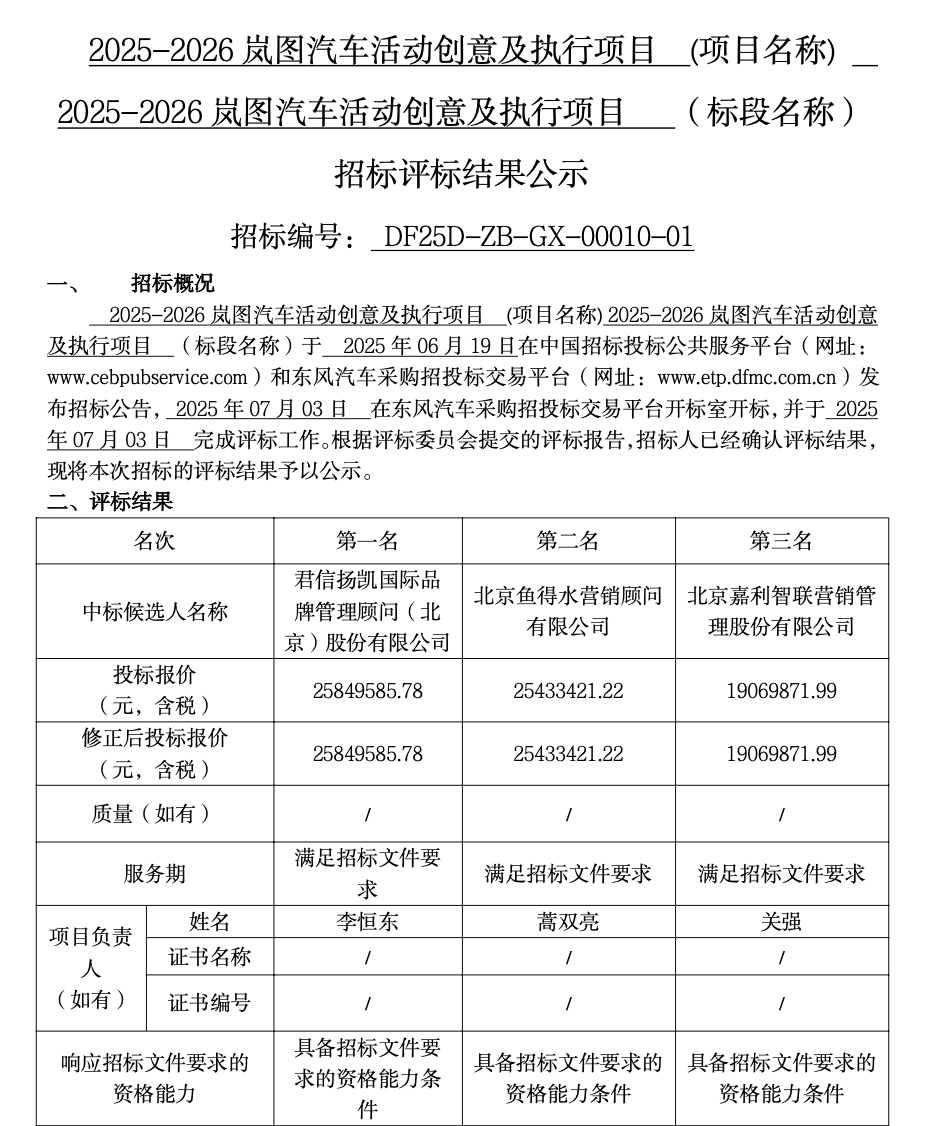
(Source: Dongfeng Motor Procurement Bidding Platform)
By year-end, the winning bid for "Segment 1 of the 2026-2027 VOYAH Automobile Annual PR Agency" was announced, with Beijing Yudeshui Marketing Technology Co., Ltd. clinching the contract for approximately 2.1884 million yuan.
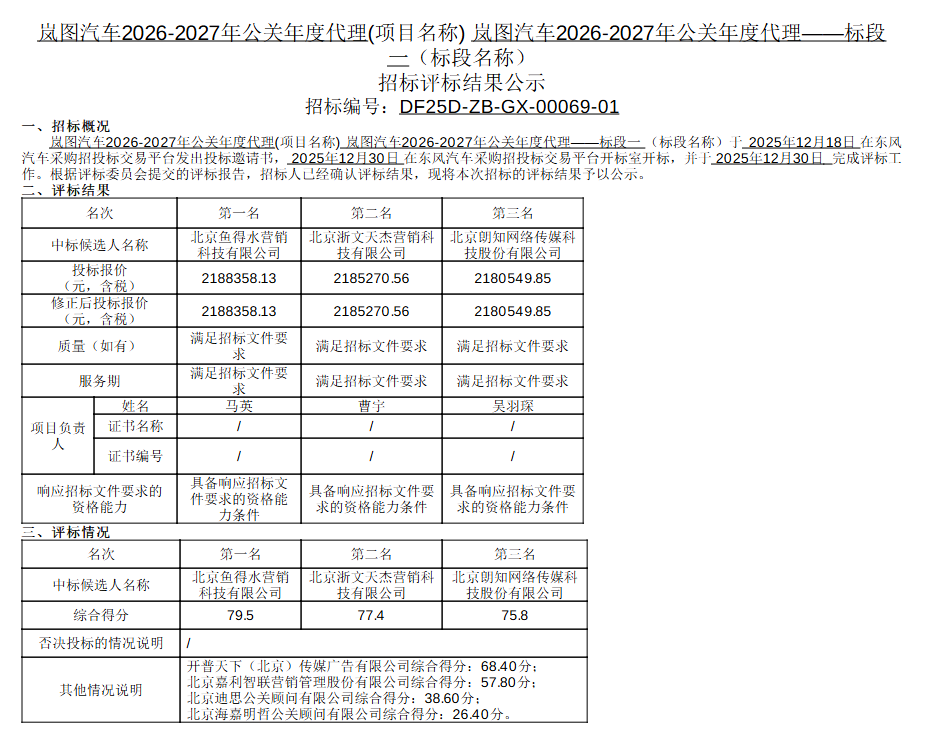
(Source: Dongfeng Motor Procurement Bidding Platform)
These two projects, spanning one and two years respectively, signify that Yudeshui has rapidly secured marketing budgets exceeding 27.62 million yuan from VOYAH alone.
When factoring in Yudeshui's involvement in a slew of other projects, such as digital media, performance-based precision customer acquisition agency services, and regional marketing agency work, the total estimated annual marketing expenditure from VOYAH to Yudeshui ranges between 50 million and 80 million yuan.
This is no trifling sum.
It's crucial to note that this figure represents only agency fees, excluding the actual media purchasing costs.
Nevertheless, in an era where automakers are universally fixated on cost reduction and efficiency enhancement, VOYAH's willingness to allocate such substantial funds to Yudeshui underscores a deeply entrenched partnership.
02
However, Niudao must stress: This does not imply that VOYAH invests exclusively in Yudeshui.
The automotive marketing landscape is highly fragmented, with various service providers specializing in distinct areas and a highly detailed division of labor.
In the "VOYAH's Nearly 80 Million Yuan Digital Marketing Project Bidding," another firm, "Beijing BAFOC," holds the lion's share of the media budget.
At the regional agency level, more locally grounded companies vie for a piece of the pie.
So, what is Yudeshui's core competitive edge? It lies in "precision conversion during heavy promotion."
This company specializes in offline execution and precision PR for VOYAH.
03
Niudao observed something noteworthy.
In 2025, VOYAH Automobile reported revenue of 34.86 billion yuan, achieving full-year profitability for the first time (excluding government subsidies and other factors). However, VOYAH's selling expenses that year soared to 5.341 billion yuan. Although the selling expense ratio had decreased to 15.3%, it still substantially surpassed the 8.5% of Li Auto and 15.2% of Zeekr.
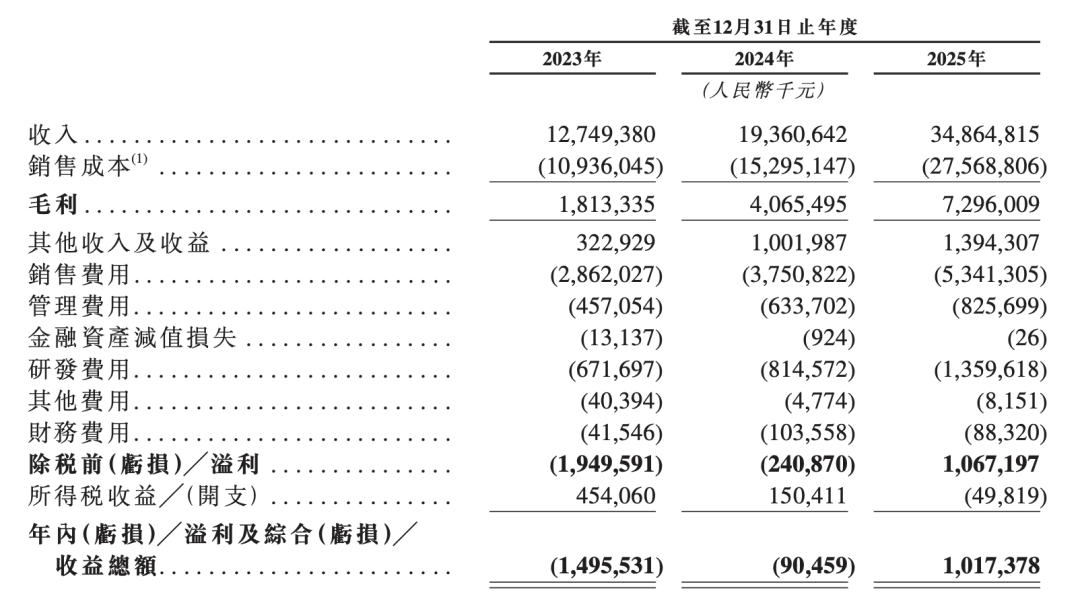
(Source: VOYAH Automobile's prospectus)
When horizontally comparing the 5.341 billion yuan in advertising and promotion expenditures among new energy vehicle companies, VOYAH's approach is typically high-profile.
Some emerging automakers outsell VOYAH yet spend less on advertising.
Of course, brand marketing professionals would counter: "In the knockout stage of the new energy vehicle sector, once momentum wanes, market share can be swiftly devoured by competitors."
Allocating 50 million or even several hundred million yuan to advertising service providers echoes the aggressive tactics witnessed during the real estate boom cycle.
The issue is that while the now-listed VOYAH enjoys the backing of the Hong Kong stock market, the market has become highly sensitive, with both market share and gross profit margins under intense scrutiny.
Once selling expenses excessively erode profit margins, the capital market's patience is not boundless.
04
Now, let's revisit Yudeshui.
Its confidence stems from its long-standing partnership with Dongfeng Motor Group. Besides VOYAH, it has also secured substantial bids from Dongfeng Nissan's Venucia (34.35 million yuan) and Dongfeng eπ (51.03 million yuan), among others.
In just one year, the project amounts secured from the Dongfeng Group have surpassed 100 million yuan.
However, high industry prosperity does not guarantee smooth sailing. The client's demands for "cost reduction and efficiency improvement" from the service provider are intensifying. How long traditional offline activities and PR tactics can sustain high premiums remains uncertain.
Another concern is industry overcrowding. If Yudeshui becomes overly reliant on the Dongfeng Group, any future leadership changes at VOYAH or shifts in company strategy could disrupt this stable cash flow.
Keep in mind that after the 3-year contract cycle for automotive marketing agencies concludes, success in the next round of bidding is not assured.
Why is it worth calculating VOYAH's annual marketing expenditure with Yudeshui, ranging from 50 million to 80 million yuan?
Because it represents a microcosm of the "marketing competition" within the entire new energy vehicle industry.
As the sector becomes increasingly crowded and price wars more frequent, companies must maintain visibility through seemingly costly means, exchanging high investments for consumer attention.
Yet, the harsh reality of the industry is that spending more does not necessarily equate to selling more vehicles.
Niudao has always maintained that user experience and technological prowess truly determine a brand's destiny.
For Yudeshui, while aligning with VOYAH is undoubtedly crucial, relying solely on this annual "windfall" from VOYAH as its protective charm may not ensure long-term success in today's fiercely competitive landscape.
-
![]()
DJI Osmo 360 II In-Depth Review: How Does It Achieve Significant Image Quality Enhancements Without Sensor Changes or Excessive Spec Stacking?
-
![]()
Samsung’s Latest Foldable Phone Skips S Pen Again! Is AI Ushering in the End of Styluses?
-
![]()
Registered Capital Slashed to 372 Million Yuan! Yutong Optical Finalizes Industrial and Commercial Change Registration
-
![]()
Zhuque-3 Successfully Lands, and 'Time Traveler' Secures Another ¥100 Million in Funding: China's Commercial Space Industry Experiences a 'Dynamic August'
-
![]()
Autohome Faces a Shrinking Window of Opportunity
-
![]()
Even a Titan Like Musk Has Faced Setbacks in Fulfilling Promises
-
![]()
AI Office: The End of the Racing Era, Context Becomes the Key to Success
-
![]()
Domestic Vehicle Chassis Revolution ②: The Steering Wheel Remains, But Mechanical Connections in the Steering System Are Decreasing