180 Billion Market Cap Vanished! How Did Seres Fall So Far?
 06/25 2026
 669
669

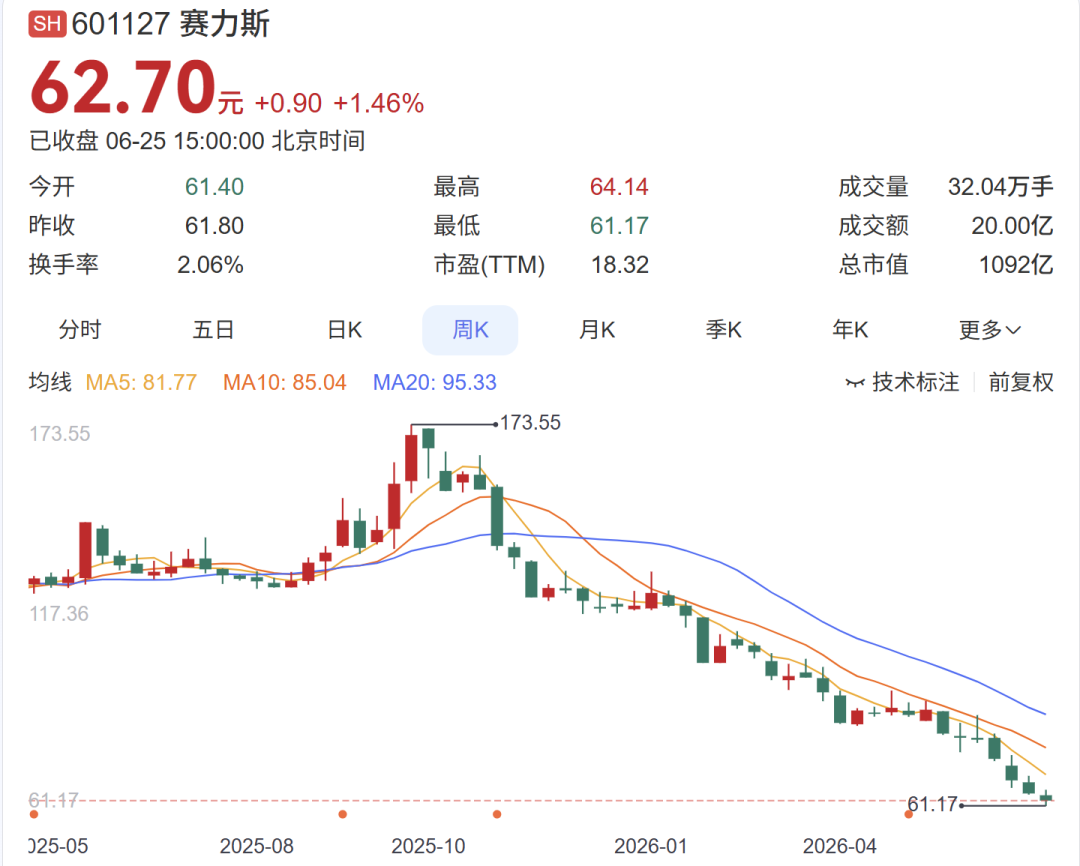
On June 25, Seres' stock price hit a new 60-day low during intraday trading.
This once-star new energy vehicle company, which saw its market cap surge past 300 billion yuan, has witnessed its A-share price collapse by over 60% from its historic high of 173.55 yuan in just over eight months, with its market cap evaporating by more than 180 billion yuan.
The situation is equally dire in Hong Kong. Since its listing in November last year, the stock broke below its issue price, and its market cap has now shrunk by over 100 billion Hong Kong dollars.
How did a vehicle company with annual revenue of 165 billion yuan and two consecutive years of profitability end up like this?

From Myth to Reality
Let's look at the data. On September 30, 2025, Seres' A-share price hit a historic peak of 173.55 yuan. Since then, it has been on a downward trajectory.
By mid-June 2026, the stock price had fallen to around 66 yuan. In the previous 10 trading days, net outflows of principal funds totaled 1.87 billion yuan.
What's even more disheartening is that the company hasn't been idle. In late March this year, Seres announced plans to repurchase A-shares worth 1 to 2 billion yuan for cancellation to reduce registered capital.
By mid-June, the cumulative repurchase amount had exceeded 320 million yuan. Yet, despite this substantial investment, the stock price continued to decline. The fact that even repurchases couldn't stabilize the price is what's most unsettling for investors.
"Three Blades at the Neck"
Seres' predicament boils down to three simultaneous challenges.
The First Blade: Revenue Growth Without Profit Increase, Core Business Profitability Collapsing
In 2025, Seres' revenue reached a record high of 165.054 billion yuan, up 13.69% year-on-year. However, net profit attributable to shareholders was only 5.957 billion yuan, a mere 0.18% increase. Net profit excluding non-recurring items was 5.136 billion yuan, down 7.84% year-on-year.
The problem became more acute in the first quarter of 2026. Revenue was 25.746 billion yuan, up 34.46% year-on-year. Net profit attributable to shareholders was 754 million yuan, up just 0.89%. However, net profit excluding non-recurring items was only 103 million yuan, a staggering 73.87% drop.
In essence, while revenue surged by over 30%, the actual money earned from vehicle sales plummeted by more than 70%.
Where did the money go? Selling expenses and R&D costs have become bottomless pits. In 2025, selling expenses were 24.194 billion yuan, up 26.12% year-on-year. R&D expenses were 7.954 billion yuan, up 42.41%. In the first quarter, R&D expenses were 1.794 billion yuan, a massive 70.68% increase. The company attributed the plunge in net profit excluding non-recurring items primarily to "sustained increases in R&D investment."
Even more concerning is cash flow. In the first quarter, net cash flow from operating activities was -20.95 billion yuan, compared to 28.91 billion yuan at the end of 2025. The speed at which vehicle sales are generating cash can't keep up with payments to suppliers.
The Second Blade: AITO's Slowdown, Growth Myth Fading
AITO is Seres' lifeblood, accounting for over 82% of its sales in 2025.
In 2024, AITO delivered 386,300 vehicles, up over 300% year-on-year. In 2025, deliveries reached 426,000 vehicles, but growth slowed sharply to 10.1%.
The data in 2026 is even more alarming: 40,012 deliveries in January, plummeting to 10,003 in February, 20,234 in March, and 30,003 in April. Although deliveries rebounded to 30,187 in May, it fell far short of Yu Chengdong's target of "over 40,000 vehicles per month on average."
The product lineup is also hemorrhaging. The M5's presence in the 220,000-250,000 yuan price range is weakening. M9 deliveries fell from an average of 13,000 vehicles per month in 2024 to just 3,794 per month in the first four months of 2026. The M7 faces fierce competition, and M8 sales have also declined from their peak. The only bright spot is the M6, with first-month deliveries exceeding 20,000 units, but one model can't carry the entire lineup.
The Third Blade: Huawei's Dividends Being "Diluted"
This is the most critical issue—Seres' core competitive moat is being eroded.
AITO's success is essentially the success of "Huawei Intelligent Driving." For the past two years, Huawei's ADS system has been virtually unchallenged. When it came to high-end intelligent driving vehicles, AITO was almost the only choice.
But by 2026, things had changed. Even Yu Chengdong admitted that in the two years since the M9's launch, over 40 Series 9 SUVs had entered the market. The Li Auto L9 Livis, NIO ES9, Zeekr 9X, and other flagship models have flooded in. The total market size for Series 9 SUVs is only 100,000-150,000 units.
More crucially, Huawei Intelligent Driving is no longer exclusive to the M9.
With the launch of HarmonyOS Intelligent Driving's "Five Brands"—AITO, Luxeed, Enjoya, Zenseact, and Shangjie—Huawei's resources are now spread across five brands. AITO no longer holds exclusivity. When intelligent driving shifts from an "exclusive ace" to an "industry standard," how long can Seres' premium pricing model hold up? This is the biggest question mark in the capital markets.
In its latest report on June 11, Citigroup sharply lowered its sales forecast for Seres in 2026 to 468,000 vehicles. This once-sought-after automaker is now facing a crisis of confidence.
The Other Side of the Coin
Just because the stock price has plummeted doesn't mean the company is doomed. To be clear, Seres' fundamentals remain solid.
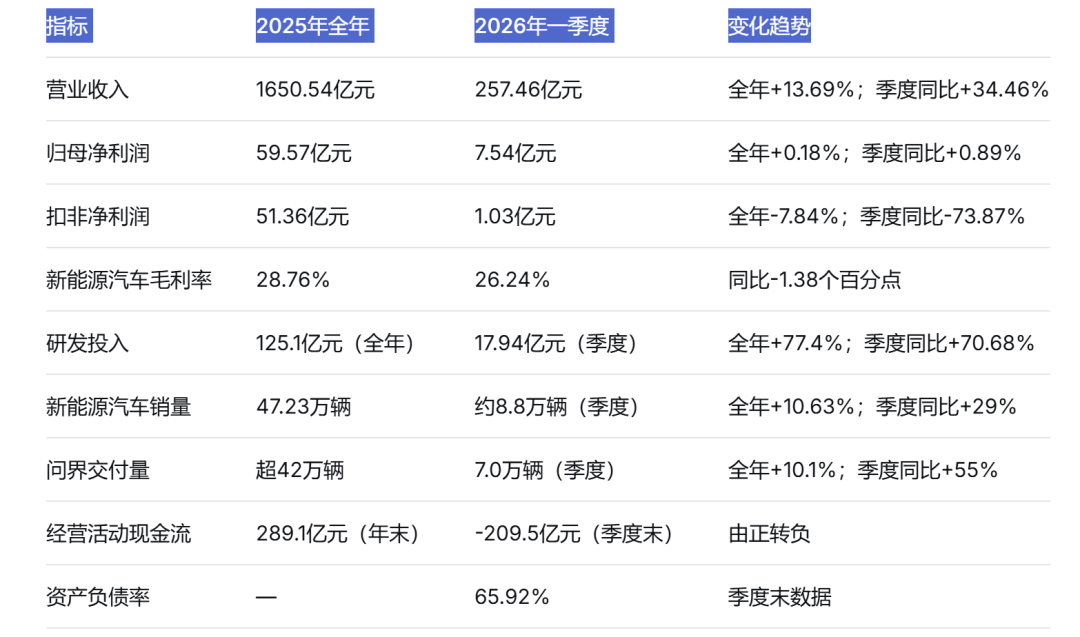
Gross margins still lead the industry. In 2025, the gross margin for new energy vehicles was 28.76%, topping the A-share auto sector. In the first quarter of 2026, the gross margin was 26.24%, still the only listed automaker to exceed 25%, far surpassing XPeng (20.58%), NIO (19.03%), and BYD (17.78%). The premium pricing power of high-end brands remains intact.
The new product cycle is just beginning. The M6's first-month deliveries exceeded 20,000 units. The all-new M9 received over 20,000 orders within 24 hours of its launch, with cumulative advance orders exceeding 70,000 units. Cumulative deliveries of the AITO M9 series have surpassed 290,000 units. Product strength hasn't collapsed.
Brand value is rising. In Brand Finance's 2026 Global Automotive Brand Value 100, AITO ranked with a brand value of $3.448 billion, making it China's most valuable luxury automotive brand and the only Chinese brand in the global luxury automotive brand TOP 10.
Globalization is accelerating. The company has launched several global models, including the AITO 9/8/7/5, and is undergoing deep localization development in the Middle East market, with overseas deliveries expected to begin in 2026. Overseas models are significantly more profitable than domestic ones, which could be a major source of earnings elasticity.
Robot business is in the works. The company is developing technologies for various robot forms, including bipedal, wheeled, and quadrupedal robots. While no revenue is expected in the short term, it opens up long-term imaginative possibilities.
Bubble Burst or Genuine Crisis?
Ultimately, Seres' plunge is a double whammy of "valuation correction" and "logic restructuring."
"Huawei premium" is being repriced by the market. Much of the valuation premium previously given to Seres was due to its exclusive access to Huawei's dividends. As this exclusivity is diluted, valuations naturally take a hit. This isn't unique to Seres—the entire "Huawei concept stock" sector is undergoing similar valuation restructuring.
But the market may be overreacting. AITO remains the absolute mainstay of the HarmonyOS Intelligent Driving ecosystem. In May, HarmonyOS Intelligent Driving delivered about 46,000 vehicles in total, with AITO accounting for 34,300 units, over 70% of the total.
Huawei is unlikely to abandon its most capable partner. Seres' deep integration with Huawei remains unchanged, just shifting from a "one-to-one" to a "one-to-many" relationship.
Short-term pain for long-term gain. The plunge in net profit excluding non-recurring items in the first quarter was primarily due to a 70% surge in R&D investment. These funds were poured into the M6, the new M9, the Magic Cube technology platform, AI transformation, and the robot business. R&D personnel now number 9,019, accounting for 41.1% of the total workforce. This is about positioning for the next stage, not burning money recklessly.
The entire industry is taking a hit, not just Seres.
On June 22, the Hong Kong automotive sector was a sea of red, with Geely down nearly 6%, Great Wall down 5%, and BYD, NIO down over 4%. Li Auto, XPeng, NIO, and Leapmotor have all seen their maximum year-to-date declines exceed 20%. Xiaomi Corporation is down 34% year-to-date, while Seres is down 44%. The entire sector is undergoing a bubble burst.
Seres' stock price has indeed collapsed from 173 yuan to just over 60 yuan, which is brutal.
But is a company with industry-leading gross margins, the golden AITO brand, hundreds of billions in R&D investment, and just-beginning globalization really only worth its current valuation?
Capital markets have always been emotional amplifiers.
They crash when pessimism sets in and soar when optimism takes over. For Seres, the real test begins now as the "Huawei halo" fades and the market scrutinizes its independent value more harshly. But those that survive the test will emerge stronger.
What's your take on Seres' recent performance?
Disclaimer: This article is solely for financial hotspot analysis, with data and information sourced from public queries, company announcements, and Tonghuashun IFinD. The views expressed are for reference only and do not constitute any investment or consumption advice.
-
![]()
DJI Osmo 360 II In-Depth Review: How Does It Achieve Significant Image Quality Enhancements Without Sensor Changes or Excessive Spec Stacking?
-
![]()
Samsung’s Latest Foldable Phone Skips S Pen Again! Is AI Ushering in the End of Styluses?
-
![]()
Registered Capital Slashed to 372 Million Yuan! Yutong Optical Finalizes Industrial and Commercial Change Registration
-
![]()
Zhuque-3 Successfully Lands, and 'Time Traveler' Secures Another ¥100 Million in Funding: China's Commercial Space Industry Experiences a 'Dynamic August'
-
![]()
Autohome Faces a Shrinking Window of Opportunity
-
![]()
Even a Titan Like Musk Has Faced Setbacks in Fulfilling Promises
-
![]()
AI Office: The End of the Racing Era, Context Becomes the Key to Success
-
![]()
Domestic Vehicle Chassis Revolution ②: The Steering Wheel Remains, But Mechanical Connections in the Steering System Are Decreasing