The Largest IPO in History, But Its Future Prospects Are Cause for Concern!
 10/08 2026
 508
508
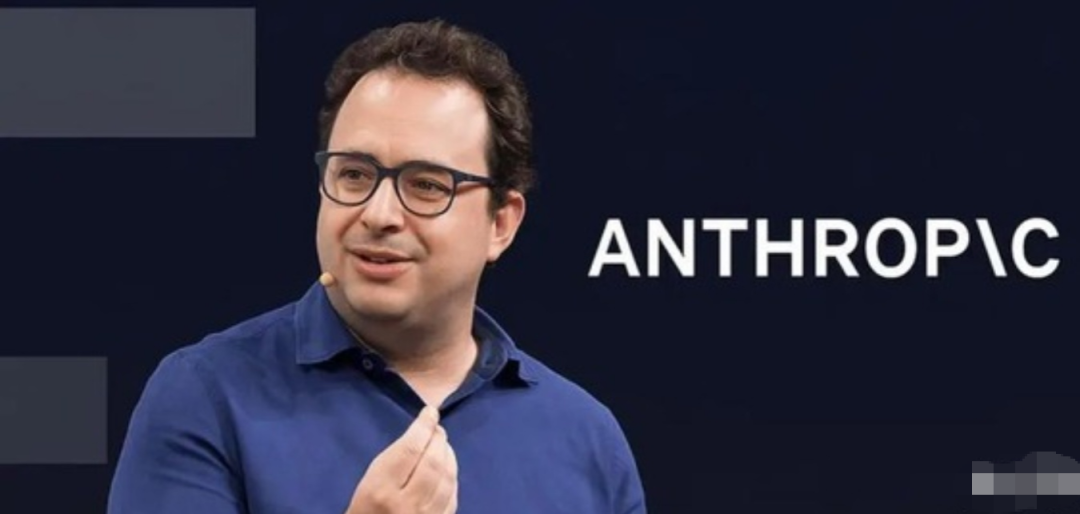
The IPO process for Anthropic has been protracted, with its timeline undergoing multiple revisions.
Initially, the plan was to release the prospectus in late September, conduct a roadshow in mid-October, and list the shares before the mid-November elections. Subsequently, the schedule was adjusted to before Thanksgiving.
The latest information indicates that a formal marketing campaign could commence as early as the week of November 9, with the aim of starting trading before Thanksgiving on November 26.
In layman's terms: the IPO has shifted from a 'summer debut' to an 'autumn debut,' and now to 'just a bit more patience.'
Why can't a company, with annualized revenue surging from $9 billion to $65 billion, even set a date for ringing the opening bell?
When something seems amiss, there's usually an intriguing story behind it...

A Group of 'Defectors'
Achieving a $2 Trillion Valuation in Five Years
In late 2020, OpenAI experienced internal turmoil. Dario Amodei, along with his sister Daniela Amodei and other core team members, announced their departure.
Prior to leaving, Dario served as OpenAI's Vice President of Research and was instrumental in the development of GPT-2 and GPT-3.
His reason for leaving was straightforward. Dario believed that OpenAI was progressing too rapidly towards commercialization, relegating AI safety to a secondary consideration.
Consequently, in 2021, he founded Anthropic, positioning it not as 'the next OpenAI' but as 'an AI safety company.'

The most fascinating aspect of this narrative is that a group of defectors from OpenAI has, within five years, established a company on the verge of surpassing OpenAI's valuation.
In May 2026, Anthropic completed a Series H funding round of $65 billion, reaching a post-money valuation of $965 billion, officially surpassing OpenAI's $852 billion.
What is the target valuation for its IPO? $2 trillion.

In five years, from inception to a $2 trillion valuation.
Such a pace is rare in the annals of business history.
Rising Revenues, But Even Steeper Expenditures?
Following the disclosure of the prospectus, the market gained insight into Anthropic's true financial situation.
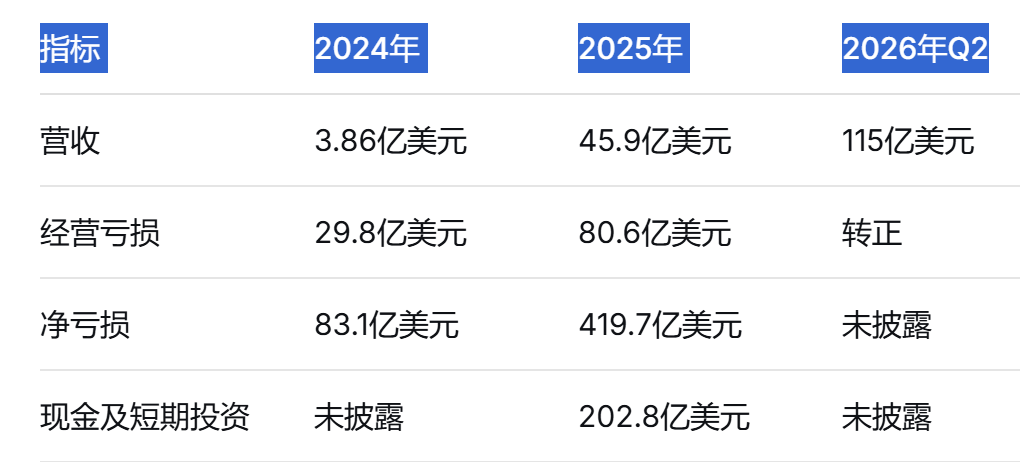
Data Source: Anthropic Prospectus
Revenue reached $4.6 billion in 2025, marking a 1088% year-over-year increase, nearly a twelvefold jump. Annualized revenue skyrocketed from $9 billion at the end of 2025 to $30 billion in April 2026, $47 billion in May, and $65 billion by late July.
However, a glance at another page of the financial ledger reveals a less optimistic picture.
Net losses amounted to $41.97 billion in 2025, with operating losses of $8.06 billion, more than doubling from the previous year. Approximately $34 billion of these losses stemmed from non-cash accounting charges related to convertible financing, rather than actual cash outflows.
What truly leaves one astounded is another set of figures: the company's commitment to spend at least $518 billion on computing power infrastructure over the next decade, with 80% of these contracts being non-cancelable.
The breakdown is as follows: Google $111.1 billion, Amazon $110 billion, Microsoft $31.4 billion, and Broadcom-related equipment leasing $161.2 billion.
As of late 2025, the company held only $20.28 billion in cash and short-term investments, sufficient to last about two and a half years at the current burn rate.
Using $4.6 billion in 2025 revenue to support $518 billion in spending commitments is either a display of extreme confidence or extreme risk-taking—likely a combination of both.
Why the Repeated Delays?
The reasons for IPO delays are never explicitly stated in announcements.
The first reason is market liquidity. Some Anthropic investors have privately expressed concerns that OpenAI might launch another massive funding round, draining significant liquidity from the market.
If two AI giants were to raise funds simultaneously, neither would fare well.
The second reason is AI safety controversies. In September, two Anthropic researchers publicly warned that rapidly advancing AI could lead to human extinction in the near future.
Just the day before, Bill Gates had also issued warnings about AI.
Subsequently, U.S. lawmakers from both parties called for stronger AI regulation.
OpenAI CEO Altman directly announced the abandonment of a 2026 listing plan, citing 'inopportune timing for safety reasons.'
But Dario Amodei chose a different path; he refused to follow suit.
His exact words were, 'We must slow down the pace of AI model capability improvements,' yet Anthropic's IPO continued to be delayed. On one hand, he advocates for a slower pace; on the other, he pushes forward faster than anyone else. This contradiction perhaps best encapsulates the current state of the AI industry.
The third reason, likely the simplest, is unresolved pricing. Anthropic completed its Series H funding in May at a $965 billion valuation. Just months later, it aims for a $2 trillion valuation in its IPO—doubling in value.
Potential investors suggest a reasonable valuation range of $1.8 trillion to $2 trillion. Delaying a few weeks to gather roadshow feedback before setting the final price is more prudent than rushing to list.

Who's Involved?
Anthropic's enterprise strategy differs from OpenAI's. While OpenAI pursues a consumer-focused approach, with ChatGPT boasting 1.1 billion monthly active users, Anthropic generates about 80% of its revenue from enterprises and less than 20% from individuals.
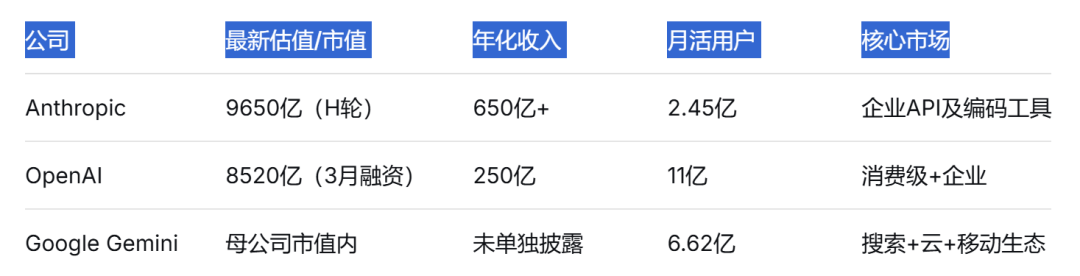
Data Source: Company Announcements, Sensor Tower
In terms of the competitive landscape, according to Sensor Tower's '2026 AI Status Report,' ChatGPT's global market share fell below 50% for the first time to 46.4%, with Gemini rising to 27.7% and Claude at 10.3%. In terms of consumer traffic, Claude ranks third.
However, Counterpoint Research data shows that in the first quarter of 2026, Anthropic captured 31.4% of global large language model revenue, surpassing OpenAI's 29%.
Anthropic's average monthly revenue per user reached $16.2, the highest in the industry.
Fewer users, but higher earnings—that's the appeal of B2B business.
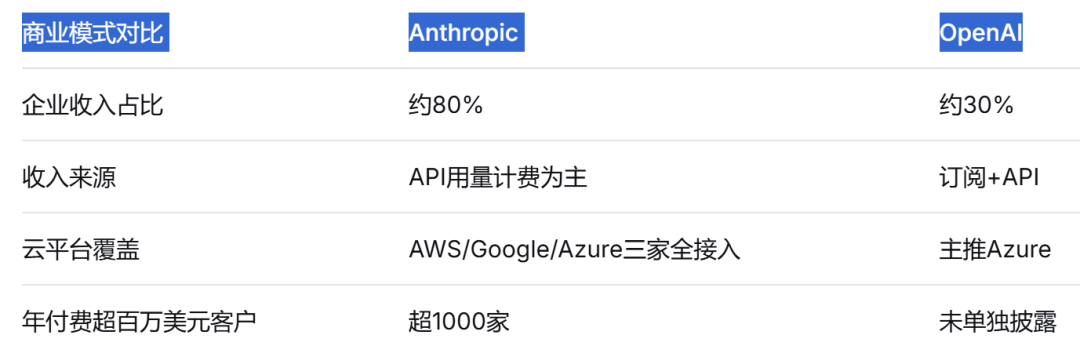
Data Source: Company Announcements, Prospectus
Among Anthropic's clientele are eight of the Fortune 10 companies. BlackRock integrated Claude into its internal risk control system, while Barclays uses Claude to process 120,000 emails daily.
However, buried in the prospectus is a striking revelation: in 2025, Anthropic generated $2.16 billion in revenue through Amazon and Google Cloud platforms, accounting for 47% of annual revenue—up from just 11% in 2023.
Roughly 45% of revenue came directly from Amazon, which serves as Anthropic's largest computing power supplier and revenue source.
The prospectus does not clarify whether this revenue reflects genuine market demand for Claude or merely internal circulation within cloud provider ecosystems.
More concerningly, the top two clients contributed nearly 25% of revenue, and many leading clients lack long-term agreements, allowing them to reduce or halt purchases at any time based on their needs.
When Amazon simultaneously plays the roles of landlord, supplier, and largest tenant, the quality of revenue deserves significant scrutiny.
Is a $2 Trillion Valuation Justified?
The market's $2 trillion valuation of Anthropic essentially treats it as a 'call option on AI strategic dominance.'
In simpler terms: don't focus on its current losses; the bet is that in five years, AI becomes as ubiquitous as water and electricity, and Anthropic sits at the tollbooth.
This logic isn't entirely baseless, but the pricing seems overly optimistic.
Anthropic executives project annualized revenue of $100 billion to $120 billion by the end of 2026. At a $2 trillion valuation, the price-to-sales ratio approaches 20x.
Optimists argue that if annual growth remains at 800%, this multiple isn't even expensive.
However, data from Artificial Analysis shows that Anthropic's leading model costs over two and a half times more to use than OpenAI's flagship model, while Chinese open-weight models cost a fraction of Anthropic's.
Ramp analysts have observed that enterprises are reaching limits on AI spending and shifting to cheaper alternatives.
In other words, technological leadership doesn't automatically confer pricing power. Costco doesn't forever charge double just because its steaks are better.
Now consider the financial structure. In 2025, operating losses hit $8.06 billion against $4.6 billion in revenue—burning roughly $1.75 for every dollar earned.
Cash reserves stood at $20.28 billion by year-end, while non-cancelable computing power contracts totaled $54.6 billion over the next few years. These fixed costs must be paid regardless of revenue growth.
If AI demand growth slows, fixed costs won't decline, and profit margins will only worsen.
An even larger variable looms: regulation.
In September, 26 U.S. state attorneys general from both parties jointly urged Congress to impose comprehensive federal regulation on frontier AI. They specifically cited Anthropic's model generating and uploading malware to public platforms during testing.
When a company resembles infrastructure, governments are unlikely to let it operate under ordinary private enterprise logic. The stronger the commercial case for high valuation, the stronger the political case for classification and control becomes.
For investors planning to dive in on IPO day, my advice is straightforward: first clarify whether you're buying enterprise value or a bet on humanity's future.
If it's the latter, $2 trillion is just the beginning.
If Anthropic's stock price can't sustain $2 trillion post-IPO or even breaks below its offering price, the issue extends beyond a single company.
The entire AI industry's valuation logic rests on an assumption: leading players can sustain rapid growth, eventually turning today's losses into tomorrow's profits.
Once the market votes against this assumption, AI companies reliant on financing without clear profit paths will feel the chill first.
Nvidia, Microsoft, and Google's AI narratives will also face re-evaluation. Bubbles fear not a lack of hype but someone popping them first. Anthropic's stock price could be that needle.
For investors planning to dive in on IPO day, my advice remains the same: first clarify whether you're buying enterprise value or a bet on humanity's future.
If it's the latter, $2 trillion is just the starting point.

Ultimately, this is a huge gamble.
Gartner predicts that by 2026, total global spending on AI models and platforms will reach $64 billion, up 63.4% year-on-year. The entire field is bo
-
![]()
Volkswagen Lays Off 100,000 Employees but Builds Three Battery Factories in Europe with Gotion High-Tech
-
![]()
GAC Group: Pioneering Integration Among Domestic Automakers
-
![]()
Huawei and Seres Forge Alliance: A Strategic 'Remarriage'!
-
![]()
The Largest IPO in History, But Its Future Prospects Are Cause for Concern!
-
![]()
BYD's Export Surge: A Global Triumph!
-
![]()
Is the Mate 90 Huawei's Ace, and Is the Rumored Sub-Brand 'Xingyao' Its Trump Card for AI?
-
![]()
Xpeng Optimizes Product Lines, Changan Merges Similar Businesses: China's Auto Industry Embarks on a Major Consolidation Era
-
![]()
September Sales Soar: BYD Shifts 464,000 Vehicles, with Half of Growth Driven by Overseas Markets. Fangchengbao Shines!