Big Tech Borrows to Buy Future
 10/09 2026
 332
332
No Matter How Good Cash Flow Is, It’s Afraid of AI Expenses
Author|Qingyun
Editor|Xiaobai
Illustration|AI-Generated
Produced by|Qiangdiao Next
On October 8, Tencent was reported to be considering issuing up to $5 billion in offshore bonds, possibly denominated in both USD and offshore RMB, with a potential launch as early as this month. Four months earlier, Tencent had just raised nearly $4.7 billion through USD and RMB note issuances. Tencent’s financing is not an isolated case. On August 26, Alibaba completed an 80 billion HKD share placement. In September, ByteDance was reported to have secured a $29.6 billion syndicated loan. On October 6, DeepSeek was reported to be raising over 80 billion yuan in a new funding round. The four deals total approximately $56 billion, equivalent to nearly 400 billion RMB.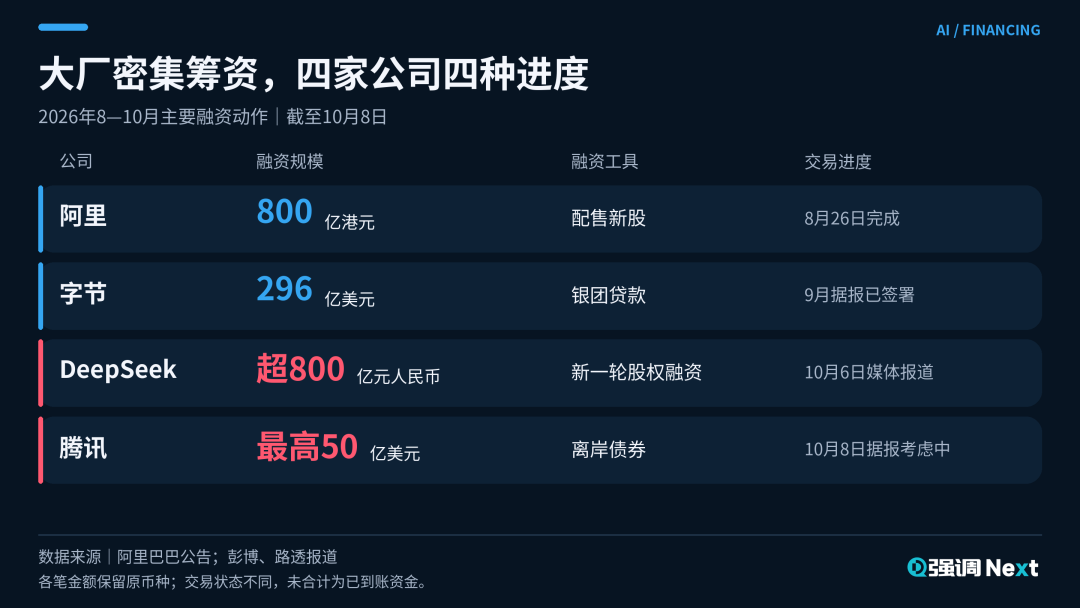
None of these companies are short of cash. What they want is to secure sufficient investment for the next few years while capital costs are still low, allowing AI expansion without waiting for slow business repayments.
Over the past decade, the financial logic of Chinese internet giants has been “cash cows plus buybacks.” The AI race is rewriting it as “debt plus capital withdrawals.” How this money will ultimately be repaid depends on whether enterprise clients are willing to pay for AI.
Securing Supply First
Alibaba’s operating cash flow in the June quarter was 22.945 billion yuan, up 11% YoY, but capital expenditures reached 67.678 billion yuan, resulting in a free cash flow outflow of 44.67 billion yuan, primarily due to increased cloud infrastructure spending.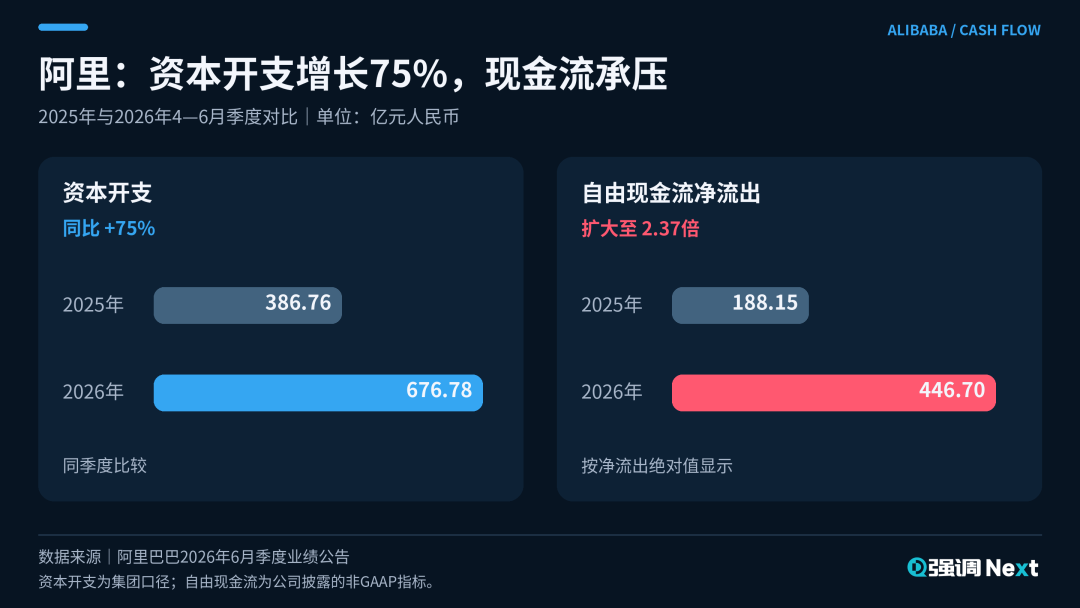
Tencent’s Q2 capital expenditures were 52.8 billion yuan, up 176% YoY, with a negative free cash flow of 13.8 billion yuan. After excluding prepayments for computing power purchases, this figure becomes a positive 37.6 billion yuan.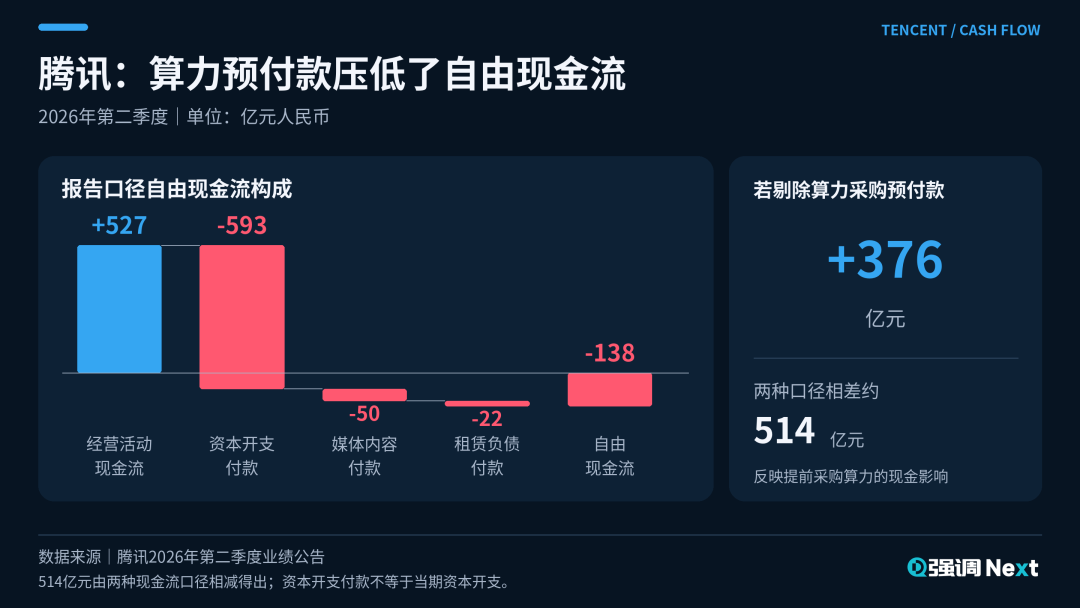
Both sets of figures illustrate a similar issue: Old businesses are still generating stable cash, but new investments have surpassed current cash-generating capacity, and funds are required earlier than revenues arrive. Infrastructure is built in advance based on capacity, while clients pay monthly based on actual usage—the gap is what financing fills.
However, funds arriving don’t immediately translate to computing power. DeepSeek’s planned 1GW data center in Ulanqab, Inner Mongolia, will require at least 160,000 Huawei Ascend 950DT chips. Limited by high-end storage (HBM) supply, full delivery will take over a year. ByteDance’s approach is more direct: According to Reuters, it is the capacity offtaker for multiple Southeast Asian data center projects, using binding contracts to secure capacity in advance, with part of its $29.6 billion loan also allocated to overseas projects.
Such contracts hand over several years of future demand to suppliers upfront, allowing them to organize construction funding in return for more certain supply for ByteDance. The downside is irrevocability—if demand projections are wrong, the money cannot be recovered.
Financing lets them act now, while capacity contracts lock in supply for years. Combined, they extend the AI competition timeline from a single product quarter to multi-year construction cycles.
Where Money Comes From Determines Strategy
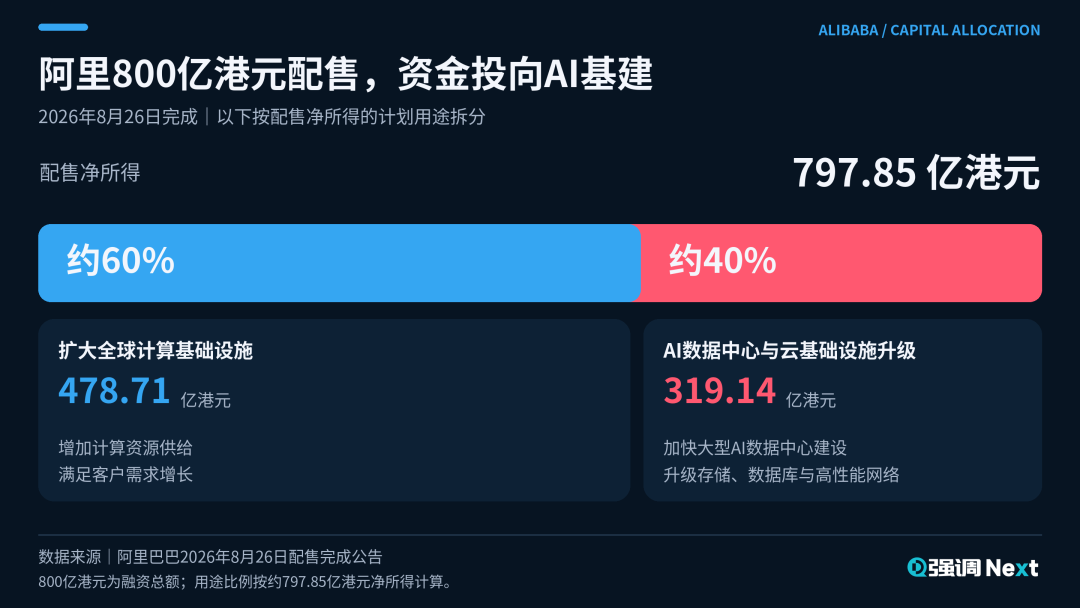
Alibaba launched its share placement three days after its Q2 earnings release, issuing 710 million new shares at 112.70 HKD each to raise 80 billion HKD.
Approximately 60% of net proceeds will expand global computing infrastructure, with ~40% allocated to large AI data centers, storage, database, and network upgrades.
Equity financing has no repayment deadline, with dilution borne by existing shareholders and return risks shared by new and old investors. For rapidly expanding infrastructure businesses, this is the most flexible form of capital.
Alibaba aims to expand the total bill enterprise clients pay for AI operations. Models can be swapped, but migrating data, databases, deployment, and operations is more complex. Providing multi-layer services together turns a single model call into a longer-term customer relationship. This business already has revenue support.
In the June quarter, Alibaba’s AI cloud and computing power services generated 48.437 billion yuan in revenue, up 45% YoY, with adjusted EBITA of 5.628 billion yuan. AI-related product revenue was 12.376 billion yuan, with annualized revenue exceeding 49.5 billion yuan. The MaaS platform BaiLian’s customer count grew 8x YoY. In the same quarter, AI Labs and Applications had an adjusted EBITA loss of 13.861 billion yuan.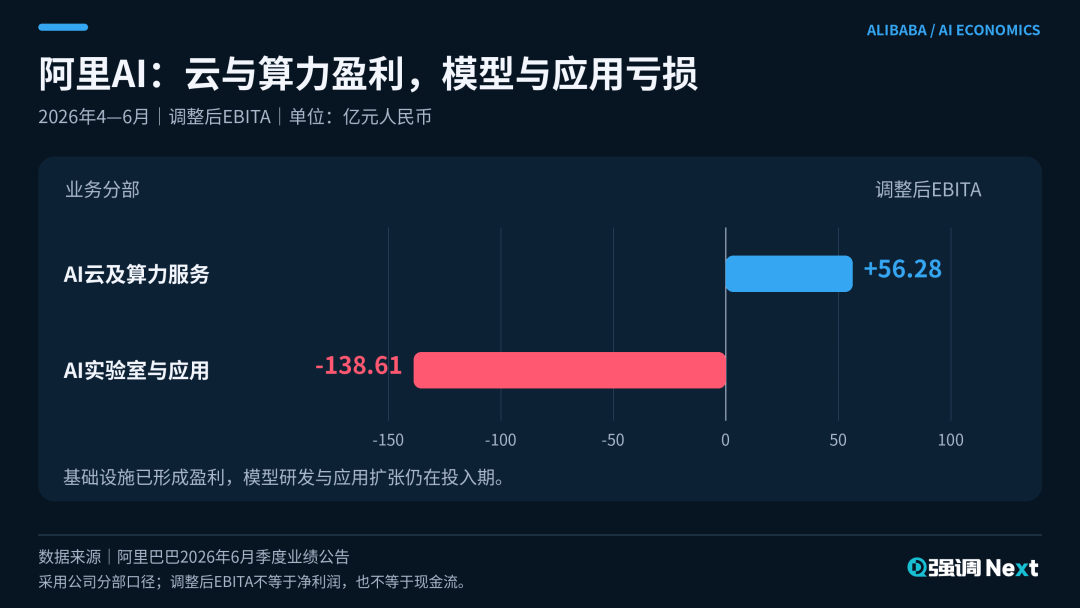
Selling infrastructure is already profitable, while model development and application incubation still burn cash. This is where financing expansion matters: Accelerating growth in revenue-generating areas while buying time for investments yet to recoup. Alibaba CEO Wu Yongming’s goal is to raise AI-related product revenue’s share of external cloud revenue from 30% to 50% within a year.
ByteDance, meanwhile, secured bank credit. According to Bloomberg, 28 banks participated in its $29.6 billion loan, with 15 Chinese lenders committing $18.9 billion (64%). The initial term is three years, extendable to five, with an initial spread of SOFR + 68 bps.
Compared to its 2024 $10.8 billion loan, this financing is significantly larger, with the spread above benchmark rates dropping from 85 bps to 68 bps. Banks’ willingness to accept lower margins for ByteDance’s credit risk allows it to expand investment without diluting equity.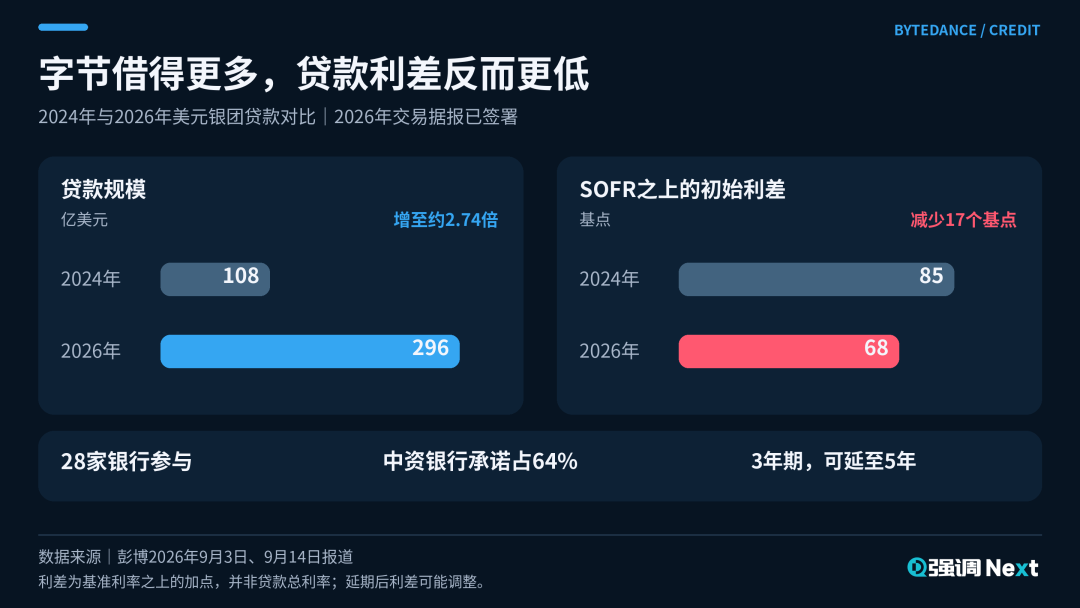
Beyond funding, ByteDance is adjusting its sales approach. In July, its Feishu product team merged with Doubao, consolidating marketing, sales, and customer service systems for Feishu and Volcano Engine.
Loans support supply, while organizational changes drive sales. Office products attract enterprise clients, while models and cloud services expand per-customer procurement. Doubao App has 345 million MAUs, with daily token calls exceeding 120 trillion. ByteDance is extending its consumer-end capabilities into a full enterprise business. Tencent Uses Debt to Buy Flexibility. In Q2, despite soaring capital expenditures, Tencent repurchased ~16.9 billion HKD in shares. AI investments, shareholder returns, and external investments all compete for group capital.
Increasing external financing eases short-term crowding-out among these expenses. Tencent’s bond issuance purpose remains undisclosed, but its strategic value is clear: Preserving capital allocation flexibility so AI expansion doesn’t immediately require cutting other initiatives. Beyond borrowing amounts, fund tenor, currency, and cost will influence how aggressively Tencent can invest.
DeepSeek Pays for Independence
While the three giants buy capacity, DeepSeek buys time.
For nearly three years after its founding, DeepSeek relied solely on internal funds from High-Flyer Quantitative Trading, repeatedly denying external financing rumors.
The turning point came on June 16 this year, when Qichacha showed it completed its first external funding round of ~51 billion yuan, with post-money valuation rumored at nearly 400 billion yuan. According to The Information, Liang Wenfeng personally contributed up to ~20 billion yuan in this round.
Three months later, a second round followed. On October 6, Bloomberg reported the original target was ~50 billion yuan, but subscriptions exceeded expectations, with signed term sheets suggesting a final close near 100 billion yuan. Tencent and CATL were top contributors.
The investor lists for both rounds include Tencent, JD.com, NetEase, CATL, and the National AI Industry Investment Fund—but not Alibaba or ByteDance.
Alibaba has QianWen, ByteDance has Doubao; buying stakes in top rivals is expensive and offers no control. Tencent, JD.com, and NetEase all need a strong external model. CATL values the power and energy storage behind gigawatt-scale data centers. Thus, this list is less an investment portfolio than a alignment chart.
Funding allocations tell a similar story. According to Bloomberg, DeepSeek is building a ~1GW data center in Ulanqab, Inner Mongolia, planning to deploy at least 160,000 Huawei Ascend 950DT chips in an order worth ~$2.56 billion. These chips will primarily run inference, with training still reliant on NVIDIA. Delivery is bottlenecked by HBM supply, with full delivery likely taking over a year. DeepSeek hopes some computing power will go live by late 2027 to early 2028.
For Ascend, this is its most significant demand order to date. For DeepSeek, it means shifting revenue-generating inference to domestic chips first, while training—the hardest part—waits.
The hardest part lies ahead. According to Bloomberg and The Information, DeepSeek has begun preparing for an IPO, targeting a 2027 mainland listing, with first CFO Yan Wentao arriving in late September. Media reports suggest its annualized recurring revenue is ~$1 billion. At a pre-money valuation of ~500 billion yuan, this implies a valuation-to-revenue multiple of ~70x.
According to Bloomberg, Liang Wenfeng has told investors he remains committed to open-source and pursuing AGI, prioritizing innovation over profit. These goals will eventually collide: A public company’s financials must show profitability somewhere.
Money Flows Up, Model Layer May Not Benefit
This financing round will also reshape AI industry profit allocation.
Money flows upward first. Alibaba’s H1 capital expenditures were 190 billion yuan, Tencent’s Q2 spending was 52.8 billion yuan (+176% YoY), and ByteDance raised its 2026 AI infrastructure budget to 200 billion yuan. Little of this money stays at the model layer—it becomes orders for chips, servers, optics, and storage.
Yangtze Memory’s prospectus shows Q1 2026 revenue of 47.042 billion yuan and net profit of 33.379 billion yuan, with NAND product gross margin at 78.73%. ChangXin Technology’s H1 revenue was 150.31 billion yuan (+873.64% YoY), with net profit of 77.605 billion yuan—exceeding its previous guidance upper limit—and main business gross margin at 84.84%. Q2 net profit alone was 52.843 billion yuan, doubling Q1.
Downstream is a different story. Zhipu generated 724 million yuan in 2025 revenue against 3.18 billion yuan in R&D spending, with an adjusted net loss of 3.182 billion yuan. Model companies compete on price while computing power providers collect rents.
Big Tech dares to invest this way because they have multiple revenue layers. Alibaba’s infrastructure segment earned 5.628 billion yuan while its model segment lost 13.861 billion yuan. Models need not be profitable—open-sourcing them drives adoption, with money recouped through computing power, storage, databases, and agent services. The cheaper models are, the more users they attract, stabilizing revenue from subsequent layers.
Companies with a single revenue stream lack this buffer. DeepSeek’s first seven-month revenue was 475 million yuan, against ~11 billion yuan in AI infrastructure spending—23x revenue. No matter how fast call volumes grow, the 11 billion yuan must be recouped first.
Fortunately, pricing headroom exists. In mid-August, DeepSeek raised API prices to 2.3–4.5x original levels without significant customer loss, boosting annualized revenue run rate from under $500 million to over $1 billion. This suggests previous prices were below equilibrium, and the model layer actually holds pricing power—it was trading margins for call volume.
Further pressure comes from depreciation. Of ByteDance’s 200 billion yuan, ~85 billion went to chips and 90 billion to data center construction, forming fixed assets that will depreciate over years. Once equipment is powered on, depreciation, O&M, and capital costs must be covered by orders.
By end-June, China’s total intelligent computing capacity reached 2,185 EFLOPS, with average data center utilization rising to 71.4%—little idle buffer remains. The nearly 400 billion yuan raised by these four companies buys years of time, but when bills come due, enterprise client orders must foot them.
Sources: Bloomberg: Tencent considers up to $5B offshore bond issuance, 2026-10-08; Alibaba: Completes 80B HKD share placement and fund usage, 2026-08-26; Bloomberg: ByteDance signs $29.6B loan, bank composition and initial spread, 2026-09-14; Reuters: DeepSeek’s new funding round expected to exceed 80B yuan, 2026-10-06; Alibaba: Q2 2026 results, 2026-08-20; Tencent: Q2 2026 results, 2026-08-12; Bloomberg: DeepSeek to procure Huawei chips for Inner Mongolia data center, 2026-09-04; Reuters: ByteDance’s loan and overseas data center capacity offtake arrangements, 2026-09-04; Alibaba: 80B HKD placement pricing, 2026-08-24; Reuters via The Information: DeepSeek’s annualized revenue run rate reaches $1B, 2026-09-24
- END -
-
![]()
SZSE Works Overtime During National Day, Issuing Inquiry Letter Swiftly After ColoredChinese Announces Plan to Raise 2.8 Billion Yuan, Over 10 Times Its Net Assets
-
PC Manufacturers Feel the Pinch as Memory Prices Surge and Sales Dive by 20%
-
![]()
Net Profit Soars by 269%! Inspur Information Unveils 9 Billion Yuan Investment Plan to Boost Computing Power, Capitalizing on Large-Scale Agent Deployment
-
Bangze Chuangke: 30% Revenue from OEM, Eyes Export Sales, Leans on Overseas E-commerce, but Faces Slowing Growth in Revenue and Profit
-
![]()
Big Tech Borrows to Buy Future
-
![]()
Has the AI-Driven Advertising Age Dawned? ChatGPT Launches Image Ad Trials, Boosting Sales Through Enhanced Visibility
-
![]()
What is the boundary of collaboration between FAW Toyota and GAC Toyota behind FAW Toyota's 'independent survival'?
-
![]()
Optical Waveguide Route Selection and Performance Optimization: Four Questions Integrators Must Answer Correctly